| Enduring Understanding | Learning Objective | Essential Knowledge |
|---|---|---|
CHA-3 | CHA-3.G |
|
Parametric Equations, Polar Coordinates, and Vector-Valued Functions
AP Calculus BC · Topic 9
 6:06
6:06
Parametric, Vector & Polar
Some curves cannot be written as y equals a function of x. Think of a particle looping around, or a path that crosses itself — for one x there would be two y…
English narration · English + 中文 subtitles burned in
9.1
Defining and Differentiating Parametric Equations
Syllabus
Source: College Board AP Course and Exam Description
Parametric equations 参数方程 give $x$ and $y$ each as functions of a parameter $t$ (often time): $x=x(t)$, $y=y(t)$. They trace a curve that need not be a function of $x$. The slope of the curve is found with the chain rule:
$$\frac{dy}{dx}=\frac{dy/dt}{dx/dt}\qquad(dx/dt\neq0).$$
Worked example. For $x=t^2$, $y=t^3-t$, find the slope at $t=2$. Here $\dfrac{dx}{dt}=2t$ and $\dfrac{dy}{dt}=3t^2-1$, so $\dfrac{dy}{dx}=\dfrac{3t^2-1}{2t}$; at $t=2$ this is $\dfrac{11}{4}$.
Vocabulary
Train
| English |
|---|
| Parametric equations/ˌpærəˈmetrɪk ɪˈkweɪʒnz/ |
9.2
Second Derivatives of Parametric Equations
Syllabus
| Enduring Understanding | Learning Objective | Essential Knowledge |
|---|---|---|
CHA-3 | CHA-3.G |
|
Source: College Board AP Course and Exam Description
The second derivative is not $\dfrac{d^2y/dt^2}{d^2x/dt^2}$. Instead, differentiate the first derivative with respect to $t$, then divide by $dx/dt$ again:
$$\frac{d^2y}{dx^2}=\frac{\dfrac{d}{dt}\!\left(\dfrac{dy}{dx}\right)}{dx/dt}.$$
Use it to test concavity of a parametric curve.
9.3
Finding Arc Lengths of Curves Given by Parametric Equations
Syllabus
| Enduring Understanding | Learning Objective | Essential Knowledge |
|---|---|---|
CHA-6 | CHA-6.B |
|
Source: College Board AP Course and Exam Description
The length of a parametric curve for $t$ from $a$ to $b$ is
$$L=\int_a^b\sqrt{\left(\frac{dx}{dt}\right)^2+\left(\frac{dy}{dt}\right)^2}\,dt.$$
This is the parametric version of arc length – summing tiny hypotenuses $\sqrt{dx^2+dy^2}$ over the parameter.
9.4
Defining and Differentiating Vector-Valued Functions
Syllabus
| Enduring Understanding | Learning Objective | Essential Knowledge |
|---|---|---|
CHA-3 | CHA-3.H |
|
Source: College Board AP Course and Exam Description
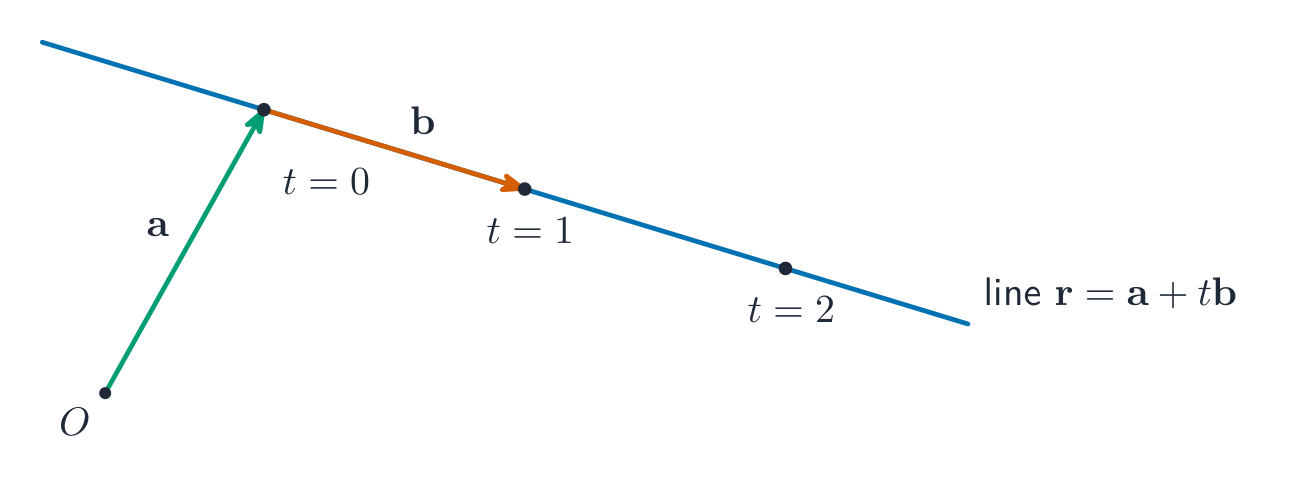
A vector-valued function 向量值函数 $\vec{r}(t)=\langle x(t),\,y(t)\rangle$ gives a position vector for each $t$. Differentiate component-wise: the velocity is $\vec{v}(t)=\langle x'(t),\,y'(t)\rangle$ and the acceleration is $\vec{a}(t)=\langle x''(t),\,y''(t)\rangle$. The speed is the magnitude $|\vec{v}|=\sqrt{x'^2+y'^2}$.
Explore
Add vector-valued components
A vector-valued function packs an $x(t)$ and $y(t)$ into one vector. Differentiating each component gives the velocity vector, tangent to the path.
Vocabulary
Train
| English |
|---|
| vector-valued function/ˈvektə ˈvæljuːd ˈfʌŋkʃn/ |
9.5
Integrating Vector-Valued Functions
Syllabus
| Enduring Understanding | Learning Objective | Essential Knowledge |
|---|---|---|
FUN-8 | FUN-8.A |
|
Source: College Board AP Course and Exam Description
Integrate a vector function component by component. Given acceleration or velocity plus an initial condition, integrate each component and use the condition to find the constants – recovering velocity from acceleration, or position from velocity.
9.6
Solving Motion Problems Using Parametric and Vector-Valued Functions
Syllabus
| Enduring Understanding | Learning Objective | Essential Knowledge |
|---|---|---|
FUN-8 | FUN-8.B |
|
Source: College Board AP Course and Exam Description
For a particle moving in a plane: position is $\langle x(t),y(t)\rangle$, velocity and acceleration are its derivatives, speed is $|\vec v|$, and the distance traveled over $[a,b]$ is
$$\int_a^b\sqrt{x'(t)^2+y'(t)^2}\,dt.$$
Exam skill: these plane-motion problems appear on the BC free-response nearly every year – be fluent finding speed, the position at a later time (initial point plus the integral of velocity), and total distance.
Worked example. A particle has position $\langle t^2,\ t^3-t\rangle$. Its velocity is $\langle 2t,\ 3t^2-1\rangle$, so at $t=1$ the velocity is $\langle 2,\ 2\rangle$ and the speed is $\sqrt{2^2+2^2}=2\sqrt{2}$. Its position at $t=2$ is $\langle 4,\ 6\rangle$.
9.7
Defining Polar Coordinates and Differentiating in Polar Form
Syllabus
| Enduring Understanding | Learning Objective | Essential Knowledge |
|---|---|---|
FUN-3 | FUN-3.G |
|
Source: College Board AP Course and Exam Description
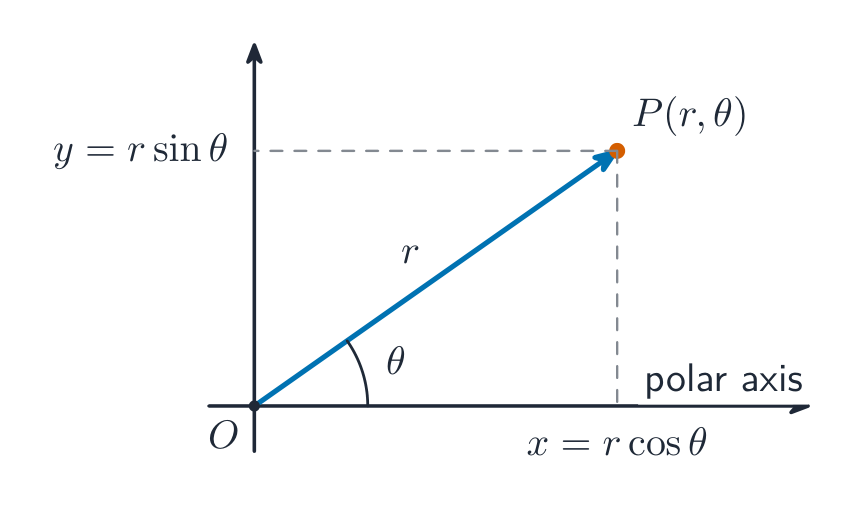
Polar coordinates 极坐标 locate a point by its distance $r$ from the origin and angle $\theta$: convert with $x=r\cos\theta$, $y=r\sin\theta$. A polar curve $r=f(\theta)$ is a parametric curve in $\theta$, so its slope is
$$\frac{dy}{dx}=\frac{dy/d\theta}{dx/d\theta},\quad\text{with } x=r\cos\theta,\ y=r\sin\theta.$$
Explore
Plot a polar curve
In polar coordinates a point is a distance $r$ at angle $\theta$. Letting $r$ depend on $\theta$ traces curves like this cardioid.
Vocabulary
Train
| English |
|---|
| Polar coordinates/ˈpəʊlə kəʊˈɔːdɪnəts/ |
9.8
Finding the Area of a Polar Region
Syllabus
| Enduring Understanding | Learning Objective | Essential Knowledge |
|---|---|---|
CHA-5 | CHA-5.D |
|
Source: College Board AP Course and Exam Description
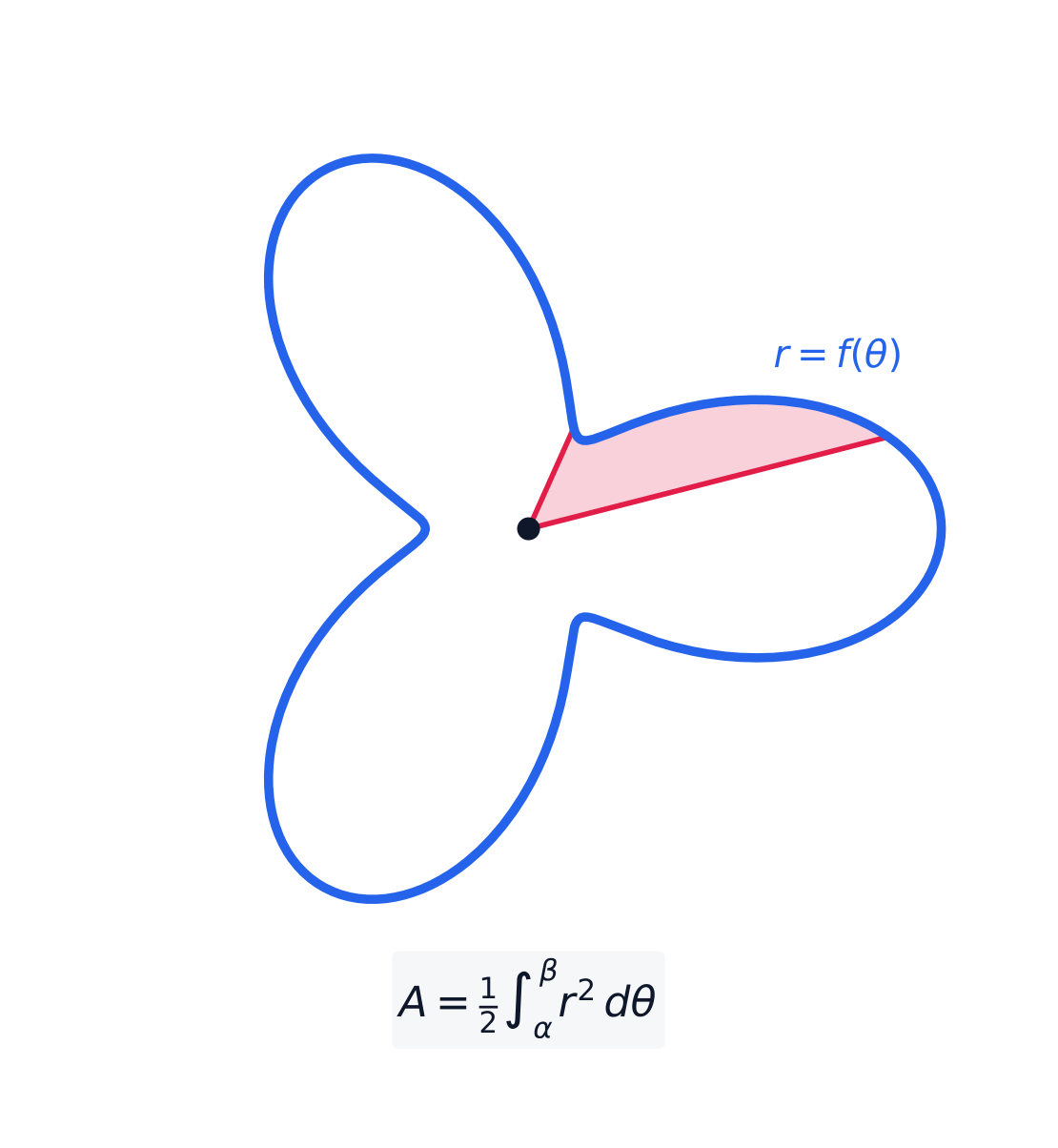
The area swept out by a polar curve $r=f(\theta)$ from $\alpha$ to $\beta$ is
$$A=\frac12\int_\alpha^\beta \big(f(\theta)\big)^2\,d\theta.$$
The region is a "fan" of thin triangular sectors; choosing the correct $\theta$-limits (where the curve starts and finishes tracing the region) is the main challenge.
Worked example. Find the area of one petal of the rose $r=2\sin(2\theta)$ (traced for $\theta$ from $0$ to $\tfrac{\pi}{2}$). Using $\sin^2 u=\tfrac12(1-\cos 2u)$,
$$A=\frac12\int_0^{\pi/2}(2\sin 2\theta)^2\,d\theta=\int_0^{\pi/2}(1-\cos 4\theta)\,d\theta=\left[\theta-\tfrac{\sin 4\theta}{4}\right]_0^{\pi/2}=\frac{\pi}{2}.$$
9.9
Finding the Area of the Region Bounded by Two Polar Curves
Syllabus
| Enduring Understanding | Learning Objective | Essential Knowledge |
|---|---|---|
CHA-5 | CHA-5.D |
|
Source: College Board AP Course and Exam Description
For the area between an outer curve $r_1$ and an inner curve $r_2$, subtract the sectors:
$$A=\frac12\int_\alpha^\beta\big(r_1^2-r_2^2\big)\,d\theta.$$
Find the intersection angles first (set $r_1=r_2$), and be careful which curve is outer over each interval – they can swap.
9.9
Exam tips
- For parametric curves, $\tfrac{dy}{dx}=\tfrac{dy/dt}{dx/dt}$; speed is $\sqrt{(dx/dt)^2+(dy/dt)^2}$.
- A vector-valued function carries the same information — differentiate/integrate it component by component.
- In polar, convert with $x=r\cos\theta$, $y=r\sin\theta$; area swept is $\tfrac12\int r^2\,d\theta$.
- Watch the direction of tracing (the sign of $dx/dt$) and set correct $\theta$-limits for polar area.
- Eliminate the parameter to recover the ordinary $y$-vs-$x$ shape when it helps.
Interactive lessons on this topic
Work through it step by step, with instant-check exercises.
- Defining and Differentiating Parametric Equations
- Second Derivatives of Parametric Equations
- Finding Arc Lengths of Curves Given by Parametric Equations
- Defining and Differentiating Vector-Valued Functions
- Integrating Vector-Valued Functions
- Solving Motion Problems Using Parametric and Vector-Valued Functions
- Defining Polar Coordinates and Differentiating in Polar Form
- Find the Area of a Polar Region or the Area Bounded by a Single Polar Curve
- Finding the Area of the Region Bounded by Two Polar Curves