| Enduring Understanding | Learning Objective | Essential Knowledge |
|---|---|---|
LIM-7 | LIM-7.A |
|
Infinite Sequences and Series
AP Calculus BC · Topic 10
 8:20
8:20
Infinite Series
Can you add infinitely many numbers and get a finite answer? Surprisingly, yes. Add forever, and sometimes the total runs away to infinity — but sometimes it…
English narration · English + 中文 subtitles burned in
10.1
Defining Convergent and Divergent Infinite Series

Syllabus
Source: College Board AP Course and Exam Description
An infinite series 无穷级数 adds infinitely many terms, $\sum_{n=1}^\infty a_n$. Its value is defined as the limit of the partial sums 部分和 $S_N=a_1+a_2+\cdots+a_N$. If $S_N$ approaches a finite number $L$, the series converges 收敛 to $L$; otherwise it diverges 发散. Every convergence question is really a question about the limit of the partial sums.

Vocabulary
Train
| English |
|---|
| infinite series/ˈɪnfɪnət ˈsɪəriːz/ |
| partial sums/ˈpɑːʃl sʌmz/ |
| converges/kənˈvɜːdʒɪz/ |
| diverges/daɪˈvɜːdʒɪz/ |
10.2
Working with Geometric Series
Syllabus
| Enduring Understanding | Learning Objective | Essential Knowledge |
|---|---|---|
LIM-7 | LIM-7.A |
|
Source: College Board AP Course and Exam Description
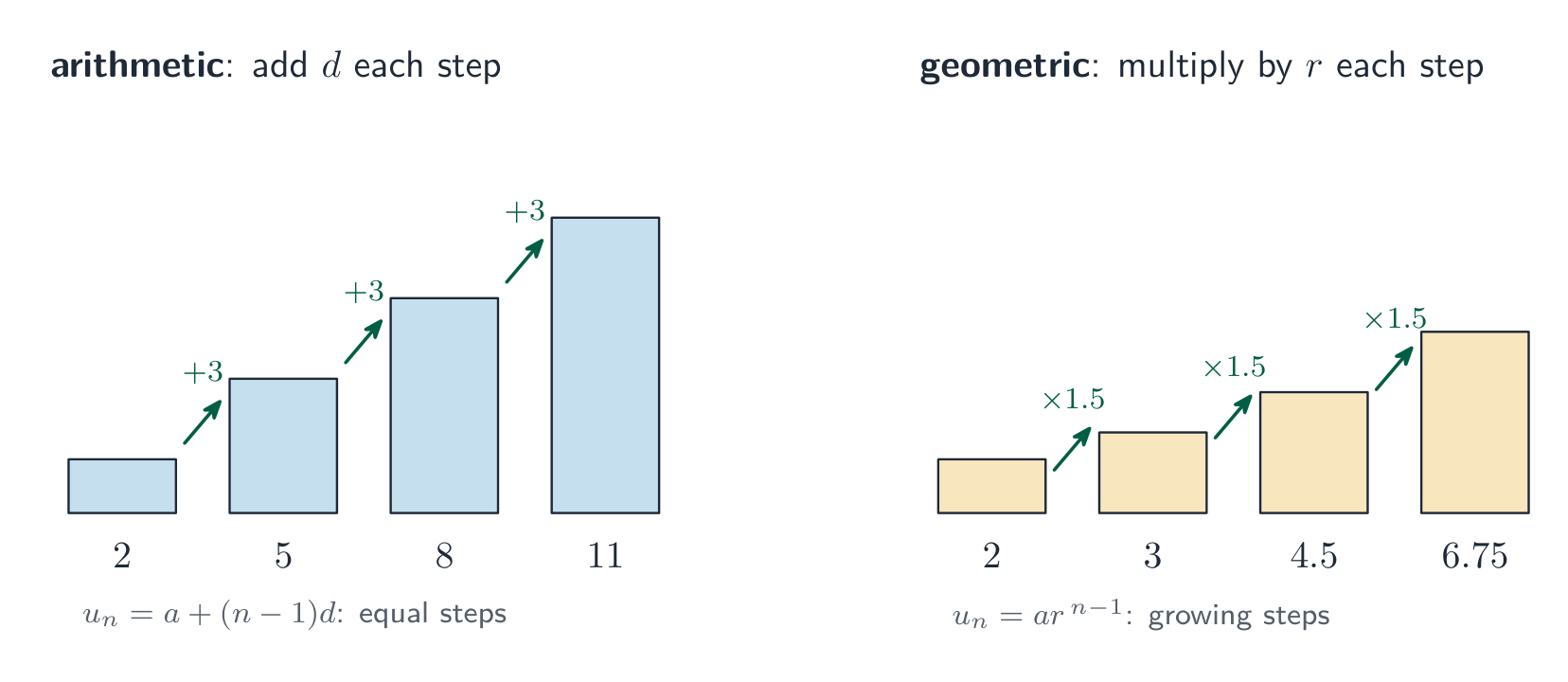
A geometric series 几何级数 $\sum ar^{n}$ has a constant ratio $r$ between terms. It converges exactly when $|r|<1$, and then
$$\sum_{n=0}^\infty ar^n=\frac{a}{1-r}.$$
This is the one series whose sum you can find exactly, and it underlies power series later in the unit.
Worked example. Sum $3+\tfrac32+\tfrac34+\tfrac38+\cdots$. Here $a=3$ and $r=\tfrac12$ (with $|r|<1$), so the sum is $\dfrac{a}{1-r}=\dfrac{3}{1-\tfrac12}=6$.
Explore
When a geometric series converges
A geometric series $\sum ar^n$ converges only when $|r|<1$, summing to $\frac{a}{1-r}$. Change the ratio and watch the partial sums settle or blow up.
Vocabulary
Train
| English |
|---|
| geometric series/ˌdʒiːəʊˈmetrɪk ˈsɪəriːz/ |
10.3
The nth Term Test for Divergence
Syllabus
| Enduring Understanding | Learning Objective | Essential Knowledge |
|---|---|---|
LIM-7 | LIM-7.A |
|
Source: College Board AP Course and Exam Description
If the terms do not shrink to zero, the sum cannot settle: if $\lim_{n\to\infty}a_n\neq0$, the series diverges. This is only a test for divergence – if the terms do go to zero, the test is inconclusive (the series may still diverge, like the harmonic series). Always check this quick test first.
10.4
Integral Test for Convergence
Syllabus
| Enduring Understanding | Learning Objective | Essential Knowledge |
|---|---|---|
LIM-7 | LIM-7.A |
|
Source: College Board AP Course and Exam Description
If $a_n=f(n)$ for a positive, decreasing, continuous $f$, then $\sum a_n$ and $\int_1^\infty f(x)\,dx$ both converge or both diverge. The integral test 积分判别法 turns a series question into an improper-integral question, and it is what proves the p-series rule below.
Vocabulary
Train
| English |
|---|
| integral test/ˈɪntɪɡrəl test/ |
10.5
Harmonic Series and p-Series
Syllabus
| Enduring Understanding | Learning Objective | Essential Knowledge |
|---|---|---|
LIM-7 | LIM-7.A |
|
Source: College Board AP Course and Exam Description
A p-series $\sum \dfrac{1}{n^p}$ converges if $p>1$ and diverges if $p\le1$. The special case $p=1$, $\sum\dfrac1n$, is the harmonic series 调和级数 – it diverges even though its terms go to zero (a famous, must-know fact). The p-series family is the standard yardstick for comparison tests.
Vocabulary
Train
| English |
|---|
| harmonic series/hɑːˈmɒnɪk ˈsɪəriːz/ |
10.6
Comparison Tests for Convergence
Syllabus
| Enduring Understanding | Learning Objective | Essential Knowledge |
|---|---|---|
LIM-7 | LIM-7.A |
|
Source: College Board AP Course and Exam Description
Compare an unfamiliar series to a known one (a p-series or geometric series):
- Direct comparison 直接比较: if $0\le a_n\le b_n$ and $\sum b_n$ converges, so does $\sum a_n$; if $a_n\ge b_n\ge0$ and $\sum b_n$ diverges, so does $\sum a_n$.
- Limit comparison 极限比较: if $\lim\dfrac{a_n}{b_n}$ is a finite positive number, the two series do the same thing. This is easier when the terms only behave like a known series.
Vocabulary
Train
| English |
|---|
| Direct comparison/daɪˈrekt kəmˈpærɪsn/ |
| Limit comparison/ˈlɪmɪt kəmˈpærɪsn/ |
10.7
Alternating Series Test for Convergence
Syllabus
| Enduring Understanding | Learning Objective | Essential Knowledge |
|---|---|---|
LIM-7 | LIM-7.A |
|
Source: College Board AP Course and Exam Description
An alternating series 交错级数 has terms that switch sign, $\sum(-1)^n b_n$. It converges if the $b_n$ are positive, decreasing, and $\lim b_n=0$. This lets series like $\sum\dfrac{(-1)^n}{n}$ converge even though the same terms without the signs (the harmonic series) diverge.
Vocabulary
Train
| English |
|---|
| alternating series/ˈɔːltəneɪtɪŋ ˈsɪəriːz/ |
10.8
Ratio Test for Convergence
Syllabus
| Enduring Understanding | Learning Objective | Essential Knowledge |
|---|---|---|
LIM-7 | LIM-7.A |
|
Source: College Board AP Course and Exam Description
The ratio test 比值判别法 examines $L=\lim_{n\to\infty}\left|\dfrac{a_{n+1}}{a_n}\right|$:
- $L<1$: the series converges absolutely;
- $L>1$: it diverges;
- $L=1$: inconclusive.
It is the go-to test for series with factorials or $n$th powers, and it is exactly how you find the radius of convergence of a power series.
Worked example. Test $\displaystyle\sum \frac{n}{2^n}$. The ratio is $\left|\dfrac{a_{n+1}}{a_n}\right|=\dfrac{n+1}{2^{n+1}}\cdot\dfrac{2^n}{n}=\dfrac{n+1}{2n}\to\dfrac12<1$, so the series converges.
Vocabulary
Train
| English |
|---|
| ratio test/ˈreɪʃɪəʊ test/ |
10.9
Determining Absolute or Conditional Convergence
Syllabus
| Enduring Understanding | Learning Objective | Essential Knowledge |
|---|---|---|
LIM-7 | LIM-7.A |
|
Source: College Board AP Course and Exam Description
A series converges absolutely 绝对收敛 if $\sum|a_n|$ converges. It converges conditionally 条件收敛 if $\sum a_n$ converges but $\sum|a_n|$ diverges (the classic example is $\sum\dfrac{(-1)^n}{n}$). Absolute convergence is the stronger property; conditional convergence relies on the cancellation of signs.
Vocabulary
Train
| English |
|---|
| converges absolutely/kənˈvɜːdʒɪz ˌæbsəˈluːtli/ |
| converges conditionally/kənˈvɜːdʒɪz kənˈdɪʃənəli/ |
10.10
Alternating Series Error Bound
Syllabus
| Enduring Understanding | Learning Objective | Essential Knowledge |
|---|---|---|
LIM-7 | LIM-7.B |
|
Source: College Board AP Course and Exam Description
For a convergent alternating series, the error in stopping at the $N$th partial sum is no larger than the first omitted term:
$$|S-S_N|\le b_{N+1}.$$
This simple, powerful bound lets you say how many terms guarantee a desired accuracy.
10.11
Finding Taylor Polynomial Approximations of Functions

Syllabus
| Enduring Understanding | Learning Objective | Essential Knowledge |
|---|---|---|
LIM-8 | LIM-8.A |
|
LIM-8.B |
|
Source: College Board AP Course and Exam Description
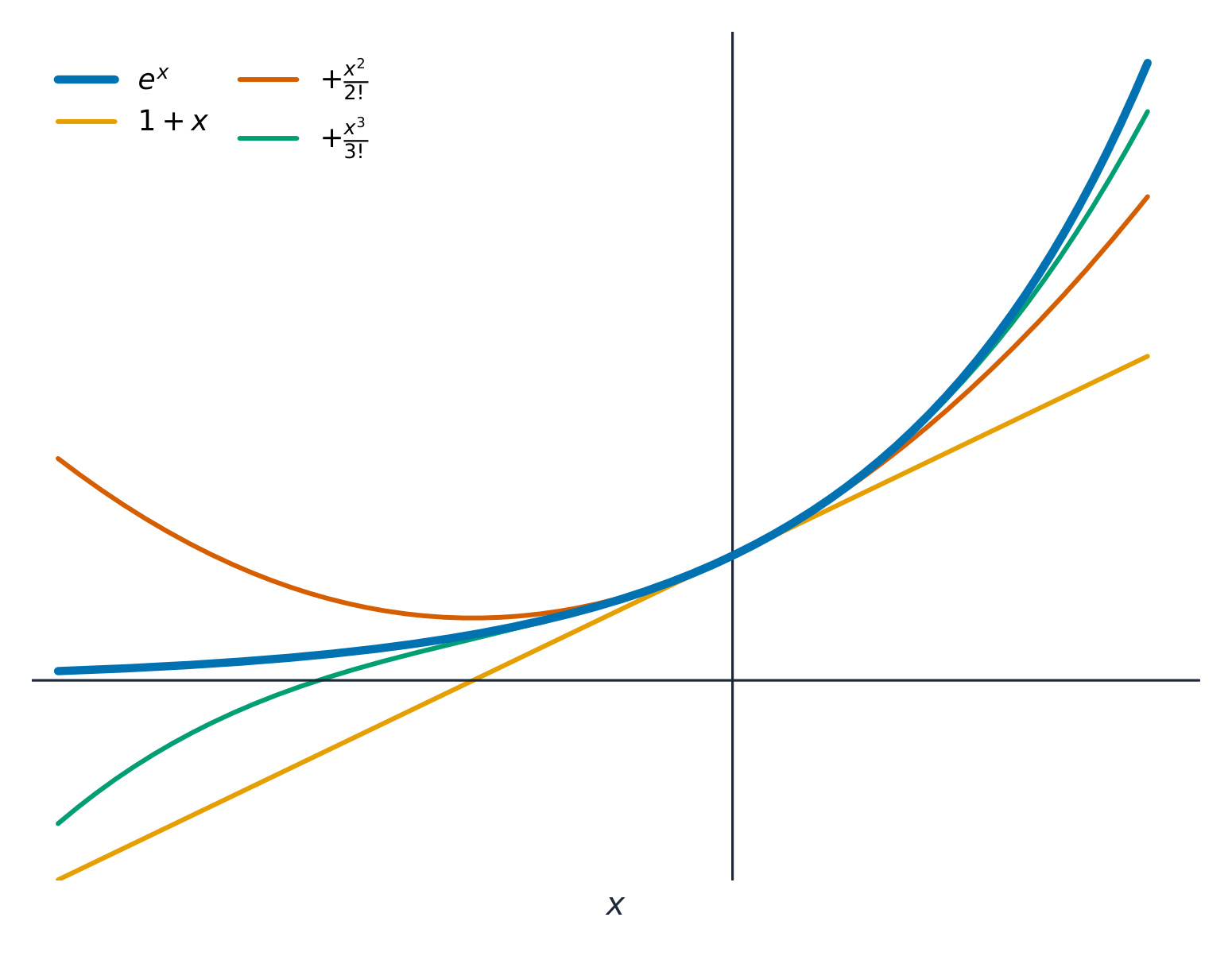
A Taylor polynomial 泰勒多项式 approximates a function near a center $x=a$ using its derivatives there:
$$P_n(x)=\sum_{k=0}^{n}\frac{f^{(k)}(a)}{k!}(x-a)^k.$$
Each added term matches one more derivative, so the polynomial hugs the curve more closely near $a$. Centered at $a=0$ it is a Maclaurin polynomial.
Exam skill: be able to build a Taylor polynomial from a table of derivative values and use it to estimate a function value.
Vocabulary
Train
| English |
|---|
| Taylor polynomial/ˈteɪlə ˌpɒlɪˈnəʊmɪəl/ |
10.12
Lagrange Error Bound
Syllabus
| Enduring Understanding | Learning Objective | Essential Knowledge |
|---|---|---|
LIM-8 | LIM-8.C |
|
Source: College Board AP Course and Exam Description
The Lagrange error bound 拉格朗日误差界 bounds how far a Taylor polynomial can be from the true value:
$$|R_n(x)|\le\frac{\max\big|f^{(n+1)}(z)\big|}{(n+1)!}\,|x-a|^{\,n+1}.$$
You bound the $(n+1)$th derivative on the interval, then compute – the standard way to prove a Taylor estimate is accurate enough.
Vocabulary
Train
| English |
|---|
| Lagrange error bound/ˈlæɡreɪndʒ ˈerə baʊnd/ |
10.13
Radius and Interval of Convergence of Power Series
Syllabus
| Enduring Understanding | Learning Objective | Essential Knowledge |
|---|---|---|
LIM-8 | LIM-8.D |
|
Source: College Board AP Course and Exam Description
A power series 幂级数 $\sum c_n(x-a)^n$ converges for $x$ within a radius of convergence 收敛半径 $R$ of the center $a$. Find $R$ with the ratio test. Then test the two endpoints separately (the ratio test is inconclusive there) to state the full interval of convergence 收敛区间 – including or excluding each endpoint.
Worked example. Find the radius of convergence of $\displaystyle\sum \frac{x^n}{n}$. The ratio test gives $\left|\dfrac{x^{n+1}}{n+1}\cdot\dfrac{n}{x^n}\right|=|x|\dfrac{n}{n+1}\to|x|$, which is $<1$ when $|x|<1$, so $R=1$. Testing the endpoints, $x=-1$ gives the convergent alternating harmonic series and $x=1$ the divergent harmonic series, so the interval is $[-1,1)$.
Vocabulary
Train
| English |
|---|
| power series/ˈpaʊə ˈsɪəriːz/ |
| radius of convergence/ˈreɪdɪəs ɒv kənˈvɜːdʒəns/ |
| interval of convergence/ˈɪntəvl ɒv kənˈvɜːdʒəns/ |
10.14
Finding Taylor or Maclaurin Series for a Function
Syllabus
| Enduring Understanding | Learning Objective | Essential Knowledge |
|---|---|---|
LIM-8 | LIM-8.E |
|
LIM-8.F |
|
Source: College Board AP Course and Exam Description
Extending a Taylor polynomial to infinitely many terms gives a Taylor (or Maclaurin) series. Memorize the key Maclaurin series:
$$e^x=\sum\frac{x^n}{n!},\quad \sin x=\sum\frac{(-1)^n x^{2n+1}}{(2n+1)!},\quad \cos x=\sum\frac{(-1)^n x^{2n}}{(2n)!},\quad \frac{1}{1-x}=\sum x^n.$$
New series come from manipulating these – substituting, differentiating, integrating, or multiplying.
Worked example. Find the Maclaurin series for $e^{x^2}$. Substitute $x^2$ for $x$ in $e^x=\sum\dfrac{x^n}{n!}$:
$$e^{x^2}=\sum_{n=0}^{\infty}\frac{(x^2)^n}{n!}=1+x^2+\frac{x^4}{2!}+\frac{x^6}{3!}+\cdots,$$
which converges for all $x$. This substitution trick is far faster than differentiating $e^{x^2}$ six times.
Explore
The function a Taylor series approximates
y = asin(bx + c) + d
A Taylor series builds a function from its derivatives at a point; more terms hug the curve (here $\sin x$) over a wider range.
10.15
Representing Functions as Power Series
Syllabus
| Enduring Understanding | Learning Objective | Essential Knowledge |
|---|---|---|
LIM-8 | LIM-8.G |
|
Source: College Board AP Course and Exam Description
Because a power series can be differentiated and integrated term by term (within its radius), you can build new series from known ones – e.g. integrate the geometric series for $\dfrac{1}{1-x}$ to get the series for $-\ln(1-x)=\sum_{n\ge 1}\dfrac{x^n}{n}$, or substitute $-x^2$ to get the series for $\dfrac{1}{1+x^2}$. Representing a function as a power series lets you approximate values and integrals that have no elementary antiderivative.
Exam skill: the BC series free-response usually asks you to derive a new Maclaurin series from a known one, find its interval of convergence, and use the alternating-series or Lagrange bound to estimate the error – the capstone skills of the course.
10.15
Exam tips
- Test a series for convergence with the right tool: geometric ($|r|<1$, sum $\tfrac{a}{1-r}$), $n$th-term, ratio, integral, comparison, or alternating-series test.
- A geometric infinite sum converges only when $|r|<1$; otherwise it diverges.
- Build a Taylor/Maclaurin series to approximate a function; more terms give a better fit near the centre.
- Know the standard Maclaurin series for $e^x$, $\sin x$, $\cos x$, and $\tfrac{1}{1-x}$.
- Find the radius/interval of convergence with the ratio test, then check the endpoints separately.
Interactive lessons on this topic
Work through it step by step, with instant-check exercises.
- Defining Convergent and Divergent Infinite Series
- Working with Geometric Series
- The nth Term Test for Divergence
- Integral Test for Convergence
- Harmonic Series and p-Series
- Comparison Tests for Convergence
- Alternating Series Test for Convergence
- Ratio Test for Convergence
- Determining Absolute or Conditional Convergence
- Alternating Series Error Bound
- Finding Taylor Polynomial Approximations of Functions
- Lagrange Error Bound
- Radius and Interval of Convergence of Power Series
- Finding Taylor or Maclaurin Series for a Function
- Representing Functions as Power Series