| Enduring Understanding | Learning Objective | Essential Knowledge |
|---|---|---|
CHA-4 | CHA-4.B |
|
Applications of Integration
AP Calculus BC · Topic 8
 9:59
9:59
Applications of Integration
Here is a bumpy graph, and the area underneath it. Now imagine pouring that area into a rectangle over the same interval, and letting it level off. The height…
English narration · English + 中文 subtitles burned in
8.1
Finding the Average Value of a Function on an Interval
Syllabus
Source: College Board AP Course and Exam Description
The average value 平均值 of $f$ over $[a,b]$ is the integral divided by the width:
$$f_{\text{avg}}=\frac{1}{b-a}\int_a^b f(x)\,dx.$$
It is the constant height a rectangle would need to have the same area as the region under $f$. Do not confuse this with the average rate of change (which uses the derivative).
Worked example. The average value of $f(x)=x^2$ on $[0,3]$ is $\dfrac{1}{3}\displaystyle\int_0^3 x^2\,dx=\dfrac13\left[\dfrac{x^3}{3}\right]_0^3=\dfrac13(9)=3$.
Explore
The average value of a function
y = ax³ + bx² + cx + d
The average value of $f$ on $[a,b]$ is its integral divided by the width — the constant height whose rectangle has the same area as under the curve.
Vocabulary
Train
| English |
|---|
| average value/ˈævrɪdʒ ˈvæljuː/ |
8.2
Connecting Position, Velocity, and Acceleration Using Integrals
Syllabus
| Enduring Understanding | Learning Objective | Essential Knowledge |
|---|---|---|
CHA-4 | CHA-4.C |
|
Source: College Board AP Course and Exam Description
For straight-line motion, integration reverses differentiation:
$$v(t)=\int a(t)\,dt,\qquad s(t)=\int v(t)\,dt.$$
Two key distinctions: displacement 位移 is $\int_a^b v\,dt$ (net change in position), while total distance 总路程 is $\int_a^b |v|\,dt$ (splitting where $v$ changes sign). Speed is $|v|$.
Vocabulary
Train
| English |
|---|
| displacement/dɪˈspleɪsmənt/ |
| total distance/ˈtəʊtl ˈdɪstəns/ |
8.3
Using Accumulation Functions and Definite Integrals in Applied Contexts
Syllabus
| Enduring Understanding | Learning Objective | Essential Knowledge |
|---|---|---|
CHA-4 | CHA-4.D |
|
CHA-4.E |
|
Source: College Board AP Course and Exam Description
When a rate is given (flow rate, sales per day), the definite integral gives the accumulated total, and $\int_a^b R(t)\,dt$ carries the units of $R$ times time. A common setup: initial amount $+\int(\text{rate in}-\text{rate out})\,dt$ gives the amount at a later time. Always interpret the answer in context, with units.
8.4
Finding the Area Between Curves Expressed as Functions of x
Syllabus
| Enduring Understanding | Learning Objective | Essential Knowledge |
|---|---|---|
CHA-5 | CHA-5.A |
|
Source: College Board AP Course and Exam Description
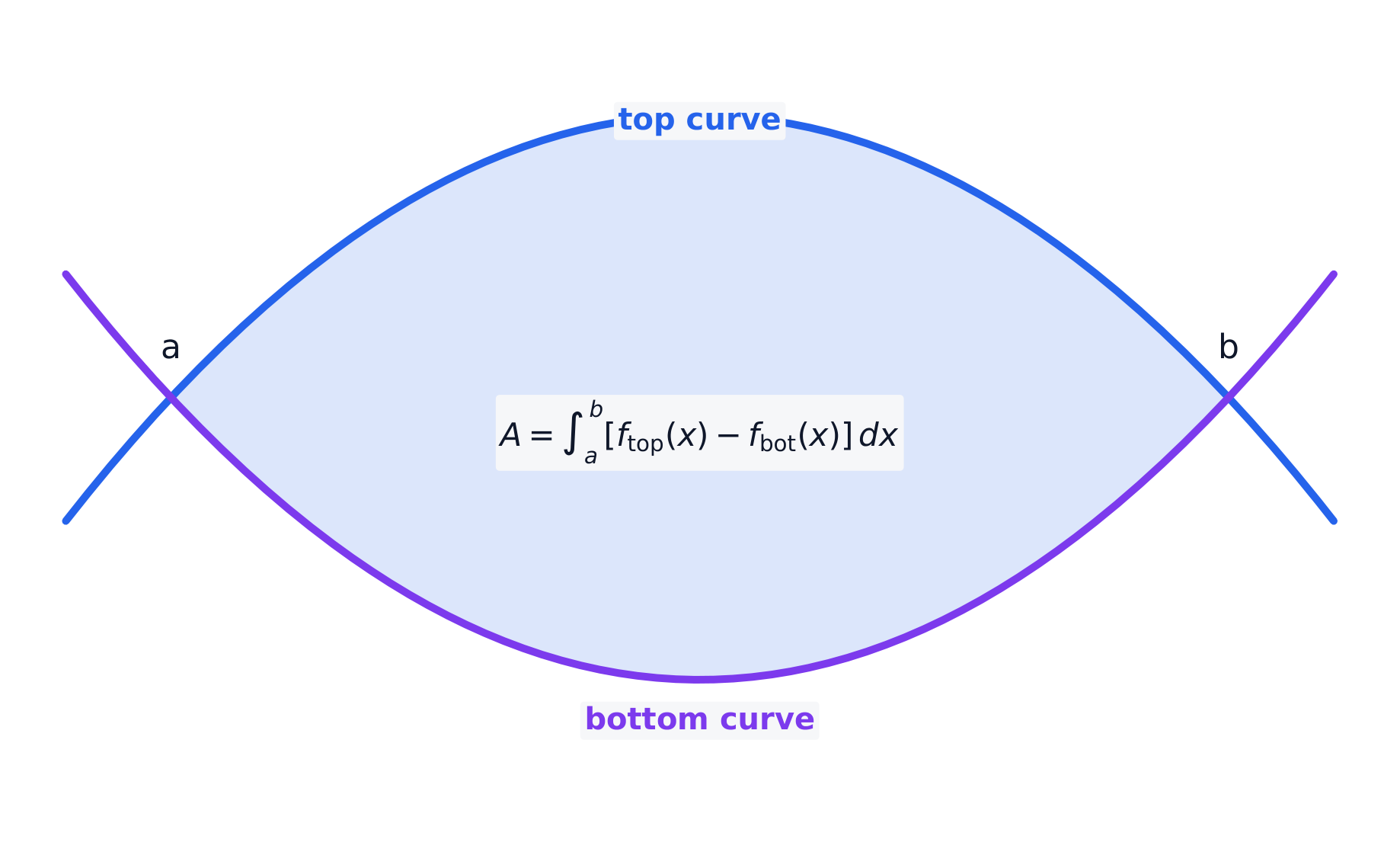
The area between $y=f(x)$ (top) and $y=g(x)$ (bottom) from $a$ to $b$ is
$$\int_a^b\big(f(x)-g(x)\big)\,dx.$$
Find the intersection points for the limits, and always subtract top minus bottom.
Worked example. Between $y=x$ and $y=x^2$ (crossing at $x=0,1$, with $y=x$ on top), the area is $\displaystyle\int_0^1 (x-x^2)\,dx=\left[\dfrac{x^2}{2}-\dfrac{x^3}{3}\right]_0^1=\dfrac16$.
8.5
Finding the Area Between Curves Expressed as Functions of y
Syllabus
| Enduring Understanding | Learning Objective | Essential Knowledge |
|---|---|---|
CHA-5 | CHA-5.A |
|
Source: College Board AP Course and Exam Description
When curves are easier to describe as $x=f(y)$, integrate with respect to $y$ instead, using right minus left:
$$\int_c^d\big(f_{\text{right}}(y)-g_{\text{left}}(y)\big)\,dy.$$
Choosing to integrate in $y$ can avoid splitting the region into several pieces.
8.6
Finding the Area Between Curves That Intersect More Than Twice
Syllabus
| Enduring Understanding | Learning Objective | Essential Knowledge |
|---|---|---|
CHA-5 | CHA-5.A |
|
Source: College Board AP Course and Exam Description
If two curves cross several times, the top and bottom switch. Split the region at each intersection and integrate each piece with the correct top-minus-bottom (or use $\int|f-g|$), then add the pieces.
8.7
Volumes with Cross Sections: Squares and Rectangles
Syllabus
| Enduring Understanding | Learning Objective | Essential Knowledge |
|---|---|---|
CHA-5 | CHA-5.B |
|
Source: College Board AP Course and Exam Description
If a solid's cross sections 横截面 perpendicular to the $x$-axis are squares or rectangles, integrate their area. With side length equal to the distance between two curves, a square cross section gives
$$V=\int_a^b \big(f(x)-g(x)\big)^2\,dx.$$
The method is always "integrate the cross-sectional area."
Vocabulary
Train
| English |
|---|
| cross sections/krɒs ˈsekʃnz/ |
8.8
Volumes with Cross Sections: Triangles and Semicircles
Syllabus
| Enduring Understanding | Learning Objective | Essential Knowledge |
|---|---|---|
CHA-5 | CHA-5.B |
|
Source: College Board AP Course and Exam Description
Same idea, different area formula: for equilateral-triangle cross sections use $A=\tfrac{\sqrt3}{4}s^2$, and for semicircular ones $A=\tfrac{\pi}{8}s^2$ (with $s$ the distance between the curves). Substitute the area formula and integrate.
8.9
Volume with Disc Method: Revolving Around the x- or y-Axis
Syllabus
| Enduring Understanding | Learning Objective | Essential Knowledge |
|---|---|---|
CHA-5 | CHA-5.C |
|
Source: College Board AP Course and Exam Description
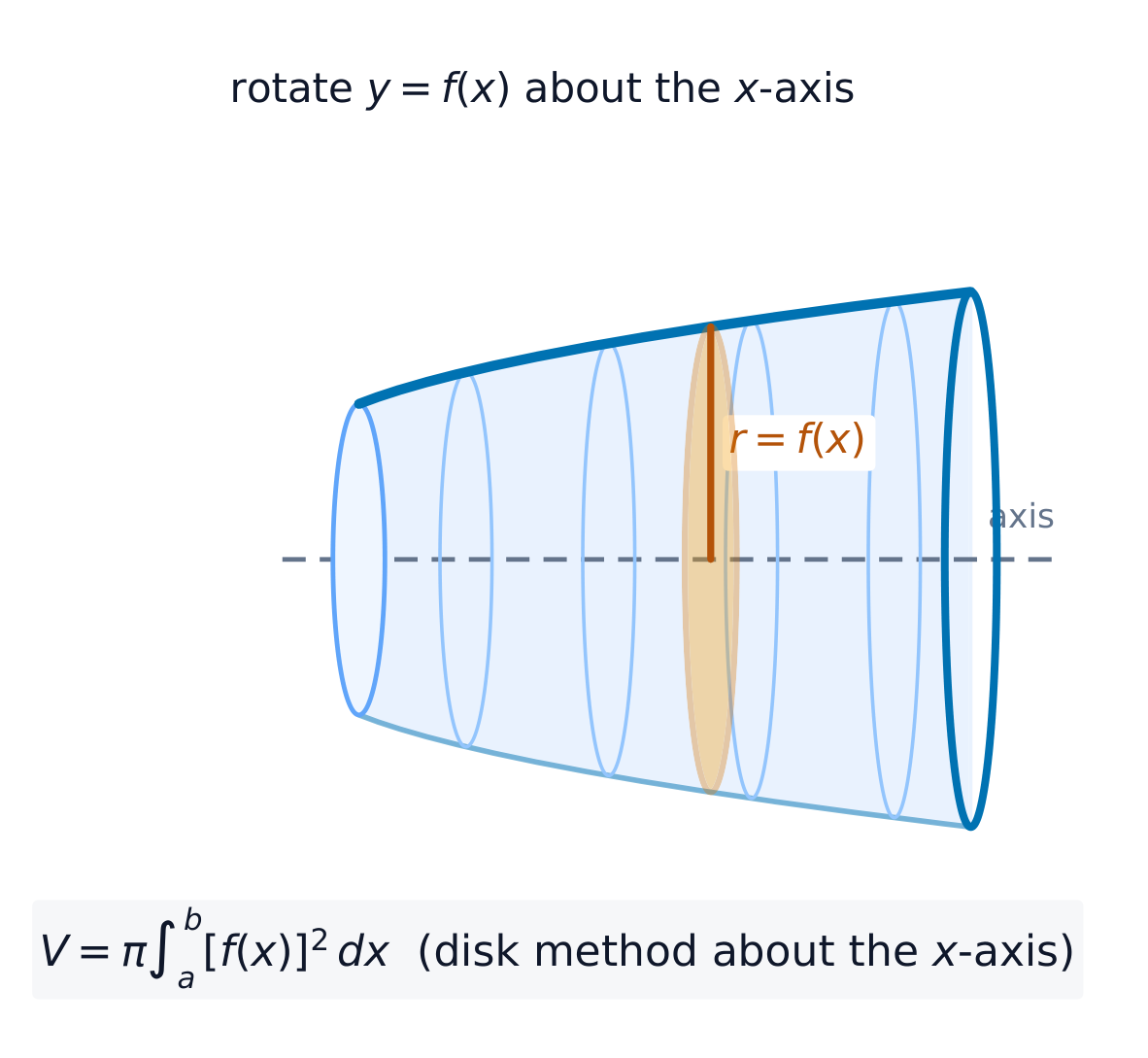
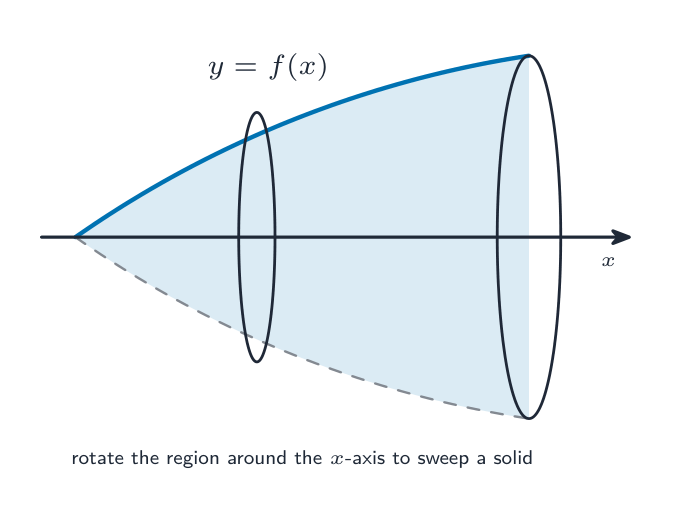
Revolving a region around an axis makes a solid whose cross sections are discs. The disc method 圆盘法 integrates $\pi(\text{radius})^2$:
$$V=\pi\int_a^b \big(R(x)\big)^2\,dx,$$
where the radius $R$ is the distance from the curve to the axis. Use $dy$ when revolving around the $y$-axis.
Worked example. Revolving the region under $y=\sqrt{x}$ from $0$ to $4$ about the $x$-axis gives discs of radius $\sqrt{x}$: $V=\pi\displaystyle\int_0^4 (\sqrt{x})^2\,dx=\pi\int_0^4 x\,dx=8\pi$.
Vocabulary
Train
| English |
|---|
| disc method/dɪsk ˈmeθəd/ |
8.10
Volume with Disc Method: Revolving Around Other Axes
Syllabus
| Enduring Understanding | Learning Objective | Essential Knowledge |
|---|---|---|
CHA-5 | CHA-5.C |
|
Source: College Board AP Course and Exam Description
When the axis of revolution is a horizontal or vertical line like $y=k$ (not an axis), the radius adjusts: $R=|f(x)-k|$. Set up the radius as the distance from the curve to that line, then integrate $\pi R^2$ as before.
8.11
Volume with Washer Method: Revolving Around the x- or y-Axis
Syllabus
| Enduring Understanding | Learning Objective | Essential Knowledge |
|---|---|---|
CHA-5 | CHA-5.C |
|
Source: College Board AP Course and Exam Description
If the region does not touch the axis, revolving leaves a hole, so cross sections are washers (rings). The washer method 垫圈法 subtracts the inner disc:
$$V=\pi\int_a^b\Big(R_{\text{outer}}^2-R_{\text{inner}}^2\Big)\,dx.$$
Identify the outer and inner radii as distances from each curve to the axis.
Vocabulary
Train
| English |
|---|
| washer method/ˈwɒʃə ˈmeθəd/ |
8.12
Volume with Washer Method: Revolving Around Other Axes
Syllabus
| Enduring Understanding | Learning Objective | Essential Knowledge |
|---|---|---|
CHA-5 | CHA-5.C |
|
Source: College Board AP Course and Exam Description
As with discs, revolving around a line $y=k$ or $x=k$ shifts both radii – each becomes the distance from its curve to that line. Sketch the region and the axis, label $R_{\text{outer}}$ and $R_{\text{inner}}$, then integrate the difference of squares.
8.13
The Arc Length of a Smooth Curve and Distance Traveled
Syllabus
| Enduring Understanding | Learning Objective | Essential Knowledge |
|---|---|---|
CHA-6 | CHA-6.A |
|
Source: College Board AP Course and Exam Description
The arc length 弧长 of $y=f(x)$ from $a$ to $b$ is
$$L=\int_a^b\sqrt{1+\big(f'(x)\big)^2}\,dx.$$
This BC-only formula comes from summing tiny hypotenuses $\sqrt{dx^2+dy^2}$. The same idea gives the distance a particle travels along a curved path.
Worked example. Find the arc length of $y=\tfrac{2}{3}x^{3/2}$ from $x=0$ to $x=3$. Here $f'(x)=x^{1/2}$, so $1+(f')^2=1+x$ and
$$L=\int_0^3\sqrt{1+x}\,dx=\left[\tfrac{2}{3}(1+x)^{3/2}\right]_0^3=\tfrac{2}{3}(8-1)=\tfrac{14}{3}.$$
Vocabulary
Train
| English |
|---|
| arc length/ɑːk leŋθ/ |
8.13
Exam tips
- Area between curves is $\int(\text{top}-\text{bottom})\,dx$ — find the intersection points for the limits and keep top minus bottom.
- For a volume of revolution, add up disc/washer cross-sections of area $\pi r^2$ (or $\pi(R^2-r^2)$).
- The average value of $f$ on $[a,b]$ is $\tfrac{1}{b-a}\int_a^b f\,dx$.
- Accumulated change is $\int$ of a rate: total = initial value $+\int_a^b(\text{rate})\,dt$.
- Integration means "adding up infinitely many tiny pieces" — set up the integrand as one thin slice.
Interactive lessons on this topic
Work through it step by step, with instant-check exercises.
- Finding the Average Value of a Function on an Interval
- Connecting Position, Velocity, and Acceleration of Functions Using Integrals
- Using Accumulation Functions and Definite Integrals in Applied Contexts
- Finding the Area Between Curves Expressed as Functions of x
- Finding the Area Between Curves Expressed as Functions of y
- Finding the Area Between Curves That Intersect at More Than Two Points
- Volumes with Cross Sections: Squares and Rectangles
- Volumes with Cross Sections: Triangles and Semicircles
- Volume with Disc Method: Revolving Around the x- or y-Axis
- Volume with Disc Method: Revolving Around Other Axes
- Volume with Washer Method: Revolving Around the x- or y-Axis
- Volume with Washer Method: Revolving Around Other Axes
- The Arc Length of a Smooth, Planar Curve and Distance Traveled