| Enduring Understanding | Learning Objective | Essential Knowledge |
|---|---|---|
CHA-3 | CHA-3.A |
|
Contextual Applications of Differentiation
AP Calculus BC · Topic 4
 8:26
8:26
Interpreting the Derivative in Context
A tank is draining. A cup of coffee is cooling. A city is growing. Every one of those sentences hides the same phrase. The rate at which something changes. And…
English narration · English + 中文 subtitles burned in
4.1
Interpreting the Meaning of the Derivative in Context
Syllabus
Source: College Board AP Course and Exam Description
Once you can compute derivatives, you use them to describe the real world. The derivative $f'(x)$ is the instantaneous rate of change of $f$ with respect to its input. Reading and reporting this rate correctly is a graded skill.
Units matter. The unit of $f'(x)$ is the unit of $f$ divided by the unit of $x$. If $C(t)$ is a number of acres and $t$ is in weeks, then $C'(t)$ is in acres per week. On the exam, "Using correct units, interpret the meaning of $g'(140)$" wants a full sentence: the value, the quantity, the rate word "per", and the moment. For example: "$g'(140)=2.3$ means that at $x=140$, the quantity is increasing at about $2.3$ units per unit of $x$."
4.2
Straight-Line Motion: Position, Velocity, and Acceleration
Syllabus
| Enduring Understanding | Learning Objective | Essential Knowledge |
|---|---|---|
CHA-3 | CHA-3.B |
|
Source: College Board AP Course and Exam Description
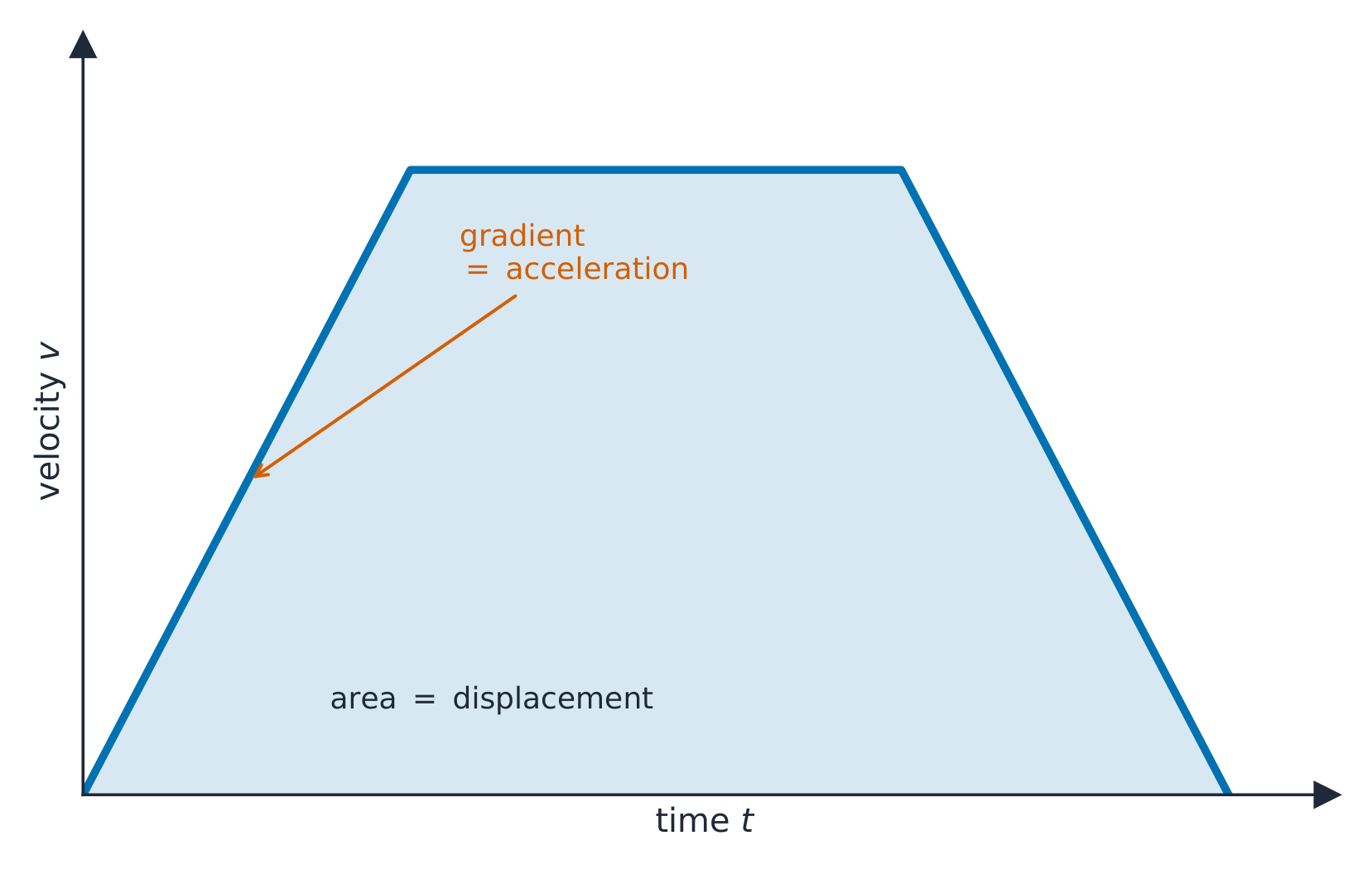
For a particle moving on a line, three functions of time are linked by differentiation:
- position 位置 $s(t)$;
- velocity 速度 $v(t)=s'(t)$ – signed; its sign gives direction;
- acceleration 加速度 $a(t)=v'(t)=s''(t)$.
Key readings (frequent exam parts):
- The particle is at rest 静止 when $v(t)=0$.
- It moves right/up when $v(t)>0$ and left/down when $v(t)<0$; it changes direction where $v$ changes sign.
- Speed 速率 is $|v(t)|$. Speed is increasing when $v$ and $a$ have the same sign (the particle is speeding up), and decreasing when they have opposite signs.
Distinguish carefully between velocity (has direction) and speed (does not) – the exam tests this exact difference.
Worked example. A particle moves with $s(t)=t^3-6t^2+9t$. Then $v(t)=3(t-1)(t-3)$, so it is at rest at $t=1$ and $t=3$ and changes direction at each. At $t=2$, $v=-3<0$ and $a(2)=6(2)-12=0$; just after, $a>0$ while $v<0$, so the particle is slowing down there.
Explore
Velocity is the slope of position
y = ax³ + bx² + cx + d
For straight-line motion, velocity is the derivative (slope) of position and acceleration the derivative of velocity. Slide the point to read the instantaneous velocity.
Vocabulary
Train
| English |
|---|
| position/pəˈzɪʃn/ |
| velocity/vəˈlɒsɪti/ |
| acceleration/əkˌseləˈreɪʃn/ |
| at rest/æt rest/ |
| Speed/spiːd/ |
4.3
Rates of Change in Applied Contexts Other Than Motion
Syllabus
| Enduring Understanding | Learning Objective | Essential Knowledge |
|---|---|---|
CHA-3 | CHA-3.C |
|
Source: College Board AP Course and Exam Description
The same derivative idea models any changing quantity: a draining tank, a spreading population, a cooling cup. Whenever a problem says "the rate at which...", it is describing a derivative. Read the units to know which quantity's rate you have, then interpret in context.
4.4
Introduction to Related Rates

Syllabus
| Enduring Understanding | Learning Objective | Essential Knowledge |
|---|---|---|
CHA-3 | CHA-3.D |
|
Source: College Board AP Course and Exam Description
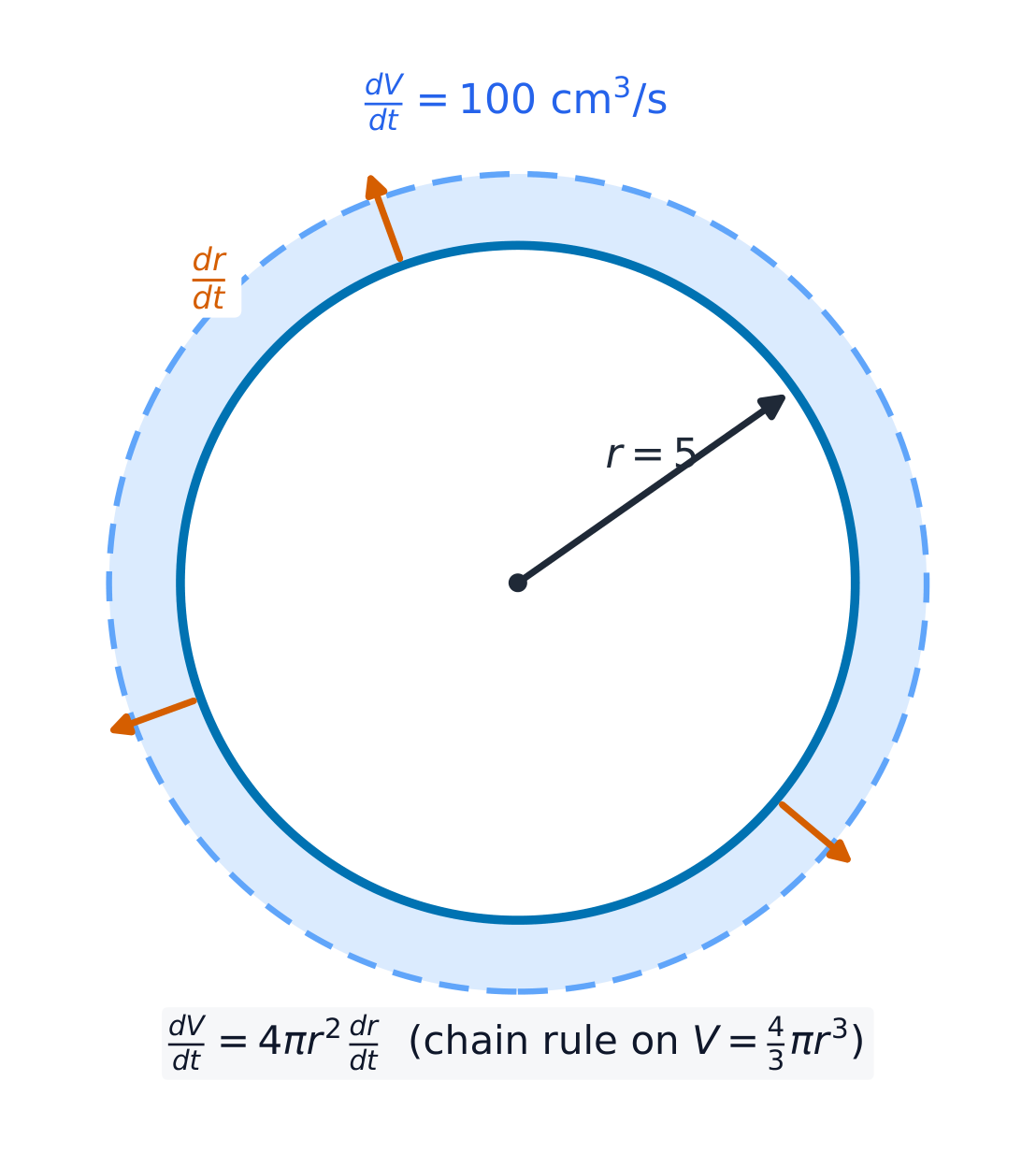
In a related rates 相关变化率 problem, several quantities change together over time, and you know some rates but want another. The engine is the chain rule: differentiate a relationship with respect to time $t$. Every variable becomes a function of $t$, so each derivative picks up a "$\,/\,dt$" factor. Product and quotient rules may also be needed.

Vocabulary
Train
| English |
|---|
| related rates/rɪˈleɪtɪd reɪts/ |
4.5
Solving Related Rates Problems
Syllabus
| Enduring Understanding | Learning Objective | Essential Knowledge |
|---|---|---|
CHA-3 | CHA-3.E |
|
Source: College Board AP Course and Exam Description
A reliable procedure – and a full-credit template on the exam:
- Name the variables and write down the given rates and the unknown rate (e.g. "$\dfrac{dh}{dt}=-2$ cm/day, find $\dfrac{dV}{dt}$").
- Write an equation relating the quantities (often a geometric or volume formula).
- Differentiate both sides with respect to $t$ (chain rule) – before substituting numbers.
- Substitute the known values at the instant of interest, and solve for the unknown rate.
- State the answer with units and the correct sign (a decreasing quantity has a negative rate).
Substituting numbers too early is the classic error: differentiate the general relationship first, then plug in.
Worked example. A spherical balloon's volume grows at $\dfrac{dV}{dt}=100\ \text{cm}^3/\text{s}$. From $V=\tfrac43\pi r^3$, differentiate first: $\dfrac{dV}{dt}=4\pi r^2\dfrac{dr}{dt}$. At $r=5$, $100=4\pi(25)\dfrac{dr}{dt}$, so $\dfrac{dr}{dt}=\dfrac{1}{\pi}\approx0.32\ \text{cm/s}$.
4.6
Approximating Values Using Local Linearity and Linearization
Syllabus
| Enduring Understanding | Learning Objective | Essential Knowledge |
|---|---|---|
CHA-3 | CHA-3.F |
|
Source: College Board AP Course and Exam Description
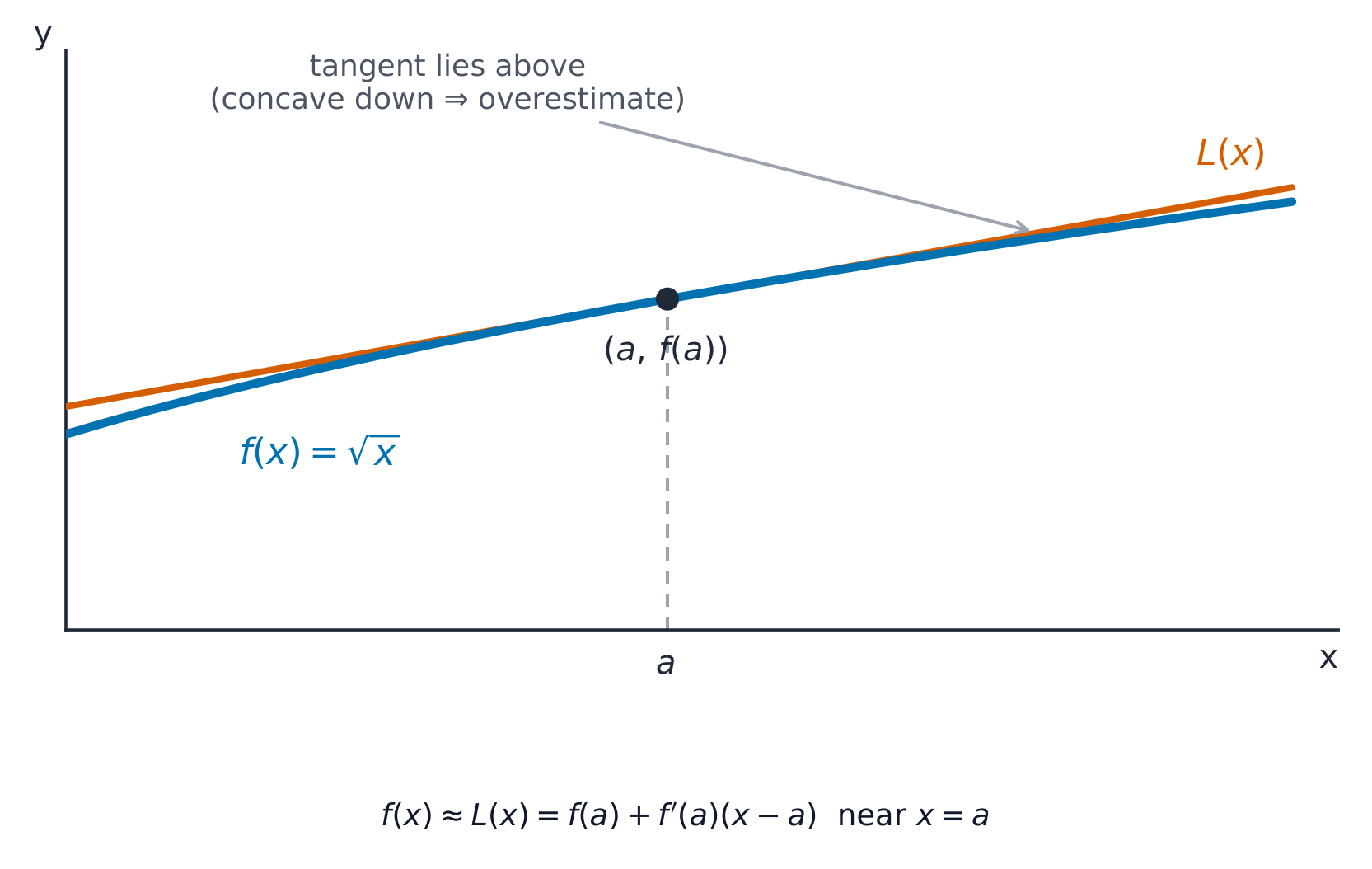
Near a point of tangency, a smooth curve looks like its tangent line – this is local linearity 局部线性. So the tangent line gives a linear approximation 线性近似 (linearization) of the function near that point:
$$f(x) \approx L(x) = f(a) + f'(a)(x-a).$$
Use it to estimate $f$ at an $x$ close to $a$.
Over- or underestimate? The answer follows from concavity 凹凸性. If the graph is concave up near $a$ (it curves above its tangent), the tangent-line value is an underestimate 低估. If it is concave down, the tangent line lies above the curve, giving an overestimate 高估. Exam parts test this reasoning, so justify with the sign of $f''$.
Explore
Approximate a curve with its tangent line
y = ax³ + bx² + cx + d
Local linearity: near a point a smooth curve looks like its tangent line, so the tangent gives a good linear approximation of nearby values.
Vocabulary
Train
| English |
|---|
| local linearity/ˈləʊkl lɪˈnɪərɪti/ |
| linear approximation/ˈlɪnɪə əˌprɒksɪˈmeɪʃn/ |
| concavity/kənˈkævɪti/ |
| underestimate/ˌʌndəˈrestɪmət/ |
| overestimate/ˌəʊvəˈrestɪmət/ |
4.7
Using L'Hospital's Rule for Indeterminate Forms
Syllabus
| Enduring Understanding | Learning Objective | Essential Knowledge |
|---|---|---|
LIM-4 | LIM-4.A |
|
Source: College Board AP Course and Exam Description
When direct substitution in a quotient of limits gives the indeterminate form 未定式 $\dfrac{0}{0}$ or $\dfrac{\infty}{\infty}$, you may use L'Hospital's Rule 洛必达法则:
$$\lim_{x\to c}\frac{f(x)}{g(x)} = \lim_{x\to c}\frac{f'(x)}{g'(x)},$$
provided the right-hand limit exists. Differentiate the top and bottom separately (this is not the quotient rule), then try the limit again. First confirm the form really is $\tfrac{0}{0}$ or $\tfrac{\infty}{\infty}$ – applying the rule to any other form is a mistake.
Worked example. $\displaystyle\lim_{x\to0}\frac{\sin x}{x}$ gives $\tfrac00$, so differentiate top and bottom: $\displaystyle\lim_{x\to0}\frac{\cos x}{1}=1$. And $\displaystyle\lim_{x\to0}\frac{e^{2x}-1}{x}$ is also $\tfrac00$; it becomes $\displaystyle\lim_{x\to0}\frac{2e^{2x}}{1}=2$.
Vocabulary
Train
| English |
|---|
| indeterminate form/ˌɪndɪˈtɜːmɪnət fɔːm/ |
| L'Hospital's Rule/ˈelhɒspɪtlz ruːl/ |
4.7
Exam tips
- In motion problems: velocity is the derivative of position, acceleration the derivative of velocity; speed increases when velocity and acceleration share a sign.
- For related rates, differentiate the relating equation with respect to time, then substitute the given values last.
- Use the tangent line for a linear approximation near a known point; it is accurate only close by.
- Read the sign of a rate: positive means the quantities move together, negative means opposite.
- Always state units and interpret the answer in context.
Interactive lessons on this topic
Work through it step by step, with instant-check exercises.
- Interpreting the Meaning of the Derivative in Context
- Straight-Line Motion: Connecting Position, Velocity, and Acceleration
- Rates of Change in Applied Contexts Other Than Motion
- Introduction to Related Rates
- Solving Related Rates Problems
- Approximating Values Using Local Linearity and Linearization
- Using L'Hospital's Rule for Determining Limits of Indeterminate Forms