| English | 释义 | 拼音 |
|---|---|---|
| left-hand limit/left hænd ˈlɪmɪt/ | 左极限 | zuǒ jí xiàn |
| right-hand limit/raɪt hænd ˈlɪmɪt/ | 右极限 | yòu jí xiàn |
| hole/həʊl/ | 洞 | dòng |
| jump/dʒʌmp/ | 跳跃 | tiào yuè |
| unbounded/ʌnˈbaʊndɪd/ | 无界 | wú jiè |
| oscillation/ˌɒsɪˈleɪʃn/ | 振荡 | zhèn dàng |
Read the limit straight off the picture
- Put your finger on the curve a little left of $x=c$ and slide toward $c$. Then do the same from the right. If both fingers head for the same height, that height is the limit.
- Watch where the curve is going. Ignore any single dot plotted at $x=c$.
To read $\lim_{x\to c} f(x)$ from a graph, you should look at...
难度 1/5 · 今日首次完成可获 100 金币及少量额外奖励
A limit is the shared height approached from both sides — the dot at $c$ is irrelevant.
Filled dots, open dots, and the two sides
- Left only gives the left-hand limit 左极限 $\displaystyle\lim_{x\to c^-}f(x)$; right only gives the right-hand limit 右极限 $\displaystyle\lim_{x\to c^+}f(x)$.
- A filled dot ● is a point on the graph: it gives $f(c)$. An open dot ○ is a hole 洞: the curve heads there, but the point is missing.
If the graph shows an open hole at $(2,4)$ and a filled dot at $(2,1)$, then $\lim_{x\to 2} f(x) = 4$.
难度 1/5 · 今日首次完成可获 100 金币及少量额外奖励
The curve approaches height $4$ from both sides, so the limit is $4$; the filled dot is only $f(2)=1$.
A graph rises steadily and, just left of $x=5$, the curve is passing through heights $2.9, 2.99, 2.999$. Estimate $\lim_{x\to 5^-} f(x)$.
难度 2/5 · 今日首次完成可获 140 金币及少量额外奖励
The left-hand values close in on $3$, so the left-hand limit is $3$.
When the limit does not exist
- A jump 跳跃 (the sides reach different heights), an unbounded 无界 blow-up at a vertical asymptote, or an oscillation 振荡 that never settles (like $\sin\frac1x$ near 0).
- In each case $\displaystyle\lim_{x\to c}f(x)$ does not exist (DNE).
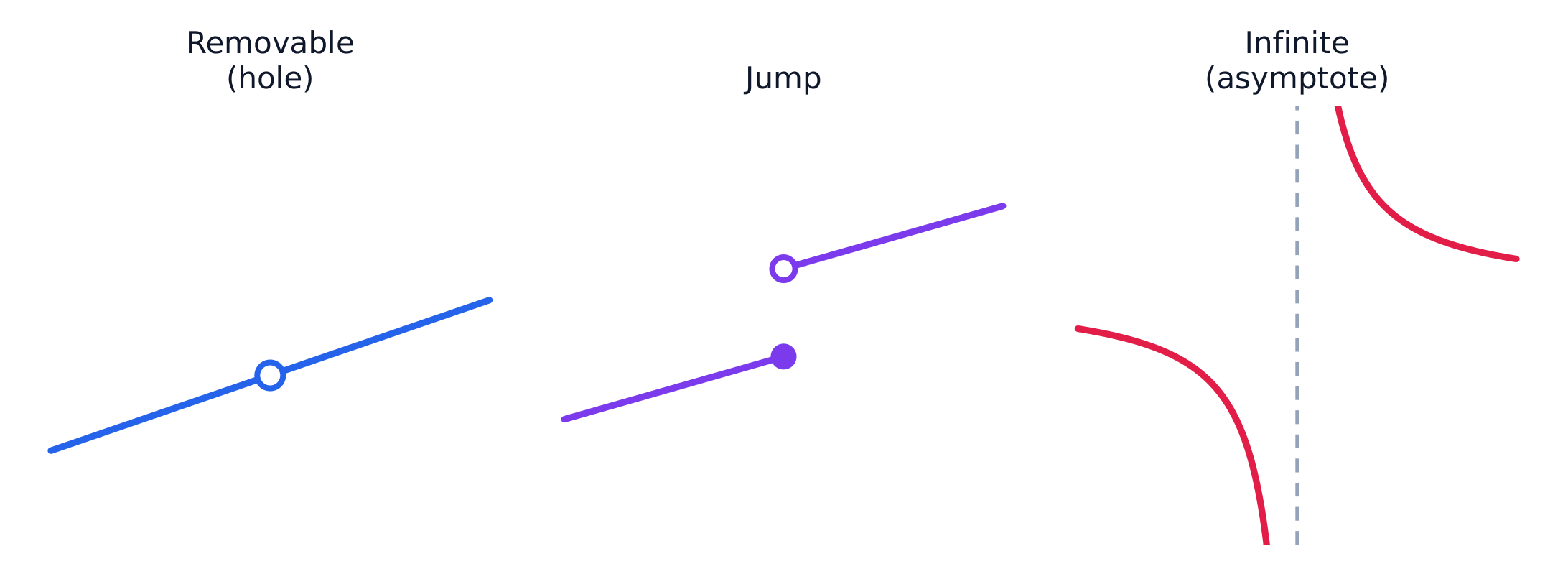
If the left side of a graph heads to $2$ and the right side heads to $6$, the limit does not exist because of a ____.
难度 1/5 · 今日首次完成可获 100 金币及少量额外奖励
Different one-sided heights means a 跳跃 discontinuity, so the two-sided limit is DNE.
From a graph, select 所有 features that make $\lim_{x\to c} f(x)$ fail to exist.
难度 2/5 · 今日首次完成可获 140 金币及少量额外奖励
Blow-ups, jumps, and oscillation all kill a limit. A removable hole does 不 — both sides still agree.
Worked example: read six values from one graph
| Question | Answer | Why |
|---|---|---|
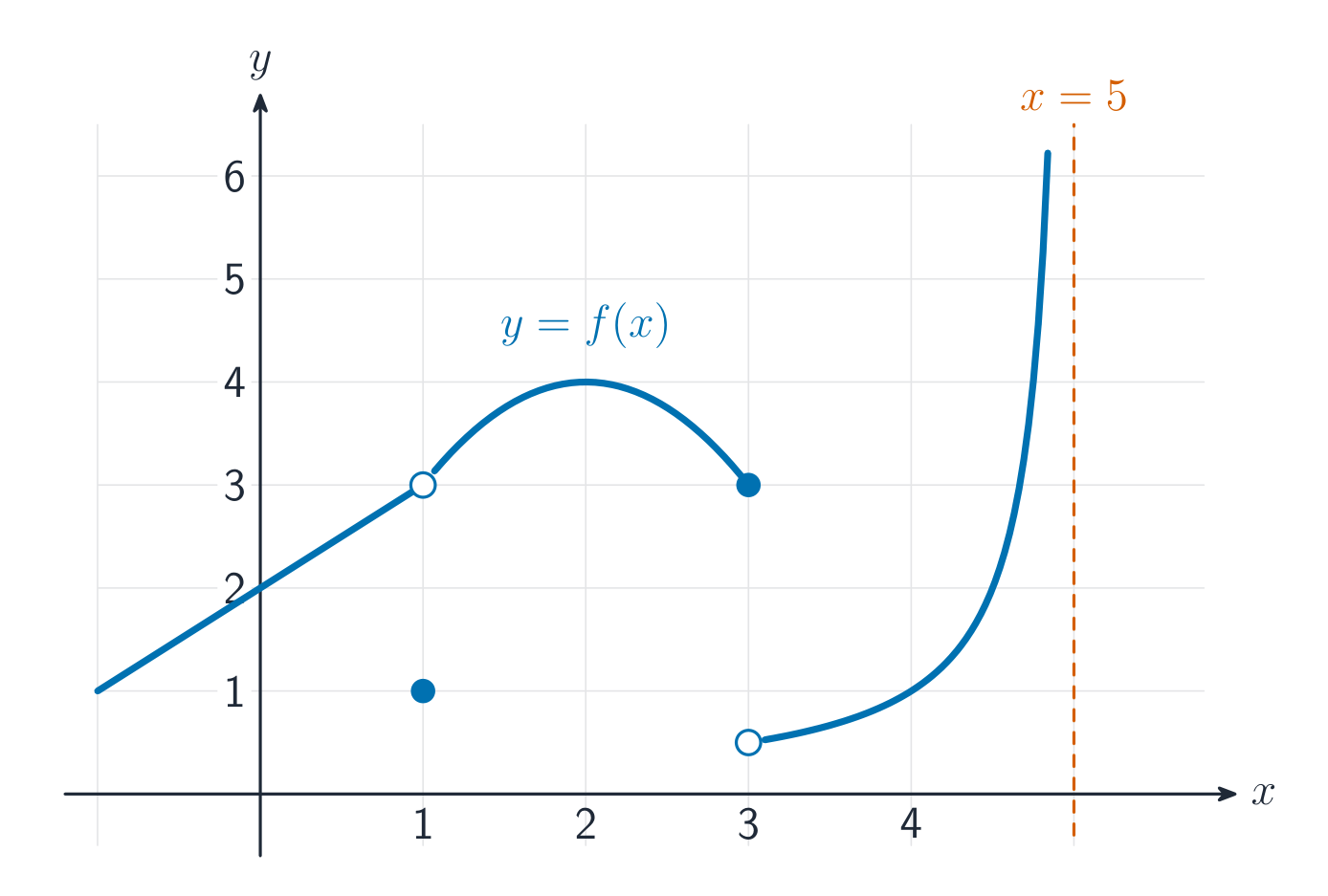
| $\displaystyle\lim_{x\to1}f(x)$ | $3$ | both sides head for the hole at height 3 |
| $f(1)$ | $1$ | the filled dot, below the hole |
| $\displaystyle\lim_{x\to2}f(x)$ | $4$ | a smooth point: limit $=f(2)$ |
| $\displaystyle\lim_{x\to3^-}f(x)$, $\displaystyle\lim_{x\to3^+}f(x)$ | $3$, $0.5$ | the sides disagree, so $\displaystyle\lim_{x\to3}f(x)$ DNE |
| $f(3)$ | $3$ | the filled dot is on the left piece |
| $\displaystyle\lim_{x\to5^-}f(x)$ | $\infty$ | unbounded: the curve rises along $x=5$ |
Use the graph of $f$ in the worked example. Find $\displaystyle\lim_{x\to1}f(x)+f(1)+\lim_{x\to0}f(x)$.
难度 2/5 · 今日首次完成可获 140 金币及少量额外奖励
The limit at 1 is the hole height, 3. $f(1)=1$ is the filled dot. At $x=0$ the line passes through height 2, so the limit is 2. $3+1+2=6$.
Use the same graph. Which statement about $x=3$ is true?
难度 1/5 · 今日首次完成可获 100 金币及少量额外奖励
The filled dot gives $f(3)=3$. From the left the curve heads to 3, from the right to 0.5 (the open dot). The sides disagree, so the two-sided limit DNE.
- Don't read the dot when the question asks for the limit. At $x=1$ above, the limit is $3$ but $f(1)=1$.
- A jump makes the two-sided limit DNE, but each one-sided limit can still exist (3 and 0.5 at $x=3$).
- "$\lim=\infty$" is a description of how the limit fails. It is not a number.
A smooth curve passes through height $7$ at $x=3$ with 否 hole or dot elsewhere. What are $f(3)$ and $\lim_{x\to 3} f(x)$?
难度 1/5 · 今日首次完成可获 100 金币及少量额外奖励
With no hole or jump, the curve is continuous there, so limit $= f(3) = 7$.
Trace toward $c$ from both sides and ask what height you head for; the dot at $c$ gives $f(c)$, not the limit. The limit is DNE for a jump, an unbounded curve or an oscillation.