Defining Limits and Using Limit Notation · 定义极限与使用极限符号
| English | 中文 | Pinyin · 拼音 |
|---|---|---|
| limit/ˈlɪmɪt/ | 极限 | jí xiàn |
| approaches/əˈprəʊtʃɪz/ | 趋近 | qū jìn |
| one-sided limit/wʌn ˈsaɪdɪd ˈlɪmɪt/ | 单侧极限 | dān cè jí xiàn |
| left-hand/left hænd/ | 左侧 | zuǒ cè |
| right-hand/raɪt hænd/ | 右侧 | yòu cè |
| two-sided limit/tuː ˈsaɪdɪd ˈlɪmɪt/ | 双侧极限 | shuāng cè jí xiàn |
Where is the graph heading?
- Forget the single point for a moment — ask where the curve is heading as you slide $x$ toward a value.
- Follow $f(x)=\dfrac{x^2-1}{x-1}$ as $x$ gets close to $1$. Plug in $x=1$ and you get $\tfrac{0}{0}$ — undefined.
- Yet the outputs march steadily toward $2$: $f(0.9)=1.9$, $f(0.99)=1.99$, $f(1.01)=2.01$.
- The function has a hole at $x=1$, but it is clearly aiming at $2$. That target value is the limit 极限.
图像正在"奔向"哪里?
- 先别管那一个点——问一问:当 $x$ 滑向某个值时,曲线正在奔向哪里。
- 让 $x$ 靠近 $1$,观察 $f(x)=\dfrac{x^2-1}{x-1}$。代入 $x=1$ 会得到 $\tfrac{0}{0}$——没有定义。
- 可是输出稳稳地逼近 $2$:$f(0.9)=1.9$,$f(0.99)=1.99$,$f(1.01)=2.01$。
- 函数在 $x=1$ 处有一个洞,但它显然在"瞄准"$2$。那个目标值就是极限。
Watch where the curve heads · 观察曲线的走向
y = ax² + bx + c
Drag the coefficients and pick an input $c$ in your mind — the limit is the height the curve approaches near $c$, not the point itself. · 拖动系数并在心中选定一个输入 $c$ —— 极限是曲线在 $c$ 附近趋近的高度,而非该点本身。
Writing it down: limit notation
- We write $\displaystyle\lim_{x \to c} f(x) = L$ and read it "the limit of $f$ of $x$, as $x$ approaches 趋近 $c$, equals $L$."
- $c$ is the input we creep toward; $L$ is the output the function heads for.
- Crucially, $x \to c$ means "gets close to $c$" — never "equals $c$." We stay off the point itself.
- For our example: $\displaystyle\lim_{x \to 1}\dfrac{x^2-1}{x-1} = 2$, even though $f(1)$ does not exist.
把它写下来:极限记号
- 我们写 $\displaystyle\lim_{x \to c} f(x) = L$,读作"当 $x$ 趋近 $c$ 时,$f$ 关于 $x$ 的极限等于 $L$"。
- $c$ 是我们慢慢靠近的输入;$L$ 是函数奔向的输出。
- 关键是:$x \to c$ 表示"靠近 $c$",绝不是"等于 $c$"。我们始终不踩到那个点本身。
- 对我们的例子:$\displaystyle\lim_{x \to 1}\dfrac{x^2-1}{x-1} = 2$,即使 $f(1)$ 不存在。
The notation $\lim_{x \to c} f(x) = L$ means that as $x$... · 符号 $\lim_{x \to c} f(x) = L$ 表示当 $x$...
$x \to c$ means $x$ approaches $c$ without touching it, and $f(x)$ heads toward $L$. · $x \to c$ 意味着 $x$ 趋近 $c$ 而不触碰它,且 $f(x)$ 趋向于 $L$。
Evaluate · 评价 $\displaystyle\lim_{x \to 3}\dfrac{x^2-9}{x-3}$. · 计算 $\displaystyle\lim_{x \to 3}\dfrac{x^2-9}{x-3}$。
Factor: $\frac{(x-3)(x+3)}{x-3}=x+3$ for $x\neq3$, which heads to $3+3=6$. · 因素:$\frac{(x-3)(x+3)}{x-3}=x+3$ 对于 $x\neq3$,趋向于 $3+3=6$。
Coming from the left and the right
- You can approach $c$ from two directions, and each has its own one-sided limit 单侧极限.
- From below ($x$ slightly less than $c$): the left-hand 左侧 limit, $\displaystyle\lim_{x \to c^-} f(x)$.
- From above ($x$ slightly more than $c$): the right-hand 右侧 limit, $\displaystyle\lim_{x \to c^+} f(x)$.
- The small $-$ and $+$ signs sit up high on $c$ to show the direction of travel.
从左边和右边靠近
- 你可以从两个方向靠近 $c$,每个方向都有自己的单侧极限。
- 从下方靠近($x$ 略小于 $c$):左侧极限,$\displaystyle\lim_{x \to c^-} f(x)$。
- 从上方靠近($x$ 略大于 $c$):右侧极限,$\displaystyle\lim_{x \to c^+} f(x)$。
- 小小的 $-$ 和 $+$ 号写在 $c$ 的右上角,标明前进的方向。
Which expression is the right-hand limit of $f$ at $c$? · 下列哪个表达式是 $f$ 在 $c$ 处的右极限?
The $+$ superscript on $c$ means $x$ approaches from above — the right-hand side. · $+$上的上标$c$表示从上方(右侧)接近$x$。
The two sides must agree
- The ordinary two-sided limit 双侧极限 $\displaystyle\lim_{x \to c} f(x)$ exists only when both one-sided limits exist and are equal.
-
$$\lim_{x \to c^-} f(x) = \lim_{x \to c^+} f(x) = L \iff \lim_{x \to c} f(x) = L$$
- If the left side heads for one value and the right side for another, the two-sided limit does not exist (DNE).
两侧必须一致
- 普通的双侧极限 $\displaystyle\lim_{x \to c} f(x)$,只有在两个单侧极限都存在且相等时才存在。
-
$$\lim_{x \to c^-} f(x) = \lim_{x \to c^+} f(x) = L \iff \lim_{x \to c} f(x) = L$$
- 如果左侧奔向一个值、右侧奔向另一个值,那么双侧极限不存在(DNE)。
A two-sided limit at $c$ exists only when the left-hand and right-hand limits are both present and ____. · $c$ 处的双侧极限存在的充要条件是左极限和右极限都存在且 ____。
The two one-sided limits must agree on a single value $L$. · 两个单侧极限必须在同一个值 $L$ 上 一致。
Select all · 所有 situations in which $\lim_{x\to c} f(x)$ does · 作用 not · 不 exist. · 选择所有 $\lim_{x\to c} f(x)$ 不存在的情况。
A limit fails when the sides disagree, the value is unbounded, or it oscillates. A mismatch with $f(c)$ alone does not · 不 kill the limit — it only breaks continuity. · 当两侧不一致、值无界或发生振荡时极限不存在。仅与 $f(c)$ 不匹配并不破坏极限——它只破坏连续性。
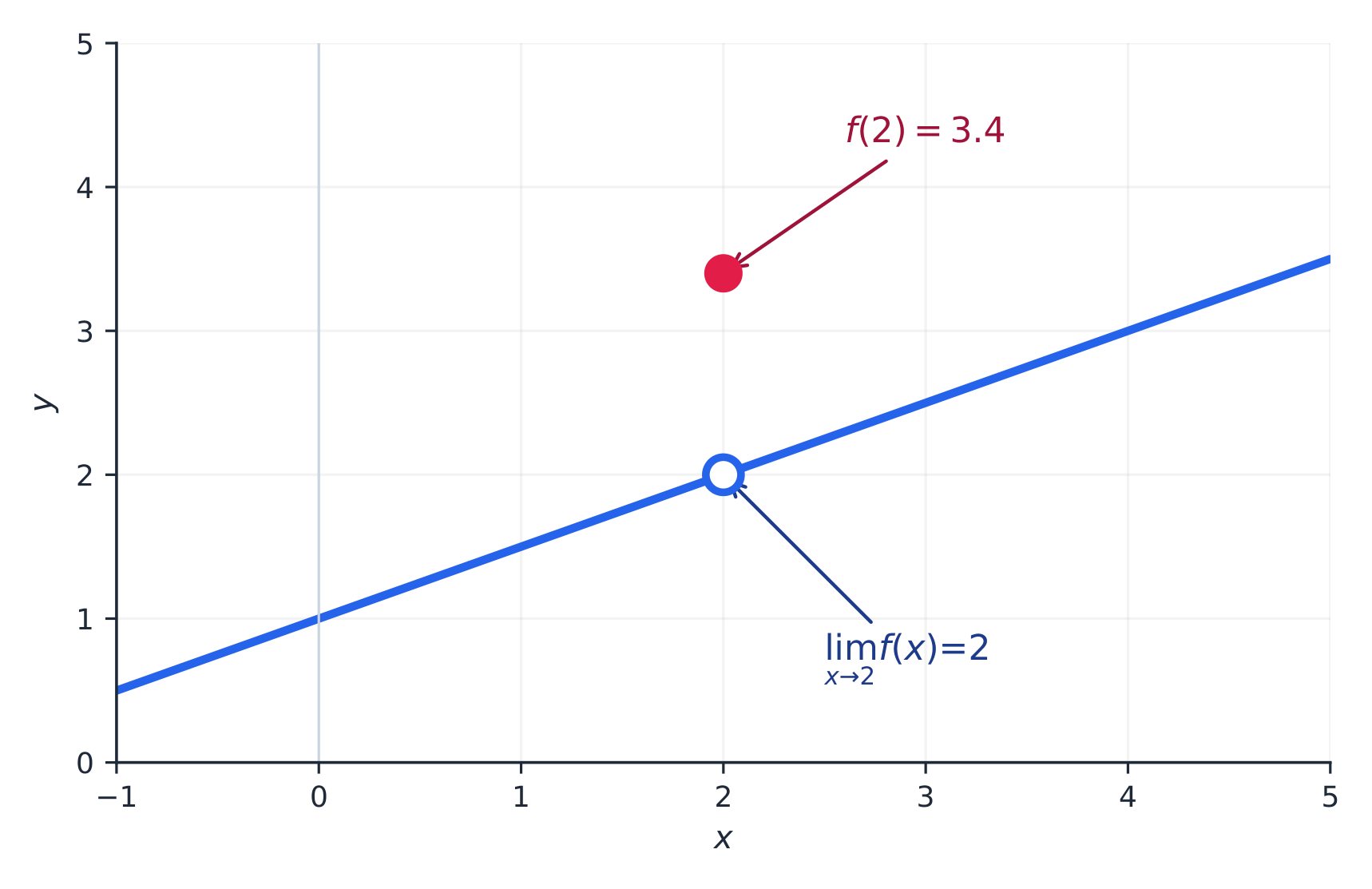
The limit is about the journey, not the destination point. $\lim_{x \to c} f(x)$ can exist even when $f(c)$ is undefined, and it can differ from $f(c)$ when the point is plotted somewhere off the curve. Never assume $\lim_{x\to c} f(x)=f(c)$ — that is a special case (continuity), not a rule.
极限说的是过程,而不是终点那一个点。当 $f(c)$ 没有定义时,$\lim_{x \to c} f(x)$ 仍可以存在;当那个点被画在曲线之外时,极限还可以与 $f(c)$ 不同。千万别默认 $\lim_{x\to c} f(x)=f(c)$——那是一种特殊情形(连续性),不是通则。
If $f(c)$ is undefined, then $\lim_{x \to c} f(x)$ cannot exist. · 如果 $f(c)$ 未定义,则 $\lim_{x \to c} f(x)$ 无法存在。
The limit is about the approach, not the point. $\lim_{x\to 1}\frac{x^2-1}{x-1}=2$ even though $f(1)$ is undefined. · 极限关乎趋近过程,而非具体的点。$\lim_{x\to 1}\frac{x^2-1}{x-1}=2$ 尽管 $f(1)$ 未定义。
For a piecewise function, $\displaystyle\lim_{x\to 2^-} f(x) = 3$ and $\displaystyle\lim_{x\to 2^+} f(x) = 5$.
- The left side heads for $3$; the right side heads for $5$.
- They disagree, so $\displaystyle\lim_{x \to 2} f(x)$ does not exist — the graph jumps at $x=2$.
- This is true no matter what value (if any) is plotted at $x=2$.
对一个分段函数,$\displaystyle\lim_{x\to 2^-} f(x) = 3$,$\displaystyle\lim_{x\to 2^+} f(x) = 5$。
- 左侧奔向 $3$;右侧奔向 $5$。
- 两者不一致,所以 $\displaystyle\lim_{x \to 2} f(x)$ 不存在——图像在 $x=2$ 处跳跃。
- 无论 $x=2$ 处画着什么值(如果有的话),结论都成立。
$\displaystyle\lim_{x\to c} f(x)=L$ says $f(x)$ heads toward $L$ as $x$ nears $c$ from both sides — without ever touching $c$. The two-sided limit exists iff the left-hand and right-hand limits both exist and are equal. The limit describes where the function is going, which need not equal $f(c)$.
$\displaystyle\lim_{x\to c} f(x)=L$ 表示:当 $x$ 从两侧靠近 $c$(却从不碰到 $c$)时,$f(x)$ 奔向 $L$。双侧极限存在当且仅当左侧极限与右侧极限都存在且相等。极限描述函数要去哪里,而这不一定等于 $f(c)$。