持久理解(FUN-3): 识别应用求导法则的契机可以简化微分过程。
学习目标 FUN-3.C: 计算可微函数复合体的导数。
- FUN-3.C.1 链式法则提供了一种对复合函数进行微分的方法。
AP 微积分 BC · 知识点 3
 7:58
链式法则
想象两个啮合的齿轮。转动第一个,它会驱动第二个。如果第二个转得比第一个快三倍,而第一个转动……
英语旁白 · 英中内嵌字幕
持久理解(FUN-3): 识别应用求导法则的契机可以简化微分过程。
学习目标 FUN-3.C: 计算可微函数复合体的导数。
来源:College Board AP 课程与考试说明
Unit 2 differentiated single functions. Unit 3 differentiates functions built inside other functions. The chain rule 链式法则 differentiates a composite function 复合函数 $f\big(g(x)\big)$:
In Leibniz notation 莱布尼茨记号, with $y=f(u)$ and $u=g(x)$, the rule reads $\dfrac{dy}{dx}=\dfrac{dy}{du}\cdot\dfrac{du}{dx}$ – the intermediate $du$ appears to “cancel.” Exam questions often give a table for $f$, $g$, $f'$, $g'$ and ask for $h'(a)$ where $h(x)=f\big(g(x)\big)$; evaluate $f'\big(g(a)\big)\cdot g'(a)$ by reading values.
Worked example. Differentiate $h(x)=(2x^2+1)^5$. The outer function 外函数 is “(something)$^5$” and the inner function 内函数 is $2x^2+1$:
y = ax² + bx + c
像 $(3x+1)^2$ 这样的复合函数比其内部直线本身更陡——链式法则将内部速率乘入。
| English | 中文 | 拼音 |
|---|---|---|
| chain rule/tʃeɪn ruːl/ | 链式法则 | liàn shì fǎ zé |
| composite function/ˈkɒmpəzɪt ˈfʌŋkʃn/ | 复合函数 | fù hé hán shù |
| Leibniz notation | 莱布尼茨记号 | lái bù ní cí jì hào |
| outer function | 外函数 | wài hán shù |
| inner function | 内函数 | nèi hán shù |
持久理解 (FUN-3): 识别应用求导法则的机会可以简化求导过程。
学习目标 FUN-3.D: 计算隐式定义函数的导数。
来源:College Board AP 课程与考试说明
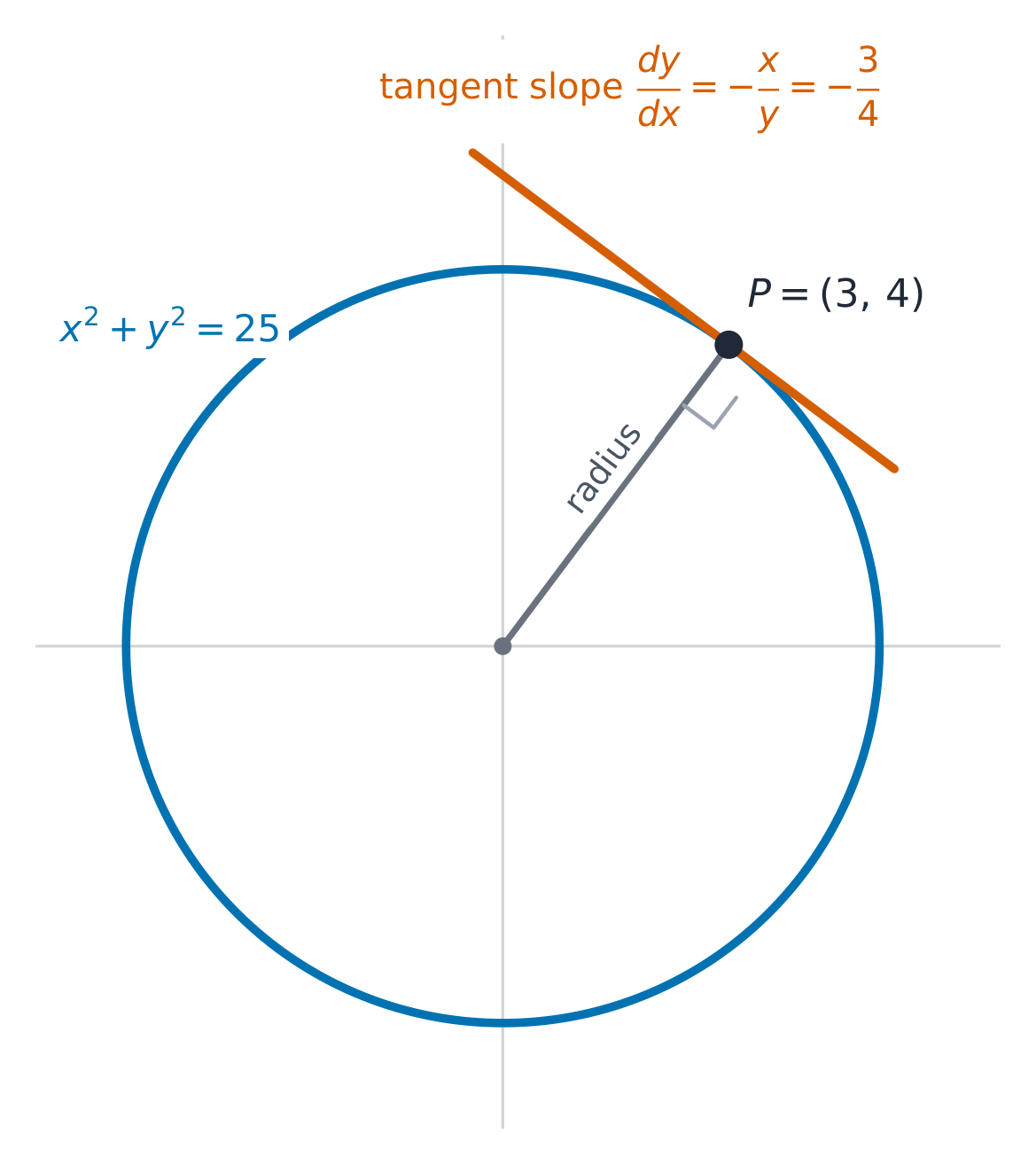
Some curves are defined implicitly – by an equation in $x$ and $y$ that is not solved for $y$, such as $x^2+y^2=25$. Implicit differentiation 隐函数求导 finds $\dfrac{dy}{dx}$ without solving for $y$ first. It is just the chain rule, treating $y$ as a function of $x$.
The method: differentiate both sides with respect to $x$; every time you differentiate a $y$-term, multiply by $\dfrac{dy}{dx}$ (the chain rule); then solve algebraically for $\dfrac{dy}{dx}$. For $x^2+y^2=25$:
Worked example. Find the tangent to $x^2+y^2=25$ at $(3,4)$. Here $\dfrac{dy}{dx}=-\dfrac{3}{4}$, so the tangent line 切线 is $y-4=-\tfrac{3}{4}(x-3)$ – perpendicular 垂直 to the radius 半径, as geometry predicts.
Exam skill – “Show that $\dfrac{dy}{dx}=\ldots$”. This exact prompt appears most years (e.g. “Show that $\dfrac{dy}{dx}=\dfrac{2y}{y^2-2x}$”). Because the target is given, you must show every algebra step cleanly: differentiate both sides, use the product/chain rules on mixed $xy$ terms, collect all $\dfrac{dy}{dx}$ terms on one side, factor, and divide. A correct final line that skips the algebra earns little. Follow-up parts then ask for a tangent line, or where the tangent is horizontal ($\tfrac{dy}{dx}=0$, so the numerator is $0$) or vertical (the denominator is $0$).
Worked example. The curve $x^2+xy+y^2=7$ passes through $(1,2)$. Show that $\dfrac{dy}{dx}=-\dfrac{2x+y}{x+2y}$, and find the slope at $(1,2)$.
The middle term $xy$ is a product, so it needs the product rule: $\dfrac{d}{dx}(xy)=1\cdot y+x\dfrac{dy}{dx}$. Differentiate every term:
Collect the $\dfrac{dy}{dx}$ terms on one side and factor:
At $(1,2)$ (check: $1+2+4=7$), the slope is $-\dfrac{2(1)+2}{1+2(2)}=-\dfrac{4}{5}$.
Common mistakes. Writing $\dfrac{d}{dx}(xy)=\dfrac{dy}{dx}$ (the product rule is missing), and writing $\dfrac{d}{dx}(y^2)=2y$ (the factor $\dfrac{dy}{dx}$ is missing).
y = √(25 − x²) (上半圆)
即使无法解出 $y$ 的曲线,每一点也有切线——隐函数求导找到该斜率。
| English | 中文 | 拼音 |
|---|---|---|
| implicit differentiation/ɪmˈplɪsɪt ˌdɪfəˌrenʃɪˈeɪʃn/ | 隐函数求导 | yǐn hán shù qiú dǎo |
| tangent line/ˈtændʒənt laɪn/ | 切线 | qiè xiàn |
| perpendicular/ˌpɜːpənˈdɪkjʊlə/ | 垂直 | chuí zhí |
| radius/ˈreɪdɪəs/ | 半径 | bàn jìng |
持久理解(FUN-3): 识别应用求导法则的机会可以简化求导过程。
学习目标 FUN-3.E: 计算反函数及反三角函数的导数。
来源:College Board AP 课程与考试说明
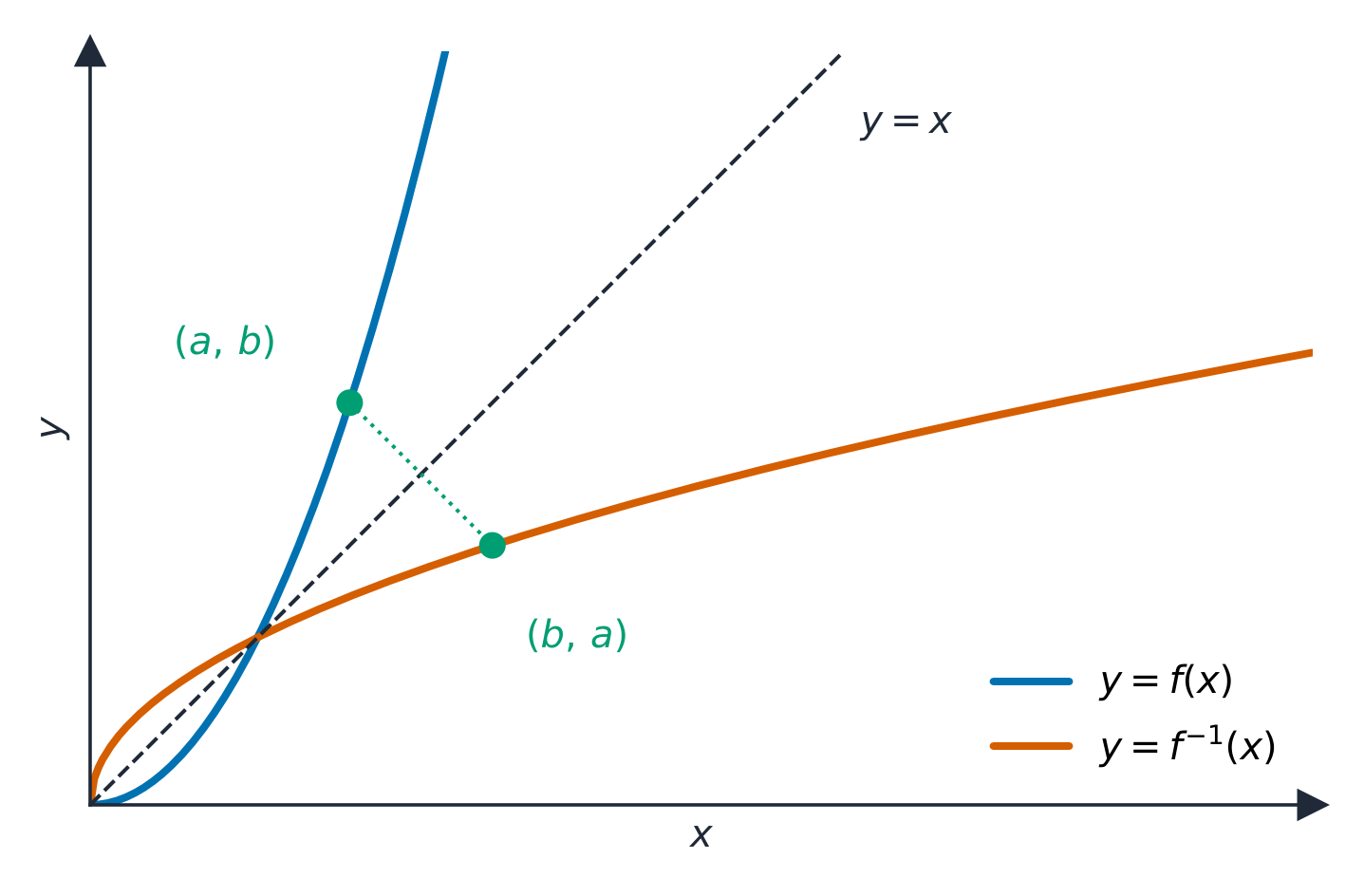
If $g$ is the inverse function 反函数 of $f$ (so $f(g(x))=x$), the chain rule links their derivatives:
Worked example. If $f(2)=5$ and $f'(2)=3$, and $g$ is the inverse of $f$, then $(5,2)$ lies on $g$ and $g'(5)=\dfrac{1}{f'(2)}=\dfrac{1}{3}$.
y = a·e^(bx) + c
反函数关于 $y=x$ 镜像对称,且它们的斜率互为倒数。当一个陡峭时,其反函数则平缓。
| English | 中文 | 拼音 |
|---|---|---|
| inverse function/ɪnˈvɜːs ˈfʌŋkʃn/ | 反函数 | fǎn hán shù |
| reciprocal/rɪˈsɪprəkl/ | 倒数 | dào shǔ |
持久理解(FUN-3): 识别应用求导法则的机会可以简化求导过程。
学习目标 FUN-3.E: 计算反函数和反三角函数的导数。
来源:College Board AP 课程与考试说明
The same idea gives the derivatives of the inverse trigonometric functions 反三角函数. The three you should know:
y = a·tanh(bx)(类似反正切的形状)
$\arctan x$ 在 $0$ 处上升最快(斜率为 $1$),随后趋于平坦——其导数 $\tfrac{1}{1+x^2}$ 趋近于 $0$。
| English | 中文 | 拼音 |
|---|---|---|
| inverse trigonometric function | 反三角函数 | fǎn sān jiǎo hán shù |
本主题旨在重点训练学生选择适当方法来计算导数的技能。应为学生提供充分机会,练习何时以及如何应用所有与计算导数相关的学习目标。
来源:College Board AP 课程与考试说明
A skill topic: real derivatives mix several rules, so read the structure of the expression first, from the outside in.
Name the outermost operation, apply its rule, and recurse inward. Neatness prevents the sign and bookkeeping errors that cost marks.
y = a / (x − b)
曲线源自乘积、商还是复合运算决定了使用哪个规则进行求导——首先阅读顶层结构。
| English | 中文 | 拼音 |
|---|---|---|
| product rule/ˈprɒdʌkt ruːl/ | 乘积法则 | chéng jī fǎ zé |
| quotient rule/ˈkwəʊʃənt ruːl/ | 商法则 | shāng fǎ zé |
持久理解 (FUN-3): 识别应用求导法则的机会可以简化微分过程。
学习目标 FUN-3.F: 确定函数的高阶导数。
来源:College Board AP 课程与考试说明
Differentiating $f'$ produces the second derivative 二阶导数 $f''$; repeating gives higher-order derivatives 高阶导数. The notations:
Worked example. For the circle $x^2+y^2=25$, find $\dfrac{d^2y}{dx^2}$ in terms of $y$.
Start from $\dfrac{dy}{dx}=-\dfrac{x}{y}$ and use the quotient rule, remembering that $y$ depends on $x$:
The last step uses the curve itself: $x^2+y^2=25$. On the top half ($y>0$) the second derivative is negative, so the curve is concave down there, as a circle's top should be.
y = ax³ + bx² + cx + d
再次求导得到 $f''$,即斜率的变化率。当斜率增加时,曲线向上弯曲。
| English | 中文 | 拼音 |
|---|---|---|
| second derivative/ˈsekənd dɪˈrɪvətɪv/ | 二阶导数 | èr jiē dǎo shù |
| higher-order derivative | 高阶导数 | gāo jiē dǎo shù |
| concavity/kənˈkævɪti/ | 凹凸性 | āo tū xìng |
| acceleration/əkˌseləˈreɪʃn/ | 加速度 | jiā sù dù |
逐步完成,配合即时检查练习。
正在加载学科…