The same parameter identifies both coordinates of a point on its path.
Parametric equations 参数方程 give coordinates $x=f(t)$ and $y=g(t)$ in terms of a parameter 参数$t$. A robot's position needs both coordinates at the same time. For $x=t^2$, $y=t^3$, increasing $t$ through $-1,0,1,2$ gives $(1,-1),(0,0),(1,1),(4,8)$. The same x-coordinate can have different y-coordinates, so the whole curve need not be one function $y=f(x)$.
Keep the parameter interval and direction. For $x=\cos t$, $y=\sin t$, $0\le t\le\pi$ traces only the upper semicircle, from $(1,0)$ to $(-1,0)$. The interval $[0,2\pi]$ traces a full circle counterclockwise. Eliminating $t$ gives $x^2+y^2=1$ but loses this interval and travel order.
Where $dx/dt\ne0$, the chain rule gives the slope 斜率
$$\frac{dy}{dx}=\frac{dy/dt}{dx/dt}.$$
Differentiate both coordinates, then evaluate at the same parameter. This is not the derivative of $y/x$ or the product of the coordinate rates.
Worked example: slope and tangent. For $x=t^2$, $y=t^3$ at $t=2$, the point is $(4,8)$ and the derivatives are $4$ and $12$. The slope is $3$, so the tangent is $y-8=3(x-4)$. For the related curve $x=t^2$, $y=t^3-t$, the slope is $(3t^2-1)/(2t)$ for $t\ne0$; at $t=2$ it is $11/4$.
A regular horizontal tangent has $dy/dt=0$ and $dx/dt\ne0$; a regular vertical tangent has $dx/dt=0$ and $dy/dt\ne0$. If both derivatives vanish, these tests do not decide the tangent. For $x=t^3$, $y=t^3$ at zero, both vanish but the path is the line $y=x$. Zero coordinate rates do not prove that no geometric tangent exists.
Try it. For $x=t^2+2$, $y=t^3-12t$, $-3\le t\le3$, find the regular horizontal and vertical tangent lines.
Answer. The derivatives are $2t$ and $3t^2-12$. Horizontal tangents occur at $t=\pm2$, with points $(6,-16)$ and $(6,16)$ and lines $y=-16$, $y=16$. At $t=0$, the y-coordinate rate is $-12\ne0$, so the vertical tangent is $x=2$ at $(2,0)$. All three parameters lie in the stated interval.
探索
Trace the parameter and inspect the tangent
For x=t² and y=t³ at t=2, locate (4,8), compare the two coordinate derivatives and see slope 3. Compare regular horizontal/vertical tangents with a both-zero derivative ratio.
CHA-3.G.3$\dfrac{d^2 y}{dx^2}$ 可以通过将 $\dfrac{d}{dt}\left(\dfrac{dy}{dx}\right)$ 除以 $\dfrac{dx}{dt}$ 来计算。仅限 BC 课程
来源:College Board AP 课程与考试说明
English
The second derivative 二阶导数 measures change of slope with x. Write the first slope as $m(t)=dy/dx$. Where $dx/dt\ne0$,
$$\frac{d^2y}{dx^2}=\frac{dm/dt}{dx/dt}.$$
Differentiate the first slope in t, then divide by $dx/dt$ again. It is not generally the ratio of the second coordinate derivatives. Simplify first when helpful; a quotient rule is needed only if the remaining expression requires it. The equivalent formula is
Worked example: two different derivatives. For $x=t^2$, $y=t^3$ and $t\ne0$, the first slope is $3t/2$, whose t-derivative is $3/2$. Dividing by $2t$ gives $3/(4t)$. At $t=1$ the second x-derivative is $3/4$, rather than the intermediate value $3/2$ or the incorrect ratio $6t/2=3$.
Its sign gives concavity 凹凸性 on a smooth local graph: positive means concave up, negative means concave down. The upper branch of this curve is concave up for $t>0$; the lower branch is concave down for $t<0$. At zero the formula is unavailable, and the branches meet at a cusp. A sign change across that singular parameter does not by itself establish an inflection of one smooth graph.
Worked example: decreasing x. For $x=-t$, $y=t^2$, the slope is $-2t$ and its t-derivative is $-2$. Dividing by $dx/dt=-1$ gives $d^2y/dx^2=2$. The graph is $y=x^2$, concave up despite the negative intermediate derivative.
Try it. For $x=t^3+2t$, $y=t^2$, find the second x-derivative and its sign at $t=1$.
Answer. The first slope is $2t/(3t^2+2)$; its t-derivative is $2(2-3t^2)/(3t^2+2)^2$. Divide again to obtain $2(2-3t^2)/(3t^2+2)^3$. At $t=1$ this is $-2/125$, so the curve is locally concave down at $(3,1)$. The denominator $3t^2+2$ is always positive.
A zero second derivative alone is not an inflection test: $y=x^4$ has second derivative zero at the origin but is concave up on both sides. Check a change of concavity and the regularity of the graph.
Worked example. For the curve $x=t^2$, $y=t^3-t$, find $\dfrac{d^2y}{dx^2}$ at $t=2$. First write $\dfrac{dy}{dx}=\dfrac{3t^2-1}{2t}=\dfrac32 t-\dfrac12 t^{-1}$, and differentiate with respect to $t$:
It is positive, so the curve is concave up at $t=2$. Forgetting the final division by $\dfrac{dx}{dt}$ is the usual error.
探索
Concavity on a parametric path
At t=1 for x=t²,y=t³, compare slope 3/2, its t-derivative 3/2, and second x-derivative 3/4. Compare reversed travel, zero second derivatives and a singular parameter value.
The integrand is speed 速率 when t is time. Square and add both coordinate rates under a nonnegative root. Use parameter bounds; a zero component or isolated zero speed is allowed because no rate is in a denominator.
Worked example: a curved route. For $x=t^2$, $y=t^3$, the speed is
$$\sqrt{4t^2+9t^4}=|t|\sqrt{4+9t^2}.$$
On $[0,1]$, use $|t|=t$. Substitution $u=4+9t^2$ gives
On $[-1,0]$, use $|t|=-t$ to obtain the same positive length. On $[-1,1]$, double the half-interval length to get approximately $2.879$. Always retain $\sqrt{t^2}=|t|$ when simplifying.
Worked example: retracing. For $x=t^2$, $y=0$ on $[-1,1]$, moving from x=1 to 0 and back gives $\int_{-1}^1 2|t|\,dt=2$. The segment counted once has length 1; endpoint distance is 0. The integral counts repeated traversals.
Try it. Find the length for $x=t^2$, $y=t^3$ on $[-2,0]$.
Answer. Integrate $(-t)\sqrt{4+9t^2}$ on this interval. The length is $(40^{3/2}-8)/27$. Using t instead of -t would incorrectly produce a negative integrand.
Worked example. Find the length of $x=\tfrac13 t^3$, $y=\tfrac12 t^2$ for $0\le t\le\sqrt3$. Here $\dfrac{dx}{dt}=t^2$ and $\dfrac{dy}{dt}=t$, so for $t\ge 0$
Most exam arc lengths need a calculator; this one was chosen so the integral works by hand ($u=t^2+1$).
探索
Compare a travelled path with its speed integral
For x=t²,y=t³ on[0,1], the speed integral gives length≈1.440, exceeding the endpoint distance√2. Compare constant-rate and retraced routes, including negative parameter intervals.
A vector-valued function 向量值函数$\mathbf r(t)=\langle x(t),y(t)\rangle$ gives a vector for each parameter value. A position vector 位置向量 is a vector from the chosen origin to a point, giving its coordinates. Differentiate component by component:
The velocity 速度 and acceleration 加速度 are vectors. Speed is the scalar magnitude 模长$|\mathbf v|=\sqrt{x'^2+y'^2}$. Differentiate the functions before substituting a parameter value; differentiating a fixed position vector loses the nearby change information.
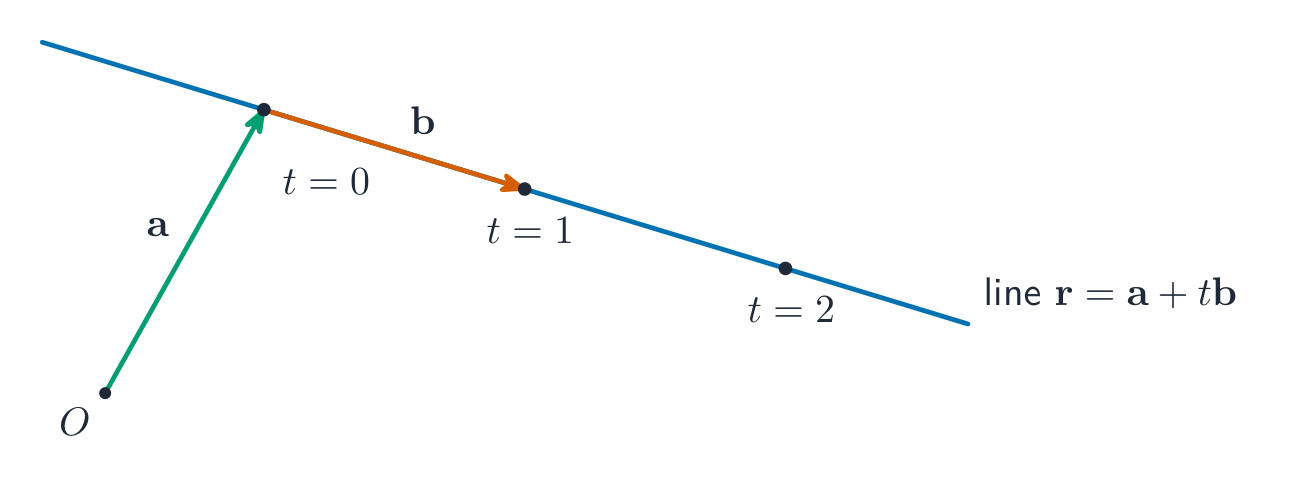
A vector-valued line: start at a, then slide by t lots of the direction b
Worked example: the complete chain. For $\mathbf r(t)=\langle t^2,\sin t\rangle$, velocity is $\langle2t,\cos t\rangle$ and acceleration is $\langle2,-\sin t\rangle$. At zero, position is $\langle0,0\rangle$, velocity is $\langle0,1\rangle$, acceleration is $\langle2,0\rangle$ and speed is 1. Being at the origin does not mean being stationary.
Nonzero velocity gives the tangent direction. A zero velocity vector has no direction, but does not rule out a geometric tangent: $\mathbf r(t)=\langle t^3,t^3\rangle$ has zero velocity at zero while its path is the line $y=x$. Position and velocity vectors need not point in the same direction.
Worked example: nontrivial speed. For $\mathbf r(t)=\langle t^2,t^3-t\rangle$, velocity is $\langle2t,3t^2-1\rangle$ and acceleration is $\langle2,6t\rangle$. At $t=1$, the point is $(1,0)$, velocity is $\langle2,2\rangle$, acceleration is $\langle2,6\rangle$ and speed is $2\sqrt2$. At $t=-1$, the point is again $(1,0)$ but velocity $\langle-2,2\rangle$ points left and up.
Try it. For $\mathbf r(t)=\langle3t^2+1,t^3-2t\rangle$, find position, velocity, acceleration and speed at $t=1$.
Answer. The values are $\langle4,-1\rangle$, $\langle6,1\rangle$, $\langle6,6\rangle$ and $\sqrt{37}$. Motion is right and up, determined by velocity rather than the negative y-coordinate.
探索
Position and its vector derivatives
For r(t)=⟨t²,sin t⟩ at t=0, compare position⟨0,0⟩, velocity⟨0,1⟩, acceleration⟨2,0⟩ and speed 1. The derivative arrows are shown from a common origin for comparison.
A constant vector 常向量 is a vector whose components do not vary with the parameter. Integrate each component and retain an independent constant in each component: $\int\langle f,g\rangle\,dt=\langle F+C_1,G+C_2\rangle$ when $F'=f$, $G'=g$. An initial condition 初始条件 fixes each component's constant independently. Each new integration introduces another constant vector.
Worked example: recover velocity and position. Given $\mathbf a(t)=\langle2,6t\rangle$ and $\mathbf v(0)=\langle1,0\rangle$, integration gives $\mathbf v(t)=\langle2t+1,3t^2\rangle$. If also $\mathbf r(0)=\langle2,-1\rangle$, integrate again to obtain $\mathbf r(t)=\langle t^2+t+2,t^3-1\rangle$. The velocity condition and position condition fix different constants.
Equivalently, include the initial values with definite integrals:
The vector integrals give changes; add the initial vector to recover the state. The dummy variable u is distinct from the upper limit t. These signed integrals can also recover an earlier state when $t<t_0$.
Worked example: data at a nonzero time. Keep acceleration $\langle2,6t\rangle$ but use $\mathbf v(1)=\langle4,-2\rangle$, $\mathbf r(1)=\langle3,7\rangle$. The resulting functions are $\mathbf v(t)=\langle2t+2,3t^2-5\rangle$ and $\mathbf r(t)=\langle t^2+2t,t^3-5t+11\rangle$. Substitute t=1 into both and differentiate to verify. The constants are not simply the initial coordinates copied into the antiderivative.
Try it. Given $\mathbf a(t)=\langle4,6t\rangle$, $\mathbf v(1)=\langle1,-2\rangle$, $\mathbf r(1)=\langle3,5\rangle$, recover velocity and position, then find position at $t=2$.
Answer. Velocity is $\langle4t-3,3t^2-5\rangle$, position is $\langle2t^2-3t+4,t^3-5t+9\rangle$, and position at 2 is $\langle6,7\rangle$. Check both derivative equations and both initial vectors.
Worked example. A particle 质点 has velocity $\vec v(t)=\langle 2t,\ 3t^2-1\rangle$ and is at $(1,-2)$ when $t=0$. Find its position at $t=2$. Add the integral of each component to its starting value:
The particle is at $(5,4)$. Leaving out the starting point is the classic lost mark.
探索
Initial vectors select a particular motion
With acceleration⟨2,6 t⟩, initial velocity⟨1,0⟩ and initial position⟨2,−1⟩ at t₀=0, recover velocity⟨3,3⟩ and position⟨4,0⟩ at t=1. Change the initial time and velocity components to see their effects.
FUN-8.B.1 导数可用于确定沿由参数方程或向量值函数定义的平面曲线运动的质点的速度、速率和加速度。仅限 BC 段
FUN-8.B.2 对于在一段时间区间内做平面运动的质点,速度向量的定积分表示该质点在该时间区间内的位移(位置的净变化),据此可求出其位置;速率的定积分表示该质点在该时间区间内走过的总路程。仅限 BC 段
来源:College Board AP 课程与考试说明
English
Displacement 位移 is the vector change in position, $\int_a^b\mathbf v(t)\,dt=\mathbf r(b)-\mathbf r(a)$. Distance traveled 路程 is the total length of the route, found by integrating its nonnegative speed. For $a\le b$, this scalar is $\int_a^b|\mathbf v(t)|\,dt$. Final position is initial position plus displacement. Distance is at least the displacement magnitude, with equality possible on a straight route traced in one direction.
Worked example: compare the quantities. For $\mathbf v(t)=\langle2t,3\rangle$ and $\mathbf r(0)=\langle1,-2\rangle$, position is $\langle1+t^2,-2+3t\rangle$ and acceleration is $\langle2,0\rangle$. At t=2, position is $\langle5,4\rangle$, velocity is $\langle4,3\rangle$ and speed is 5. On $[0,2]$, displacement is $\langle4,6\rangle$.
The traveled distance is $D=\int_0^2\sqrt{4t^2+9}\,dt=5+\frac94\ln3\approx7.472$.
The endpoint distance is $\sqrt{52}\approx7.211$, shorter than this curved route. Keep position, velocity, acceleration, speed, displacement and total distance distinct.
Where speed is positive, its derivative is $(\mathbf v\cdot\mathbf a)/|\mathbf v|$. A positive dot product means speeding up; a negative one means slowing down. At t=2 in the example, the rate is $8/5>0$. At zero speed, investigate separately instead of dividing by zero. Constant speed can coexist with nonzero acceleration when velocity changes direction, as on a circle.
Worked position example. For $\mathbf r(t)=\langle t^2,t^3-t\rangle$, velocity at 1 is $\langle2,2\rangle$, speed is $2\sqrt2$, and position at 2 is $\langle4,6\rangle$.
Common mistake. Adding the components for the speed ($2+2=4$). Speed is the length of the velocity vector, $\sqrt{(dx/dt)^2+(dy/dt)^2}$.
The pictured velocity is nonzero and tangent to the path; speed is its magnitude.
Try it. For $\mathbf r(t)=\langle(t-2)^2,0\rangle$ on $[0,3]$, find displacement, traveled distance and the reversal time.
Answer. The endpoints are $(4,0)$ and $(1,0)$, giving displacement $\langle-3,0\rangle$. Speed is $2|t-2|$; splitting its integral at 2 gives distance 4+1=5. The point slows down before t=2, stops and reverses there, then speeds up afterward.
探索
One motion, several different quantities
For v(t)=⟨2 t,3⟩ and r(0)=⟨1,−2⟩, compare position, velocity, acceleration, speed, displacement and the speed integral. Then compare a reversing route and a circle.
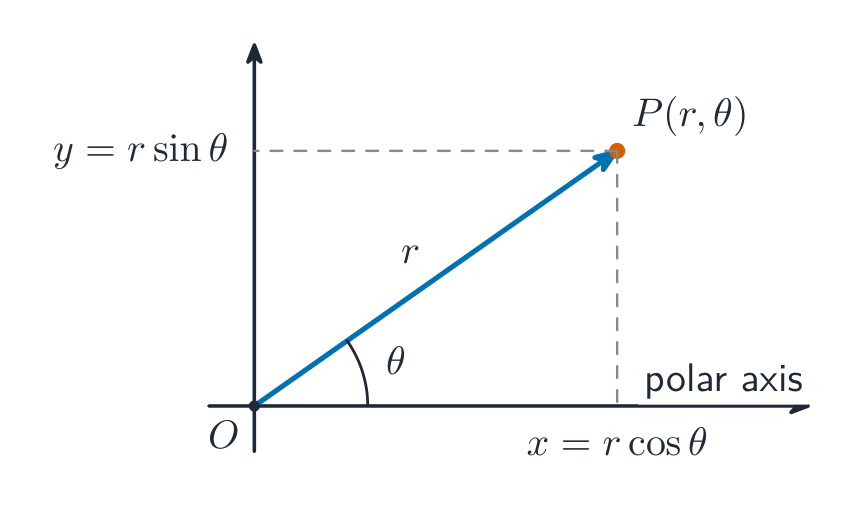
Polar coordinates 极坐标 locate a point by a signed radius r and an angle $\theta$, measured from the positive x-axis. A positive radius moves along that ray; a negative radius moves in the opposite direction. The distance from the origin is $|r|$. The pole 极点 is the origin of the polar coordinate system.
Cartesian 直角坐标 refers to a coordinate system with perpendicular axes. Convert with $x=r\cos\theta$, $y=r\sin\theta$. These formulas also work for negative r.
Worked example: converting points.$(2,\pi/3)$ gives $(1,\sqrt3)$, while $(-2,\pi/6)$ gives $(-\sqrt3,-1)$.
Polar representations are not unique. Adding a full turn leaves a point unchanged, and $(-r,\theta+\pi)$ gives the same point as $(r,\theta)$. To choose a nonnegative radius from x and y, use $r=\sqrt{x^2+y^2}$ and select an angle in the correct quadrant. The point $(-1,\sqrt3)$ has angle $2\pi/3$ in $[0,2\pi)$; $\arctan(y/x)=-\pi/3$ would choose the wrong quadrant. Handle axes without dividing by x; at the pole every angle represents the same point.
Polar coordinates give a point by its distance r and angle theta
For $r=f(\theta)$, use radians and treat the angle as a parameter. With primes denoting angle derivatives,
The tangent slope 切线斜率 is the rate of change of y with x along a curve, where that derivative is finite. Where $x'\ne0$, it is $dy/dx=y'/x'$, not $dr/d\theta$.
Worked example: point and tangent. For $r=2\cos\theta$ at $\pi/4$, $r=\sqrt2$ and $r'=-\sqrt2$. The point is $(1,1)$, and the coordinate rates are $x'=-2$, $y'=0$. Hence the slope is 0 and the tangent is $y=1$, although the radial rate is $-\sqrt2$. At $\pi/2$, the point is the pole with $x'=0$, $y'=-2$, so the tangent is $x=0$.
Regular horizontal and vertical tangents require the complementary coordinate rate to be nonzero. If both vanish, investigate further: for $r=1+\cos\theta$ at $\pi$, $x'=y'=0$, so the regular ratio test is inconclusive. A zero radius alone does not cause this; for $r=\theta$ at zero, $x'=1$, $y'=0$ and the tangent is $y=0$.
For the second x-derivative, differentiate the slope in the angle and divide by $x'$ again:
Here $x''=(r''-r)\cos\theta-2r'\sin\theta$ and $y''=(r''-r)\sin\theta+2r'\cos\theta$. For $r=2$ at $\pi/4$, the slope is $-\cot\theta$, whose angle derivative is 2 at that point. Dividing by $x'=-\sqrt2$ gives $d^2y/dx^2=-\sqrt2$, consistent with the upper circle being concave down.
Try it. For $r=3\sin\theta$ at $\pi/6$, find the Cartesian point, coordinate rates and tangent line.
Answer. Here $r=3/2$, $r'=3\sqrt3/2$ and $(x,y)=(3\sqrt3/4,3/4)$. The rates are $x'=3/2$, $y'=3\sqrt3/2$, so the slope is $\sqrt3$ and the tangent is $y-3/4=\sqrt3(x-3\sqrt3/4)$.
探索
Signed radius, Cartesian point and tangent
For r=2 cos θ at θ=π/4, compare the radial rate with the horizontal tangent. Then examine negative radii, a vertical tangent and a both-zero case.
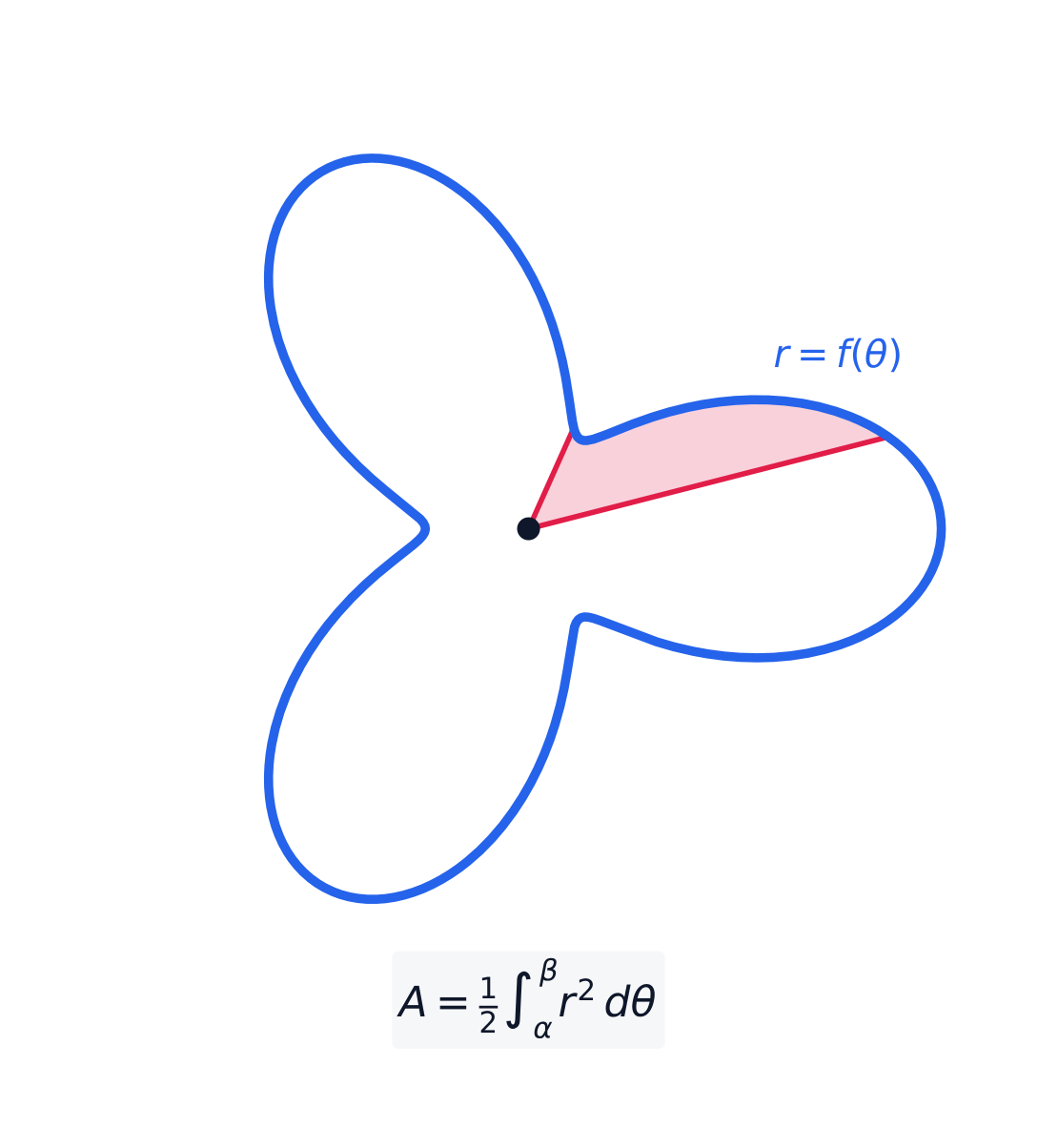
A sector 扇形 is a circular region bounded by two radii and the arc joining their endpoints. Its area is $R^2\Delta\theta/2$ for a radian angle $\Delta\theta$. Thin sectors lead to the sweep integral
The integrand is nonnegative even for negative r. It gives geometric area when the radial sweep covers the intended region once; repeated coverage is counted repeatedly. Use ordered radian bounds, the complete squared radius and square units.
A petal 花瓣 is a loop of a rose curve 玫瑰线 from the pole back to the pole. Find its start and end angles, rather than automatically integrating through a full turn.
Worked example. Find the area of one petal of the rose curve$r=2\sin(2\theta)$ (traced for $\theta$ from $0$ to $\tfrac{\pi}{2}$). Using $\sin^2 u=\tfrac12(1-\cos 2u)$,
Symmetry 对称性 is a property in which a shape matches itself after a reflection or rotation. This rose has three equal petals, giving total area $\pi/4$. It is traced once on $[0,\pi]$; the integral on $[0,2\pi]$ is $\pi/2$ because it counts the rose twice. Likewise, $r=2\cos\theta$ traces its circle once on $[0,\pi]$, with area $\pi$, and twice on $[0,2\pi]$.
The shaded region is a fan of thin sectors swept from $\alpha$ to $\beta$; each has area $\tfrac12 r^2\,d\theta$, so the total is $\tfrac12\int_\alpha^\beta r^2\,d\theta$.
Try it. Find the full area and upper-half area for $r=2+2\cos\theta$.
Answer. Use $[0,2\pi]$ for the full cardioid. Expanding its square gives
On $[0,\pi]$, r is nonnegative and y is nonnegative, so this interval sweeps the upper half once. Reflection symmetry gives upper-half area $3\pi$. All radii are twice those of $r=1+\cos\theta$, so the full area is four times $3\pi/2$, not twice it.
探索
A polar region and its sweep integral
For r=cos 3θ, the bounds −π/6 to π/6 give one petal with area π/12. Compare a full rose and repeated coverage.
An outer polar radius 外极径 is the nonnegative distance to the farther boundary on a common ray. An inner polar radius 内极径 is the nonnegative distance to the nearer boundary on that ray. For a radial band with $r_{\mathrm{out}}\ge r_{\mathrm{in}}\ge0$, subtract the sectors:
Square each radius before subtracting; this is not $(r_{\mathrm{out}}-r_{\mathrm{in}})^2/2$. Use common physical rays and nonnegative distances, rather than comparing signed parameters at unrelated angles.
An intersection 交点 is a point shared by two curves. Equating radii at the same angle finds candidates; also check the pole and other parameter representations.
Bounds can come from given rays or a full turn. The concentric circles $r=2$ and $r=1$ never cross, yet their ring has area $\tfrac12\int_0^{2\pi}(4-1)\,d\theta=3\pi$.
Area inside r = 3cos θ and outside r = 1 + cos θ: outer radius squared minus inner radius squared
Worked example: the pictured region. For $r_A=3\cos\theta$ and $r_B=1+\cos\theta$, common nonnegative crossing radii satisfy $\cos\theta=1/2$, giving angles $\pm\pi/3$ and radius $3/2$. Both curves also reach the pole, but at different parameters: A at $\pi/2$ and B at $\pi$.
Inside A but outside B requires $3\cos\theta\ge1+\cos\theta\ge0$, so keep $[-\pi/3,\pi/3]$. The area is
Where A is nearer than B, that requested radial band is empty. Taking an absolute difference there would add the opposite region, inside B but outside A. Do not use an absolute value to repair bounds chosen for a different request.
Worked example: switching outer boundary. For the band between $r_A=1+\cos\theta$ and $r_B=1$ on $[0,2\pi]$, split at $\pi/2$ and $3\pi/2$. A is outer on the first and last intervals; B is outer in the middle. Let
The two A-outer pieces total $2+\pi/4$; the middle B-outer area is $2-\pi/4$. Their sum is 4 square units, while the unsplit signed integral of f is only $\pi/2$. For this band, integrate $|f|$, or reverse the subtraction on the middle interval.
For inside both radial regions, use the smaller nonnegative reach and integrate $\tfrac12\min(r_A,r_B)^2$. For the concentric circles 2 and 1, the common disk has area $\pi$, rather than the ring area $3\pi$.
Try it. Find the area inside $r=3$, outside $r=1$, between the rays $\pi/6$ and $5\pi/6$.
Answer. The given rays supply the limits. The angle span is $2\pi/3$, so the area is $\tfrac12(9-1)(2\pi/3)=8\pi/3$ square units. No intersection calculation is needed for these concentric circles.
探索
Two boundaries, one requested region
For A=3 cos θ and B=1+cos θ, bounds −π/3 to π/3 give area π. Compare omitted rays, an annulus and a band whose outer boundary switches.
For parametric curves, $\tfrac{dy}{dx}=\tfrac{dy/dt}{dx/dt}$ where $dx/dt\ne0$; speed is $\sqrt{(dx/dt)^2+(dy/dt)^2}$.
A vector-valued function carries the same information — differentiate/integrate it component by component.
In polar, distance is $|r|$; convert with $x=r\cos\theta$, $y=r\sin\theta$. The slope ratio needs $dx/d\theta\ne0$, and geometric area needs a once-only radial sweep.
Watch the direction of tracing using both coordinate rates and set correct $\theta$-limits for polar area.
Eliminate the parameter to recover the ordinary $y$-vs-$x$ shape when it helps.