You have a toolbox — now choose the tool
- By now you own power, constant-multiple, sum/difference, product, quotient, chain, and elementary derivative rules.
- The exam skill is picking the right rule fast, and combining rules in the correct order.
- A messy-looking derivative is usually easy once you see its structure.
- This lesson is a decision guide for reading that structure.
Read the outermost structure first
- Ask: at the very top level, is this a sum, a product, a quotient, or a composition?
- Sum/difference → differentiate term by term.
- Product → product rule; quotient → quotient rule.
- Composition (function inside function) → chain rule, peeling outer to inner.
阅读结构,选择规则
y = a / (x − b)
曲线源自乘积、商还是复合运算决定了使用哪个规则进行求导——首先阅读顶层结构。
$y=x^2\sin x$ 在顶层需要哪种规则?
难度 1/5 · 今日首次完成可获 100 金币及少量额外奖励
它是 $x^2$ 与 $\sin x$ 的乘积 → 乘积法则。
$\dfrac{\sin x}{x^2}$ 的顶层结构是一个...
难度 1/5 · 今日首次完成可获 100 金币及少量额外奖励
它是 $\sin x$ 除以 $x^2$ —— 一个商(或重写为 $x^{-2}\sin x$)。
将每个函数与其所需的顶层规则匹配。
难度 2/5 · 今日首次完成可获 140 金币及少量额外奖励
阅读最外层运算:逐项、乘积、商或复合。
Combine rules in the right order
- Real functions nest rules: a product whose factors are composites, a quotient with a chain inside.
- Work outside-in: apply the top-level rule first, then handle each sub-piece with its own rule.
- $\dfrac{d}{dx}\big[x^2\sin(3x)\big]$: product rule first, and the $\sin(3x)$ factor needs the chain rule → $2x\sin(3x)+x^2\cos(3x)\cdot3$.
- Keep sub-derivatives in labeled boxes so nothing gets dropped.
先简化 $\dfrac{x^2+x}{x}$,再求导。导数是什么?
难度 2/5 · 今日首次完成可获 140 金币及少量额外奖励
$\frac{x^2+x}{x}=x+1$,因此导数为 $1$ —— 不需要商法则。
对于嵌套函数,从____层向内应用规则。
难度 1/5 · 今日首次完成可获 100 金币及少量额外奖励
先处理最外层结构,然后逐个处理每个子部分。
Simplify smart, then sanity-check
- Before diving in, ask if algebra makes it easier: expand a small product, or split a fraction into terms.
- $\dfrac{x^2+x}{x}=x+1$, so its derivative is just $1$ — no quotient rule needed.
- After differentiating, check for reasonableness: right number of terms, signs sensible, units plausible.
- Choosing well up front beats grinding through the hardest rule by reflex.
求导后,检查答案的合理性(项数、符号)是好习惯。
难度 1/5 · 今日首次完成可获 100 金币及少量额外奖励
快速 sanity check 可以发现许多错误。
Match the rule to the top-level structure, not to the first symbol you see. $\dfrac{\sin x}{x^2}$ is a quotient (use the quotient rule or rewrite as $x^{-2}\sin x$ for the product rule) — it is not just "the derivative of $\sin$." Misreading the structure sends you down the wrong rule entirely.
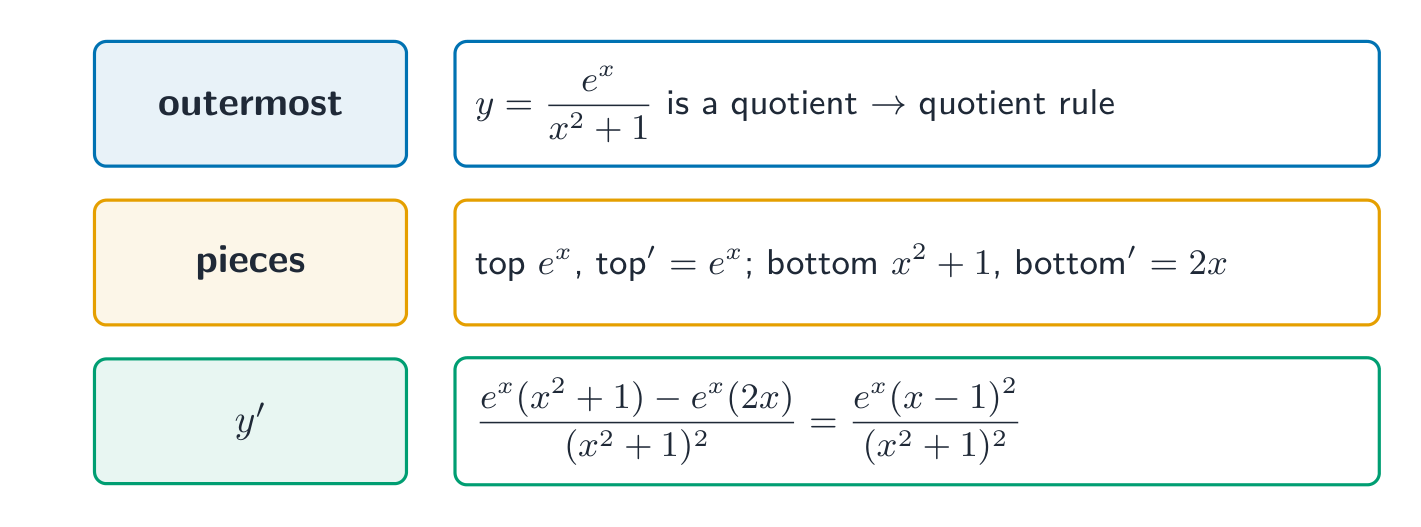
Differentiate $y=\dfrac{e^{x}}{x^2+1}$.
- Top level is a quotient: $f=e^x$, $g=x^2+1$.
- $f'=e^x$, $g'=2x$ (the $g'$ is a simple power-rule sub-step).
- $y'=\dfrac{e^x(x^2+1)-e^x(2x)}{(x^2+1)^2}=\dfrac{e^x(x^2-2x+1)}{(x^2+1)^2}$.
Selecting a procedure: read the top-level structure — sum, product, quotient, or composition — and apply that rule first, then handle each sub-piece with its own rule, working outside-in. Simplify with algebra when it's cheaper, and check the result for reasonableness.