| English | 释义 | 拼音 |
|---|---|---|
| flowchart/ˈfləʊtʃɑːt/ | 流程图 | liú chéng tú |
| procedure/prəˈsiːdʒə/ | 步骤 | bù zhòu |
A limit is a "which tool?" puzzle
- You now have several ways to find a limit. The skill is picking the right one fast: heavy algebra where substitution works wastes time, and guessing at $\tfrac00$ loses marks.
- This lesson is the flowchart 流程图 that joins the earlier tools.
Step 1: substitute, then read the result
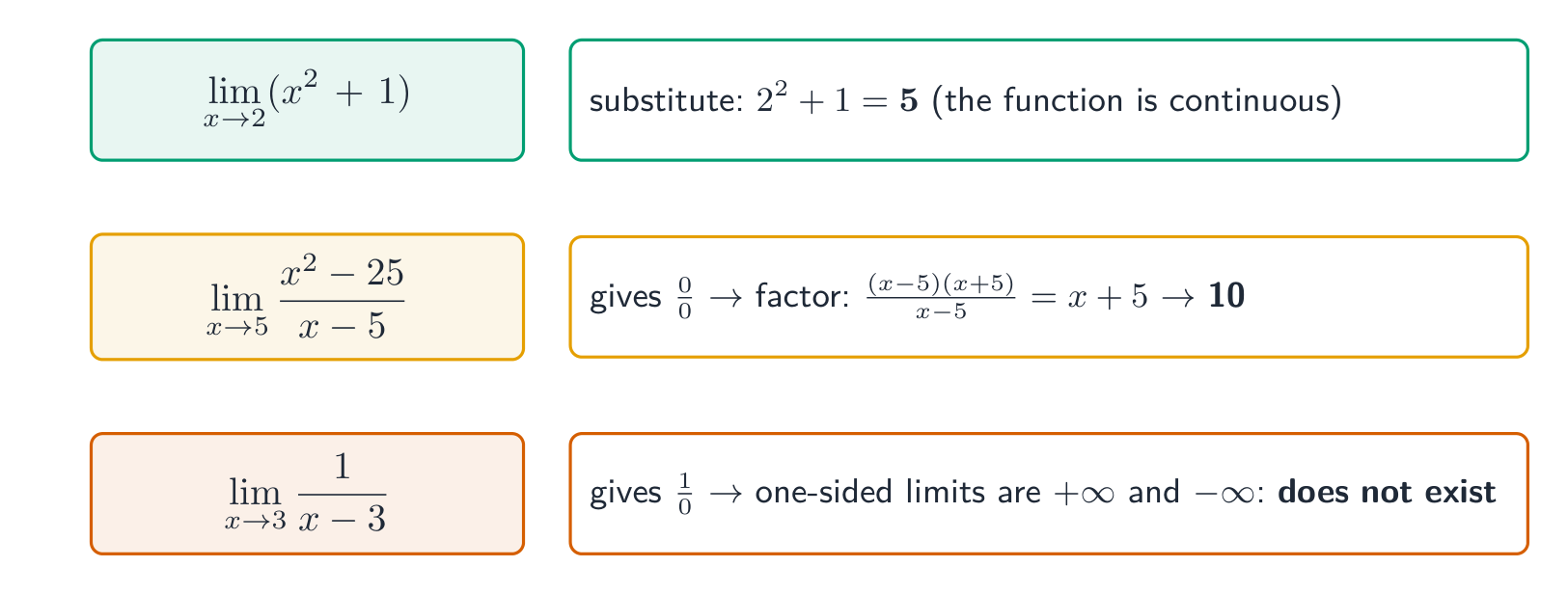
- A real number: that is the limit (the function is continuous there). $\tfrac00$: indeterminate, go to Step 2.
- Nonzero over 0 (like $\tfrac40$): a vertical asymptote. The one-sided limits are $\pm\infty$; check the sign on each side. No algebra will help.
The first procedure to attempt on almost any limit is direct ____.
难度 1/5 · 今日首次完成可获 100 金币及少量额外奖励
It is fastest when it works and tells you which branch to take when it does not.
Step 2: match the $\tfrac00$ form to a technique
- Polynomials top and bottom → factor and cancel. A square root → multiply by the conjugate. Fractions inside a fraction → combine over a common denominator.
- Trig → rewrite toward $\dfrac{\sin x}{x}\to1$. Oscillating or piecewise → the Squeeze Theorem (1.8) or one-sided limits.
The top of (x² − 9)/(x − 3)
y = ax² + bx + c
This is the numerator $x^2-9$. It is $0$ at $x=3$, where the denominator $x-3$ is also $0$: substitution gives $frac00$, so factor and cancel. Slide $c$ and the numerator is no longer $0$ at $3$, which gives $frac{n}{0}$ (a blow-up) instead.
Direct substitution into $\lim_{x\to 4}\dfrac{x-4}{x^2-16}$ gives $\tfrac00$. What next?
难度 1/5 · 今日首次完成可获 100 金币及少量额外奖励
Polynomial over polynomial, both zero at $4$ → factor: $\frac{x-4}{(x-4)(x+4)}=\frac{1}{x+4}\to\frac18$.
Select 所有 correct method-to-form matches.
难度 2/5 · 今日首次完成可获 140 金币及少量额外奖励
The first three match. Nonzero over zero is an asymptote, not something factoring resolves.
Choose a method for each, then evaluate.
- $\displaystyle\lim_{x\to 5}\dfrac{x^2-25}{x-5}$: $\tfrac00$, polynomials → factor: $x+5\to10$.
- $\displaystyle\lim_{x\to 9}\dfrac{\sqrt x-3}{x-9}$: $\tfrac00$, a root → conjugate: $\dfrac{1}{\sqrt x+3}\to\dfrac16$.
- $\displaystyle\lim_{x\to 0}\dfrac{\sin 4x}{2x}$: $\tfrac00$, trig → $2\cdot\dfrac{\sin4x}{4x}\to2$.
Evaluate $\displaystyle\lim_{x\to 5}\dfrac{x^2-25}{x-5}$.
难度 2/5 · 今日首次完成可获 140 金币及少量额外奖励
$\tfrac00$ → factor: $x+5 \to 10$.
查找 $\displaystyle\lim_{x\to4}\dfrac{\sqrt x-2}{x-4}$. Give a decimal.
难度 2/5 · 今日首次完成可获 140 金币及少量额外奖励
Substitution gives $\tfrac00$ with a root, so use the conjugate: $\dfrac{(\sqrt x-2)(\sqrt x+2)}{(x-4)(\sqrt x+2)}=\dfrac{1}{\sqrt x+2}\to\dfrac14$.
Nonzero over zero. Find $\displaystyle\lim_{x\to3}\dfrac{x+1}{x-3}$.
- Substitution gives $\tfrac40$: an asymptote, not algebra.
- $x\to3^+$: the bottom is small and positive, so $\to+\infty$. $x\to3^-$: small and negative, so $\to-\infty$. The sides differ: the two-sided limit does not exist.
Substitution into $\lim_{x\to 3}\dfrac{x+1}{x-3}$ gives $\dfrac{4}{0}$. This signals...
难度 1/5 · 今日首次完成可获 100 金币及少量额外奖励
Nonzero over zero blows up; factoring cannot help. The two-sided limit is DNE (one side $+\infty$, other $-\infty$).
What is $\displaystyle\lim_{x\to2^-}\dfrac{3}{x-2}$?
难度 1/5 · 今日首次完成可获 100 金币及少量额外奖励
Substitution gives $\tfrac30$: an asymptote. For $x$ just below 2, $x-2$ is a small negative number, so $\tfrac{3}{x-2}\to-\infty$.
Step 3: justify and sanity-check
- Say why the method is valid: "the function is continuous at 2", or "cancelling is valid for $x\neq5$".
- Check the answer against a quick table value or the graph's shape.
- $\tfrac00$ means simplify. $\tfrac50$ means asymptote. Don't factor a $\tfrac50$, and don't call a $\tfrac00$ DNE.
- Don't write "$=\tfrac00$" as a step in your answer. Write the limit of the rewritten expression instead.
$\tfrac00$ and $\tfrac{5}{0}$ should be handled the same way.
难度 1/5 · 今日首次完成可获 100 金币及少量额外奖励
$\tfrac00$ is indeterminate (simplify); $\tfrac{5}{0}$ blows up (asymptote). Different situations, different responses.
Substitute first. A number is the answer; $\tfrac00$ means simplify (factor, conjugate, combine, trig limit, squeeze); $\tfrac{\text{nonzero}}{0}$ means an infinite limit, so check each side's sign. Then justify the method.