这个主题更深入地看消费者、成本和企业。
价格体系与微观经济(A Level)
A-Level 经济学 · 第 7 主题
 18:50
18:50
The price system and the microeconomy (A Level)
Look at these shoppers. Each has a limited budget, and every extra thing they buy gives a little less pleasure than the last. Now a huge steel plant: it makes…
英文讲解 · 内嵌中英文字幕
7.1
效用

大纲
- explain total and marginal utility and the law of diminishing marginal utility
- derive the equi-marginal principle and explain how it relates to the demand curve, including the limitations of the marginal utility approach
来源:剑桥国际大纲
效用(utility)是一个消费者从一个物品得到的满足。
- 总效用(total utility)是从所有被消费的单位得到的满足。
- 边际效用(marginal utility)是从多一单位得到的额外满足。
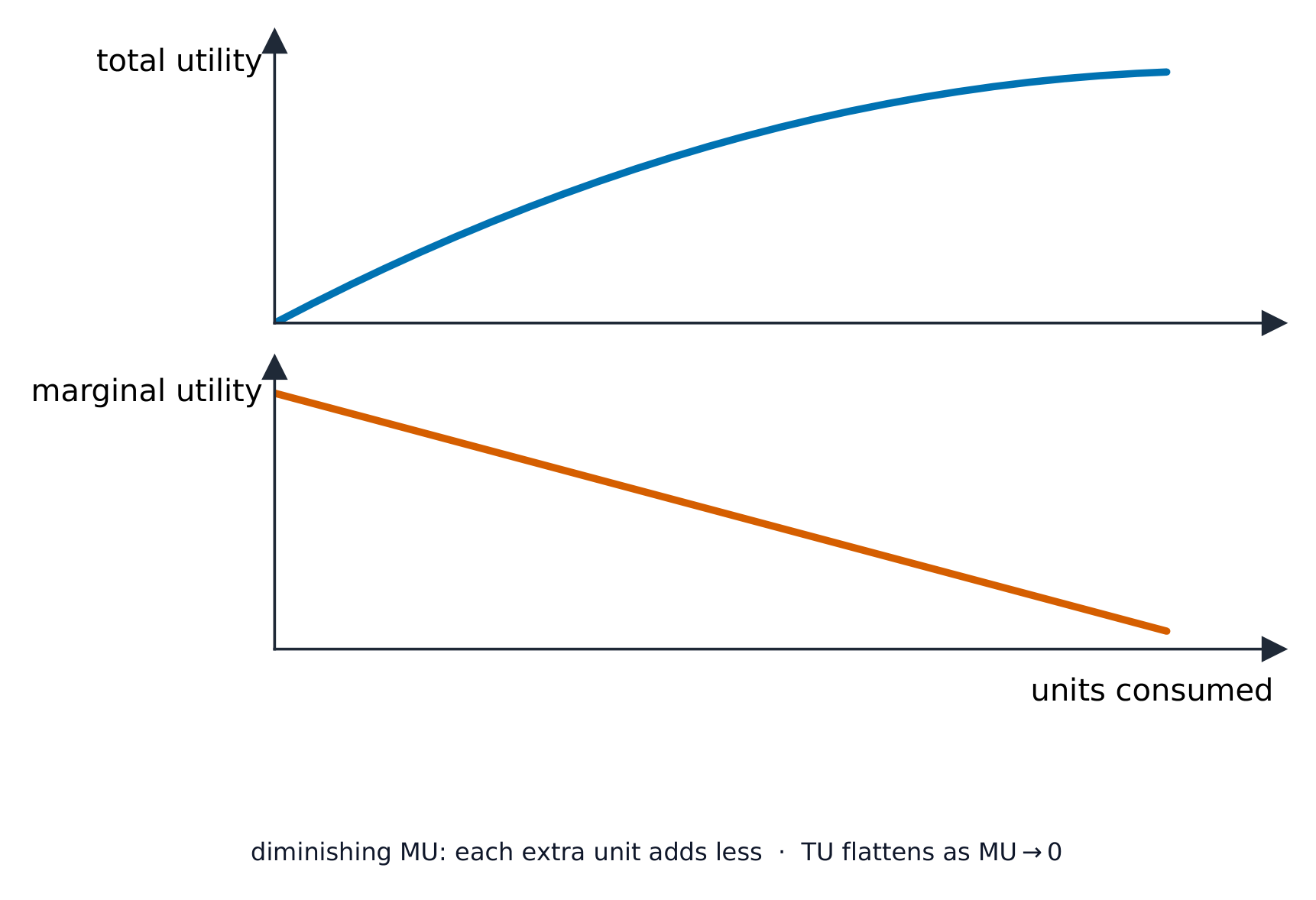
边际效用递减(diminishing marginal utility)定律说每额外一单位给出更少的额外满足。总效用仍上升,但越来越慢。
The equi-marginal principle
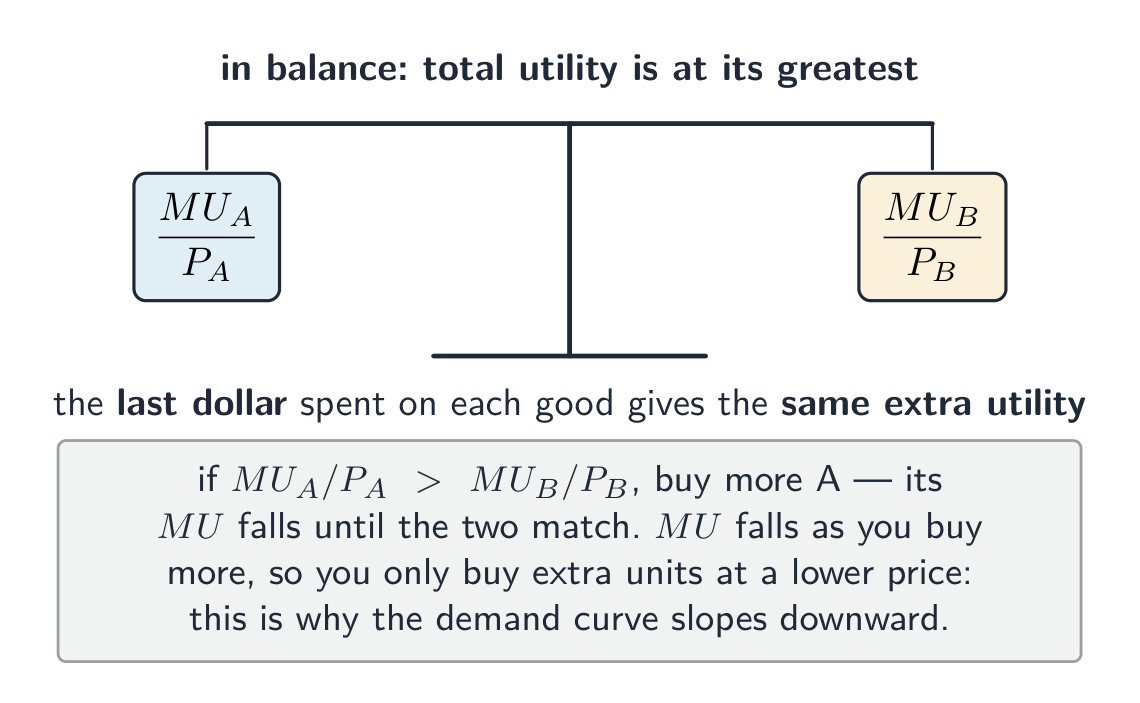
一个有固定预算的消费者在花在每个物品上的最后一元给出同样的额外效用时得到最多的总效用。这是等边际原则(equi-marginal principle):
$$\frac{MU_A}{P_A} = \frac{MU_B}{P_B}$$
因为边际效用随你买更多而下降,你只在价格下降时买额外的单位。这就是为什么需求曲线(demand curve)向下倾斜。
Limitations
这个方法在实践中难以使用:效用不能真的用数字测量,而人们不这样计算。它也忽略习惯和广告。
探索
Diminishing marginal utility lab
total utility rises more slowly as quantity increases
Add units consumed and see why extra satisfaction usually falls.
词汇表
训练
| 英文 | 中文 | 拼音 |
|---|---|---|
| utility/juːˈtɪlɪti/ | 效用 | xiào yòng |
| total utility/ˈtəʊtl juːˈtɪlɪti/ | 总效用 | zǒng xiào yòng |
| marginal utility/ˈmɑːdʒɪnl juːˈtɪlɪti/ | 边际效用 | biān jì xiào yòng |
| diminishing marginal utility/dɪˈmɪnɪʃɪŋ ˈmɑːdʒɪnl juːˈtɪlɪti/ | 边际效用递减 | biān jì xiào yòng dì jiǎn |
| equi-marginal principle/ˈekwi ˈmɑːdʒɪnl ˈprɪnsɪpl/ | 等边际原则 | děng biān jì yuán zé |
| demand curve/dɪˈmænd kɜːv/ | 需求曲线 | xū qiú qū xiàn |
7.2
无差异曲线与预算线

大纲
- explain indifference curves and budget lines and consumer equilibrium
- explain income and substitution effects for normal, inferior and Giffen goods
来源:剑桥国际大纲
一条无差异曲线(indifference curve)显示给一个消费者同样总效用的两种物品的所有组合。它向下倾斜(一个物品更多意味着另一个更少)并朝原点向内凸出。
一条预算线(budget line)显示消费者用他们的收入、在当前价格能刚好负担的所有组合。
消费者均衡(consumer equilibrium)是消费者能做到的最好的:预算线刚好触到可能最高的无差异曲线的那个点。
Income and substitution effects
当一个物品的价格下降时,消费者出于两个原因买更多:
- 替代效应(substitution effect)——这个物品现在比其他的便宜,所以消费者转向它。
- 收入效应(income effect)——消费者的钱现在买得更多,所以实际收入上升了。
这些效应对不同的物品有不同的作用:
- 对一个正常品(normal good),两个效应都提高购买的数量。
- 对一个低档品(inferior good),收入效应反过来作用(更高的实际收入降低需求),但它通常更弱,所以当价格下降时需求仍上升。
- 一个吉芬品(Giffen good)是一个罕见的、非常低档的物品,收入效应如此强,以至于当价格下降时需求实际上下降。它的需求曲线向上倾斜。
探索
Budget line lab
good B = income / priceB - slope x good A
Move quantity of one good and see the trade-off with the other good.
词汇表
训练
| 英文 | 中文 | 拼音 |
|---|---|---|
| indifference curve/ɪnˈdɪfrəns kɜːv/ | 无差异曲线 | wú chā yì qū xiàn |
| budget line/ˈbʌdʒɪt laɪn/ | 预算线 | yù suàn xiàn |
| consumer equilibrium/kənˈsuːmə ˌiːkwɪˈlɪbrɪəm/ | 消费者均衡 | xiāo fèi zhě jūn héng |
| substitution effect/ˌsʌbstɪˈtjuːʃn ɪˈfekt/ | 替代效应 | tì dài xiào yìng |
| income effect/ˈɪŋkʌm ɪˈfekt/ | 收入效应 | shōu rù xiào yìng |
| normal good/ˈnɔːml ɡʊd/ | 正常品 | zhèng cháng pǐn |
| inferior good/ɪnˈfɪərɪə ɡʊd/ | 低档品 | dī dàng pǐn |
| Giffen good/ˈdʒɪfən ɡʊd/ | 吉芬品 | jí fēn pǐn |
7.3
效率与市场失灵

大纲
- explain productive and allocative efficiency, Pareto optimality and dynamic efficiency
- explain market failure, including from monopoly, externalities, public goods, information failure and factor immobility
来源:剑桥国际大纲
经济学家判断资源被用得多好。
- 生产效率(productive efficiency)——以可能最低的成本制造物品(用最少的资源)。
- 配置效率(allocative efficiency)——制造人们最想要的物品,在价格等于边际成本的地方。
- 帕累托最优(Pareto optimality)——一个点,在那里没有人能在不使别人变差的情况下变好。
- 动态效率(dynamic efficiency)——随时间通过新技术和更好的产品改进。
市场失灵(market failure)在自由市场不能到达一个高效结果时发生。主要的原因是垄断势力、外部性(externalities)、公共物品(public goods)、信息失灵(information failure),以及要素不流动性(factor immobility,要素不能快速移动到它们被需要的地方)。
探索
Allocative efficiency
The market is allocatively efficient where supply meets demand — price equals marginal cost. Market failure pushes it away from that point.
词汇表
训练
| 英文 | 中文 | 拼音 |
|---|---|---|
| productive efficiency/prəˈdʌktɪv ɪˈfɪʃənsi/ | 生产效率 | shēng chǎn xiào lǜ |
| allocative efficiency/ˈæləkətɪv ɪˈfɪʃənsi/ | 配置效率 | pèi zhì xiào lǜ |
| Pareto optimality/pæˈriːtəʊ ˌɒptɪˈmælɪti/ | 帕累托最优 | pà lèi tuō zuì yōu |
| dynamic efficiency/daɪˈnæmɪk ɪˈfɪʃənsi/ | 动态效率 | dòng tài xiào lǜ |
| market failure/ˈmɑːkɪt ˈfeɪlɪə/ | 市场失灵 | shì chǎng shī líng |
| public good/ˈpʌblɪk ɡʊd/ | 公共物品 | gōng gòng wù pǐn |
| information failure/ˌɪnfəˈmeɪʃn ˈfeɪlɪə/ | 信息失灵 | xìn xī shī líng |
| factor immobility/ˈfæktə ɪˌməʊˈbɪlɪti/ | 要素不流动性 | yào sù bù liú dòng xìng |
7.4
私人成本与收益、外部性与社会成本与收益

大纲
- distinguish private, external and social costs and benefits
- analyse positive and negative externalities of production and consumption using marginal analysis and explain deadweight welfare loss
来源:剑桥国际大纲
一些成本和收益落在交易之外的人身上。我们分开三个层次:
- 一个私人成本(private cost)或私人收益(private benefit)落在买者或卖者身上。
- 一个外部成本(external cost)或外部收益(external benefit)落在一个第三方身上。
- 社会成本(social cost)是私人成本加外部成本;社会收益(social benefit)是私人收益加外部收益。
Marginal analysis
我们用边际分析(marginal analysis)研究外部性,用这些曲线:
- 边际私人成本(marginal private cost,MPC)和边际社会成本(marginal social cost,MSC)。
- 边际私人收益(marginal private benefit,MPB)和边际社会收益(marginal social benefit,MSB)。
对社会最好的结果是 MSC = MSB 的地方。但市场在 MPC = MPB 的地方生产。这些之间的差距创造损失的福利。
- 一个负外部性(negative externality,像污染)意味着 MSC 在 MPC 之上。市场制造太多。
- 一个正外部性(positive externality,像教育)意味着 MSB 在 MPB 之上。市场制造太少。
来自制造太多或太少的损失福利是无谓损失(deadweight welfare loss)——图上社会曲线和私人曲线之间的三角形。
探索
Externalities shift the social curve
A negative externality means the social cost is above the private supply curve; the free-market quantity is then too high.
词汇表
训练
| 英文 | 中文 | 拼音 |
|---|---|---|
| externality/ekˈstɜːnælɪti/ | 外部性 | wài bù xìng |
| private cost/ˈpraɪvət kɒst/ | 私人成本 | sī rén chéng běn |
| private benefit/ˈpraɪvət ˈbenɪfɪt/ | 私人收益 | sī rén shōu yì |
| external cost/ekˈstɜːnl kɒst/ | 外部成本 | wài bù chéng běn |
| external benefit/ekˈstɜːnl ˈbenɪfɪt/ | 外部收益 | wài bù shōu yì |
| social cost/ˈsəʊʃl kɒst/ | 社会成本 | shè huì chéng běn |
| social benefit/ˈsəʊʃl ˈbenɪfɪt/ | 社会收益 | shè huì shōu yì |
| marginal analysis/ˈmɑːdʒɪnl əˈnæləsɪs/ | 边际分析 | biān jì fēn xī |
| marginal private cost/ˈmɑːdʒɪnl ˈpraɪvət kɒst/ | 边际私人成本 | biān jì sī rén chéng běn |
| marginal social cost/ˈmɑːdʒɪnl ˈsəʊʃl kɒst/ | 边际社会成本 | biān jì shè huì chéng běn |
| marginal private benefit/ˈmɑːdʒɪnl ˈpraɪvət ˈbenɪfɪt/ | 边际私人收益 | biān jì sī rén shōu yì |
| marginal social benefit/ˈmɑːdʒɪnl ˈsəʊʃl ˈbenɪfɪt/ | 边际社会收益 | biān jì shè huì shōu yì |
| negative externality/ˈneɡətɪv ekˈstɜːnælɪti/ | 负外部性 | fù wài bù xìng |
| positive externality/ˈpɒzɪtɪv ekˈstɜːnælɪti/ | 正外部性 | zhèng wài bù xìng |
| deadweight welfare loss/ˈdedweɪt ˈwelfeə lɒs/ | 无谓损失 | wú wèi sǔn shī |
7.5
成本、收益与利润的类型,短期与长期生产

大纲
- explain fixed, variable, total, average and marginal cost and short-run and long-run production (law of diminishing returns, returns to scale)
- explain total, average and marginal revenue and normal, supernormal (abnormal) and subnormal profit
来源:剑桥国际大纲
Costs
在短期(short run),至少一个要素是固定的;在长期(long run),所有要素都能改变。
| 成本 | 意义 |
|---|---|
| 固定成本(fixed cost) | 不随产出改变(一个工厂的租金) |
| 可变成本(variable cost) | 随产出改变(原材料) |
| 总成本(total cost) | 固定成本加可变成本 |
| 平均成本(average cost) | 每单位的总成本:$AC = TC / Q$ |
| 边际成本(marginal cost) | 多一单位的成本:$MC = \Delta TC / \Delta Q$ |
例题。 制造 $10$ 单位总共花 £500;制造 $11$ 单位花 £540。求 $10$ 单位的平均成本和第 11 单位的边际成本。
$$AC = \frac{TC}{Q} = \frac{500}{10} = \text{\pounds} 50, \qquad MC = \frac{\Delta TC}{\Delta Q} = \frac{540 - 500}{11 - 10} = \text{\pounds} 40.$$
这里 $MC$($\text{\pounds} 40$)在 $AC$($\text{\pounds} 50$)之下,所以制造第 11 单位把平均成本拉低——每当边际成本在平均成本之下时,平均成本下降。
在短期,产出被边际报酬递减(diminishing returns)定律限制:随着你把更多的一个可变要素(工人)加到一个固定要素(机器)上,每个额外的工人最终增加更少的产出。这使边际成本上升。

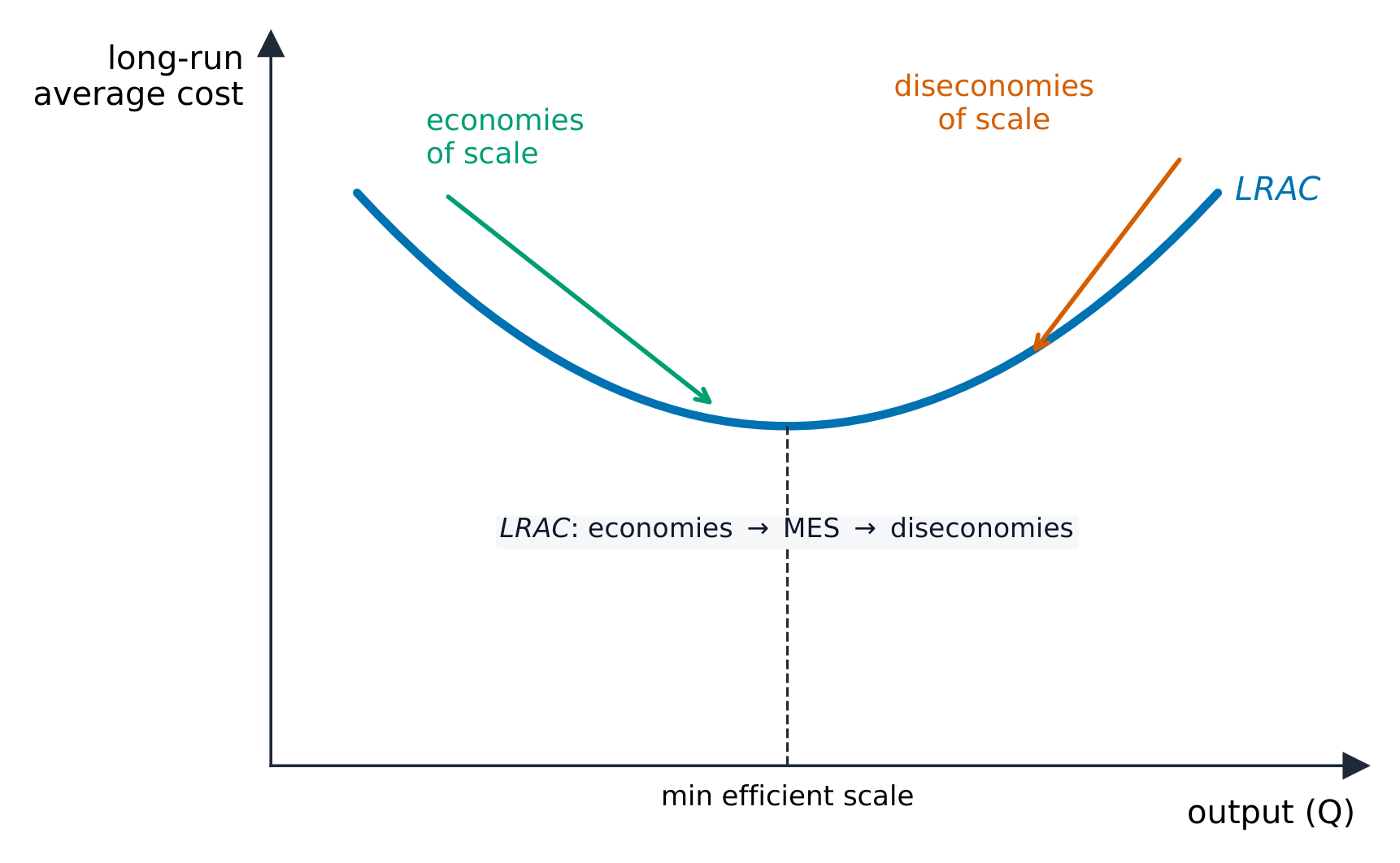
在长期,所有要素都变化,所以我们看规模报酬(returns to scale)。随着一个企业增长,它能获得规模经济(economies of scale,来自大批购买、使用大机器和专业化的更低平均成本)。若它增长得太大,它可能遭受规模不经济(diseconomies of scale,糟糕的沟通和控制),而平均成本上升。
Revenue
| 收益 | 意义 |
|---|---|
| 总收益(total revenue) | 来自销售的所有钱:$TR = P \times Q$ |
| 平均收益(average revenue) | 每单位的收益,它等于价格 |
| 边际收益(marginal revenue) | 来自多一单位的收益:$MR = \Delta TR / \Delta Q$ |
例题。 一个企业以每个 £50 卖 $10$ 单位。要卖第 11 单位它必须把每个单位的价格降到 £48。求每个产出的总收益和第 11 单位的边际收益。
$$TR_{10} = 50 \times 10 = \text{\pounds} 500, \qquad TR_{11} = 48 \times 11 = \text{\pounds} 528, \qquad MR = \frac{528 - 500}{1} = \text{\pounds} 28.$$
边际收益($\text{\pounds} 28$)远在 £48 的价格之下,因为更低的价格适用于所有 $11$ 单位,而不只是额外的那个。
Profit
利润是总收益减总成本。经济学家把所有者资源的机会成本包括在成本中,所以:
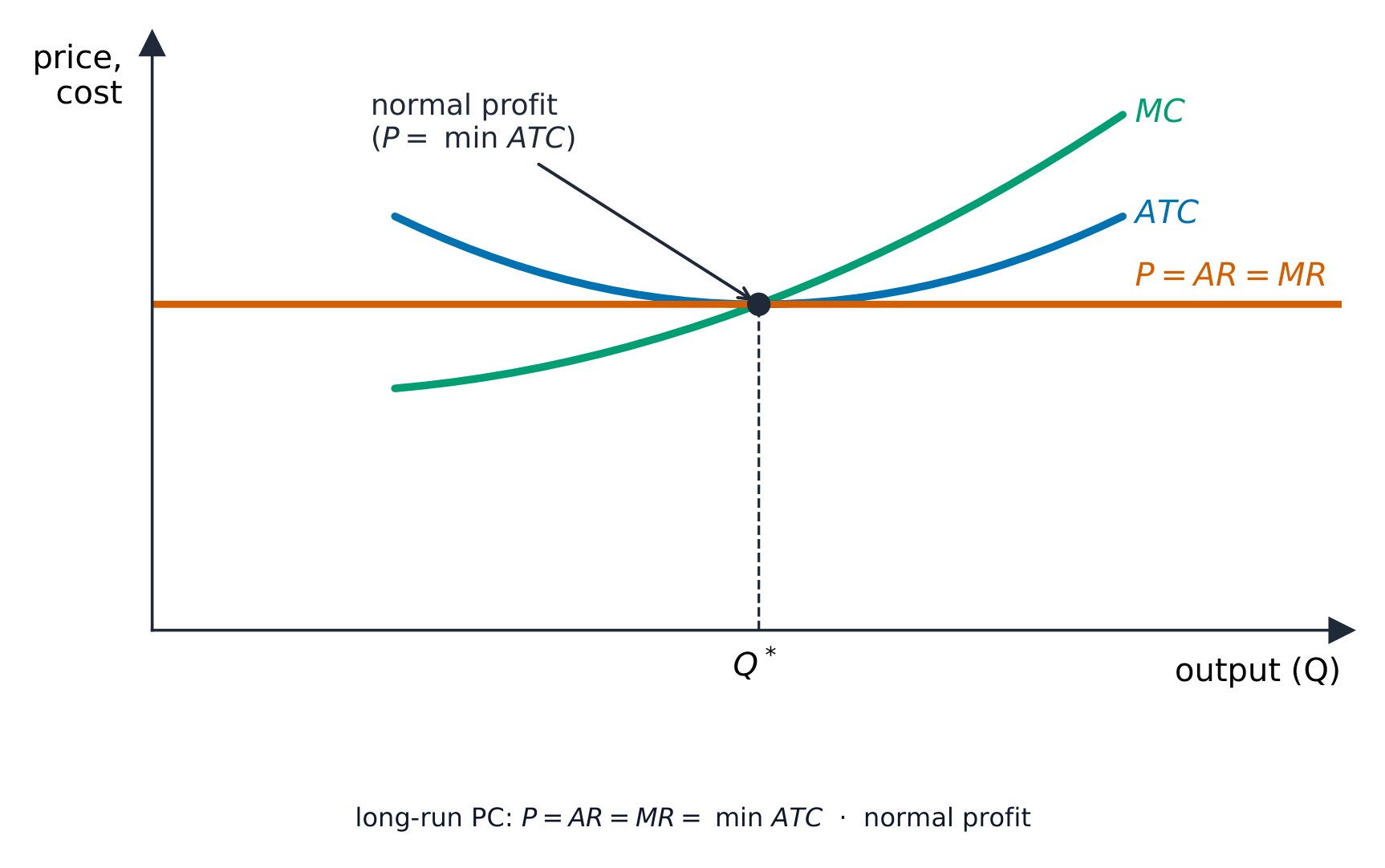
- 正常利润(normal profit)是刚好足以把企业保留在行业中的利润。它算作一个成本。
- 超常利润(supernormal profit,也叫非正常利润)是高于正常的利润。
- 次正常利润(subnormal profit)是低于正常的利润——企业可能在长期离开。
一个企业在 $MR = MC$ 的产出制造最多的利润。
例题。 在它的最佳产出,一个企业制造 $100$ 单位、每个卖 £12(它的平均收益),而有一个 £9 的平均成本。求超常利润。
$$\text{profit} = (AR - AC) \times Q = (12 - 9) \times 100 = \text{\pounds} 300.$$
因为平均收益(£12)在平均成本(£9)之上,企业挣得超常利润。若相反 $AR = AC$,它只会制造正常利润;若 $AR < AC$,它会亏损。
探索
Revenue & profit
y = ax² + bx + c
Total revenue rises then falls as price changes.
探索
Costs and the firm
Average cost is U-shaped; marginal cost cuts it at the minimum. Different market structures price relative to these curves.
探索
Average and marginal cost
Change output. Marginal cost cuts average cost at its lowest point — the heart of the theory of the firm.
词汇表
训练
| 英文 | 中文 | 拼音 |
|---|---|---|
| short run/ʃɔːt rʌn/ | 短期 | duǎn qī |
| long run/lɒŋ rʌn/ | 长期 | cháng qī |
| fixed cost/fɪkst kɒst/ | 固定成本 | gù dìng chéng běn |
| variable cost/ˈveərɪəbl kɒst/ | 可变成本 | kě biàn chéng běn |
| total cost/ˈtəʊtl kɒst/ | 总成本 | zǒng chéng běn |
| average cost/ˈævrɪdʒ kɒst/ | 平均成本 | píng jūn chéng běn |
| marginal cost/ˈmɑːdʒɪnl kɒst/ | 边际成本 | biān jì chéng běn |
| diminishing returns/dɪˈmɪnɪʃɪŋ rɪˈtɜːnz/ | 边际报酬递减 | biān jì bào chóu dì jiǎn |
| returns to scale/rɪˈtɜːnz tə skeɪl/ | 规模报酬 | guī mó bào chóu |
| economies of scale/ɪˈkɒnəmiz ɒv skeɪl/ | 规模经济 | guī mó jīng jì |
| diseconomies of scale/ˌdɪsɪˈkɒnəmiz ɒv skeɪl/ | 规模不经济 | guī mó bù jīng jì |
| total revenue/ˈtəʊtl ˈrevənjuː/ | 总收益 | zǒng shōu yì |
| average revenue/ˈævrɪdʒ ˈrevənjuː/ | 平均收益 | píng jūn shōu yì |
| marginal revenue/ˈmɑːdʒɪnl ˈrevənjuː/ | 边际收益 | biān jì shōu yì |
| normal profit/ˈnɔːml ˈprɒfɪt/ | 正常利润 | zhèng cháng lì rùn |
| supernormal profit/ˈsuːpənɔːml ˈprɒfɪt/ | 超常利润 | chāo cháng lì rùn |
| subnormal profit/ˈsʌbnɔːml ˈprɒfɪt/ | 次正常利润 | cì zhèng cháng lì rùn |
7.6
不同的市场结构

大纲
- explain the assumptions, behaviour and outcomes of perfect competition, monopolistic competition, oligopoly and monopoly
- explain price and non-price competition, collusion, price discrimination and the efficiency of each market structure
来源:剑桥国际大纲
一个市场结构(market structure)按企业的数目、进入壁垒和产品的类型来描述一个市场。
| 结构 | 企业 | 壁垒 | 产品 | 长期利润 |
|---|---|---|---|---|
| 完全竞争(perfect competition) | 非常多 | 无 | 相同 | 只有正常 |
| 垄断竞争(monopolistic competition) | 许多 | 低 | 稍微不同 | 正常 |
| 寡头垄断(oligopoly) | 少数 | 高 | 各异 | 常常超常 |
| 垄断(monopoly) | 一个 | 非常高 | 独特 | 超常 |
- 在完全竞争中,每个企业是一个微小的价格接受者(price taker)——它必须接受市场价格。企业在长期只制造正常利润,而市场既生产高效又配置高效。
- 在垄断竞争中,许多企业卖稍微不同的产品(产品差异化(product differentiation)),所以每个有一点定价权力,但自由进入把利润竞争掉。
- 在一个寡头垄断中,少数大企业主导。它们密切观察彼此。它们可能在价格上激烈竞争,或它们可能同意固定价格——这是合谋(collusion),而一个这样做的群是一个卡特尔(cartel)。
- 一个垄断是一个被高进入壁垒(barriers to entry)保护的单一卖者。它能长时间挣得超常利润,但通常低效。

Price and non-price competition
- 价格竞争(price competition)意味着削减价格以赢得顾客。
- 非价格竞争(non-price competition)意味着以其他方式竞争——广告、质量、品牌和服务。
Price discrimination
价格歧视(price discrimination)是对同样的物品向不同的消费者收取不同的价格(例如,给学生更便宜的火车票)。它需要定价权力、有不同弹性的群,以及一种阻止群之间转售的方式。它提高企业的利润。
探索
Pricing and competition
How a firm prices depends on demand and supply; with market power it can charge above the competitive level.
词汇表
训练
| 英文 | 中文 | 拼音 |
|---|---|---|
| market structure/ˈmɑːkɪt ˈstrʌktʃə/ | 市场结构 | shì chǎng jié gòu |
| perfect competition/ˈpɜːfekt ˌkɒmpəˈtɪʃn/ | 完全竞争 | wán quán jìng zhēng |
| monopolistic competition/məˈnɒpəlɪstɪk ˌkɒmpəˈtɪʃn/ | 垄断竞争 | lǒng duàn jìng zhēng |
| oligopoly/ˌɒlɪˈɡɒpəli/ | 寡头垄断 | guǎ tóu lǒng duàn |
| monopoly/məˈnɒpəli/ | 垄断 | lǒng duàn |
| price taker/praɪs ˈteɪkə/ | 价格接受者 | jià gé jiē shòu zhě |
| product differentiation/ˈprɒdʌkt ˌdɪfəˌrenʃɪˈeɪʃn/ | 产品差异化 | chǎn pǐn chā yì huà |
| collusion/kəˈluːʒn/ | 合谋 | hé móu |
| cartel/kɑːˈtel/ | 卡特尔 | kǎ tè ěr |
| barriers to entry/ˈbærɪəz tʊ ˈentri/ | 进入壁垒 | jìn rù bì lěi |
| price competition/praɪs ˌkɒmpəˈtɪʃn/ | 价格竞争 | jià gé jìng zhēng |
| non-price competition/nɒn praɪs ˌkɒmpəˈtɪʃn/ | 非价格竞争 | fēi jià gé jìng zhēng |
| price discrimination/praɪs dɪˌskrɪmɪˈneɪʃn/ | 价格歧视 | jià gé qí shì |
7.7
企业的成长与生存

大纲
- explain why firms grow (internal and external — horizontal, vertical, conglomerate integration) and why some remain small
- explain barriers to entry and exit and the survival of small firms
来源:剑桥国际大纲
企业以两种方式增长:
- 内部增长(internal growth,有机)——通过卖更多变得更大。
- 外部增长(external growth)——通过一次合并(merger)或收购与另一个企业结合。类型:
- 横向一体化(horizontal integration)——与同一行业同一阶段的一个企业结合(两个汽车制造商)。
- 纵向一体化(vertical integration)——与一个不同阶段的企业结合(一个汽车制造商买一个轮胎制造商)。
- 混合一体化(conglomerate integration)——与一个不同行业的企业结合,以分散风险。
Why some firms stay small
许多企业保持小,因为市场小(本地服务)、所有者想保持控制,或有很少的规模经济。它们通过提供个人服务或填补一个利基市场(niche)来存活。
企业也面对进入壁垒和退出壁垒(barriers to exit,如不能被出售的昂贵机器)。高的退出壁垒能把一个企业困在一个亏损的市场中。
探索
Firm objective lab
Classify real firm decisions by the objective they reveal.
词汇表
训练
| 英文 | 中文 | 拼音 |
|---|---|---|
| internal growth/ɪnˈtɜːnl ɡrəʊθ/ | 内部增长 | nèi bù zēng zhǎng |
| external growth/ekˈstɜːnl ɡrəʊθ/ | 外部增长 | wài bù zēng zhǎng |
| merger/ˈmɜːdʒə/ | 合并 | hé bìng |
| horizontal integration/ˌhɒrɪˈzɒntl ˌɪntɪˈɡreɪʃn/ | 横向一体化 | héng xiàng yī tǐ huà |
| vertical integration/ˈvɜːtɪkl ˌɪntɪˈɡreɪʃn/ | 纵向一体化 | zòng xiàng yī tǐ huà |
| conglomerate integration/kənˈɡlɒməreɪt ˌɪntɪˈɡreɪʃn/ | 混合一体化 | hùn hé yī tǐ huà |
| niche/niːʃ/ | 利基市场 | lì jī shì chǎng |
| barriers to exit/ˈbærɪəz tʊ ˈeɡzɪt/ | 退出壁垒 | tuì chū bì lěi |
7.8
企业不同的目标与策略
大纲
- explain alternative objectives of firms: profit maximisation, revenue maximisation, sales maximisation, satisficing
- explain the divorce of ownership from control (principal–agent problem) and its consequences
来源:剑桥国际大纲
不是每个企业都只追逐最多的利润。
- 利润最大化(profit maximisation)——在 MR = MC 的地方生产。传统的目标。
- 收益最大化(revenue maximisation)——在 MR = 0 的地方生产,或许为了增长市场份额。
- 销售最大化(sales maximisation)——在仍制造正常利润的同时尽可能多地卖。
- 满意化(satisficing)——瞄准"足够好"的结果,使所有者、工人和顾客都相当满意。
Divorce of ownership from control
在大公司中,所有者(股东)不是管理者。这种所有权与控制权分离(divorce of ownership from control)创造委托代理问题(principal-agent problem):管理者(代理人)可能追求他们自己的目标——更大的薪水或更轻松的生活——而不是所有者最大利润的目标。
探索
Firm objective lab
Classify real firm decisions by the objective they reveal.
词汇表
训练
| 英文 | 中文 | 拼音 |
|---|---|---|
| profit maximisation/ˈprɒfɪt ˌmæksɪmaɪˈzeɪʃn/ | 利润最大化 | lì rùn zuì dà huà |
| revenue maximisation/ˈrevənjuː ˌmæksɪmaɪˈzeɪʃn/ | 收益最大化 | shōu yì zuì dà huà |
| sales maximisation/seɪlz ˌmæksɪmaɪˈzeɪʃn/ | 销售最大化 | xiāo shòu zuì dà huà |
| satisficing/ˈsætɪsfɪsɪŋ/ | 满意化 | mǎn yì huà |
| divorce of ownership from control/dɪˈvɔːs ɒv ˈəʊnəʃɪp frɒm kənˈtrəʊl/ | 所有权与控制权分离 | suǒ yǒu quán yǔ kòng zhì quán fēn lí |
| principal-agent problem/ˈprɪnsɪpl ˈeɪdʒənt ˈprɒbləm/ | 委托代理问题 | wěi tuō dài lǐ wèn tí |
7.8
考试技巧
- 计算 AC、MC、TR 和 MR,并记住一个企业在 $MR = MC$ 的地方使利润最大化。
- 按企业的数目、壁垒和定价权力区分市场结构(完全竞争、垄断竞争、寡头垄断、垄断)。
- 区分正常与超常利润并把长期进入和退出与它联系起来。
- 在一个成本图上,注意 MC 在 AC 的最小值切 AC。
本主题的互动课程
逐步学习,并即时检测练习。