Market structures · 市场结构
| English | 中文 | Pinyin · 拼音 |
|---|---|---|
| market structure/ˈmɑːkɪt ˈstrʌktʃə/ | 市场结构 | shì chǎng jié gòu |
| perfect competition/ˈpɜːfekt ˌkɒmpəˈtɪʃn/ | 完全竞争 | wán quán jìng zhēng |
| price-taker/praɪs ˈteɪkə/ | 价格接受者 | jià gé jiē shòu zhě |
| monopoly/məˈnɒpəli/ | 垄断 | lǒng duàn |
| oligopoly/ˌɒlɪˈɡɒpəli/ | 寡头垄断 | guǎ tóu lǒng duàn |
| monopolistic competition/məˈnɒpəlɪstɪk ˌkɒmpəˈtɪʃn/ | 垄断竞争 | lǒng duàn jìng zhēng |
| differentiated/ˌdɪfəˈrenʃɪeɪtɪd/ | 差异化的 | chā yì huà de |
| barriers to entry/ˈbærɪəz tʊ ˈentri/ | 进入壁垒 | jìn rù bì lěi |
A spectrum of competition
- At one extreme, thousands of identical wheat farmers, none able to budge the price. At the other, a single water company. Most industries sit between.
- Market structure 市场结构 — how many firms, how much power — shapes price, output and profit.
一个竞争的光谱
- 在一个极端,成千上万个相同的小麦农民,没有一个能撼动价格。在另一个极端,一家单一的自来水公司。大多数产业坐落在两者之间。
- 市场结构(market structure)——多少企业、多少力量——塑造价格、产出和利润。
In perfect competition, each firm is a: · 在完全竞争中,每个企业是一个:
With many firms and an identical product, each must accept the market price. · 有许多企业和一个相同的产品时,每个都必须接受市场价格。
A firm that must accept the market price, unable to influence it, is a price-. · 一个必须接受市场价格、无法影响它的企业是一个价格。
Perfectly competitive firms are price-takers. · 完全竞争的企业是价格接受者。
Perfect competition 完全竞争
- Perfect competition: many small firms, an identical product, free entry, perfect information.
- Each firm is a price-taker 价格接受者: it faces a horizontal demand at the market price (P = MR = AR).
In long-run perfect competition the price line is tangent to AC at its minimum — only normal profit.
完全竞争
- 完全竞争(perfect competition):许多小企业、一个相同的产品、自由进入、完美信息。
- 每个企业是一个价格接受者(price-taker):它在市场价格面对一条水平需求(P = MR = AR)。
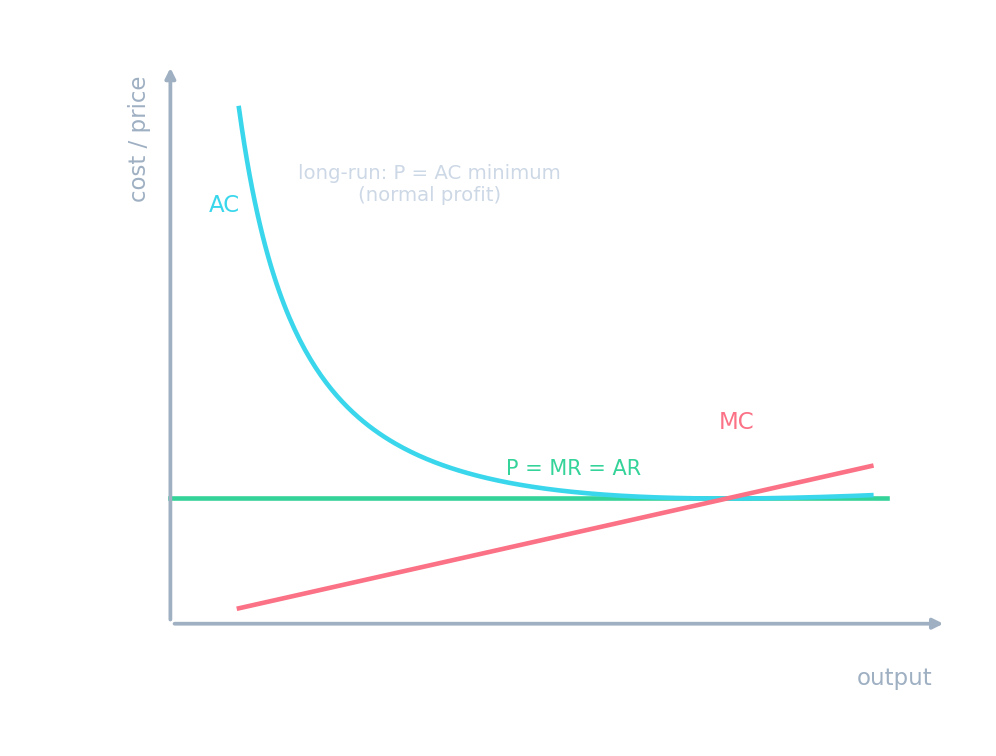
在长期完全竞争中,价格线在 AC 的最低点与其相切——只有正常利润。
Costs and the firm · 成本与企业
Average cost is U-shaped; marginal cost cuts it at the minimum. Different market structures price relative to these curves. · 平均成本是 U 形的;边际成本在最低点切过它。不同的市场结构相对于这些曲线定价。
Match each market structure to its key feature. · 把每个市场结构与它的关键特征配对。
Number of firms and product differentiation define the structure. · 企业数量和产品差异化定义结构。
The other structures
- Monopoly 垄断: one dominant firm, high barriers, price-maker (supernormal profit possible).
- Oligopoly 寡头垄断: a few large firms, interdependent (they watch each other), often non-price competition.
- Monopolistic competition 垄断竞争: many firms, differentiated 差异化的 products (branding) — normal profit in the long run.
Market structures form a spectrum, from perfect competition through to monopoly
其他结构
- 垄断(monopoly):一个占主导的企业、高壁垒、价格制定者(可能有超常利润)。
- 寡头垄断(oligopoly):几个大企业、相互依赖(它们互相观察),常常是非价格竞争。
- 垄断竞争(monopolistic competition):许多企业、差异化的产品(品牌)——长期是正常利润。

市场结构形成一个光谱,从完全竞争一直到垄断
In long-run perfect competition, firms earn only normal profit. · 在长期完全竞争中,企业只赚正常利润。
Free entry competes away any supernormal profit until P = AC at its minimum. · 自由进入把任何超常利润竞争掉,直到 P = AC 在它的最低点。
Which is a barrier to entry that protects market power? · 哪个是一个保护市场力量的进入壁垒?
Patents (and scale, brands, high start-up costs) keep rivals out. · 专利(以及规模、品牌、高启动成本)把竞争对手挡在外面。
Barriers to entry 进入壁垒
- What protects market power: economies of scale, patents, brand loyalty, high start-up costs, control of a resource.
- The higher the barriers, the closer to monopoly — and the more supernormal profit can persist.
Long-run profits depend on entry. Where entry is free (perfect/monopolistic competition), supernormal profit is competed away to normal. Where barriers are high (monopoly), it can persist.
进入壁垒
- 什么保护市场力量:规模经济、专利、品牌忠诚、高启动成本、对一种资源的控制。
- 壁垒越高,越接近垄断——超常利润就越能持续。
长期利润取决于进入。 在进入自由之处(完全/垄断竞争),超常利润被竞争掉到正常。在壁垒高之处(垄断),它能持续。
You've got it
- perfect competition: many firms, identical product, price-takers → normal profit long-run
- monopoly (one firm), oligopoly (few, interdependent), monopolistic competition (many, differentiated)
- barriers to entry (scale, patents, brands) let supernormal profit persist
你掌握了
- 完全竞争:许多企业、相同产品、价格接受者 → 长期正常利润
- 垄断(一个企业)、寡头垄断(几个、相互依赖)、垄断竞争(许多、差异化)
- 进入壁垒(规模、专利、品牌)让超常利润持续