| English | 释义 | 拼音 |
|---|---|---|
| monopoly/məˈnɒpəli/ | 垄断 | lǒng duàn |
| price discrimination/praɪs dɪˌskrɪmɪˈneɪʃn/ | 价格歧视 | jià gé qí shì |
| consumer surplus/kənˈsuːmə ˈsɜːpləs/ | 消费者剩余 | xiāo fèi zhě shèng yú |
| market power/ˈmɑːkɪt ˈpaʊə/ | 市场势力 | shì chǎng shì lì |
| allocatively inefficient/ˈæləkətɪvli ɪnɪˈfɪʃənt/ | 配置无效率 | pèi zhì wú xiào lǜ |
Cheaper tickets for students
- On China's railways, full-time students can buy discounted tickets during holidays, while other travellers pay full price for the same seat on the same train. Cinemas, museums and airlines do the same. Why would a seller charge two prices for one product?
- Because a seller with market power can earn more by charging each group what it is willing to pay. This lesson explains how a monopoly 垄断 sets price and output, and when price discrimination 价格歧视 is possible.
How a monopolist chooses price and output
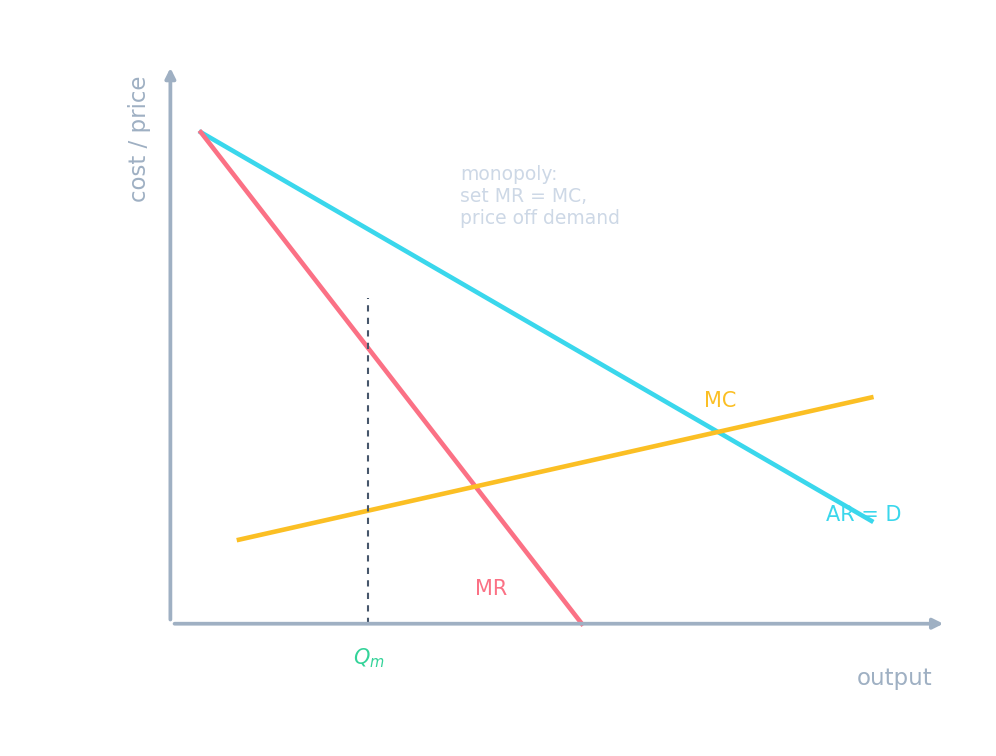
- A monopolist faces the whole market demand curve, so to sell more it must lower its price: MR lies below AR. It produces where MR = MC, then charges the highest price the demand (AR) curve allows at that output.
- Compared with perfect competition, the result is a higher price and lower output.
定价与竞争
How a firm prices depends on demand and supply; with market power it can charge above the competitive level.
How does a monopolist choose its price?
难度 1/5 · 今日首次完成可获 100 金币及少量额外奖励
Output from MR = MC, price from AR.
Price discrimination
- Charging different buyers different prices for the same good, not because of cost differences, lets the seller turn consumer surplus 消费者剩余 into profit.
- Three conditions: market power 市场势力; the ability to separate groups with different price elasticities (students show an ID card); and no resale between groups (tickets carry names).
Which conditions are needed for price discrimination?
难度 2/5 · 今日首次完成可获 140 金币及少量额外奖励
Groups must have different elasticities.
Worked example: a monopolist's profit
At the output where MR = MC, a monopolist sells 100 units. The demand curve shows buyers will pay £8 at that output, and average cost there is £5.
Total revenue = 8 × 100 = £800. Total cost = 5 × 100 = £500. Supernormal profit = (8 − 5) × 100 = £300.
Because barriers to entry keep rivals out, this profit can last into the long run.
A monopolist sells 200 units at £10 each; average cost is £6. What is its supernormal profit (in £)?
难度 2/5 · 今日首次完成可获 140 金币及少量额外奖励
(10 − 6) × 200 = 800.
Costs and benefits of monopoly
| Costs | Benefits |
|---|---|
| higher prices and lower output | economies of scale may lower average cost |
| allocatively inefficient 配置无效率 (P > MC), with a deadweight loss | supernormal profit can fund research and innovation |
| little pressure to cut costs | price discrimination can let some poorer groups buy (students) |
Price discrimination is not charging more because something costs more. A first-class seat costs more to provide; a student discount on the same seat is discrimination.
Charging more for a first-class seat than a standard seat is always price discrimination.
难度 1/5 · 今日首次完成可获 100 金币及少量额外奖励
If the price difference reflects a cost difference, it is not discrimination.
A monopolist produces where MR = MC and prices from the demand curve, giving a higher price, lower output and P > MC. Price discrimination needs market power, separable groups and no resale; it turns consumer surplus into profit. Monopoly can cost consumers but may bring economies of scale and innovation.
Practice (evaluation). Assess whether price discrimination by a railway company benefits consumers. Write one point for and one point against, and a judgement.
Weigh both groups.