Utility · 效用
| English | 中文 | Pinyin · 拼音 |
|---|---|---|
| diminishing marginal utility/dɪˈmɪnɪʃɪŋ ˈmɑːdʒɪnl juːˈtɪlɪti/ | 边际效用递减 | biān jì xiào yòng dì jiǎn |
| marginal utility/ˈmɑːdʒɪnl juːˈtɪlɪti/ | 边际效用 | biān jì xiào yòng |
| utility/juːˈtɪlɪti/ | 效用 | xiào yòng |
| total utility/ˈtəʊtl juːˈtɪlɪti/ | 总效用 | zǒng xiào yòng |
| equi-marginal principle/ˈekwi ˈmɑːdʒɪnl ˈprɪnsɪpl/ | 等边际原则 | děng biān jì yuán zé |
Why the second ice cream is never as good
- The first ice cream on a hot day is bliss; the second is nice; the fourth makes you queasy. Each extra one adds less satisfaction.
- That pattern — diminishing marginal utility 边际效用递减 — quietly explains the downward-sloping demand curve.
为什么第二个冰淇淋从不一样好
- 炎热一天的第一个冰淇淋是极乐;第二个不错;第四个让你恶心。每个额外的都增加更少的满足。
- 那个模式——边际效用递减(diminishing marginal utility)——悄悄解释了向下倾斜的需求曲线。
Diminishing marginal utility lab · 边际效用递减实验室
total utility rises more slowly as quantity increases · 随着数量增加,总效用的增长速度变慢
Add units consumed and see why extra satisfaction usually falls. · 累加消费量,理解额外满足感通常会下降的原因。
Total and marginal utility 边际效用
- Utility 效用 is the satisfaction from consuming a good.
- Total utility 总效用 (TU) is the overall satisfaction; marginal utility (MU) is the extra utility from one more unit.
- $MU$ = the change in $TU$ from the next unit.
Worked example. If total utility from 2, 3 ice creams is 18 then 24, the marginal utility of the third is 24 − 18 = 6.
Total utility rises while marginal utility falls
总效用与边际效用
- 效用(utility)是消费一种商品得来的满足。
- 总效用(total utility,TU)是整体的满足;边际效用(marginal utility,MU)是来自多一个单位的额外效用。
- $MU$ = 下一个单位带来的 $TU$ 的变化。
例题。 如果来自 2、3 个冰淇淋的总效用是 18 然后 24,那么第三个的边际效用是 24 − 18 = 6。
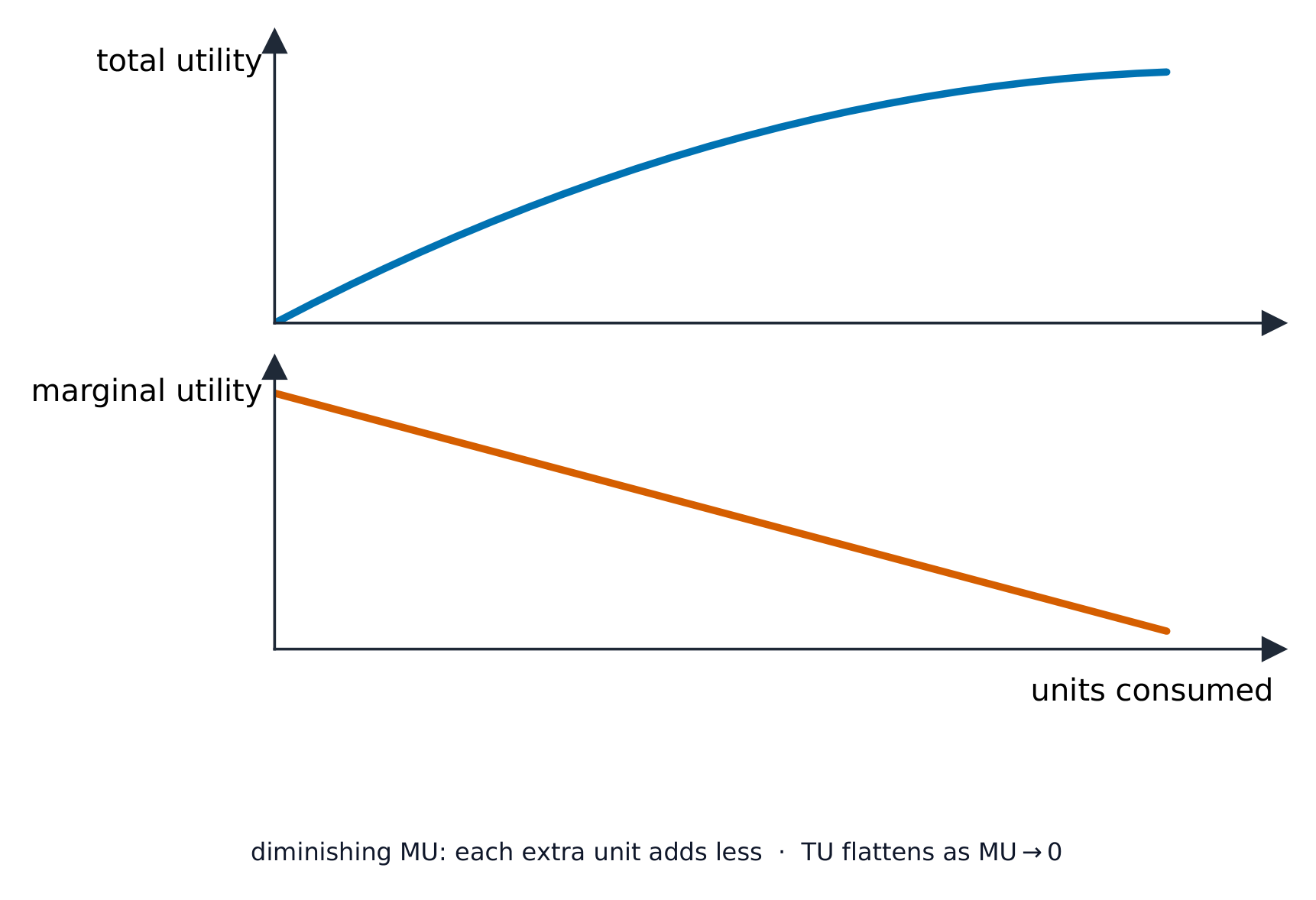
总效用上升而边际效用下降
Total utility from 2 then 3 ice creams is 18 then 24. What is the marginal utility of the 3rd? · 来自 2 的总效用为 3 个冰淇淋是 18 ,然后 24。第 3个的边际效用是多少?
MU = change in TU = 24 − 18 = 6. · MU = 总效用变化量 = 24 − 18 = 6。
Marginal utility is the change in ______ utility from one more unit. · 边际效用是指每多消费一单位带来的______效用变化。
MU = ΔTU. · MU = ΔTU。
Diminishing marginal utility
- As you consume more, each extra unit adds less — MU falls.
- That's why you'll only buy more at a lower price — the root of the downward demand curve.
Consumers spend limited income to get the most utility (satisfaction)
边际效用递减
- 随着你消费更多,每个额外单位增加更少——MU 下降。
- 那就是为什么你只会在更低的价格买更多——向下需求曲线的根源。

消费者花有限的收入以获得最多的效用(满足)
Diminishing marginal utility means each extra unit consumed gives: · 边际效用递减意味着每多消费一单位会带来:
MU falls as consumption rises — the basis of the downward demand curve. · 随着消费增加,MU下降——这是需求曲线向下倾斜的基础。
Diminishing marginal utility helps explain why the demand curve slopes: · 边际效用递减有助于解释需求曲线为何呈:
Since extra units are worth less, buyers will only take more at a lower price. · 由于额外单位的价值更低,买家只有在价格更低时才愿意购买更多。
The equi-marginal principle 等边际原则
- To maximise utility on a budget, spend so the utility per dollar is equal across goods:
- If one good gives more utility per dollar, switch spending to it until they balance.
等边际原理
- 要在一个预算上最大化效用,这样花钱使每美元的效用相等于各商品之间:
- 如果一种商品给每美元更多的效用,把支出转向它直到它们平衡。
Utility is maximised when the marginal utility per dollar is equal across all goods. · 当每种商品的每美元边际效用相等时,效用达到最大化。
MU_A/P_A = MU_B/P_B — otherwise you could gain by switching spending. · MU_A/P_A = MU_B/P_B ——否则可以通过调整支出获得收益。
You've got it
- utility = satisfaction; MU = extra utility from one more unit (= ΔTU)
- diminishing marginal utility: each extra unit adds less → downward demand
- maximise with $\dfrac{MU_A}{P_A} = \dfrac{MU_B}{P_B}$ (equal utility per dollar)
你掌握了
- 效用 = 满足;MU = 来自多一个单位的额外效用(= ΔTU)
- 边际效用递减:每个额外单位增加更少 → 向下需求
- 用 $\dfrac{MU_A}{P_A} = \dfrac{MU_B}{P_B}$(每美元相等的效用)最大化