Revenue and profit · 收入与利润
| English | 中文 | Pinyin · 拼音 |
|---|---|---|
| profit/ˈprɒfɪt/ | 利润 | lì rùn |
| marginal revenue/ˈmɑːdʒɪnl ˈrevənjuː/ | 边际收益 | biān jì shōu yì |
| total revenue/ˈtəʊtl ˈrevənjuː/ | 总收益 | zǒng shōu yì |
| average revenue/ˈævrɪdʒ ˈrevənjuː/ | 平均收益 | píng jūn shōu yì |
| normal profit/ˈnɔːml ˈprɒfɪt/ | 正常利润 | zhèng cháng lì rùn |
| supernormal profit/ˈsuːpənɔːml ˈprɒfɪt/ | 超常利润 | chāo cháng lì rùn |
| profit-maximising/ˈprɒfɪt ˈmæksɪmaɪzɪŋ/ | 利润最大化 | lì rùn zuì dà huà |
Revenue isn't profit 利润
- A firm selling a million units can still go bust. What matters isn't how much money comes in, but how much is left after costs.
- Understanding revenue, then subtracting cost, gives profit — and the rule for maximising it.
收入不是利润
- 一个卖一百万单位的企业仍能破产。重要的不是多少钱进来,而是在成本之后剩下多少。
- 理解收入,然后减去成本,给出利润——以及最大化它的规则。
A firm sells 30 units at a price of 5. What is total revenue (TR = P x Q)? · 一个企业以 5 的价格卖 30 单位。总收入(TR = P x Q)是多少?
TR = 5 x 30 = 150. · TR = 5 x 30 = 150。
Average revenue (TR divided by quantity) is the same as the ______. · 平均收入(TR 除以数量)与______相同。
AR = TR/Q = P. · AR = TR/Q = P。
Total, average and marginal revenue 边际收益
- Total revenue 总收益 (TR) = price × quantity.
- Average revenue 平均收益 (AR) = TR ÷ Q = the price.
- Marginal revenue (MR) = the revenue from one more unit.
For a price-maker, AR is the demand curve and MR lies below it; for a price-taker both are horizontal.
Worked example. Sell 30 units at a price of 5. TR = 5 × 30 = 150. If total cost is 100, profit = 150 − 100 = 50.
总收入、平均收入与边际收入
- 总收入(total revenue,TR)= 价格 × 数量。
- 平均收入(average revenue,AR)= TR ÷ Q = 价格。
- 边际收入(marginal revenue,MR)= 多一单位的收入。
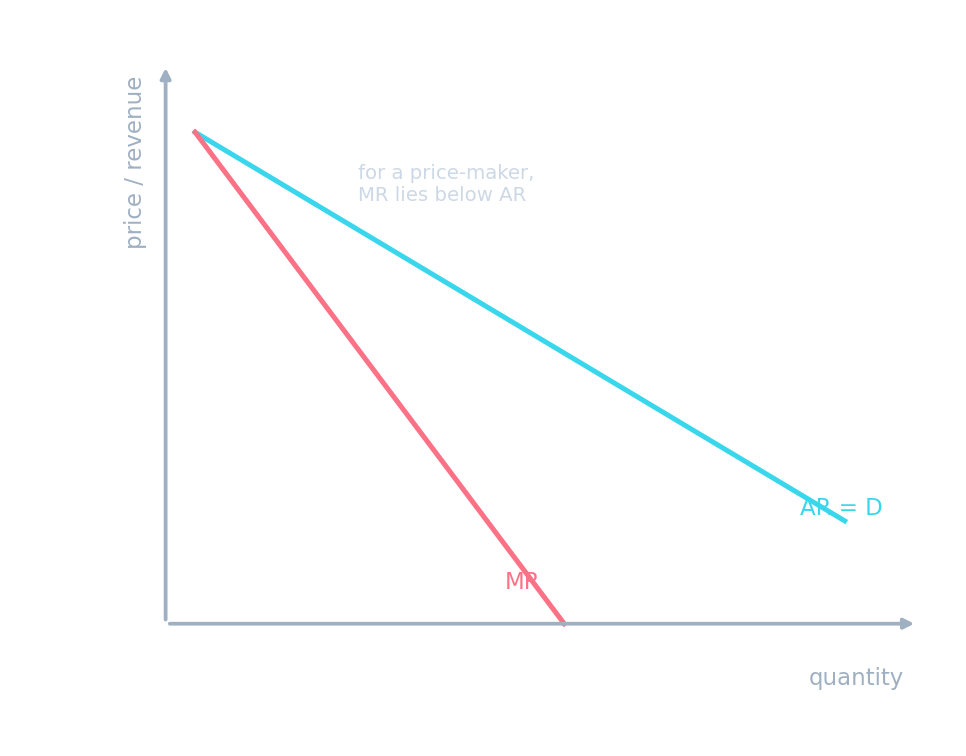
对一个价格制定者,AR 是需求曲线且 MR 位于它之下;对一个价格接受者两者都是水平的。
例题。 以 5 的价格卖 30 单位。TR = 5 × 30 = 150。如果总成本是 100,利润 = 150 − 100 = 50。
Revenue & profit · 收入与利润
y = ax² + bx + c
Total revenue · 总收益 rises then falls as price changes. · 总收入随价格变化先升后降。
Total revenue is 150 and total cost is 100. What is the profit? · 总收入是 150 而总成本是 100。利润是多少?
Profit = TR - TC = 150 - 100 = 50. · 利润 = TR - TC = 150 - 100 = 50。
Normal profit is the minimum needed to keep a firm in the industry. · 正常利润是让一个企业留在产业中所需的最低限度。
It covers opportunity cost; anything above is supernormal profit. · 它涵盖机会成本;之上的任何东西是超常利润。
Profit and its types
- Profit = total revenue − total cost.
- Normal profit 正常利润: just enough to keep the firm in the industry (covers opportunity cost).
- Supernormal (abnormal) profit: anything above normal.
A monopoly maximises profit at MC = MR and earns supernormal profit 超常利润
利润及其类型
- 利润 = 总收入 − 总成本。
- 正常利润(normal profit):刚好足以让企业留在产业中(涵盖机会成本)。
- 超常(非正常)利润(supernormal / abnormal profit):正常之上的任何东西。
A firm maximises profit where: · 一个企业在以下之处最大化利润:
MR = MC: before it each unit adds net profit, beyond it each unit loses money. · MR = MC:在它之前每单位增加净利润,在它之外每单位亏钱。
The profit-maximising 利润最大化 rule
- A firm maximises profit where marginal revenue = marginal cost (MR = MC).
- Before that point, an extra unit adds more revenue than cost (make it); beyond it, the reverse.
利润最大化规则
- 一个企业在边际收入 = 边际成本(MR = MC)之处最大化利润。
- 在那一点之前,一个额外单位增加的收入比成本多(制造它);在它之外,反过来。
You've got it
- TR = P × Q; AR = price; MR = revenue from one more unit
- profit = TR − TC; normal profit keeps the firm in; supernormal is extra
- maximise profit where MR = MC
你掌握了
- TR = P × Q;AR = 价格;MR = 多一单位的收入
- 利润 = TR − TC;正常利润让企业留下;超常是额外的
- 在 MR = MC 之处最大化利润