Costs and production · 成本与生产
| English | 中文 | Pinyin · 拼音 |
|---|---|---|
| variable costs/ˈveərɪəbl kɒsts/ | 可变成本 | kě biàn chéng běn |
| fixed costs/fɪkst kɒsts/ | 固定成本 | gù dìng chéng běn |
| total cost/ˈtəʊtl kɒst/ | 总成本 | zǒng chéng běn |
| average cost/ˈævrɪdʒ kɒst/ | 平均成本 | píng jūn chéng běn |
| marginal cost/ˈmɑːdʒɪnl kɒst/ | 边际成本 | biān jì chéng běn |
| diminishing returns/dɪˈmɪnɪʃɪŋ rɪˈtɜːnz/ | 边际报酬递减 | biān jì bào chóu dì jiǎn |
| economies of scale/ɪˈkɒnəmiz ɒv skeɪl/ | 规模经济 | guī mó jīng jì |
What it really costs to make something
- Run a factory and some bills arrive whether you make one unit or a million (rent); others rise with every unit (materials).
- Splitting costs the right way — and knowing how they change with output — is the foundation of every firm's decisions.
制造某物真正的成本
- 经营一个工厂,有些账单无论你制造一单位还是一百万单位都会到来(租金);其他的随每一单位上升(材料)。
- 用正确的方式拆分成本——并知道它们如何随产出变化——是每个企业决策的基础。
Which is a fixed cost? · 哪个是一项固定成本?
Rent does not change with output; the others vary with how much is produced. · 租金不随产出变化;其他的随生产多少而变化。
Match each cost term to its meaning. · 把每个成本术语与它的含义配对。
FC constant, VC rises, AC = TC/Q, MC = ΔTC. · FC 恒定,VC 上升,AC = TC/Q,MC = ΔTC。
Fixed and variable costs 可变成本
- Fixed costs 固定成本 (FC) don't change with output (rent, insurance).
- Variable costs (VC) rise with output (materials, wages).
- Total cost 总成本 (TC) = FC + VC; average cost 平均成本 (AC) = TC ÷ output; marginal cost 边际成本 (MC) = the cost of one more unit.
Worked example. If total cost is 120 to make 10 units, average cost = 120 ÷ 10 = 12 per unit.
Productive efficiency is lowest cost; allocative is making what people want
固定成本与可变成本
- 固定成本(fixed costs,FC)不随产出变化(租金、保险)。
- 可变成本(variable costs,VC)随产出上升(材料、工资)。
- 总成本(total cost,TC)= FC + VC;平均成本(average cost,AC)= TC ÷ 产出;边际成本(marginal cost,MC)= 多一单位的成本。
例题。 如果制造 10 单位的总成本是 120,平均成本 = 120 ÷ 10 = 每单位 12。
Costs of production · 生产成本
AC is U-shaped; MC cuts it at the minimum · AC 是 U 形的;MC 在最低点切过它
Average cost · 平均成本 falls then rises; marginal cost crosses it exactly at the lowest AC. · 平均成本先降后升;边际成本恰好在最低 AC 处穿过它。
Total cost is 120 to make 10 units. What is the average cost per unit? · 制造 10 单位的总成本是 120。每单位的平均成本是多少?
AC = TC / Q = 120 / 10 = 12. · AC = TC / Q = 120 / 10 = 12。
Short-run cost curves
- In the short run at least one factor is fixed, so the law of diminishing returns 边际报酬递减 sets in: beyond a point, each extra worker adds less.
- This makes the AC and MC curves U-shaped.
MC always cuts AC at the minimum of AC — a defining feature of the cost diagram.
短期成本曲线
- 在短期至少一个要素是固定的,所以收益递减规律(law of diminishing returns)开始起作用:超过一个点,每个额外的工人增加更少。
- 这使 AC 和 MC 曲线呈 U 形。
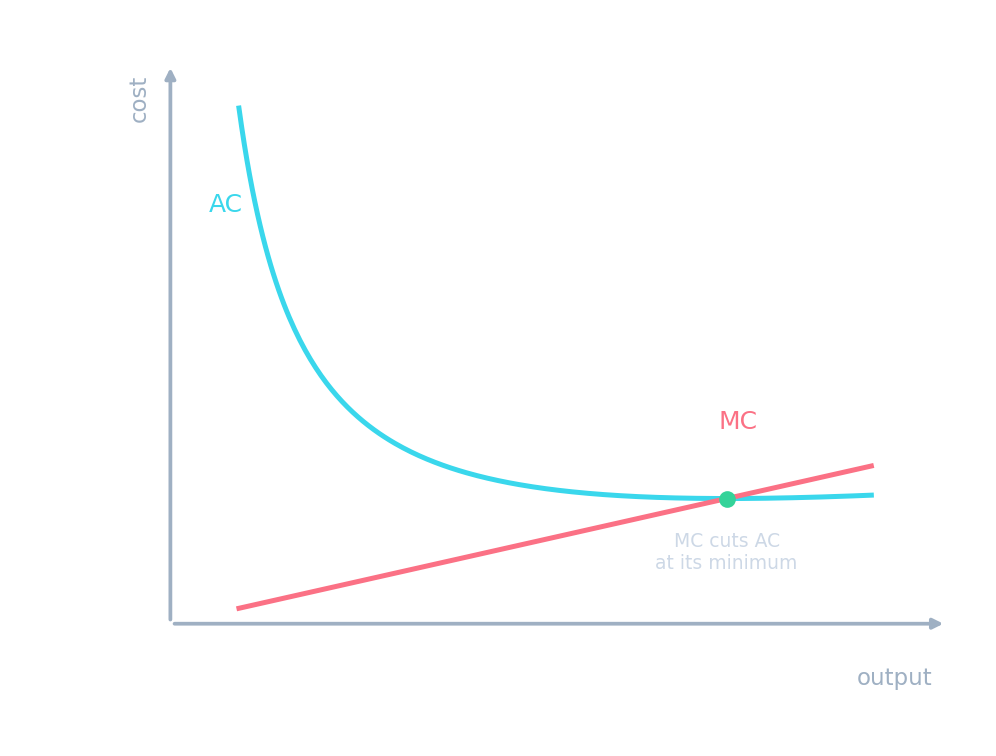
MC 总是在 AC 的最低点切过 AC——成本图的一个决定性特征。
The marginal cost curve cuts the average cost curve at its minimum point. · 边际成本曲线在它的最低点切过平均成本曲线。
When MC < AC, AC falls; when MC > AC, AC rises — so they cross at AC's minimum. · 当 MC < AC 时,AC 下降;当 MC > AC 时,AC 上升——所以它们在 AC 的最低点相交。
Short-run cost curves are U-shaped because of the law of diminishing ______. · 短期成本曲线是 U 形的,因为收益______规律。
With a fixed factor, extra units of a variable factor eventually add less output. · 有一个固定要素时,一个可变要素的额外单位最终增加更少的产出。
The long run
- In the long run all factors vary; the firm can change scale.
- Spreading fixed costs and specialising bring economies of scale 规模经济 (lower long-run AC) — explored in lesson 09.
长期
- 在长期所有要素都变化;企业能改变规模。
- 分摊固定成本和专业化带来规模经济(economies of scale,更低的长期 AC)——在第 09 课探讨。
You've got it
- FC (constant) + VC (rise with output) = TC; AC = TC ÷ Q; MC = cost of one more unit
- short-run AC and MC are U-shaped (diminishing returns); MC cuts AC at its minimum
- in the long run all factors vary → economies of scale
你掌握了
- FC(恒定)+ VC(随产出上升)= TC;AC = TC ÷ Q;MC = 多一单位的成本
- 短期 AC 和 MC 是 U 形(收益递减);MC 在 AC 的最低点切过它
- 在长期所有要素都变化 → 规模经济