English
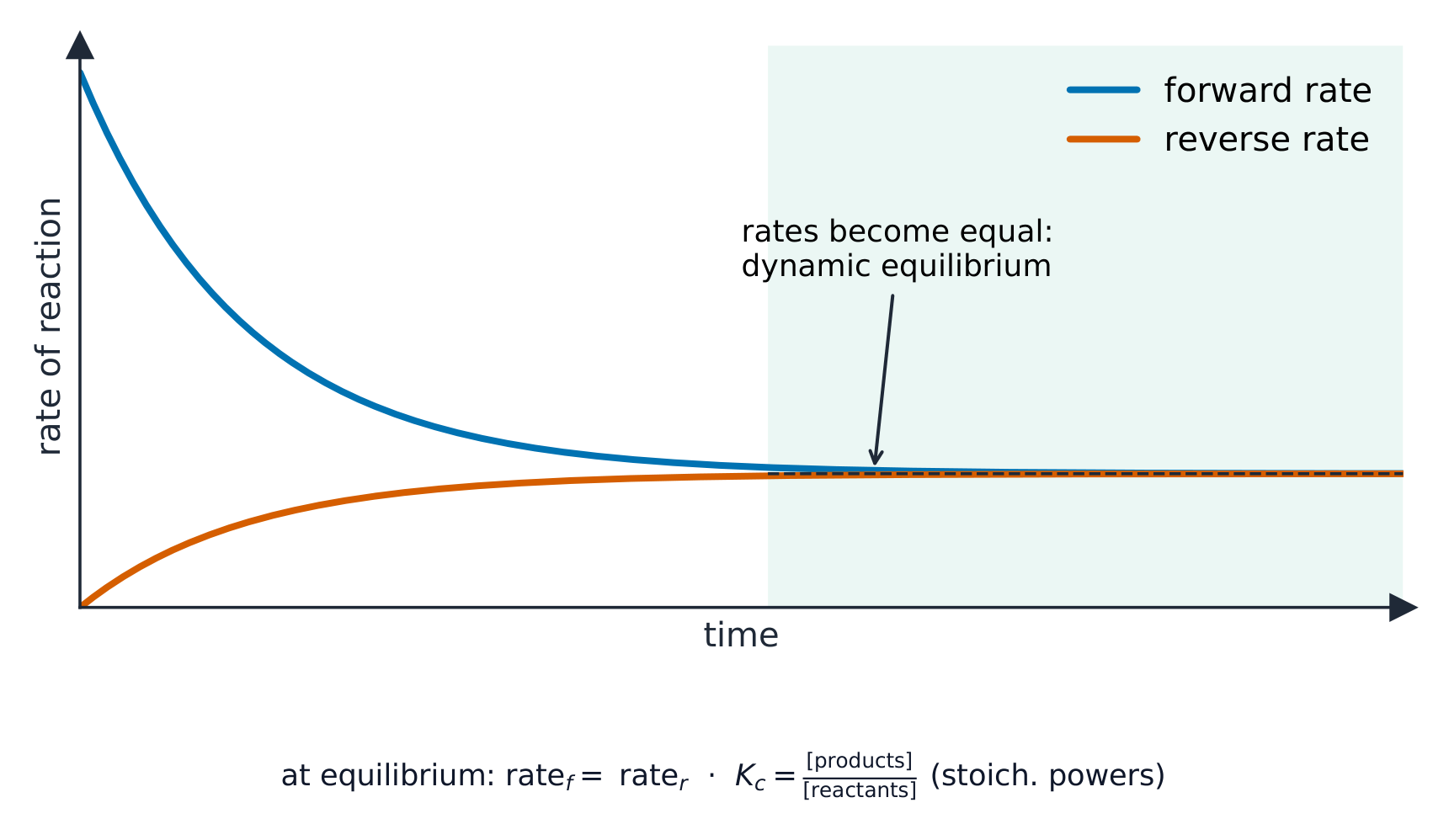
- (a) understand what is meant by a reversible reaction (b) understand what is meant by dynamic equilibrium in terms of the rate of forward and reverse reactions being equal and the concentration of reactants and products remaining constant (c) understand the need for a closed system in order to establish dynamic equilibrium
- define Le Chatelier’s principle as: if a change is made to a system at dynamic equilibrium, the position of equilibrium moves to minimise this change
- use Le Chatelier’s principle to deduce qualitatively (from appropriate information) the effects of changes in temperature, concentration, pressure or presence of a catalyst on a system at equilibrium
- deduce expressions for equilibrium constants in terms of concentrations, $K_c$
- use the terms mole fraction and partial pressure
- deduce expressions for equilibrium constants in terms of partial pressures, $K_p$ (use of the relationship between $K_p$ and $K_c$ is not required)
- use the $K_c$ and $K_p$ expressions to carry out calculations (such calculations will not require the solving of quadratic equations)
- calculate the quantities present at equilibrium, given appropriate data
- state whether changes in temperature, concentration or pressure or the presence of a catalyst affect the value of the equilibrium constant for a reaction
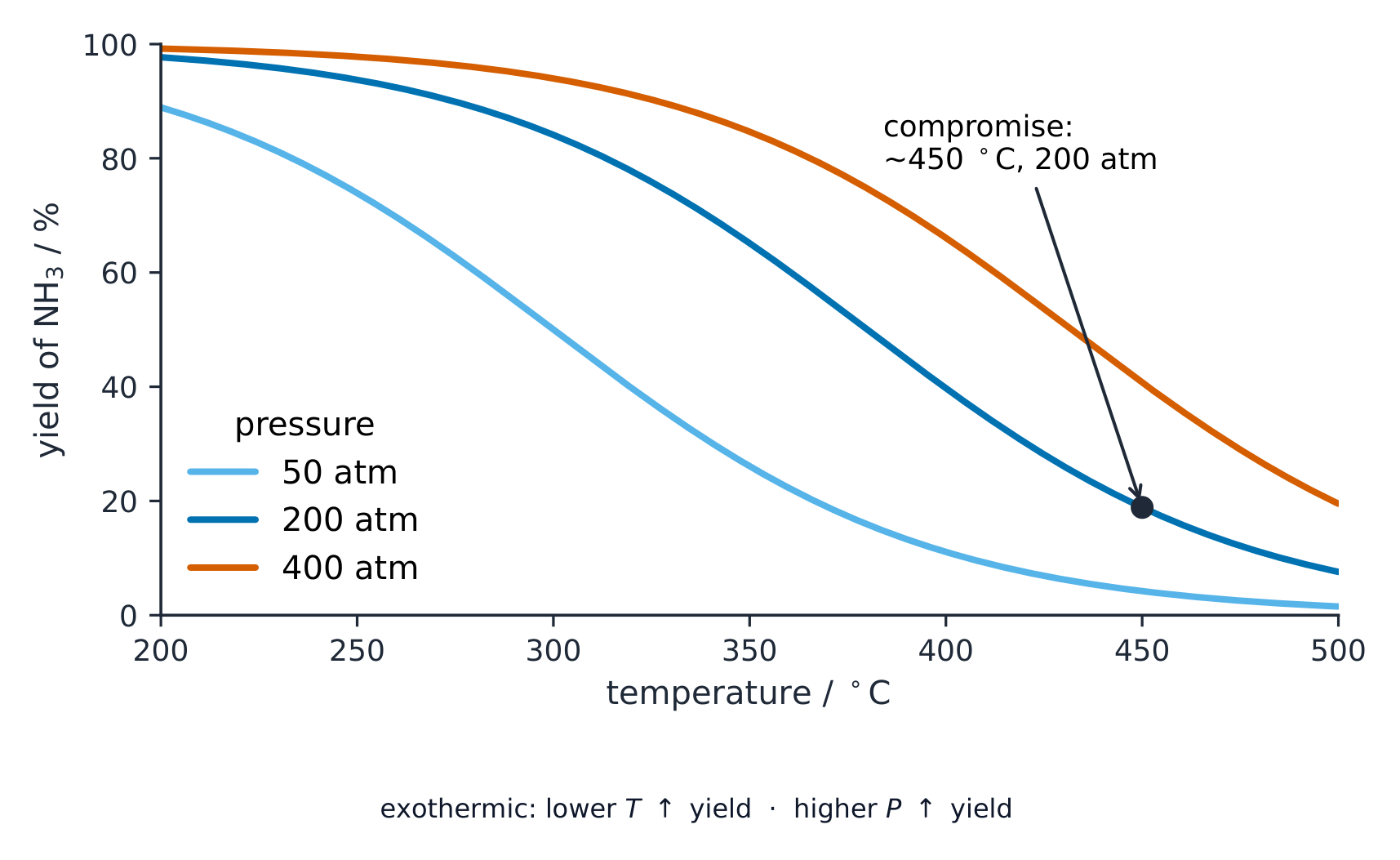
- describe and explain the conditions used in the Haber process and the Contact process, as examples of the importance of an understanding of dynamic equilibrium in the chemical industry and the application of Le Chatelier’s principle
Tiếng Việt
- (a) hiểu ý nghĩa của phản ứng thuận nghịch (b) hiểu ý nghĩa của cân bằng động dưới góc độ tốc độ phản ứng thuận và phản ứng nghịch bằng nhau, nồng độ chất tham gia và sản phẩm không đổi (c) hiểu sự cần thiết của hệ kín để thiết lập cân bằng động
- định nghĩa nguyên lý Le Chatelier: nếu có một thay đổi tác động lên hệ đang ở trạng thái cân bằng động, vị trí cân bằng sẽ dịch chuyển theo hướng giảm thiểu thay đổi đó
- sử dụng nguyên lý Le Chatelier để suy luận định tính (từ thông tin phù hợp) về ảnh hưởng của sự thay đổi nhiệt độ, nồng độ, áp suất hoặc sự hiện diện của xúc tác lên hệ đang ở trạng thái cân bằng
- suy luận các biểu thức cho hằng số cân bằng theo nồng độ, $K_c$
- sử dụng các thuật ngữ phần mol và áp suất riêng phần
- suy luận các biểu thức cho hằng số cân bằng theo áp suất riêng phần, $K_p$ (không yêu cầu sử dụng mối liên hệ giữa $K_p$ và $K_c$)
- sử dụng các biểu thức $K_c$ và $K_p$ để thực hiện tính toán (các phép tính này sẽ không yêu cầu giải phương trình bậc hai)
- tính lượng chất tồn tại ở trạng thái cân bằng, khi có dữ liệu phù hợp
- nêu xem sự thay đổi nhiệt độ, nồng độ hay áp suất, hoặc sự hiện diện của xúc tác có làm thay đổi giá trị hằng số cân bằng của phản ứng hay không
- mô tả và giải thích các điều kiện được sử dụng trong quá trình Haber và quá trình Contact, như những ví dụ về tầm quan trọng của việc hiểu biết cân bằng động trong công nghiệp hóa chất và ứng dụng của nguyên lý Le Chatelier