Dynamic equilibrium
Introduced| English | Meaning |
|---|---|
| reversible reaction/rɪˈvɜːsɪbl rɪˈækʃn/ | A reaction whose products can react to form the original reactants under suitable conditions. |
| closed system/kləʊzd ˈsɪstəm/ | A system that does not exchange matter with its surroundings, although energy may be transferred. |
| dynamic equilibrium/daɪˈnæmɪk ˌiːkwɪˈlɪbrɪəm/ | A state in which opposing processes continue at equal rates, so there is no overall change in composition. |
| macroscopic/ˌmækrəˈskɒpɪk/ | Describing properties or observations at a scale involving bulk matter rather than individual atoms or molecules. |
Reactions that never finish
- A reversible reaction 可逆反应 can go both ways ($\rightleftharpoons$).
- In a closed system 封闭系统 it reaches a dynamic equilibrium 动态平衡.
- At equilibrium nothing appears to change — but both reactions are still going.
A reversible reaction is one that:
Difficulty 1/5 · 100 coins + a small bonus on first completion today
A reversible reaction (⇌) can form products and turn them back into reactants.
A closed system is needed to reach equilibrium.
Difficulty 1/5 · 100 coins + a small bonus on first completion today
If the system were open, products could escape and the forward and reverse rates could never balance.
At dynamic equilibrium the forward and backward reactions have both stopped.
Difficulty 1/5 · 100 coins + a small bonus on first completion today
False. Both reactions continue at equal rates, which is why it is called dynamic. Concentrations stay constant because the rates balance.
What equilibrium means
- At dynamic equilibrium:
- the forward rate equals the reverse rate, and
- the concentrations of reactants and products stay constant.
- It is dynamic because both reactions are still happening — they just cancel out.
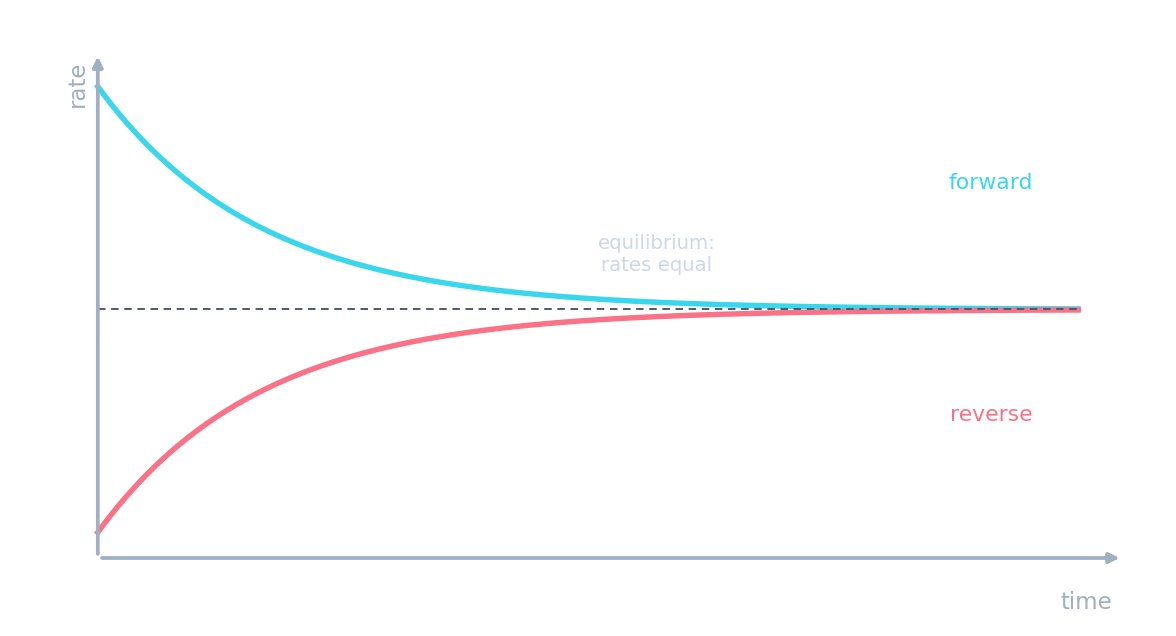
- A closed system is needed, or products would escape and equilibrium could never be reached.
Dynamic equilibrium
forward rate = reverse rate
At equilibrium the position can sit anywhere — change a condition and watch it shift.
At dynamic equilibrium:
Difficulty 1/5 · 100 coins + a small bonus on first completion today
The two rates are equal, so the concentrations of reactants and products no longer change.
Why is it called a "dynamic" equilibrium?
Difficulty 1/5 · 100 coins + a small bonus on first completion today
Both forward and reverse reactions continue at equal rates, so they balance — dynamic, not static.
The features of equilibrium
- Equilibrium is only reached in a closed system.
- The macroscopic 宏观 properties (concentration, colour) stay constant once equilibrium is reached.

Cobalt chloride changes colour as its equilibrium shifts
Match each equilibrium term to its meaning.
Difficulty 2/5 · 140 coins + a small bonus on first completion today
Each item links the term to its correct meaning.
A common misconception
- At equilibrium the amounts of reactants and products are constant, but not necessarily equal.
- The position of equilibrium can lie far to one side.
You've got it
- a reversible reaction ($\rightleftharpoons$) goes both ways
- dynamic equilibrium: forward rate = reverse rate, concentrations constant
- both reactions still happen (dynamic); needs a closed system