Neutralisation and titration curves
Introduced| English | Meaning |
|---|---|
| titration/taɪˈtreɪʃn/ | A method of finding an unknown concentration by measuring the volume needed to react with a solution of known concentration. |
| neutralisation/ˌnjuːtrəlaɪˈzeɪʃn/ | A reaction between an acid and a base that forms a salt, usually with water. |
| indicator/ˈɪndɪkeɪtə/ | A substance that shows a change in chemical conditions through an observable change, often in colour. |
| salt/sɒlt/ | An ionic compound formed when hydrogen ions in an acid are replaced by metal ions or other positive ions. |
| end point/end pɔɪnt/ | The observed signal used to stop a titration, such as an indicator's colour change, which should be close to equivalence. |
Following a titration 滴定
- Neutralisation 中和 reacts an acid with an alkali.
- A titration follows the pH as you add one to the other.
- The curve guides which indicator 指示剂 to use.
An indicator is used to find the end point of a titration.
Difficulty 1/5 · 100 coins + a small bonus on first completion today
It changes colour at neutralisation.
Neutralisation
- The hydrogen ions from the acid react with the hydroxide ions from the alkali:
- A salt 盐 is also formed, from the rest of the acid and base.

Titration curves have a steep jump near the end point 终点; pick an indicator that changes inside it
Titration curves
pH jumps at the equivalence point
Adding base nudges the pH, then it jumps sharply through pH 7 at the equivalence point.
The ionic equation for neutralisation is:
Difficulty 1/5 · 100 coins + a small bonus on first completion today
Hydrogen ions from the acid combine with hydroxide ions from the alkali to make water (plus a salt).
The titration curve
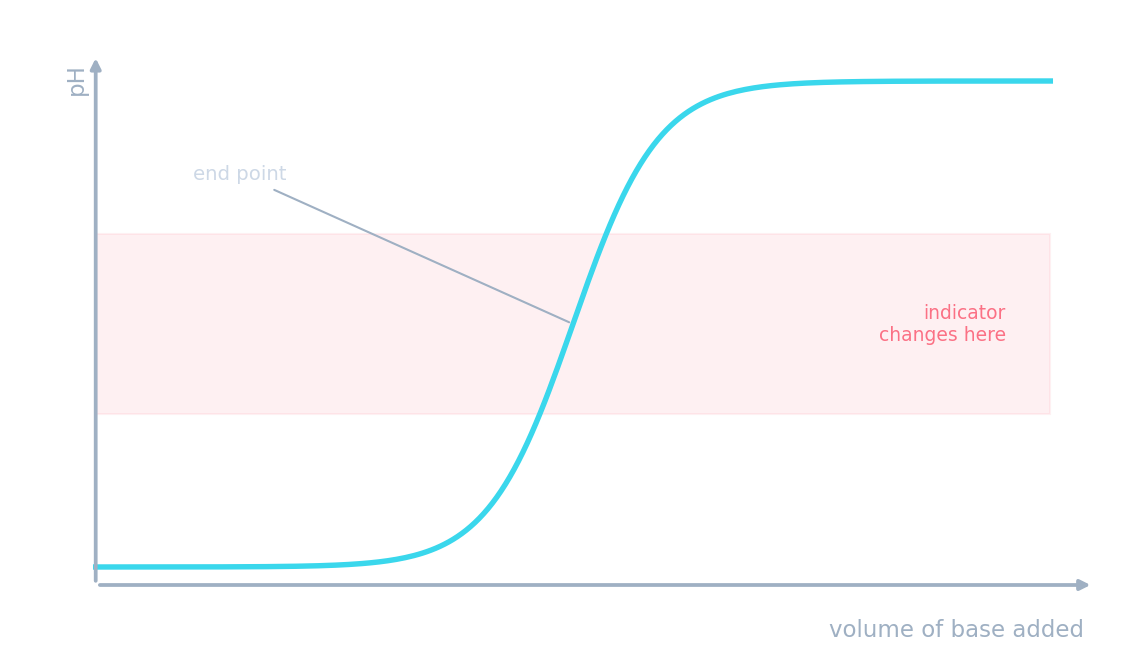
- The curve has a steep, almost vertical jump near the end point.
- Its exact shape depends on whether each reactant is strong or weak.
A titration curve has:
Difficulty 1/5 · 100 coins + a small bonus on first completion today
Near the end point the pH changes very rapidly, giving a steep jump on the curve.
For a weak acid with a strong base, the indicator should change colour in the:
Difficulty 1/5 · 100 coins + a small bonus on first completion today
The weak-acid/strong-base jump sits at higher pH, so the indicator must change in that range.
Match each titration idea to its meaning.
Difficulty 2/5 · 140 coins + a small bonus on first completion today
Each item links the term to its correct meaning.
Choosing an indicator
- Pick an indicator whose colour change falls inside the steep jump.
- For a weak acid with a strong base, you need one that changes in the higher pH range.
A suitable indicator is one whose colour change:
Difficulty 1/5 · 100 coins + a small bonus on first completion today
The indicator must change colour within the steep jump so the end point is shown sharply.
You've got it
- neutralisation: $\text{H}^{+} + \text{OH}^{-} \rightarrow \text{H}_2\text{O}$, also forming a salt
- a titration curve has a steep pH jump at the end point (shape depends on strong/weak)
- choose an indicator that changes colour inside the jump (higher pH for weak acid + strong base)