Rate of reaction
Introduced| English | Meaning |
|---|---|
| rate of reaction/reɪt ɒv rɪˈækʃn/ | The change in the amount or concentration of a reactant or product per unit time. |
| effective collision/ɪˈfektɪv kəˈlɪʒn/ | A collision with enough energy and the right orientation to react. |
| concentration/ˌkɒnsənˈtreɪʃn/ | The amount of a substance per unit volume of a mixture or solution. |
| orientation/ˌɔːrɪənˈteɪʃn/ | orientation |
How fast, and why
- The rate of reaction 反应速率 is how fast reactants turn into products.
- For particles to react, they must collide.
- But not every collision works.
Rate of reaction is measured as the:
Difficulty 1/5 · 100 coins + a small bonus on first completion today
Rate is how much the concentration (or amount) changes in each unit of time.
The rate of reaction can be found from the ______ of a concentration-time graph.
Difficulty 1/5 · 100 coins + a small bonus on first completion today
A steeper gradient means a faster rate.
Effective collisions 有效碰撞
- An effective collision has enough energy and the correct direction — so a reaction happens.
- A non-effective collision lacks energy or hits at the wrong angle — nothing happens.
- The rate depends on the frequency of effective collisions per second.
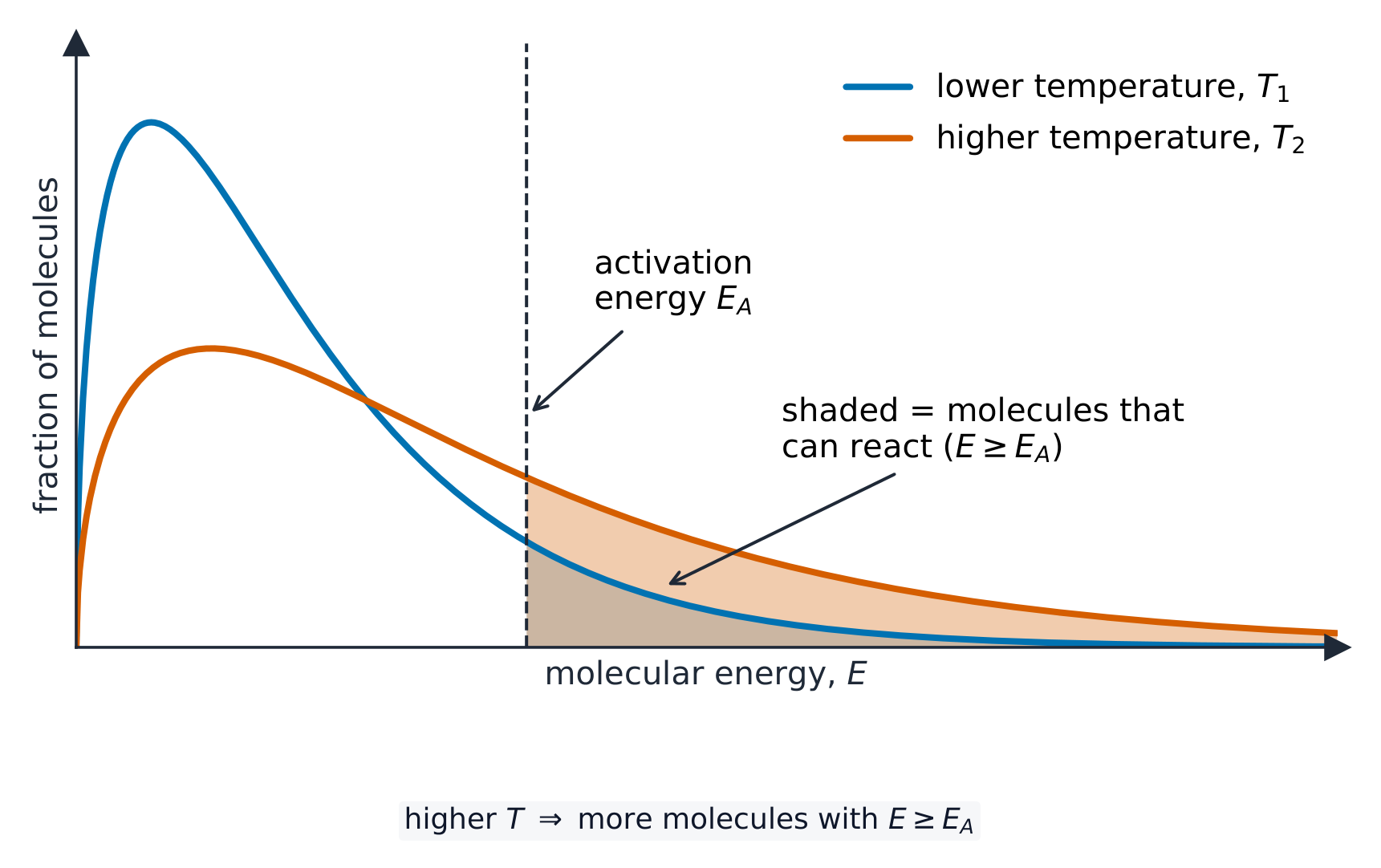
At higher temperature the curve spreads to the right, so a larger fraction of molecules can react
Rate of reaction
[A] = [A]₀·bᵗ
Reactant concentration falls over time as it's used up.
An effective collision is one that:
Difficulty 1/5 · 100 coins + a small bonus on first completion today
A collision only reacts with sufficient energy and the right orientation.
The rate of reaction depends on the:
Difficulty 1/5 · 100 coins + a small bonus on first completion today
More effective collisions per second means a faster rate.
Match each rate idea to its meaning.
Difficulty 2/5 · 140 coins + a small bonus on first completion today
Each item links the term to its correct meaning.
Concentration 浓度 and pressure
- Increasing concentration (or gas pressure) packs particles closer together.
- They collide more often, so there are more effective collisions per second — the rate rises.

A catalytic converter speeds up reactions that clean a car's exhaust gases
Increasing the concentration of a reactant speeds up the reaction because:
Difficulty 1/5 · 100 coins + a small bonus on first completion today
More particles in the same volume collide more frequently, raising the rate.
Measuring rate in the lab
- Follow a reaction by gas volume, mass loss, or a colour/conductivity change over time.
- The initial rate is the gradient of the tangent at the start.

More particles in the same volume collide more often, so the rate rises
You've got it
- rate = change in concentration (or amount) per unit time
- an effective collision needs enough energy + correct orientation 取向
- rate depends on the frequency of effective collisions
- higher concentration/pressure → more frequent collisions → faster rate