Temperature and activation energy
Introduced| English | Meaning |
|---|---|
| activation energy/ˌæktɪˈveɪʃn ˈenədʒi/ | The minimum energy that reacting particles need for a successful reaction. |
| Boltzmann distribution/ˈbɒltsmən ˌdɪstrɪˈbjuːʃn/ | Boltzmann distribution |
Why heat speeds things up
- The activation energy 活化能 ($E_A$) is the minimum energy a collision needs to be effective.
- The Boltzmann distribution 玻尔兹曼分布 shows how molecular energies are spread out.
- Raising the temperature gives a big rise in rate.
The activation energy is:
Difficulty 1/5 · 100 coins + a small bonus on first completion today
Only collisions with at least the activation energy can react.
Increasing temperature increases the proportion of molecules with energy above the activation energy.
Difficulty 1/5 · 100 coins + a small bonus on first completion today
So more collisions are successful.
The Boltzmann distribution
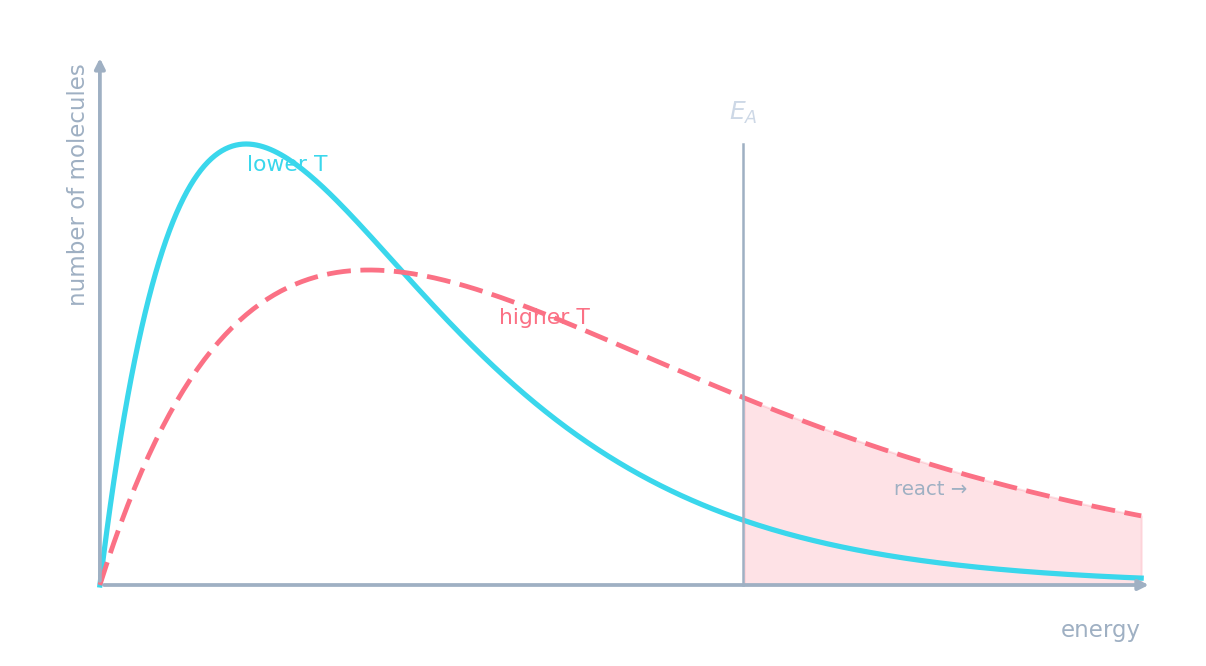
- The curve starts at the origin, peaks, then falls in a long tail. The area under it is the total number of molecules.
- Only molecules to the right of $E_A$ have enough energy to react.
Activation energy & temperature
fraction with E ≥ Ea rises with T
Heating shifts the energy spread right — far more molecules now exceed Ea, so the rate soars.
On the Boltzmann distribution, the molecules that can react are those:
Difficulty 1/5 · 100 coins + a small bonus on first completion today
Molecules with energy greater than Eₐ (right of the line) have enough energy to react.
Match each idea to its meaning.
Difficulty 2/5 · 140 coins + a small bonus on first completion today
Each item links the term to its correct meaning.
Why temperature matters
- Raising the temperature spreads the curve to the right, so a much larger fraction of molecules now exceed $E_A$.
- Molecules also collide more often — but the first effect is the bigger one.
- That's why a small rise in temperature gives a large rise in rate.

A collision only reacts with the right orientation and enough energy
The main reason a higher temperature speeds up a reaction is that:
Difficulty 1/5 · 100 coins + a small bonus on first completion today
The curve spreads right, so far more molecules exceed Eₐ; this matters more than the increased collision rate.
A small rise in temperature can give a large rise in reaction rate.
Difficulty 1/5 · 100 coins + a small bonus on first completion today
Because the reacting fraction grows sharply with temperature, even a small increase greatly speeds the reaction.
The Boltzmann picture
- Raising temperature shifts the Boltzmann distribution, so far more molecules exceed the activation energy.
- This is why a small temperature rise can roughly double the rate.
You've got it
- activation energy $E_A$ = the minimum energy for an effective collision
- on the Boltzmann distribution, only molecules with energy > $E_A$ react
- higher temperature → curve spreads right → far more molecules exceed $E_A$ (the main effect)
- so a small temperature rise → a large rate rise