Catalysts
Introduced| English | Meaning |
|---|---|
| catalyst/ˈkætəlɪst/ | A substance that increases a reaction rate without being used up overall. |
| reaction mechanism/rɪˈækʃn ˈmekənɪzəm/ | A proposed sequence of elementary steps explaining how reactants become products. |
| homogeneous catalyst/həˈməʊdʒnɪəs ˈkætəlɪst/ | A catalyst in the same physical phase as the reactants. |
| heterogeneous catalyst/ˌhetrəˈdʒiːnɪəs ˈkætəlɪst/ | A catalyst in a different physical phase from the reactants. |
A shortcut for reactions
- A catalyst 催化剂 speeds up a reaction but is not used up.
- It works by giving a new route with a lower activation energy.
- It does not change the enthalpy of the reaction.
A catalyst speeds up a reaction by:
Difficulty 1/5 · 100 coins + a small bonus on first completion today
A catalyst offers a new mechanism with a lower Eₐ, so more molecules can react; it is not used up.
A catalyst speeds up a reaction by providing a route with a lower activation energy.
Difficulty 1/5 · 100 coins + a small bonus on first completion today
It is not used up.
How a catalyst works
- A catalyst provides a different reaction mechanism 反应机理 with a lower $E_A$.
- On the Boltzmann distribution, lowering $E_A$ moves the line left, so more molecules can react → more effective collisions → faster rate.
- The enthalpy change $\Delta H$ is unchanged — only the activation energy is lowered.

A catalyst gives a route with lower activation energy; the enthalpy change is unchanged
Catalysts
a catalyst lowers Ea
A catalyst lowers Ea, so a bigger fraction of molecules can react — without heating.
A catalyst does NOT change the:
Difficulty 1/5 · 100 coins + a small bonus on first completion today
A catalyst lowers Eₐ and speeds the rate, but the overall ΔH (reactants to products) is unchanged.
Match each catalyst idea to its meaning.
Difficulty 2/5 · 140 coins + a small bonus on first completion today
Each item links the term to its correct meaning.
Two types
- a homogeneous catalyst 均相催化剂 is in the same physical state as the reactants (e.g. an acid dissolved among liquids).
- a heterogeneous catalyst 多相催化剂 is in a different state (e.g. solid iron speeding up the gases in the Haber process; a car's catalytic converter).
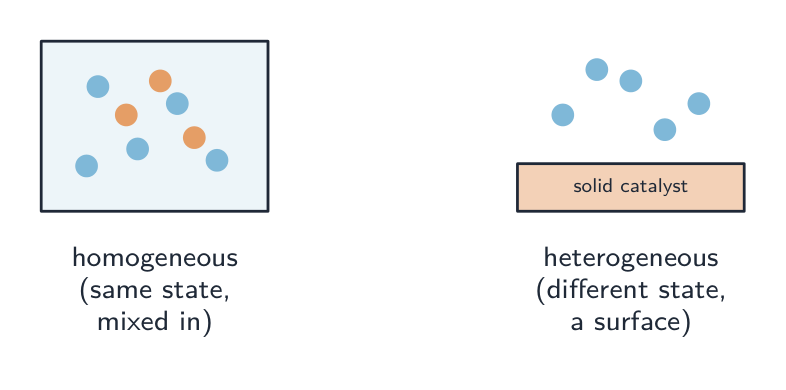
A homogeneous catalyst mixes in with the reactants; a heterogeneous one is a separate surface
A heterogeneous catalyst is one that is:
Difficulty 1/5 · 100 coins + a small bonus on first completion today
Heterogeneous = different state (e.g. solid catalyst, gas reactants); homogeneous = same state.
Solid iron speeding up the gas reaction in the Haber process is an example of a:
Difficulty 1/5 · 100 coins + a small bonus on first completion today
The solid iron is in a different state from the gaseous reactants, so it is a heterogeneous catalyst.
How a catalyst changes the picture
- A catalyst gives an alternative pathway with a lower activation energy.
- More molecules now have enough energy to react, so the rate rises — without being used up.
You've got it
- a catalyst speeds up a reaction, is not used up, and gives a route with lower $E_A$
- lower $E_A$ → more molecules can react → faster rate; $\Delta H$ is unchanged
- homogeneous = same state as reactants; heterogeneous = different state (e.g. solid iron, catalytic converter)