Equilibrium constants
Introduced| English | Meaning |
|---|---|
| equilibrium constant/ˌiːkwɪˈlɪbrɪəm ˈkɒnstənt/ | A value relating the equilibrium activities, concentrations or partial pressures of products and reactants at a specified temperature. |
| partial pressure/ˈpɑːʃl ˈpreʃə/ | The pressure a gas in a mixture would exert if it alone occupied the same volume at the same temperature. |
| mole fraction/məʊl ˈfrækʃn/ | The amount of one component divided by the total amount of all components in a mixture, using moles for both. |
Putting a number on balance
- The equilibrium constant 平衡常数 links the amounts of products and reactants.
- For concentrations we use $K_c$; for gases, $K_p$.
- Only temperature changes its value.
The equilibrium constant in terms of concentrations is written as ______.
Difficulty 1/5 · 100 coins + a small bonus on first completion today
Kc = products over reactants, each raised to its mole number.
$K_c$
For $a\text{A} + b\text{B} \rightleftharpoons c\text{C} + d\text{D}$:
- Square brackets mean concentration in $\dfrac{\text{mol}}{\text{dm}^3}$; the powers are the equation's numbers.
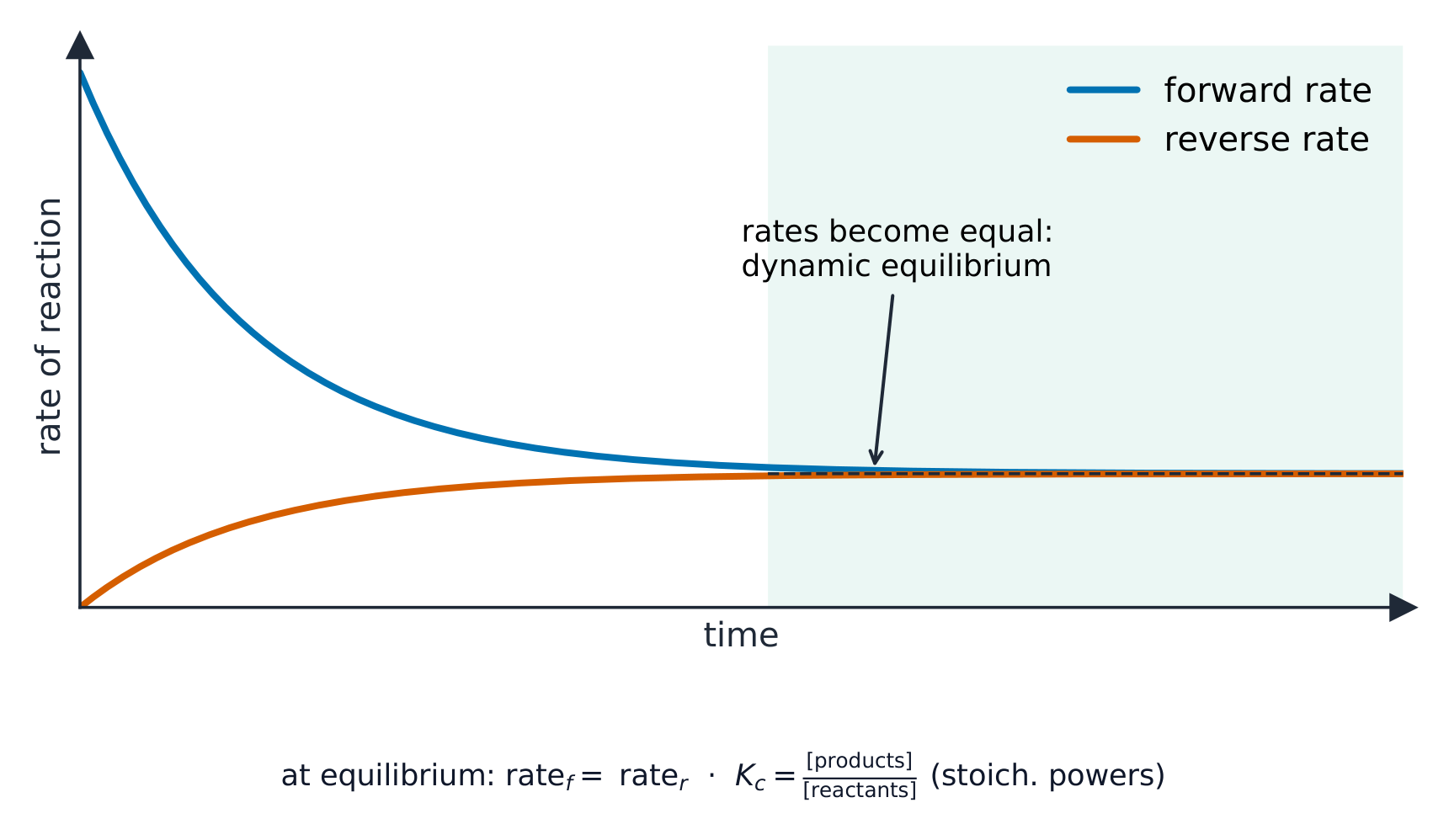
Dynamic equilibrium: forward and reverse rates become equal and the concentrations stay constant
Le Chatelier and Kc
Change temperature, pressure or concentration and watch the equilibrium shift to oppose it — Kc itself only changes with temperature.
In the expression for Kc, the concentrations of the products are:
Difficulty 1/5 · 100 coins + a small bonus on first completion today
Kc = [products]^powers / [reactants]^powers, with the powers taken from the balanced equation.
$K_p$ and partial pressure 分压
- For gases we use partial pressures ($K_p$).
- The partial pressure of a gas is its share of the total:
The partial pressure of a gas equals:
Difficulty 1/5 · 100 coins + a small bonus on first completion today
Partial pressure = mole fraction × total pressure; Kp is written using these.
Kp is written using partial pressures rather than concentrations.
Difficulty 1/5 · 100 coins + a small bonus on first completion today
For gas-phase equilibria, Kp uses the partial pressures of the gases.
What changes K
- Only temperature changes the value of $K_c$ or $K_p$.
- Changing concentration or pressure, or adding a catalyst, shifts the position but leaves $K$ unchanged.
Which change alters the value of the equilibrium constant?
Difficulty 1/5 · 100 coins + a small bonus on first completion today
Only temperature changes K; the others shift the position of equilibrium but leave K unchanged.
You've got it
- $K_c = \dfrac{[\text{C}]^c[\text{D}]^d}{[\text{A}]^a[\text{B}]^b}$ (powers from the equation; $\dfrac{\text{mol}}{\text{dm}^3}$)
- $K_p$ uses partial pressures = mole fraction 摩尔分数 × total pressure
- only temperature changes $K$; concentration/pressure/catalyst shift the position only