The Haber and Contact processes
Introduced| English | Meaning |
|---|---|
| yield/jiːld/ | The amount of product obtained in a reaction, often expressed as a percentage of the theoretical amount. |
| Haber process/ˈheɪbə ˈprəʊses/ | The industrial production of ammonia by reacting nitrogen with hydrogen under controlled temperature and pressure using a catalyst. |
| ammonia/æˈməʊnɪə/ | A compound of nitrogen and hydrogen with the formula NH3. |
| catalyst/ˈkætəlɪst/ | A substance that increases a reaction rate without being used up overall. |
| compromise/ˈkɒmprəmaɪz/ | compromise |
| Contact process/ˈkɒntækt ˈprəʊses/ | An industrial process for making sulfuric acid through catalytic oxidation of sulfur dioxide to sulfur trioxide. |
Equilibrium that feeds the world
- These industrial processes balance yield 产率, rate and cost.
- They use Le Chatelier's principle to choose conditions.
- Both reactions are exothermic.
The Haber process combines nitrogen and hydrogen to make ______.
Difficulty 1/5 · 100 coins + a small bonus on first completion today
N₂ + 3H₂ ⇌ 2NH₃.
The Haber process 哈伯法
- Makes ammonia 氨: $\text{N}_2 + 3\text{H}_2 \rightleftharpoons 2\text{NH}_3$ (exothermic).
- Conditions: about $450\,°\text{C}$, $200\ \text{atm}$, iron catalyst 催化剂.
- A low temperature would give more ammonia, but too slowly — so a moderate temperature is a compromise 折中.
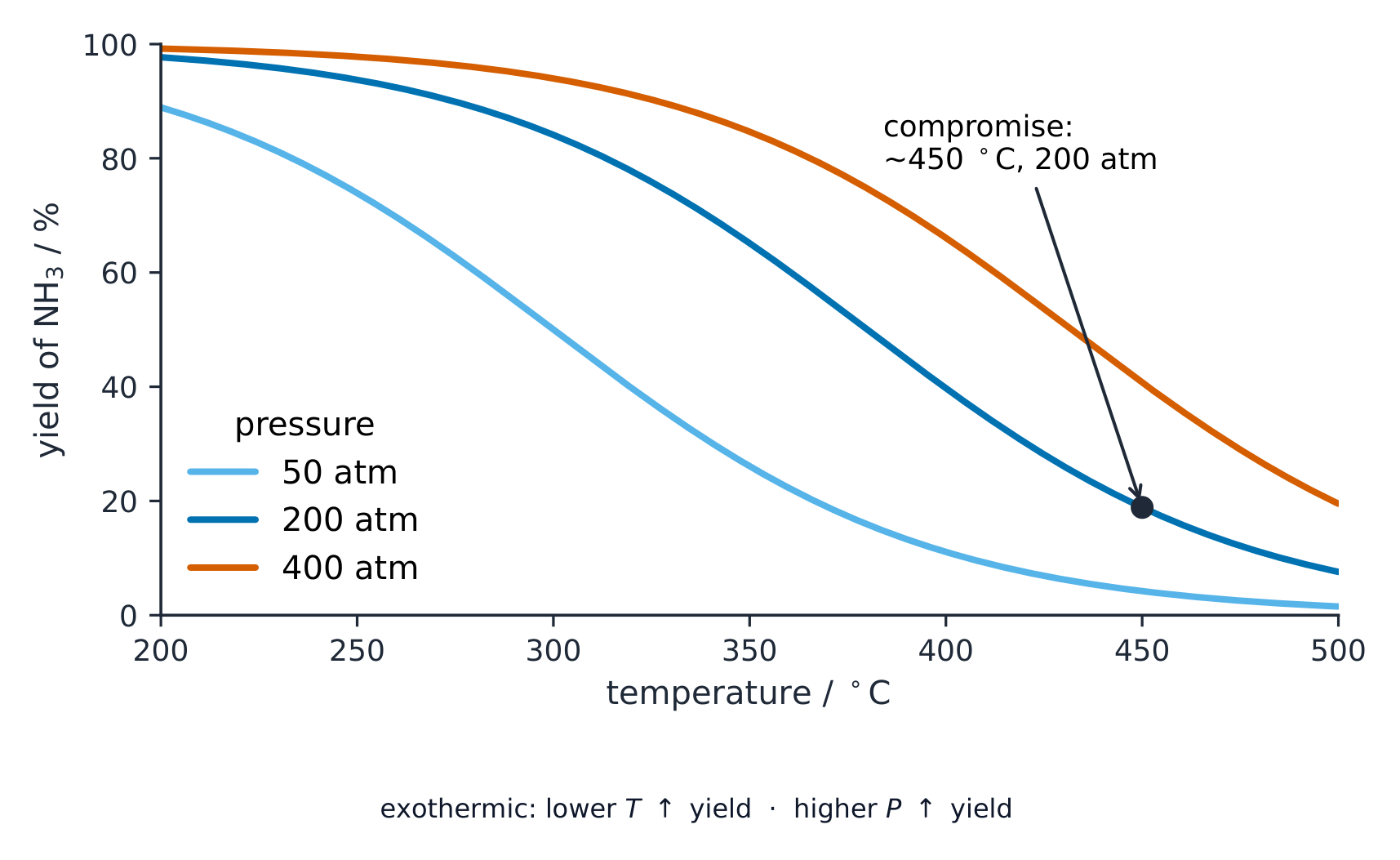
Haber process yield: more ammonia at lower temperature and higher pressure
The Haber & Contact processes
compromise: yield vs rate
High pressure boosts yield; high temperature speeds it up but lowers yield — a compromise.
The Haber process makes:
Difficulty 1/5 · 100 coins + a small bonus on first completion today
The Haber process makes ammonia: N₂ + 3H₂ ⇌ 2NH₃ (exothermic).
Why is a moderate temperature (~450 °C) used in the Haber process?
Difficulty 1/5 · 100 coins + a small bonus on first completion today
The reaction is exothermic, so low temperature favours yield but is too slow; ~450 °C balances yield and rate.
High pressure increases the yield of ammonia in the Haber process because:
Difficulty 1/5 · 100 coins + a small bonus on first completion today
4 gas molecules become 2, so higher pressure shifts the equilibrium towards ammonia.
The Contact process 接触法
- Makes sulfur trioxide: $2\text{SO}_2 + \text{O}_2 \rightleftharpoons 2\text{SO}_3$ (exothermic).
- Conditions: about $450\,°\text{C}$, near $1$–$2\ \text{atm}$, vanadium(V) oxide catalyst.

Ammonia for fertiliser is made by the Haber process, a key equilibrium
The Contact process uses which catalyst?
Difficulty 1/5 · 100 coins + a small bonus on first completion today
The Contact process (2SO₂ + O₂ ⇌ 2SO₃) uses a vanadium(V) oxide catalyst.
Match each process to its facts.
Difficulty 2/5 · 140 coins + a small bonus on first completion today
Each item links the term to its correct meaning.
Why the compromise conditions
- The Haber process uses ~450 °C and ~200 atm: a compromise between yield, rate and cost.
- A lower temperature would give more ammonia but far too slowly.
You've got it
- both processes balance yield + rate + cost (Le Chatelier), and both are exothermic
- Haber: $\text{N}_2 + 3\text{H}_2 \rightleftharpoons 2\text{NH}_3$; ~450 °C, 200 atm, iron catalyst (moderate temp = compromise)
- Contact: $2\text{SO}_2 + \text{O}_2 \rightleftharpoons 2\text{SO}_3$; ~450 °C, 1–2 atm, V₂O₅ catalyst