Skip to content · ⁨ข้ามไปยังเนื้อหา⁩

Electricity and magnetism · ⁨ไฟฟ้าและแม่เหล็ก⁩

IGCSE Physics · ⁨Physics IGCSE⁩ · Topic 4 · ⁨หัวข้อ 4⁩

Video lesson for this topic · ⁨บทเรียนวิดีโอสำหรับหัวข้อนี้⁩ Open the video page · ⁨เปิดหน้าวิดีโอ⁩
31:58

ไฟฟ้า & แม่เหล็ก

สวิตช์ไฟแล้วโคมไฟสว่างขึ้น ถือแม่เหล็กใกล้เหล็กแล้วมันดูด这两力 — electricity and magnetism — look separate, but they are deeply…

English narration · English + 中文 subtitles burned in · ⁨การบรรยายภาษาอังกฤษ · คำบรรยายภาษาอังกฤษ + 中文 ลอยตัวบนภาพ⁩

4.1

Magnetism · ⁨แม่เหล็ก⁩

Syllabus · ⁨หลักสูตร⁩
English
Core Supplement
1 Describe the forces between magnetic poles and between magnets and magnetic materials, including the use of the terms north pole (N pole), south pole (S pole), attraction and repulsion, magnetised and unmagnetised 10 Explain that magnetic forces are due to interactions between magnetic fields
2 Describe induced magnetism
3 State the differences between the properties of temporary magnets (made of soft iron) and the properties of permanent magnets (made of steel
4 State the difference between magnetic and non-magnetic materials
5 Describe a magnetic field as a region in which a magnetic pole experiences a force
6 Draw the pattern and direction of magnetic field lines around a bar magnet 11 Know that the relative strength of a magnetic field is represented by the spacing of the magnetic field lines
7 State that the direction of a magnetic field at a point is the direction of the force on the N pole of a magnet at that point
8 Describe the plotting of magnetic field lines with a compass or iron filings and the use of a compass to determine the direction of the magnetic field
9 Describe the uses of permanent magnets and electromagnets
ไทย
แก่น เพิ่มเติม
1 อธิบายแรงระหว่างขั้วแม่เหล็กและระหว่างแม่เหล็กกับวัสดุที่มีคุณสมบัติแม่เหล็ก รวมถึงการใช้คำศัพท์ ขั้วเหนือ (ขั้ว N), ขั้วใต้ (ขั้ว S), การดึงดูด และ การผลัก, การทำให้เป็นแม่เหล็กและไม่เป็นแม่เหล็ก 10 อธิบายว่าแรงแม่เหล็กเกิดจากการมีปฏิสัมพันธ์กันของสนามแม่เหล็ก
2 อธิบาย การเหนี่ยวนำให้เป็นแม่เหล็ก
3 บอกลักษณะแตกต่างของคุณสมบัติของ แม่เหล็กชั่วคราว (ทำจากเหล็กอ่อน) กับคุณสมบัติของ แม่เหล็กถาวร (ทำจากเหล็กกล้า
4 บอกลักษณะแตกต่างระหว่างวัสดุที่มีคุณสมบัติแม่เหล็กและไม่มีคุณสมบัติแม่เหล็ก
5 อธิบาย สนามแม่เหล็ก ว่าเป็นบริเวณที่ขั้วแม่เหล็กได้รับแรง
6 วาดรูปแบบและทิศทางของ เส้นสนามแม่เหล็ก รอบแท่งแม่เหล็ก 11 ทราบว่าความเข้มสัมพัทธ์ของสนามแม่เหล็กแสดงด้วยระยะห่างของเส้นสนามแม่เหล็ก
7 บอกลักษณะว่าทิศทางของสนามแม่เหล็กที่จุดหนึ่งคือทิศทางของแรงที่กระทำต่อขั้ว N ของแม่เหล็กที่จุดนั้น
8 อธิบายการทำแผนภาพเส้นสนามแม่เหล็กโดยใช้อุปกรณ์วัดcompassหรือตะกั่วเหล็ก และการใช้ compass ในการกำหนดทิศทางของสนามแม่เหล็ก
9 อธิบายการใช้งานของแม่เหล็กถาวรและแม่เหล็กไฟฟ้า

Source: Cambridge International syllabus · ⁨แหล่งที่มา: หลักสูตร Cambridge International⁩

English

A magnet 磁体 can attract some metals. Every magnet has two ends, called poles 磁极: a north pole 北极 (N pole) and a south pole 南极 (S pole).

The rule for two poles is like the rule for charges:

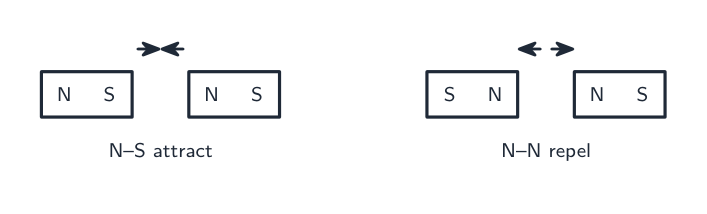
  • Poles that are the same (N and N, or S and S) repel 排斥 (push apart): this is repulsion 排斥力.
  • Poles that are different (N and S) attract 吸引 (pull together): this is attraction 吸引力.

A magnet attracts a magnetic material 磁性材料, such as iron, steel, cobalt and nickel. Other materials (copper, plastic, wood) are non-magnetic and feel no force.

Induced magnetism

Put a piece of iron near or touching a magnet, and the iron becomes a magnet itself. This is induced magnetism 感应磁性. The end of the iron nearest the magnet gains the opposite pole, so the two then attract.

Temporary and permanent magnets

  • Soft iron 软铁 is easy to magnetise 磁化 but loses its magnetism quickly. It is used for a temporary magnet 临时磁体.
  • Steel 钢 is harder to magnetise but keeps its magnetism. It is used for a permanent magnet 永磁体.

So an unmagnetised 未磁化 piece of soft iron is the best core for an electromagnet, while steel is best for a bar magnet.

Magnetic fields

A magnetic field 磁场 is a region 区域 where a magnetic pole feels a force. We draw it with magnetic field lines 磁场线:

  • The lines come out of the N pole and go into the S pole.
  • The field direction at a point is the direction of the force on the N pole of a small test magnet placed there.
  • Where the lines are close together the field is strong; where they are far apart the field is weak.

You can show the pattern by sprinkling iron filings 铁屑 on paper over a magnet, or by moving a small plotting compass 指南针 around it (the needle points along the field).

Uses of magnets

  • Permanent magnets: fridge door catches, compass needles, loudspeakers.
  • Electromagnets 电磁铁 (magnetic only while a current flows): cranes that lift scrap iron, electric bells, relays. An electromagnet can be switched on and off and made stronger, which a permanent magnet cannot.

Magnetic forces happen because the fields of the two magnets push and pull on each other.

ไทย

แม่เหล็ก สามารถดึงดูดโลหะบางชนิดได้ ทุกแม่เหล็กมีสองปลายเรียกว่า ขั้ว: ขั้วเหนือ (ขั้ว N) และ ขั้วใต้ (ขั้ว S)

แม่เหล็กสองชิ้น: ขั้ว N ชนขั้ว S ดึงดูด; ขั้ว N ชนขั้ว N ผลักกัน
ขั้วเหมือนกันผลักกัน; ขั้วต่างกันดูดกัน

กฎสำหรับสองขั้วคล้ายกับกฎสำหรับประจุ:

  • ขั้วเหมือนกัน (N กับ N, หรือ S กับ S) ผลักกัน (ผลักออกจากกัน): นี่คือ การผลักกัน
  • ขั้วต่างกัน (N กับ S) ดึงดูด (ดึงเข้าหากัน): นี่คือ การดึงดูด

แม่เหล็กดึงดูด วัสดุนำแม่เหล็ก เช่น เหล็ก เหล็กกล้า โคบอลต์ และนิกเกิล วัสดุอื่น ๆ (ทองแดง พลาสติก ไม้) เป็นวัสดุที่ไม่ใช่แม่เหล็กและไม่รู้สึกถึงแรงใด ๆ

แม่เหล็กเหนี่ยวนำ

วางชิ้นเหล็กใกล้หรือสัมผัสกับแม่เหล็ก แล้วเหล็กจะกลายเป็นแม่เหล็กเอง นี่คือ แม่เหล็กเหนี่ยวนำ ปลายของเหล็กที่อยู่ใกล้กับแม่เหล็กมากที่สุดจะได้รับขั้วตรงข้าม ทำให้ทั้งสองดึงดูดกัน

แม่เหล็กชั่วคราวและถาวร

  • เหล็กอ่อน ทำให้ง่ายต่อการ ทำให้เป็นแม่เหล็ก แต่สูญเสียความเป็นแม่เหล็กอย่างรวดเร็ว ใช้สำหรับ แม่เหล็กชั่วคราว
  • เหล็กกล้า ทำให้ง่ายต่อการทำให้เป็นแม่เหล็กยากกว่าแต่คงความเป็นแม่เหล็กไว้ได้ ใช้สำหรับ แม่เหล็กถาวร

ดังนั้น เหล็กอ่อนที่ไม่เป็นแม่เหล็ก เป็นแกนที่ดีที่สุดสำหรับแม่เหล็กไฟฟ้า ในขณะที่เหล็กกล้าดีที่สุดสำหรับแม่เหล็กแท่ง

สนามแม่เหล็ก

สนามแม่เหล็ก คือ พื้นที่ ที่ขั้วแม่เหล็กรู้สึกถึงแรง เราวาด它以 เส้นสนามแม่เหล็ก:

  • เส้นออกมา จาก ขั้ว N และเข้าไป ใน ขั้ว S
  • ทิศทางของสนาม ณ จุดหนึ่งคือทิศทางของแรงที่กระทำต่อขั้ว N ของแม่เหล็กทดสอบขนาดเล็กวางไว้ที่นั่น
  • เมื่อเส้นอยู่ชิดกันสนามแข็งแรง; เมื่อเส้นห่างกันสนามอ่อน
แม่เหล็กแท่งที่มีเส้นสนามวนจากขั้วเหนือไปยังขั้วใต้
เส้นสนามของแม่เหล็กแท่งออกมาจากขั้ว N และเข้าไปในขั้ว S

คุณสามารถแสดงรูปแบบด้วยการโรย ผงเหล็ก บนกระดาษเหนือแม่เหล็ก, หรือโดยการเคลื่อน เข็มcompass ขนาดเล็กไปรอบๆ (เข็มชี้ไปตามสนาม)

ผงเหล็กขนาดเล็กบนกระดาษสีขาวเรียงตัวเป็นเส้นโค้งรอบแม่เหล็กแท่งสีแดงและน้ำเงิน
ผงเหล็กเรียงตัวตามเส้นสนาม แสดงรูปแบบสนามของแม่เหล็กแท่ง

การใช้ประโยชน์จากแม่เหล็ก

  • แม่เหล็กถาวร: ตัวล็อคประตูตู้เย็น, เข็มทิศ, ลำโพง
  • แม่เหล็กไฟฟ้า (เกิดสนามแม่เหล็กเฉพาะเมื่อมีกระแสไหล): Crane ที่ยกเศษเหล็ก, กระดิ่งไฟฟ้า, รีเลย์ แม่เหล็กไฟฟ้าสามารถเปิด-ปิดได้และปรับความแรงเพิ่มได้ ซึ่งแม่เหล็กถาวรทำไม่ได้

แรงแม่เหล็กเกิดขึ้นเนื่องจากสนามแม่เหล็กของแม่เหล็กทั้งสองไปผลักและดึงกันเอง

Explore · ⁨สำรวจ⁩

Make the magnetic field visible · ⁨ทำให้เห็นสนามแม่เหล็ก⁩

Compass needles trace the field from N to S; switch between attract and repel and watch the whole pattern reorganise, with a neutral point appearing for like poles. · ⁨เข็มทิศแสดงเส้นทางสนามจาก N ไป S; สลับระหว่างดึงดูดและผลักดูรูปแบบทั้งหมดจัด ulangใหม่ พร้อมจุดกลางที่ปรากฏสำหรับขั้วเหมือนกัน⁩

Vocabulary · ⁨คำศัพท์⁩ Train · ⁨ฝึกฝน⁩
English ไทย
magnet/ˈmæɡnɪt/ แม่เหล็ก
poles/pəʊlz/ poles
north pole/nɔːθ pəʊl/ ขั้วเหนือ
south pole/saʊθ pəʊl/ ขั้วใต้
repel/rɪˈpel/ ผลักกัน
repulsion/rɪˈpʌlʃn/ แรงผลัก
attract/əˈtrækt/ ดึงดูด
attraction/əˈtrækʃn/ แรงดึงดูด
magnetic material/mæɡˈnetɪk məˈtɪərɪəl/ วัสดุแม่เหล็ก
induced magnetism/ɪnˈdjuːst ˈmæɡnɪtɪzəm/ การเหนี่ยวนำแม่เหล็ก
soft iron/sɒft ˈaɪən/ เหล็กอ่อน
magnetise/ˈmæɡnɪtaɪz/ ทำให้เป็นแม่เหล็ก
temporary magnet/ˈtemprəri ˈmæɡnɪt/ แม่เหล็กชั่วคราว
steel/stiːl/ เหล็กกล้า
permanent magnet/ˈpɜːmənənt ˈmæɡnɪt/ แม่เหล็กถาวร
unmagnetised/ʌnˈmæɡnɪtaɪzd/ ไม่มีสนามแม่เหล็ก
magnetic field/mæɡˈnetɪk fiːld/ สนามแม่เหล็ก
region/ˈriːdʒn/ ภูมิภาค (Region)
magnetic field lines/mæɡˈnetɪk fiːld laɪnz/ เส้นสนามแม่เหล็ก
iron filings/ˈaɪən ˈfaɪlɪŋz/ เศษเหล็ก
compass/ˈkʌmpəs/ เข็มทิศ (compass)
electromagnet/ɪˌlektrəʊˈmæɡnɪt/ แม่เหล็กไฟฟ้า
electric charge/ɪˈlektrɪk tʃɑːdʒ/ ประจุไฟฟ้า
positive charge/ˈpɒzɪtɪv tʃɑːdʒ/ ประจุบวก
negative charge/ˈneɡətɪv tʃɑːdʒ/ ประจุลบ
electron/ɪˈlektrɒn/ อิเล็กตรอน
charging by friction/ˈtʃɑːdʒɪŋ baɪ ˈfrɪkʃn/ การชาร์จด้วยการเสียดสี
conductor/kənˈdʌktə/ ตัวนำ
insulator/ˈɪnsjuːleɪtə/ ฉนวน
coulomb/ˈkuːlɒm/ คูลอมบ์
4.2

Static electricity · ⁨ไฟฟ้าสถิต⁩

Syllabus · ⁨หลักสูตร⁩
English

4.2.1 Electric charge

Core Supplement
1 State that there are positive and negative charges 7 State that charge is measured in coulombs
2 State that positive charges repel other positive charges, negative charges repel other negative charges, but positive charges attract negative charges 8 Describe an electric field as a region in which an electric charge experiences a force
3 Describe simple experiments to show the production of electrostatic charges by friction and to show the detection of electrostatic charges 9 State that the direction of an electric field at a point is the direction of the force on a positive charge at that point
4 Explain that charging of solids by friction involves only a transfer of negative charge (electrons) 10 Describe simple electric field patterns, including the direction of the field: (a) around a point charge (b) around a charged conducting sphere (c) between two oppositely charged parallel conducting plates (end effects will not be examined)
5 Describe an experiment to distinguish between electrical conductors and insulators
6 Recall and use a simple electron model to explain the difference between electrical conductors and insulators and give typical examples

4.2.2 Electric current

Core Supplement
1 Know that electric current is related to the flow of charge 5 Define electric current as the charge passing a point per unit time; recall and use the equation $I = \frac{Q}{t}$
2 Describe the use of ammeters (analogue and digital) with different ranges
3 Describe electrical conduction in metals in terms of the movement of free electrons 6 State that conventional current is from positive to negative and that the flow of free electrons is from negative to positive
4 Know the difference between direct current (d.c.) and alternating current (a.c.)

4.2.3 Electromotive force and potential difference

Core Supplement
1 Define electromotive force (e.m.f.) as the electrical work done by a source in moving a unit charge around a complete circuit 6 Recall and use the equation for e.m.f. $E = \frac{W}{Q}$
2 Know that e.m.f. is measured in volts (V)
3 Define potential difference (p.d.) as the work done by a unit charge passing through a component 7 Recall and use the equation for p.d. $V = \frac{W}{Q}$
4 Know that the p.d. between two points is measured in volts (V)
5 Describe the use of voltmeters (analogue and digital) with different ranges

4.2.4 Resistance

Core Supplement
1 Recall and use the equation for resistance $R = \frac{V}{I}$ 4 Sketch and explain the current–voltage graphs for a resistor of constant resistance, a filament lamp and a diode
2 Describe an experiment to determine resistance using a voltmeter and an ammeter and do the appropriate calculations
3 State, qualitatively, the relationship of the resistance of a metallic wire to its length and to its cross-sectional area 5 Recall and use the following relationship for a metallic electrical conductor: (a) resistance is directly proportional to length (b) resistance is inversely proportional to cross-sectional area

4.2.5 Electrical energy and electrical power

Core Supplement
1 Understand that electric circuits transfer energy from a source of electrical energy, such as an electrical cell or mains supply, to the circuit components and then into the surroundings
2 Recall and use the equation for electrical power $P = IV$
3 Recall and use the equation for electrical energy $E = IVt$
4 Define the kilowatt-hour (kWh) and calculate the cost of using electrical appliances where the energy unit is the kWh
ไทย

4.2.1 ไฟฟ้าสถิต

แก่น เพิ่มเติม
1 stating ว่ามีประจุบวกและประจุลบ 7 stating ว่าประจุวัดเป็นคูลอมบ์
2 stating ว่าประจุบวกผลักประจุบวกอื่น ๆ, ประจุลบผลักประจุลบอื่น ๆ แต่ประจุบวกดูดประจุลบ 8 อธิบาย สนามไฟฟ้า ว่าเป็นบริเวณที่ประจุไฟฟ้าได้รับแรง
3 อธิบายการทดลองอย่างง่ายเพื่อแสดงการผลิตประจุไฟฟ้าสถิตจากการเสียดสีและการตรวจสอบประจุไฟฟ้าสถิต 9 stating ว่าทิศทางของสนามไฟฟ้าที่จุดหนึ่งคือทิศทางของแรงที่กระทำต่อประจุบวกที่จุดนั้น
4 อธิบายว่าการทำให้วัตถุแข็งเป็นไฟฟ้าจากการเสียดสีเกี่ยวข้องกับการถ่ายโอนเพียงประจุลบ (อิเล็กตรอน) เท่านั้น 10 อธิบายรูปแบบสนามไฟฟ้าอย่างง่าย รวมถึงทิศทางของสนาม: (a) รอบประจุจุด (b) รอบทรงกลมตัวนำที่มีประจุ (c) ระหว่างแผ่นตัวนำขนานที่มีประจุตรงข้าม (ไม่มีการสอบเรื่องผลที่ปลายแผ่น)
5 อธิบายการทดลองเพื่อแยกแยะระหว่างตัวนำไฟฟ้าและฉนวนไฟฟ้า
6 จำและใช้โมเดลอิเล็กตรอนอย่างง่ายเพื่ออธิบายความแตกต่างระหว่างตัวนำและฉนวนไฟฟ้า พร้อมยกตัวอย่างทั่วไป

4.2.2 กระแสไฟฟ้า

แก่น เพิ่มเติม
1 ทราบว่า กระแสไฟฟ้า เกี่ยวข้องกับการไหลของประจุ 5 นิยามกระแสไฟฟ้าว่าเป็นปริมาณประจุที่ผ่านจุดหนึ่งต่อหน่วยเวลา; จำและใช้สมการ $I = \frac{Q}{t}$
2 อธิบายการใช้ ammeters (แบบอะนาโล็กและดิจิทัล) ที่มีช่วงวัดต่างกัน
3 อธิบายการนำไฟฟ้าในโลหะในแง่ของการเคลื่อนที่ของอิเล็กตรอนอิสระ 6 stating ว่ากระแสปกติไหลจากบวกไปลบ และการไหลของอิเล็กตรอนอิสระไหลจากลบไปบวก
4 ทราบความแตกต่างระหว่าง กระแสตรง (d.c.) และ กระแสสลับ (a.c.)

4.2.3 แรงดันไฟฟ้าและผลต่างศักย์

แก่น เพิ่มเติม
1 นิยาม แรงดันไฟฟ้า (e.m.f.) ว่าเป็นงานไฟฟ้าที่ทำโดยแหล่งกำเนิดในการเคลื่อนย้ายประจุหนึ่งหน่วยรอบวงจรสมบูรณ์ 6 จำและใช้สมการสำหรับ e.m.f. $E = \frac{W}{Q}$
2 ทราบว่า e.m.f. วัดเป็นโวลต์ (V)
3 นิยาม ผลต่างศักย์ (p.d.) ว่าเป็นงานที่ทำโดยประจุหนึ่งหน่วยเมื่อผ่านองค์ประกอบ 7 จำและใช้สมการสำหรับ p.d. $V = \frac{W}{Q}$
4 ทราบว่า p.d. ระหว่างสองจุดวัดเป็นโวลต์ (V)
5 อธิบายการใช้ voltmeters (แบบอะนาโล็กและดิจิทัล) ที่มีช่วงวัดต่างกัน

4.2.4 ความต้านทาน

แก่น เพิ่มเติม
1 จำและใช้สมการสำหรับ ความต้านทาน $R = \frac{V}{I}$ 4 วาดกราฟและอธิบายกราฟกระแส–แรงดันสำหรับตัวต้านทานที่มีความต้านทานคงที่ หลอดไส้ และไดโอด
2 อธิบายการทดลองเพื่อหาความต้านทานโดยใช้ voltmeter และ ammeter และทำการคำนวณที่เหมาะสม
3 stating แบบคุณภาพถึงความสัมพันธ์ของความต้านทานของลวดโลหะกับความยาวและพื้นที่หน้าตัด 5 จำและใช้ความสัมพันธ์ต่อไปนี้สำหรับตัวนำไฟฟ้าโลหะ: (a) ความต้านทานแปรผันตรงกับความยาว (b) ความต้านทานแปรผกผันกับพื้นที่หน้าตัด

4.2.5 พลังงานและกำลังไฟฟ้า

แก่น เพิ่มเติม
1 เข้าใจว่าวงจรไฟฟ้าถ่ายโอนพลังงานจากแหล่งพลังงานไฟฟ้า เช่น เซลล์ไฟฟ้าหรือแหล่งจ่ายไฟ mains ไปยังองค์ประกอบในวงจรแล้วเข้าสู่สิ่งแวดล้อม
2 จำและใช้สมการสำหรับกำลังไฟฟ้า $P = IV$
3 จำและใช้สมการสำหรับพลังงานไฟฟ้า $E = IVt$
4 นิยาม กิโลวัตต์-ชั่วโมง (kWh) และคำนวณค่าใช้จ่ายในการใช้เครื่องใช้ไฟฟ้าโดยมีหน่วยพลังงานเป็น kWh

Source: Cambridge International syllabus · ⁨แหล่งที่มา: หลักสูตร Cambridge International⁩

English

There are two kinds of electric charge 电荷: positive charge 正电荷 and negative charge 负电荷. The rule is like the rule for poles — same charges repel, different charges attract.

Charging by friction

When you rub two different materials together, electrons 电子 (tiny negative particles) move from one to the other. This is charging by friction 摩擦起电.

  • The material that gains electrons becomes negative.
  • The material that loses electrons becomes positive.

Only the negative electrons move; the positive charge stays in place. For example, a plastic rod rubbed with a cloth becomes negative because electrons move from the cloth onto the rod, leaving the cloth positive.

Detecting a charge. A charged rod picks up small pieces of paper, and it bends a thin stream of water from a tap. Hang one charged rod from a thread and bring another charged rod near it: if the two have the same kind of charge, the hanging rod swings away. Repulsion is the only sure test for a charge, because attraction also happens with uncharged objects.

Conductors and insulators

  • A conductor 导体 (copper and other metals) lets charge flow through it easily, because it has free electrons that can move.
  • An insulator 绝缘体 (plastic, rubber, glass) does not let charge flow, because its electrons cannot move freely.

To test a material, join it in a circuit with a lamp and a battery: the lamp lights only for a conductor.

Electric fields and ions

Charge is measured in coulombs 库仑 (C). An electric field 电场 is a region where an electric charge feels a force. Its direction at a point is the direction of the force on a positive charge. Simple field patterns (the arrows show the direction):

  • around a point charge 点电荷: straight lines, pointing away from a positive charge and towards a negative charge;
  • around a charged ball (sphere): the same, spreading out evenly all around;
  • between two parallel plates with opposite charges: straight, evenly spaced lines from the positive plate to the negative plate.

An atom is normally neutral. If it loses electrons it becomes a positive ion 离子; if it gains electrons it becomes a negative ion.

ไทย

มีประจุไฟฟ้าสองชนิดคือ ประจุบวก และ ประจุลบ หลักการคล้ายกับขั้วแม่เหล็ก: ประจุเหมือนกันจะผลักกัน ประจุต่างชนิดกันจะดูดกัน

เด็กหญิงสัมผัสโดมเครื่องกำเนิดไฟฟ้า Van de Graaff โดยเส้นผมตั้งตรงและแยกออกจากกัน
เส้นผมแต่ละเส้นรับประจุชนิดเดียวกันจากโดม และประจุเหมือนกันจะผลักกัน ทำให้เส้นผมดัน彼此的ห่าง

การทำให้วัตถุมีประจุด้วยการถู

เมื่อถูวัสดุสองชนิดที่ต่างกันเข้าด้วยกัน อิเล็กตรอน (อนุภาคลบขนาดเล็ก) จะเคลื่อนที่จากตัวหนึ่งไปยังอีกตัวหนึ่ง นี่คือ การทำให้วัตถุมีประจุด้วยการถู

  • วัสดุที่รับอิเล็กตรอนจะมีประจุลบ
  • วัสดุที่สูญเสียอิเล็กตรอนจะมีประจุบวก

เพียงอิเล็กตรอนลบเท่านั้นที่เคลื่อนที่ได้ ส่วนประจุบวกจะอยู่กับที่ ตัวอย่างเช่น ก้านพลาสติกที่ถูกถูด้วยผ้า จะมีประจุลบ เพราะอิเล็กตรอนเคลื่อนที่จากผ้าเข้าสู่ก้าน พลาสติก ทำให้ผ้าเหลือประจุบวก

การตรวจหาประจุไฟฟ้า ก้านที่มีประจุสามารถดูดชิ้นกระดาษเล็กๆ ได้ และทำให้สายน้ำบางๆ จากก๊อกน้ำเบี่ยงเบน ตากก้านที่มีประจุด้วยด้าย แล้วนำก้านอีกชิ้นที่มีประจุเข้ามาใกล้: หากทั้งสองมีประจุชนิดเดียวกัน ก้านที่ตากอยู่จะเหวี่ยงหนี การผลักเป็นวิธีทดสอบที่เชื่อถือได้ที่สุดสำหรับประจุไฟฟ้า เพราะการดูดก็เกิดขึ้นได้กับวัตถุที่ไม่มีประจุเช่นกัน

วัสดุนำไฟฟ้าและฉนวน

  • ตัวนำไฟฟ้า (ทองแดงและโลหะอื่นๆ) อนุญาตให้ประจุไหลผ่านได้ง่าย เนื่องจากมีอิเล็กตรอนอิสระที่สามารถเคลื่อนที่ได้
  • ฉนวน (พลาสติก ยาง กระจก) ไม่อนุญาตให้ประจุไหลผ่าน เนื่องจากอิเล็กตรอนไม่สามารถเคลื่อนที่ได้อิสระ

เพื่อทดสอบวัสดุ ให้ต่อเข้ากับวงจรพร้อมหลอดไฟและแบตเตอรี่: หลอดไฟจะสว่างก็ต่อเมื่อเป็นวัสดุที่เป็นตัวนำไฟฟ้าเท่านั้น

สนามไฟฟ้าและไอออน

วัดประจุไฟฟ้าในหน่วย คูลอมบ์ (C) สนามไฟฟ้า คือบริเวณที่ประจุไฟฟ้า experiencing แรง ดิเรกชันของสนาม ณ จุดหนึ่งคือดิเรกชันของแรงที่กระทำต่อบรรจุบวก แบบแผนสนามไฟฟ้าอย่างง่าย (ลูกศรแสดงทิศทาง):

  • รอบ ประจุจุด: เป็นเส้นตรง ชี้ออกจากประจุบวกและชี้เข้าหาประจุลบ;
  • รอบลูกบอลที่มีประจุ (ทรงกลม): เหมือนกัน กระจายออกเท่าๆ กันรอบทิศทาง;
  • ระหว่างแผ่นขนานสองแผ่นที่มีประจุตรงข้ามกัน: เส้นตรง ระยะห่างเท่ากัน จากแผ่นประจุบวกไปยังแผ่นประจุลบ
เส้นสนามชี้ออกจากประจุบวก เข้าหาประจุลบ และเป็นเส้นตรงระหว่างแผ่นที่มีประจุสองแผ่น
เส้นสนามไฟฟ้าชี้ออกจากประจุบวกและชี้เข้าหาประจุลบ; ระหว่างแผ่นขนานสนามมีความสม่ำเสมอ

อะตอมโดยปกติจะเป็นกลาง ถ้ามันสูญเสียอิเล็กตรอนจะกลายเป็น ไอออนบวก; ถ้ามันได้รับอิเล็กตรอนจะกลายเป็นไอออนลบ

Explore · ⁨สำรวจ⁩

Rub a balloon and watch it charge · ⁨ถูลูกโป่งแล้วดูมันมีประจุ⁩

Rubbing moves electrons onto the balloon, making it negative — then it attracts a neutral wall or your hair, but repels another negative balloon. · ⁨การถูทำให้อิเล็กตรอนเคลื่อนที่ไปยังลูกโป่ง ทำให้ลูกโป่งมีประจุลบ — จากนั้นมันจะดึงดูดผนังหรือเส้นผมที่มีประจุเป็นกลาง แต่จะผลักกันกับลูกโป่งอีกใบที่มีประจุลบ⁩

Vocabulary · ⁨คำศัพท์⁩ Train · ⁨ฝึกฝน⁩
English ไทย
electric field/ɪˈlektrɪk fiːld/ สนามไฟฟ้า
point charge/pɔɪnt tʃɑːdʒ/ ประจุจุด
Watch lesson · ⁨ดูบทเรียน⁩
4.2

Electric current · ⁨กระแสไฟฟ้า⁩

English

An electric current 电流 is a flow of electric charge. It is measured in amperes 安培 (A) with an ammeter 电流表, joined in series in the circuit.

An analogue 模拟 ammeter has a needle that moves over a scale; a digital 数字 ammeter shows the reading as a number. Both come with different ranges 量程. Choose the range just above the biggest current you expect, so the reading is accurate: a 0–1 A range for a current of about 0.4 A, or a 0–100 mA range for a few milliamps.

Current is the charge that passes a point each second:

$$I = \frac{Q}{t}$$

Here $I$ is current (A), $Q$ is charge (C) and $t$ is time (s). Rearranged, $Q = It$.

Worked example. A current of $3.0\ \text{A}$ flows through a lamp for $20\ \text{s}$. How much charge passes through it?

$$Q = It = 3.0 \times 20 = 60\ \text{C}$$

In a metal the current is a flow of free electrons 自由电子. There are two "directions" to know:

  • Conventional current 常规电流 is taken to flow from + to − round the outside of the cell.
  • The free electrons really drift the other way, from − to +.

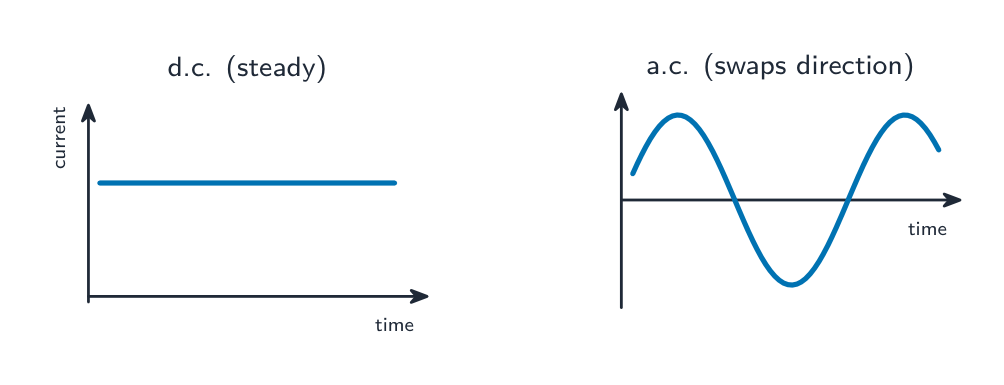
A direct current 直流电 (d.c.) always flows one way, as from a battery. An alternating current 交流电 (a.c.) keeps swapping direction many times each second, as from the mains supply 市电.

ไทย

กระแสไฟฟ้า คือการไหลของประจุไฟฟ้า วัดในหน่วย แอมแปร์ (A) ด้วย แอมมิเตอร์ ต่อแบบอนุกรมในวงจร

แอมมิเตอร์แบบ แอนาล็อก มีเข็มที่เลื่อนบนสเกล; แอมมิเตอร์แบบ ดิจิทัล แสดงค่าอ่านเป็นตัวเลข ทั้งสองมี ช่วงวัด ต่างกัน เลือกช่วงวัดที่สูงกว่ากระแสสูงสุดที่คุณคาดไว้เล็กน้อย เพื่อให้ค่าอ่านแม่นยำ: ช่วง 0–1 A สำหรับกระแสประมาณ 0.4 A, หรือช่วง 0–100 mA สำหรับกระแสหลาย miliampere

กระแสคือปริมาณประจุที่ผ่านจุดใดจุดหนึ่งในแต่ละวินาที:

$$I = \frac{Q}{t}$$

ที่นี่ $I$ แทนกระแส (A), $Q$ แทนประจุ (C) และ $t$ แทนเวลา (s) จัดรูปใหม่ได้ $Q = It$

ตัวอย่างคำนวณ กระแส $3.0\ \text{A}$ ไหลผ่านโคมไฟเป็นเวลา $20\ \text{s}$ มีประจุไฟฟ้ากี่คูลอมบ์ที่ไหลผ่าน?

$$Q = It = 3.0 \times 20 = 60\ \text{C}$$

ในโลหะ กระแสคือการไหลของ อิเล็กตรอนอิสระ มี "ทิศทาง" สองอย่างที่ต้องรู้:

  • กระแสตามแบบแผน ถือว่าไหลจาก + ไป − รอบด้านนอกของเซลล์
  • อิเล็กตรอนอิสระจริง ๆ ลอยตัวไปในทิศทางตรงกันข้าม จาก − ไป +

กระแสตรง (d.c.) ไหลในทิศทางเดียวเสมอ เช่น จากแบตเตอรี่ กระแสสลับ (a.c.) เปลี่ยนทิศทางซ้ำแล้วซ้ำเล่าหลายครั้งต่อวินาที เช่น จาก แหล่งจ่ายไฟหลัก

เส้นแนวนอนคงที่สำหรับกระแสตรงและคลื่นที่ตัดจุดศูนย์สำหรับกระแสสลับ
กระแสตรงไหลในทิศทางเดียวอย่างคงที่; กระแสสลับเปลี่ยนทิศทางซ้ำๆ ตัดจุดศูนย์หลายครั้งต่อวินาที
Vocabulary · ⁨คำศัพท์⁩ Train · ⁨ฝึกฝน⁩
English ไทย
ampere/ˈæmpeə/ แอมแปร์
ammeter/ˈæmiːtə/ แอมมิเตอร์
analogue/ˈænəlɒɡ/ อะนาล็อก
digital/ˈdɪdʒɪtl/ ดิจิทัล
ranges/ˈreɪndʒɪz/ ช่วง
free electrons/friː ɪˈlektrɒnz/ อิเล็กตรอนอิสระ
conventional current/kənˈvenʃənl ˈkʌrənt/ กระแสไฟฟ้าแบบปกติ
direct current/daɪˈrekt ˈkʌrənt/ กระแสตรง
alternating current/ˈɔːltəneɪtɪŋ ˈkʌrənt/ กระแสสลับ
mains supply/meɪnz səˈplaɪ/ แหล่งจ่ายไฟหลัก
4.2

E.m.f. and potential difference · ⁨แรงดันไฟฟ้าและผลต่างศักย์⁩

English

A cell gives energy 能量 to the charges that move through it. Two quantities describe this, and both are measured in volts 伏特 (V).

  • The electromotive force 电动势 (e.m.f.) of a source is the electrical work it does to drive unit charge all the way round a complete circuit 电路.
  • The potential difference 电势差 (p.d.) across a component is the work done by unit charge as it passes through that component.

A voltmeter 电压表 measures e.m.f. or p.d. It is joined in parallel (across the component). Like ammeters, voltmeters are analogue or digital and have different ranges: pick the range just above the largest voltage you expect.

Both are work done per unit charge:

$$E = \frac{W}{Q}, \qquad V = \frac{W}{Q}$$

where $W$ is the energy transferred (J) and $Q$ is the charge (C). For example, if a cell does $120\ \text{J}$ of work moving $60\ \text{C}$ of charge round a circuit, its e.m.f. is $120 / 60 = 2\ \text{V}$.

ไทย

เซลล์ให้ พลังงาน แก่ประจุที่เคลื่อนที่ผ่านมัน มีสองปริมาณที่อธิบายสิ่งนี้ และวัดได้ในหน่วย โวลต์ (V)

  • แรงดันไฟฟ้า (e.m.f.) ของแหล่งจ่ายคืองานไฟฟ้าที่ทำเพื่อขับเคลื่อนประจุหนึ่งหน่วยให้วนครบทั้ง วงจร
  • ผลต่างศักย์ (p.d.) Across องค์ประกอบคืองานที่ทำโดยประจุหนึ่งหน่วยขณะไหล ผ่านองค์ประกอบนั้น

โวลต์มิเตอร์ ใช้วัด e.m.f. หรือ p.d. ต่อแบบขนาน (Across องค์ประกอบ) เหมือนกับแอมมิเตอร์ โวลต์มิเตอร์มีแบบแอนาล็อกหรือดิจิทัลและมีช่วงวัดต่างๆ: เลือกช่วงวัดที่สูงกว่าแรงดันสูงสุดที่คุณคาดไว้เล็กน้อย

วงจรที่มีโวลต์มิเตอร์ต่อ Across เซลล์เพื่อวัด e.m.f. และโวลต์มิเตอร์ต่อ Across โคมไฟเพื่อวัดผลต่างศักย์
โวลต์มิเตอร์ต่อ Across เซลล์ อ่านค่า e.m.f. (พลังงานที่มอบให้ต่อหนึ่งคูลอมบ์); โวลต์มิเตอร์ต่อ Across โคมไฟ อ่านค่า p.d. (พลังงานที่สิ้นเปลืองต่อหนึ่งคูลอมบ์)

ทั้งสองคืองาน就做ต่อหนึ่งหน่วยประจุ:

$$E = \frac{W}{Q}, \qquad V = \frac{W}{Q}$$

โดยที่ $W$ แทนพลังงานที่ถ่ายโอน (J) และ $Q$ แทนประจุ (C) ตัวอย่างเช่น ถ้าเซลล์ทำงาน $120\ \text{J}$ ในการเคลื่อนย้ายประจุ $60\ \text{C}$ รอบวงจร e.m.f. ของมันคือ $120 / 60 = 2\ \text{V}$

4.2

Resistance · ⁨การต่อต้าน⁩

English

Resistance 电阻 measures how hard it is for current to flow. A bigger resistance gives a smaller current. It is measured in ohms 欧姆 (Ω).

$$R = \frac{V}{I}$$

Measuring resistance. Connect the component in series with a cell, a switch, an ammeter and a variable resistor 可变电阻器, and connect a voltmeter across the component. Close the switch, read $I$ and $V$, then change the variable resistor to get several more pairs of readings. Either calculate $R = V/I$ for each pair and take the average, or plot $V$ against $I$: for a metal wire at constant temperature the graph is a straight line through the origin, and its gradient is $R$.

Worked example. A $12\ \text{V}$ battery drives a current of $0.50\ \text{A}$ through a lamp. Find the lamp's resistance.

$$R = \frac{V}{I} = \frac{12}{0.50} = 24\ \Omega$$

For a metal wire at constant temperature:

  • a longer wire has a bigger resistance — resistance is directly proportional 成正比 to length, $R \propto l$;
  • a thicker wire has a smaller resistance — resistance is inversely proportional 成反比 to cross-sectional area 横截面积, $R \propto \dfrac{1}{A}$.

So doubling the length doubles the resistance; doubling the area halves it. (Area depends on the diameter squared, so a small change in diameter changes the resistance a lot.)

Current–voltage graphs show how three components behave:

Component Shape of the I–V graph What it tells you
resistor 电阻器 (fixed) straight line through the origin resistance is constant, so $I \propto V$
filament lamp 灯丝灯泡 S-shaped, getting flatter as $V$ rises the wire heats up, so its resistance rises
diode 二极管 current one way only very high resistance the "wrong" way
ไทย

ความต้านทาน วัดความยากในการไหลของกระแส ความต้านทานยิ่งมาก กระแสยิ่งน้อย วัดในหน่วย โอห์ม (Ω)

$$R = \frac{V}{I}$$

การวัดความต้านทาน เชื่อมต่อส่วนประกอบเข้ากับเซลล์ สวิตช์ แอมมิเตอร์ และ ตัวต้านทานแปรผัน แบบอนุกรม แล้วเชื่อมโวลต์มิเตอร์ข้ามส่วนประกอบนั้น ปิดสวิตช์ อ่านค่า $I$ และ $V$ จากนั้นปรับตัวต้านทานแปรผันเพื่อรับคู่读数เพิ่มเติมอีกหลายคู่ Either คำนวณ $R = V/I$ สำหรับแต่ละคู่แล้วหาค่าเฉลี่ย หรือกราฟ $V$ เทียบกับ $I$: สำหรับลวดโลหะที่อุณหภูมิคงที่ กราฟจะเป็นเส้นตรงผ่านจุดกำเนิด และความชันของกราฟคือ $R$.

ตัวอย่างวิธีทำ แบตเตอรี่ขนาด $12\ \text{V}$ กระแสไฟฟ้าไหลผ่านหลอดไฟได้ $0.50\ \text{A}$ จงหาความต้านทานของหลอดไฟ

$$R = \frac{V}{I} = \frac{12}{0.50} = 24\ \Omega$$

สำหรับลวดโลหะที่อุณหภูมิคงที่:

  • ลวดยาวขึ้นจะมีความต้านทานมากขึ้น — ความต้านทานเป็น สัดส่วนโดยตรง กับความยาว, $R \propto l$;
  • ลวดหนาขึ้นจะมีความต้านทานน้อยลง — ความต้านทานเป็น สัดส่วน역 กับ พื้นที่หน้าตัด, $R \propto \dfrac{1}{A}$.

ดังนั้น การเพิ่มความยาวเป็นสองเท่าจะทำให้ความต้านทานเพิ่มเป็นสองเท่า; การเพิ่มพื้นที่หน้าตัดเป็นสองเท่าจะทำให้ความต้านทานลดลงครึ่งหนึ่ง (พื้นที่ขึ้นอยู่กับเส้นผ่านศูนย์กลางกำลังสอง ดังนั้นการเปลี่ยนแปลงเส้นผ่านศูนย์กลางเล็กน้อยจะส่งผลให้ความต้านทานเปลี่ยนแปลงมาก)

กราฟกระแส-แรงดันไฟฟ้าแสดงพฤติกรรมของส่วนประกอบสามชนิด:

ส่วนประกอบ รูปร่างของกราฟ I–V สิ่งที่บอกให้คุณทราบ
ตัวต้านทาน (คงที่) เส้นตรงผ่านจุดกำเนิด ความต้านทานคงที่ ดังนั้น $I \propto V$
หลอดไส้ รูปทรงตัว S, ที่แบนลงเมื่อ $V$ เพิ่มขึ้น ลวดร้อนขึ้น ทำให้ความต้านทานเพิ่มขึ้น
ไดโอด กระแสไหลได้ทางเดียวเท่านั้น มีความต้านทานสูงมากเมื่อต่อกลับด้าน
กราฟกระแส-แรงดันไฟฟ้าสามแบบ: เส้นตรงสำหรับตัวต้านทาน, โคลนรูปตัว S สำหรับหลอดไส้, และโค้งทางเดียวสำหรับไดโอด
ตัวต้านทานให้เส้นตรง; หลอดไส้โค้งเมื่อร้อนขึ้น; ไดโอดให้กระแสไหลได้ทางเดียวเท่านั้น
Explore · ⁨สำรวจ⁩

Ohm's law · ⁨กฎของโอห์ม⁩

V = IR

For an ohmic conductor the current is proportional to the voltage — the gradient is 1/resistance. · ⁨สำหรับตัวนำแบบโอห์ม กระแสแปรผันตรงกับแรงดัน — ความชันคือ 1/ความต้านทาน⁩

Explore · ⁨สำรวจ⁩

I–V characteristics · ⁨ลักษณะกราฟ I–V⁩

A resistor gives a straight line; a filament lamp and a diode do not. Pick a component and read I and R off the curve. · ⁨ตัวต้านทานให้เส้นตรง; หลอดไส้และไดโอดไม่ demikian เลือกองค์ประกอบหนึ่งและอ่านค่า I และ R จากกราฟ⁩

Explore · ⁨สำรวจ⁩

Resistance · ⁨การต่อต้าน⁩

V = R·I

Ohm's law: voltage is proportional to current — the gradient is the resistance R. · ⁨กฎของโอห์ม: แรงดันไฟฟ้า แปรผันตรง กับกระแส — ความชันคือความต้านทาน R⁩

4.2

Electrical energy and power · ⁨พลังงานและกำลังไฟฟ้า⁩

English

A circuit transfers energy from a source (a cell or the mains) to the components, and then into the surroundings (often as heat, light or sound).

Electrical power 电功率 is the energy transferred each second, measured in watts 瓦特 (W):

$$P = IV$$

The electrical energy 电能 transferred in a time $t$, measured in joules 焦耳 (J), is:

$$E = IVt$$

Worked example. A $12\ \text{V}$ motor draws a current of $2.0\ \text{A}$. Find its power, and the energy it transfers in $30\ \text{s}$.

$$P = IV = 2.0 \times 12 = 24\ \text{W}$$
$$E = Pt = 24 \times 30 = 720\ \text{J}$$

The kilowatt-hour

Home electricity bills use a bigger energy unit, the kilowatt-hour 千瓦时 (kWh). One kilowatt-hour is the energy used by a $1\ \text{kW}$ appliance 电器 in $1$ hour.

$$\text{energy (kWh)} = \text{power (kW)} \times \text{time (h)}$$
$$\text{cost} = \text{energy (kWh)} \times \text{price per kWh}$$

For example, a $2\ \text{kW}$ heater 加热器 used for $3$ hours uses $2 \times 3 = 6\ \text{kWh}$. If one kWh costs $20$ cents, the cost is $6 \times 20 = 120$ cents.

ไทย

วงจรถ่ายโอนพลังงานจากแหล่งจ่าย (เซลล์หรือระบบไฟฟ้าหลัก) ไปยังส่วนประกอบ แล้วส่งต่อไปยังสิ่งแวดล้อม (มักเป็นความร้อน แสงหรือเสียง)

กำลังไฟฟ้า คือพลังงานที่ถ่ายโอนทุกวินาที วัดในหน่วย วัตต์ (W):

$$P = IV$$

พลังงานไฟฟ้า ที่ถ่ายโอนในช่วงเวลา $t$ วัดในหน่วย จูล (J), คือ:

$$E = IVt$$

ตัวอย่างวิธีทำ มอเตอร์ขนาด $12\ \text{V}$ ดึงกระแส $2.0\ \text{A}$ จงหากำลังไฟฟ้าของมอเตอร์ และพลังงานที่ถ่ายโอนในช่วง $30\ \text{s}$

$$P = IV = 2.0 \times 12 = 24\ \text{W}$$
$$E = Pt = 24 \times 30 = 720\ \text{J}$$

กิโลวัตต์-ชั่วโมง

บิลค่าไฟในบ้านใช้หน่วยพลังงานที่ใหญ่กว่านั้น คือ กิโลวัตต์-ชั่วโมง (kWh). One kilowatt-hour คือพลังงานที่ใช้โดยเครื่องใช้ไฟฟ้าขนาด $1\ \text{kW}$ ในเวลา $1$ ชั่วโมง

$$\text{energy (kWh)} = \text{power (kW)} \times \text{time (h)}$$
$$\text{cost} = \text{energy (kWh)} \times \text{price per kWh}$$

เช่น เครื่องทำความร้อนขนาด $2\ \text{kW}$ ที่ใช้งานเป็นเวลา $3$ ชั่วโมง ใช้พลังงาน $2 \times 3 = 6\ \text{kWh}$. หากหนึ่ง kWh มีราคา $20$ เซนต์ ค่าใช้จ่ายจะเท่ากับ $6 \times 20 = 120$ เซนต์

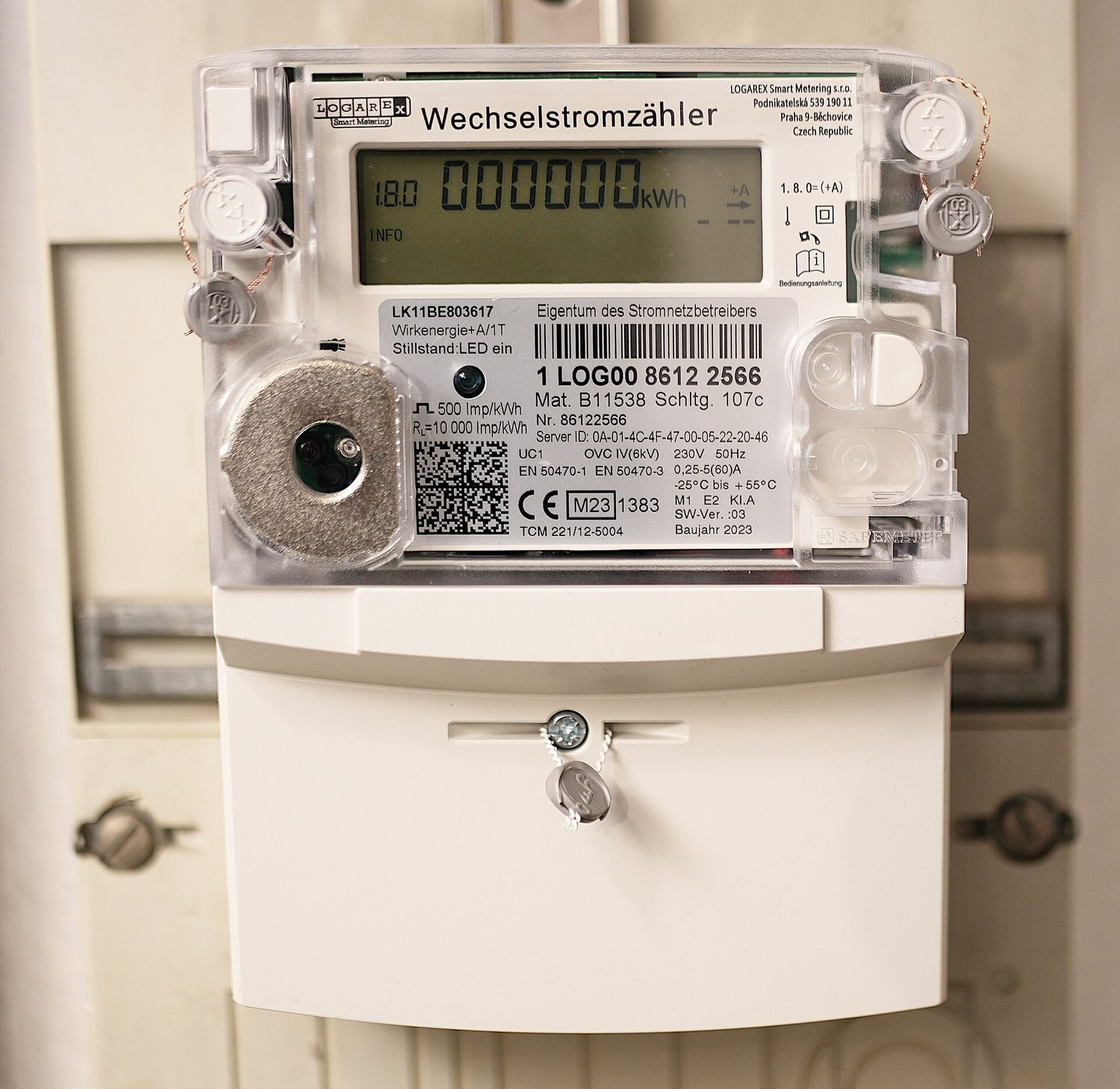
มิเตอร์ไฟฟ้าบ้านสมัยใหม่ที่มีจอแสดงผลดิจิทัลอ่านค่าศูนย์กิโลวัตต์-ชั่วโมง
มิเตอร์ไฟฟ้าบ้านนับพลังงานที่ใช้ไป เป็นกิโลวัตต์-ชั่วโมง (kWh) — จำนวนที่แสดงคือสิ่งที่คุณต้องชำระ
Vocabulary · ⁨คำศัพท์⁩ Train · ⁨ฝึกฝน⁩
English ไทย
energy/ˈenədʒi/ พลังงาน
volt/vəʊlt/ โวลต์
electromotive force/ɪˌlektrəʊˈməʊtɪv fɔːs/ แรงขับเคลื่อนไฟฟ้า
watt/wɒt/ วัตต์
electrical energy/ɪˈlektrɪkl ˈenədʒi/ พลังงานไฟฟ้า
joule/dʒuːl/ จูล
kilowatt-hour/ˈkɪləwɒt ˈaʊə/ กิโลวัตต์-ชั่วโมง
appliance/əˈplaɪəns/ อุปกรณ์ไฟฟ้า
heater/ˈhiːtə/ เครื่องทำความร้อน
cell/sel/ เซลล์
battery/ˈbætəri/ 电池
power supply/ˈpaʊə səˈplaɪ/ แหล่งจ่ายไฟ
switch/swɪtʃ/ สวิตช์
fuse/fjuːz/ ฟิวส์
thermistor/ˈθɜːmɪstə/ เทอร์มิสเตอร์
light-dependent resistor/laɪt dɪˈpendənt rɪˈzɪstə/ ตัวต้านทานแสง
light-emitting diode/laɪt ɪˈmɪtɪŋ ˈdaɪəʊd/ ไดโอดเปล่งแสง (LED)
relay/ˈriːleɪ/ รีเลย์
4.3

Circuits · ⁨วงจรไฟฟ้า⁩

Syllabus · ⁨หลักสูตร⁩
English

4.3.1 Circuit diagrams and circuit components

Core Supplement
1 Draw and interpret circuit diagrams containing cells, batteries, power supplies, generators, potential dividers, switches, resistors (fixed and variable), heaters, thermistors (NTC only), light-dependent resistors (LDRs), lamps, motors, bells, ammeters, voltmeters, magnetising coils, transformers, fuses and relays and know how these components behave in the circuit 2 Draw and interpret circuit diagrams containing diodes and light-emitting diodes (LEDs) and know how these components behave in the circuit

4.3.2 Series and parallel circuits

Core Supplement
1 Know that the current at every point in a series circuit is the same 8 Recall and use in calculations, the fact that: (a) the sum of the currents entering a junction in a parallel circuit is equal to the sum of the currents that leave the junction (b) the total p.d. across the components in a series circuit is equal to the sum of the individual p.d.s across each component (c) the p.d. across an arrangement of parallel resistances is the same as the p.d. across one branch in the arrangement of the parallel resistances
2 Know how to construct and use series and parallel circuits
3 Calculate the combined e.m.f. of several sources in series
4 Calculate the combined resistance of two or more resistors in series
5 State that, for a parallel circuit, the current from the source is larger than the current in each branch 9 Explain that the sum of the currents into a junction is the same as the sum of the currents out of the junction
6 State that the combined resistance of two resistors in parallel is less than that of either resistor by itself 10 Calculate the combined resistance of two resistors in parallel
7 State the advantages of connecting lamps in parallel in a lighting circuit

4.3.3 Action and use of circuit components

Core Supplement
1 Know that the p.d. across an electrical conductor increases as its resistance increases for a constant current 2 Describe the action of a variable potential divider
3 Recall and use the equation for two resistors used as a potential divider
$$\frac{R_1}{R_2} = \frac{V_1}{V_2}$$
ไทย

4.3.1 แผนภาพวงจรและองค์ประกอบวงจร

แก่น เพิ่มเติม
1 วาดและตีความแผนภาพวงจรที่ประกอบด้วยเซลล์, แบตเตอรี่, แหล่งจ่ายไฟ, เครื่องกำเนิดไฟฟ้า, ตัวแบ่งแรงดัน, สวิตช์, ต้านทาน (คงที่และตัวแปร), heaters, เทอร์มิสเตอร์ (NTC เท่านั้น), แอลดีอาร์, หลอดไฟ, มอเตอร์, กระดิ่ง, อัมมิเตอร์, โวลต์มิเตอร์,คอยล์แม่เหล็กไฟฟ้า, หม้อแปลง, ฟิวส์ และรีเลย์ และรู้วิธีการทำงานของส่วนประกอบเหล่านี้ในวงจร 2 วาดและตีความแผนภาพวงจรที่ประกอบด้วยไดโอดและแอลอีดี และรู้วิธีการทำงานของส่วนประกอบเหล่านี้ในวงจร

4.3.2 วงจรแบบอนุกรมและขนาน

แก่น เพิ่มเติม
1 รู้ว่ากระแสไฟฟ้า在每个จุดใน วงจรแบบอนุกรม มีค่าเท่ากัน 8 จำและใช้ในการคำนวณว่า: (ก) ผลรวมของกระแสที่ไหลเข้าจุดแยกในวงจรแบบขนานมีค่าเท่ากับผลรวมของกระแสที่ไหลออกจากจุดแยก (ข) แรงดันรวม across ส่วนประกอบในวงจรแบบอนุกรมมีค่าเท่ากับผลรวมของแรงดัน individual across ส่วนประกอบแต่ละชิ้น (ค) แรง跨过 arrangement ของตัวต้านทานแบบขนานมีค่าเท่ากับแรง跨过 one branch ใน arrangement ของตัวต้านทานแบบขนาน
2 รู้วิธีการสร้างและใช้วงจรแบบอนุกรมและขนาน
3 คำนวณ e.m.f. รวมของแหล่งกำเนิดหลายแหล่งที่ต่อแบบอนุกรม
4 คำนวณความต้านทานรวมของตัวต้านทานสองตัวหรือมากกว่าที่ต่อแบบอนุกรม
5 ระบุ ότιสำหรับ วงจรแบบขนาน, กระแสจากแหล่งจ่ายมีค่ามากกว่ากระแสในแต่ละ branch 9 อธิบายว่าผลรวมของกระแสที่ไหลเข้าจุดแยกมีค่าเท่ากับผลรวมของกระแสที่ไหลออกจากจุดแยก
6 ระบุว่าความต้านทานรวมของตัวต้านทานสองตัวที่ต่อแบบขนานมีค่าน้อยกว่าความต้านทานของแต่ละตัวเอง 10 คำนวณความต้านทานรวมของตัวต้านทานสองตัวที่ต่อแบบขนาน
7 ระบุข้อดีของการต่อหลอดไฟแบบขนานในวงจรแสงสว่าง

4.3.3 การทำงานและการใช้งานของส่วนประกอบวงจร

แก่น เพิ่มเติม
1 รู้ว่าแรง跨过 electrical conductor จะเพิ่มขึ้นเมื่อความต้านทานเพิ่มขึ้นสำหรับกระแสคงที่ 2 อธิบายการทำงานของ variable potential divider
3 จำและใช้สมการสำหรับตัวต้านทานสองตัวที่ใช้เป็น potential divider
$$\frac{R_1}{R_2} = \frac{V_1}{V_2}$$

Source: Cambridge International syllabus · ⁨แหล่งที่มา: หลักสูตร Cambridge International⁩

English

Circuit components

You should know these components and how they behave:

Component What it does
cell 电池 / battery 电池组 drives current round the circuit (a battery is two or more cells)
power supply 电源 a source of d.c. or a.c.
switch 开关 breaks or completes the circuit
resistor (fixed) gives a fixed resistance
variable resistor a resistance you can change, to control the current
fuse 保险丝 melts and breaks the circuit if the current is too big
lamp / heater turns electrical energy into light / into heat
thermistor 热敏电阻 its resistance falls as it gets hotter
light-dependent resistor 光敏电阻 (LDR) its resistance falls as the light gets brighter
diode / light-emitting diode 发光二极管 (LED) lets current one way only; an LED also gives out light
relay 继电器 a switch worked by an electromagnet (small current controls a big one)
motor 电动机 turns electrical energy into movement
bell 电铃 makes a sound
transformer 变压器 changes the size of an a.c. voltage

Series and parallel

In a series 串联 circuit the parts form one single loop:

  • the current is the same at every point;
  • the supply p.d. is shared between the components;
  • cells in series add their e.m.f.s (when they point the same way);
  • resistors in series add up: $R_{\text{total}} = R_1 + R_2 + \dots$

In a parallel 并联 circuit the parts are on separate branches:

  • each branch gets the full supply p.d.;
  • the current splits, so the current from the source is bigger than the current in any one branch;
  • the total resistance 总电阻 is less than the smallest single resistance.

Lamps in a home are wired in parallel: each gets the full voltage, and if one fails the others stay on.

For calculations (with the rules above):

  • at a junction 节点, the total current flowing in equals the total current flowing out;
  • in series, the supply p.d. equals the sum of the p.d.s across the components;
  • in parallel, the p.d. across each branch is the same;
  • two resistors in parallel combine as
$$\frac{1}{R_{\text{total}}} = \frac{1}{R_1} + \frac{1}{R_2}$$

Worked example. A $6\ \Omega$ resistor and a $3\ \Omega$ resistor are connected in parallel. Find their combined resistance.

$$\frac{1}{R_{\text{total}}} = \frac{1}{6} + \frac{1}{3} = \frac{1}{6} + \frac{2}{6} = \frac{3}{6} = \frac{1}{2} \quad\Rightarrow\quad R_{\text{total}} = 2\ \Omega$$

Notice the combined resistance ($2\ \Omega$) is smaller than the smaller of the two resistors.

Potential dividers

Two resistors in series share the supply voltage. This is a potential divider 分压器. For the same current, a bigger resistance has a bigger p.d. across it, so the bigger resistor takes the bigger share:

$$\frac{R_1}{R_2} = \frac{V_1}{V_2}$$

A variable potential divider (or a variable resistor) lets you change the output voltage smoothly, for example from $0\ \text{V}$ up to the full supply. If you use a thermistor or an LDR as one of the resistors, the output voltage changes with temperature or light — handy for switching a heater or a lamp on and off automatically.

ไทย

ส่วนประกอบวงจร

คุณควรรู้จักส่วนประกอบเหล่านี้และวิธีการทำงาน:

ส่วนประกอบ การทำงาน
เซลล์ / แบตเตอรี่ ผลักดันกระแสไฟฟ้ารอบวงจร (แบตเตอรี่คือเซลล์สองเซลล์ขึ้นไป)
แหล่งจ่ายไฟ แหล่งจ่าย d.c. หรือ a.c.
สวิตช์ เปิดหรือปิดวงจร
ตัวต้านทาน (คงที่) ให้ค่าความต้านทานคงที่
ตัวต้านทานแปรผัน ความต้านทานที่สามารถเปลี่ยนได้ เพื่อควบคุมกระแสไฟฟ้า
ฟิวส์ หลอมละลายและตัดวงจรหากมีกระแสไฟฟ้ามากเกินไป
หลอดไฟ / เครื่องทำความร้อน แปลงพลังงานไฟฟ้าเป็นแสง / เป็นความร้อน
เทอร์มิสเตอร์ ความต้านทานลดลงเมื่อร้อนขึ้น
ตัวต้านทานตามแสง (LDR) ความต้านทานลดลงเมื่อแสงสว่างขึ้น
ไดโอด / ไดโอดปล่อยแสง (LED) ให้กระแสไหลได้ทางเดียว; LED ยัง emit แสงด้วย
รีเลย์ สวิตช์ที่ขับเคลื่อนด้วยแม่เหล็กไฟฟ้า (กระแสเล็กควบคุมกระแสใหญ่)
มอเตอร์ แปลงพลังงานไฟฟ้าเป็นการเคลื่อนไหว
กระดิ่ง สร้างเสียง
หม้อแปลง เปลี่ยนขนาดแรงดันไฟฟ้า a.c.
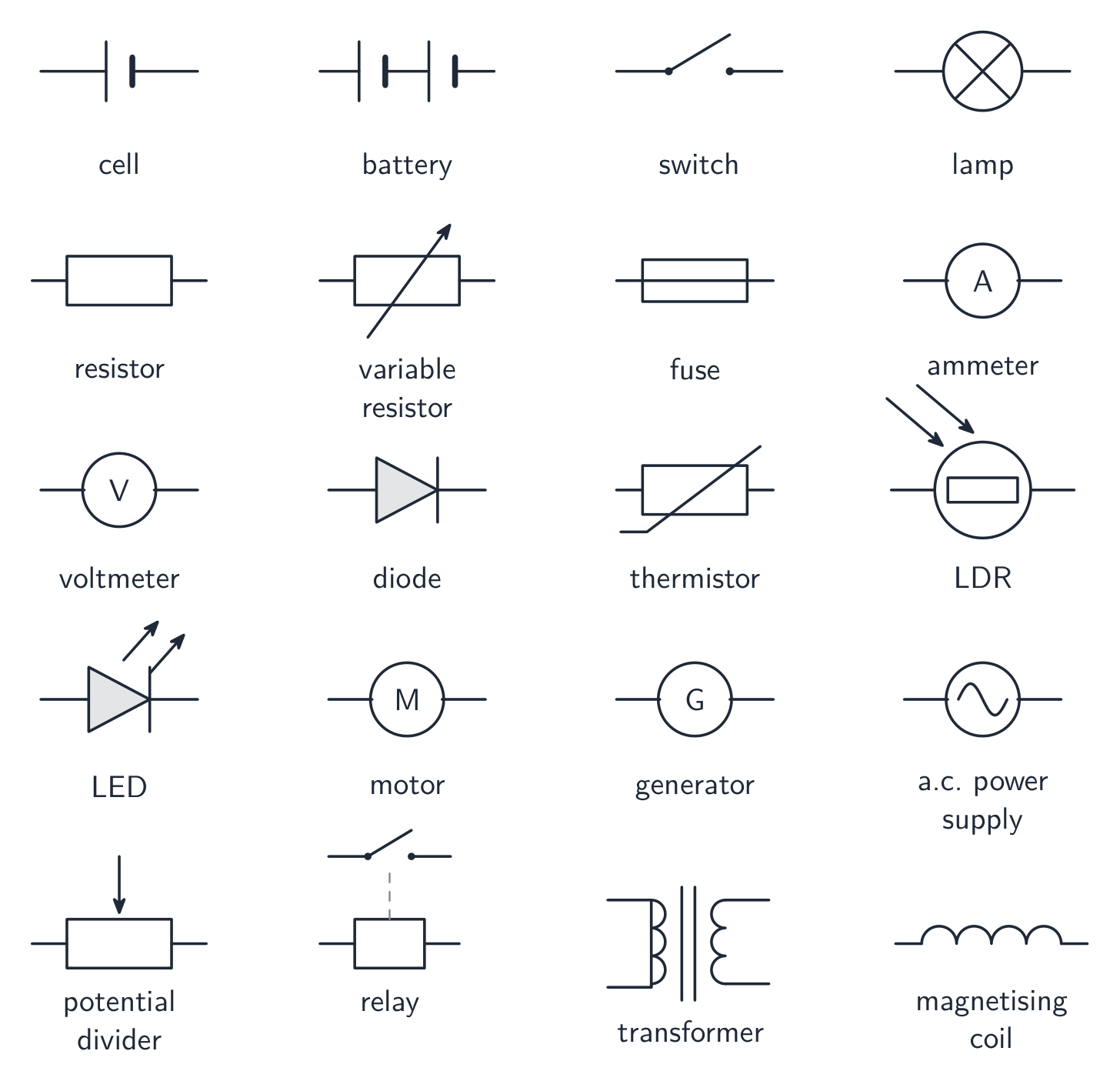
แผนภูมิสัญลักษณ์วงจรมาตรฐาน: เซลล์, แบตเตอรี่, สวิตช์, หลอดไฟ, ตัวต้านทาน, ตัวต้านทานแปรผัน, ฟิวส์, อะมิเตอร์, โวลต์มิเตอร์, ไดโอด, เทอร์มิสเตอร์, LDR, LED, มอเตอร์, เจเนอเรเตอร์, แหล่งจ่าย a.c., ตัวแบ่งศักย์, รีเลย์, เทรนส์ฟอร์เมอร์ และคอยล์แม่เหล็ก
สัญลักษณ์มาตรฐานที่ใช้วาดแผนภาพวงจร
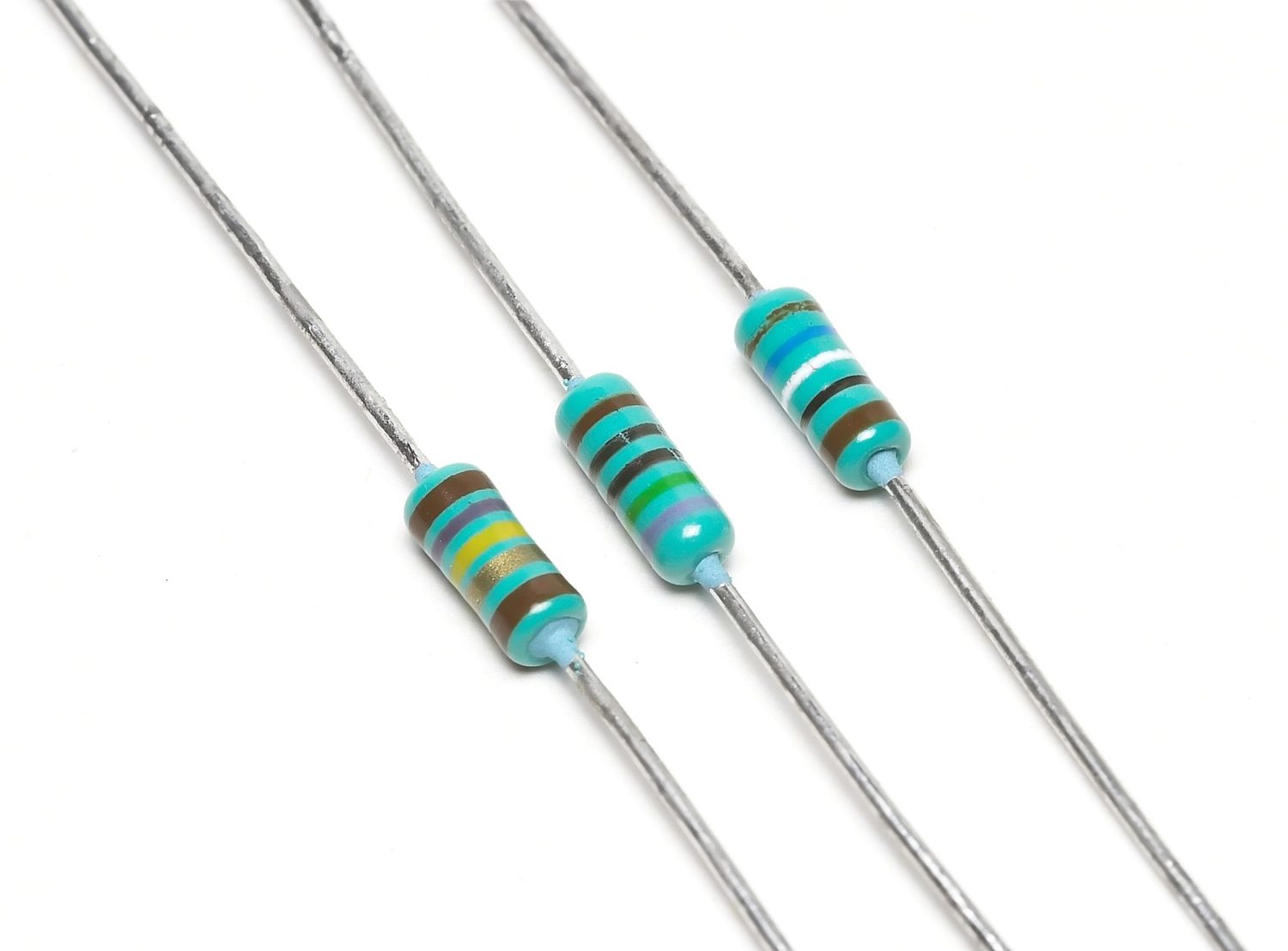
แถวของตัวต้านทานขนาดเล็กจัดเรียงบนเทปกระดาษ แต่ละตัวมีแถบสีและมีขดลวดสองเส้น
ตัวต้านทานจริง: แถบสีบอกค่าความต้านทานเป็นโอห์มของแต่ละตัว

แบบอนุกรมและแบบขนาน

ในวงจร แบบอนุกรม ส่วนประกอบสร้างวงลูปเดียว:

  • กระแสไฟฟ้าเท่ากันทุกจุด;
  • แรงดันไฟฟ้าจากแหล่งจ่ายถูกแบ่งระหว่างส่วนประกอบ;
  • เซลล์ต่อแบบอนุกรมรวม e.m.f. ของกัน (เมื่อชี้ทิศทางเดียวกัน);
  • ตัวต้านทานต่อแบบอนุกรมรวมกัน: $R_{\text{total}} = R_1 + R_2 + \dots$

ในวงจร แบบขนาน ส่วนประกอบอยู่บนสายแยกต่างหาก:

  • สายแยกแต่ละเส้นได้รับแรงดันไฟฟ้าจากแหล่งจ่ายเต็มจำนวน;
  • กระแสไฟฟ้าจะแยก分支, ดังนั้นกระแสจากแหล่งจ่ายจะมีมากกว่ากระแสในสายแยกใดสายแยกหนึ่ง;
  • ความต้านทานรวม น้อยกว่าความต้านทานเดี่ยวที่น้อยที่สุด

หลอดไฟในบ้านต่อแบบขนาน: แต่ละหลอดได้รับแรงดันไฟฟ้าเต็มจำนวน และถ้าหลอดใดเสีย หลอดอื่นยังคงติดอยู่

วงจรแบบอนุกรมที่มีหลอดไฟสองดวงอยู่ในวงเดียวกันข้างเคียงกับวงจรแบบขนานที่มีหลอดไฟสองดวงแยกอยู่ในสาขาต่างๆ
ในวงจรแบบอนุกรม ส่วนประกอบแบ่งการใช้วงลูปเดียวกัน; ในวงจรแบบขนาน หลอดไฟแต่ละดวงมีสายแยกของตัวเอง

สำหรับการคำนวณ (ตามกฎข้างต้น):

  • ที่ จุดแยก, กระแสไฟฟ้ารวมที่ไหลเข้าเท่ากับกระแสไฟฟ้ารวมที่ไหลออก;
  • ในแบบอนุกรม, แรงดันไฟฟ้าจากแหล่งจ่ายเท่ากับผลรวมของแรงดันไฟฟ้าข้ามส่วนประกอบ;
  • ในแบบขนาน, แรงดันไฟฟ้าข้ามสายแยกแต่ละเส้นเท่ากัน;
  • ตัวต้านทานสองตัวต่อแบบขนานรวมกันเป็น
$$\frac{1}{R_{\text{total}}} = \frac{1}{R_1} + \frac{1}{R_2}$$

ตัวอย่างวิธีทำ. ตัวต้านทาน $6\ \Omega$ และตัวต้านทาน $3\ \Omega$ เชื่อมต่อแบบขนาน. หาความต้านทานรวม

$$\frac{1}{R_{\text{total}}} = \frac{1}{6} + \frac{1}{3} = \frac{1}{6} + \frac{2}{6} = \frac{3}{6} = \frac{1}{2} \quad\Rightarrow\quad R_{\text{total}} = 2\ \Omega$$

สังเกตว่าความต้านทานรวม ($2\ \Omega$) มีค่าน้อยกว่าความต้านทานตัวใดตัวหนึ่งจากทั้งสองตัว

ตัวหารศักย์ไฟฟ้า

ตัวต้านทานสองตัวต่อแบบอนุกรมจะแบ่งแรงดันไฟจากแหล่งจ่าย นี่คือ ตัวหารศักย์ไฟฟ้า เมื่อกระแสไหลเท่ากัน ความต้านทานที่สูงกว่าจะมีค่า p.d. สูงกว่า ดังนั้นตัวต้านทานที่ใหญ่กว่าจึงได้รับส่วนแบ่งแรงดันที่มากกว่า:

$$\frac{R_1}{R_2} = \frac{V_1}{V_2}$$

ตัวหารศักย์ไฟฟ้าแบบปรับได้ (หรือตัวต้านทานปรับค่าได้) ช่วยให้คุณเปลี่ยนแรงดันไฟขาออกได้อย่างต่อเนื่อง ตัวอย่างเช่น จาก $0\ \text{V}$ ขึ้นไปจนถึงแรงดันไฟเต็มของแหล่งจ่าย หากใช้เทอร์มิสเตอร์หรือ LDR เป็นตัวต้านทานตัวหนึ่ง แรงดันไฟขาออกจะเปลี่ยนแปลงตามอุณหภูมิหรือแสง — มีประโยชน์สำหรับการเปิด-ปิดเครื่องทำความร้อนหรือโคมไฟอัตโนมัติ

Explore · ⁨สำรวจ⁩

Build the current with Ohm's law · ⁨สร้างกระแสด้วยกฎของโอห์ม⁩

Turn up the voltage and the electrons speed up and the bulb glows brighter; add resistance and the current drops. I = V/R, brightness = power. · ⁨เพิ่มแรงดันแล้วอิเล็กตรอนจะเร็วขึ้นและหลอดไฟจะสว่างขึ้น; เพิ่มความต้านทานแล้วกระแสจะลดลง I = V/R, ความสว่าง = กำลังไฟฟ้า⁩

Vocabulary · ⁨คำศัพท์⁩ Train · ⁨ฝึกฝน⁩
English ไทย
circuit/ˈsɜːkɪt/ วงจร
potential difference/pəˈtenʃl ˈdɪfrəns/ ต่างศักย์
voltmeter/ˈvəʊltmiːtə/ โวลต์มิเตอร์
resistance/rɪˈzɪstəns/ ความต้านทาน
ohm/əʊm/ โอห์ม
variable resistor/ˈveərɪəbl rɪˈzɪstə/ ตัวต้านทานปรับค่าได้
directly proportional/daɪˈrektli prəˈpɔːʃənl/ แปรผันตรง
inversely proportional/ɪnˈvɜːsli prəˈpɔːʃənl/ แปรผกผัน
cross-sectional area/krɒs ˈsekʃənl ˈeərɪə/ พื้นที่หน้าตัด
resistor/rɪˈzɪstə/ ตัวต้านทาน
filament lamp/ˈfɪləmənt læmp/ หลอดไฟไส้
diode/ˈdaɪəʊd/ ไดโอด
electrical power/ɪˈlektrɪkl ˈpaʊə/ กำลังไฟฟ้า
series/ˈsɪəriːz/ 串联电路中
parallel/ˈpærəlel/ 并联电路中
total resistance/ˈtəʊtl rɪˈzɪstəns/ ความต้านทานรวม
junction/ˈdʒʌŋkʃn/ จุดแยก
potential divider/pəˈtenʃl dɪˈvaɪdə/ ตัวแบ่งศักย์
hazard/ˈhæzəd/ อันตราย
insulation/ˌɪnsjuːˈleɪʃn/ ฉนวนกันความร้อน (insulation)
overheating/ˌəʊvəˈhiːtɪŋ/ ความร้อนสะสม
damp/dæmp/ ชื้น / Damp
overloading/ˌəʊvəˈləʊdɪŋ/ การโอเวอร์โหลด (Overloading)
socket/ˈsɒkɪt/ ปลั๊กไฟ
live wire/laɪv ˈwaɪə/ สายไฟ
neutral wire/ˈnjuːtrəl ˈwaɪə/ สายกลาง
earth wire/ɜːθ ˈwaɪə/ สายดิน
fuse rating/fjuːz ˈreɪtɪŋ/ ค่าฟิวส์
trip switch/trɪp swɪtʃ/ สวิตช์ตัดวงจรอัตโนมัติ
casing/ˈkeɪsɪŋ/ โครง外壳
earthed/ɜːθt/ ต่อดิน
double-insulated/ˈdʌbl ˈɪnsjuːleɪtɪd/ ฉนวนสองชั้น
Watch lesson · ⁨ดูบทเรียน⁩
4.4

Electrical safety · ⁨ความปลอดภัยทางไฟฟ้า⁩

Syllabus · ⁨หลักสูตร⁩
English
Core Supplement
1 State the hazards of: (a) damaged insulation (b) overheating cables (c) damp conditions (d) excess current from overloading of plugs, extension leads, single and multiple sockets when using a mains supply
2 Know that a mains circuit consists of a live wire (line wire), a neutral wire and an earth wire and explain why a switch must be connected to the live wire for the circuit to be switched off safely
3 Explain the use and operation of trip switches and fuses and choose appropriate fuse ratings and trip switch settings
4 Explain why the outer casing of an electrical appliance must be either non-conducting (double-insulated) or earthed
5 State that a fuse without an earth wire protects the circuit and the cabling for a double-insulated appliance
ไทย
แก่น เพิ่มเติม
1 ระบุอันตรายของ: (ก) Isolator ที่เสียหาย (ข) สายเคเบิลร้อนเกินไป (ค) สภาพแวดล้อมที่ชื้น (ง) กระแสเกินจากการ overload ของปลั๊ก, สายต่อพ่วง, ปลั๊กไฟเดี่ยวและหลายช่องเมื่อใช้ mains supply
2 รู้ว่าวงจร mains ประกอบด้วย สายไฟ (live wire), สายศูนย์ (neutral wire) และ สายดิน (earth wire) และอธิบายว่าทำไมสวิตช์ต้องต่อกับสายไฟเพื่อให้วงจรปิดได้อย่างปลอดภัย
3 อธิบายการใช้งานและการทำงานของ trip switches และ fuses และเลือกค่า rating ของฟิวส์และการตั้งค่า trip switch ที่เหมาะสม
4 อธิบายว่าทำไม外壳 ของอุปกรณ์ไฟฟ้าต้องเป็น non-conducting (double-insulated) หรือ earthed
5 ระบุว่าฟิวส์ที่ไม่มีสายดินจะปกป้องวงจรและ cabling สำหรับอุปกรณ์ double-insulated

Source: Cambridge International syllabus · ⁨แหล่งที่มา: หลักสูตร Cambridge International⁩

English

A home is fed by the mains. The mains is dangerous if it is used wrongly.

Hazards

These are hazards 危险 (dangers) with mains electricity:

  • damaged insulation 绝缘层 — bare wires can give a shock or start a fire;
  • overheating 过热 cables — too much current makes a cable hot, which can start a fire;
  • damp 潮湿 conditions — water lets current pass into a person, raising the risk of a shock;
  • overloading 过载 — plugging too many appliances into one socket 插座 draws too much current.

Live, neutral and earth

A mains cable has three wires:

  • the live wire 火线 carries the high voltage;
  • the neutral wire 零线 completes the circuit at about zero voltage;
  • the earth wire 地线 is a safety wire joined to the ground.

A switch (and a fuse) must be fitted in the live wire. Then, when the switch is off, the appliance is cut off from the high voltage and is safe to touch.

Fuses, trip switches and earthing

A fuse is a thin wire that melts if the current gets too big, breaking the circuit before the cable overheats. Choose a fuse rating 额定值 just above the normal working current — for example a $13\ \text{A}$ fuse for an appliance that normally uses about $10\ \text{A}$.

A trip switch 跳闸开关 (circuit breaker) does the same job but acts faster and can be reset instead of replaced.

The metal casing 外壳 of an appliance must be made safe in one of two ways:

  • earthed 接地: the casing is joined to the earth wire. If a live wire touches the casing, a large current flows to earth and blows the fuse.
  • double-insulated 双重绝缘: the casing is plastic, so it can never become live. Such an appliance needs no earth wire; its fuse still protects the cable.
ไทย

บ้านเรือนได้รับพลังงานจากไฟฟ้ามAINS ไฟฟ้า Mains มีความเสี่ยงหากใช้งานไม่ถูกต้อง

ความเสี่ยง

นี่คือ ความเสี่ยง (อันตราย) จากไฟฟ้า Mains:

  • ฉนวนเสียหาย — สายไฟเปลือยอาจทำให้เกิดการช็อตไฟฟ้าหรือก่อให้เกิดไฟไหม้;
  • สายไฟร้อนเกินไป — กระแสไฟมากเกินไปทำให้สายไฟร้อน ซึ่งอาจก่อให้เกิดไฟไหม้;
  • สภาพแวดล้อมชื้น — น้ำช่วยให้กระแสไฟฟ้าไหลเข้าสู่ร่างกายมนุษย์ เพิ่มความเสี่ยงในการช็อตไฟฟ้า;
  • การรับโหลดเกิน — เสียบอุปกรณ์อิเล็กทรอนิกส์หลายชิ้นเข้ากับ ซ็อกเก็ต เดียวกัน ทำให้ดึงกระแสไฟมากเกินไป

สายไฟฟ้ายก, สายไฟนอtral และสายดิน

สายไฟ Mains มีสามเส้น:

  • สายไฟฟ้ายก ส่งผ่านแรงดันไฟสูง;
  • สายไฟนอtral ปิดวงจรที่ระดับแรงดันประมาณศูนย์;
  • สายดิน เป็นสายความปลอดภัยที่เชื่อมต่อกับพื้นดิน

สวิตช์ (และฟิวส์) ต้องติดตั้งอยู่ใน สายไฟฟ้ายก เมื่อสวิตช์ปิด อุปกรณ์จะตัดการเชื่อมต่อจากแรงดันไฟสูงและปลอดภัยต่อการสัมผัส

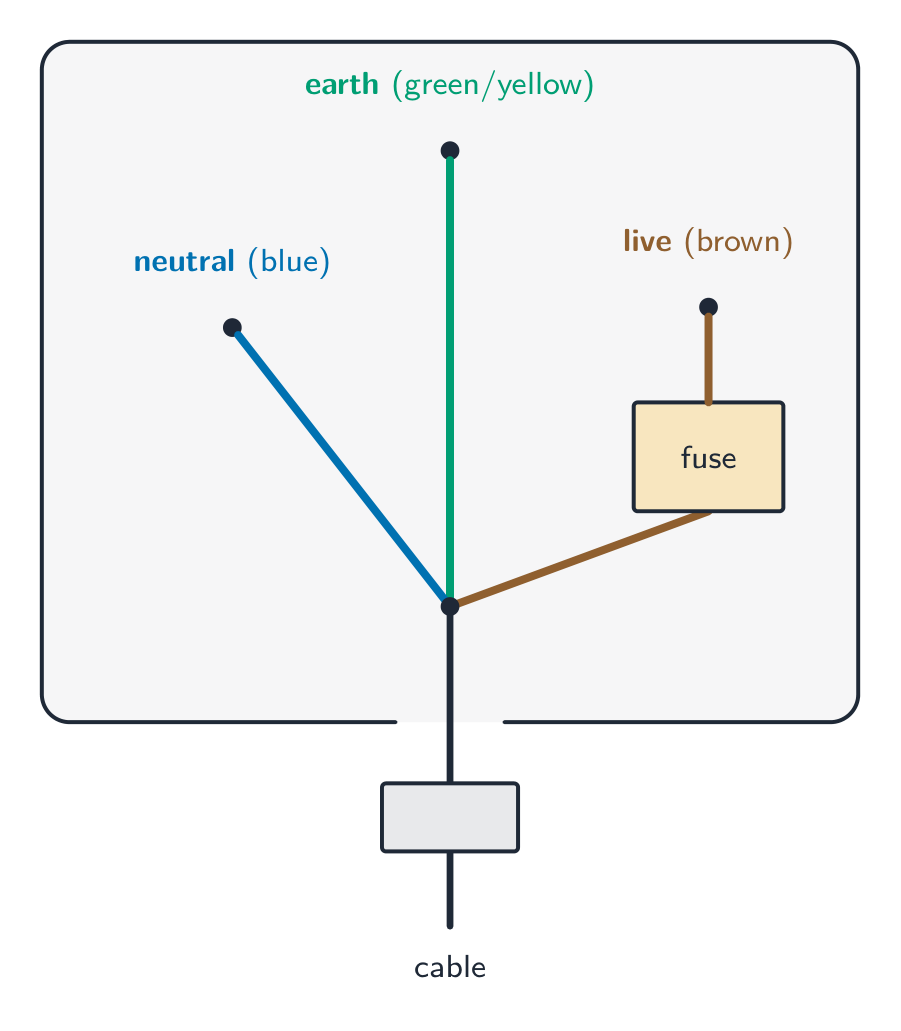
ปลั๊กสามขั้วที่มีสายไฟพร้อมสายดินสีเขียว/เหลืองด้านบน สายไฟนอtral สีน้ำเงินด้านซ้าย และสายไฟฟ้ายกสีน้ำตาลด้านขวา พร้อมติดตั้งฟิวส์ไว้ภายใน
ในปลั๊กสามขั้ว สายไฟฟ้ายก (สีน้ำตาล) และ สายไฟนอtral (สีน้ำเงิน) จะส่งกระแสไฟฟ้า ส่วน สายดิน (สีเขียว/เหลือง) เป็นสายความปลอดภัย และ ฟิวส์ จะวางอยู่ในสายไฟฟ้ายกเสมอ

ฟิวส์ สวิตช์ทริป และการต่อสายดิน

ฟิวส์เป็นลวดบางที่จะหลอมเหลวเมื่อกระแสไฟฟ้ามีขนาดใหญ่เกินไป ทำให้อุปกรณ์ตัดวงจรก่อนที่สายไฟจะร้อนเกินไป เลือกใช้ ค่า argparse ของฟิวส์ ที่สูงกว่ากระแสการทำงานปกติเพียงเล็กน้อย — ตัวอย่างเช่น ฟิวส์ขนาด $13\ \text{A}$ สำหรับอุปกรณ์ที่ปกติใช้กระแสประมาณ $10\ \text{A}$

สวิตช์ทริป (circuit breaker) ทำงานในลักษณะเดียวกันแต่ตอบสนองเร็วขึ้น และสามารถรีเซ็ตใหม่ได้โดยไม่ต้องเปลี่ยนใหม่

โครงโลหะ เคส ของอุปกรณ์ต้องได้รับการป้องกันด้วยวิธีใดวิธีหนึ่ง:

  • ต่อสายดิน: เคสเชื่อมต่อกับสายดิน หากสายไฟฟ้ายกสัมผัสกับเคส กระแสไฟฟ้าขนาดใหญ่จะไหลลงสู่ดินและทำให้ฟิวส์ขาด
  • ฉนวนคู่: เคสทำจากพลาสติก จึงไม่สามารถกลายเป็นสายไฟฟ้ายกได้ อุปกรณ์ประเภทนี้ไม่จำเป็นต้องใช้สายดิน; ฟิวส์ยังคงปกป้องสายไฟอยู่
ภายในกล่องควบคุมไฟฟ้าของบ้านแสดงแถวของ miniature circuit breakers และสวิตช์ทริป RCD สองตัว
กล่องควบคุมไฟฟ้าในบ้าน: MCB แต่ละตัวเป็นสวิตช์ทริปที่ตัดวงจรของตนเมื่อกระแสไฟฟ้ามีขนาดใหญ่ขึ้น; RCD (80 A, 30 mA) ตัดวงจรเร็วขึ้นอีกหากตรวจพบความผิดปกติต่อสายดิน
Explore · ⁨สำรวจ⁩

Electrical safety route · ⁨เส้นทางความปลอดภัยทางไฟฟ้า⁩

Follow fault current and see how safety devices protect people. · ⁨ติดตามกระแสไฟฟ้าที่ผิดปกติเพื่อดูว่าอุปกรณ์ป้องกันปกป้องผู้คนได้อย่างไร⁩

4.5

Electromagnetic effects · ⁨ผลกระทบทางแม่เหล็กไฟฟ้า⁩

Syllabus · ⁨หลักสูตร⁩
English

4.5.1 Electromagnetic induction

Core Supplement
1 Know that a conductor moving across a magnetic field or a changing magnetic field linking with a conductor can induce an e.m.f. in the conductor 4 Know that the direction of an induced e.m.f. opposes the change causing it
2 Describe an experiment to demonstrate electromagnetic induction 5 State and use the relative directions of force, field and induced current
3 State the factors affecting the magnitude of an induced e.m.f.

4.5.2 The a.c. generator

Core Supplement
1 Describe a simple form of a.c. generator (rotating coil or rotating magnet) and the use of slip rings and brushes where needed
2 Sketch and interpret graphs of e.m.f. against time for simple a.c. generators and relate the position of the generator coil to the peaks, troughs and zeros of the e.m.f.

4.5.3 Magnetic effect of a current

Core Supplement
1 Describe the pattern and direction of the magnetic field due to currents in straight wires and in solenoids 4 State the qualitative variation of the strength of the magnetic field around straight wires and solenoids
2 Describe an experiment to identify the pattern of the magnetic field (including direction) due to currents in straight wires and in solenoids
3 Describe how the magnetic effect of a current is used in relays and loudspeakers and give examples of their application 5 Describe the effect on the magnetic field around straight wires and solenoids of changing the magnitude and direction of the current

4.5.4 Force on a current-carrying conductor

Core Supplement
1 Describe an experiment to show that a force acts on a current-carrying conductor in a magnetic field, including the effect of reversing: (a) the current (b) the direction of the field 2 Recall and use the relative directions of force, magnetic field and current
3 Determine the direction of the force on beams of charged particles in a magnetic field

4.5.5 The d.c. motor

Core Supplement
1 Know that a current-carrying coil in a magnetic field may experience a turning effect and that the turning effect is increased by increasing: (a) the number of turns on the coil (b) the current (c) the strength of the magnetic field 2 Describe the operation of an electric motor, including the action of a split-ring commutator and brushes

4.5.6 The transformer

Core Supplement
1 Describe the construction of a simple transformer with a soft-iron core, as used for voltage transformations 6 Explain the principle of operation of a simple iron-cored transformer
2 Use the terms primary, secondary, step-up and step-down
3 Recall and use the equation
$$\frac{V_p}{V_s} = \frac{N_p}{N_s}$$
where p and s refer to primary and secondary
7 Recall and use the equation for 100% efficiency in a transformer
$$I_p V_p = I_s V_s$$
where p and s refer to primary and secondary
4 Describe the use of transformers in high-voltage transmission of electricity
5 State the advantages of high-voltage transmission 8 Recall and use the equation
$$P = I^2 R$$
to explain why power losses in cables are smaller when the voltage is greater
ไทย

4.5.1 การเหนี่ยวนำแม่เหล็กไฟฟ้า

แก่น เพิ่มเติม
1 รู้ว่า导体เคลื่อนที่ข้ามสนามแม่เหล็กหรือสนามแม่เหล็กที่เปลี่ยนแปลงเชื่อมโยงกับ conductor สามารถ induce e.m.f. ใน conductor 4 รู้ว่าทิศทางของ induced e.m.f. ขัดแย้งกับการเปลี่ยนแปลงที่ทำให้เกิดมัน
2 อธิบายการทดลองเพื่อแสดง electromagnetic induction 5 ระบุและใช้ relative directions ของแรง, สนามและกระแสเหนี่ยวนำ
3 ระบุปัจจัยที่มีผลต่อขนาดของ induced e.m.f.

4.5.2 เครื่องกำเนิดไฟฟ้า a.c.

แก่น เพิ่มเติม
1 อธิบายรูปแบบอย่างง่ายของ เครื่องกำเนิดไฟฟ้า a.c. (rotating coil หรือ rotating magnet) และการใช้ slip rings และ brushes เมื่อจำเป็น
2 วาดสเก็ตและตีความกราฟของ e.m.f. เทียบกับเวลาสำหรับเครื่องกำเนิดไฟฟ้า a.c. อย่างง่ายและเชื่อมโยงตำแหน่งของcoil กับจุดสูงสุด จุดต่ำสุด และศูนย์ของ e.m.f.

4.5.3 ผลของสนามแม่เหล็กจากกระแสไฟฟ้า

แก่น เพิ่มเติม
1 อธิบายรูปแบบและทิศทางของสนามแม่เหล็กจากกระแสในสายตรงและ solenoids 4 ระบุ qualitative variation ของความเข้มของสนามแม่เหล็กรอบๆ สายตรงและ solenoids
2 อธิบายการทดลองเพื่อระบุรูปแบบของสนามแม่เหล็ก (รวมถึงทิศทาง) จากกระแสในสายตรงและ solenoids
3 อธิบาย如何使用 magnetic effect of a current ใน relays และลำโพงและยกตัวอย่างการใช้งาน 5 อธิบายผลต่อการเปลี่ยนแปลงของสนามแม่เหล็กรอบๆ สายตรงและ solenoids จากการเปลี่ยนขนาดและทิศทางของกระแส

4.5.4 แรงบนตัวนำที่มีกระแสไฟฟ้า

แก่น เพิ่มเติม
1 อธิบายการทดลองเพื่อแสดงว่าแรงกระทำต่อตัวนำที่มีกระแสไฟฟ้าในสนามแม่เหล็ก รวมถึงผลของการกลับ: (ก) กระแส (ข) ทิศทางของสนาม 2 จำและใช้ relative directions ของแรง, สนามแม่เหล็กและกระแส
3 กำหนดทิศทางของแรงบน beams ของอนุภาคที่มีประจุในสนามแม่เหล็ก

4.5.5 มอเตอร์ d.c.

แก่น เพิ่มเติม
1 รู้ว่า coil ที่มีกระแสไฟฟ้าในสนามแม่เหล็กอาจได้รับ turning effect และการเพิ่ม turning effectทำได้โดยการเพิ่ม: (ก) จำนวนรอบของ coil (ข) กระแส (ค) ความเข้มของสนามแม่เหล็ก 2 อธิบายการทำงานของมอเตอร์ไฟฟ้า รวมถึงการทำงานของ split-ring commutator และ brushes

4.5.6 หม้อแปลง

แก่น เพิ่มเติม
1 อธิบายการก่อสร้างของ simple transformer ที่มี soft-iron core ซึ่งใช้สำหรับการแปลงแรงดัน 6 อธิบายหลักการทำงานของ simple iron-cored transformer
2 ใช้คำว่า primary, secondary, step-up และ step-down
3 จำและใช้สมการ
$$\frac{V_p}{V_s} = \frac{N_p}{N_s}$$
โดยที่ p และ s หมายถึง primary (ขดลวดแรก) และ secondary (ขดลวดที่สอง)
7 จำและใช้สมการสำหรับประสิทธิภาพ 100% ในหม้อแปลง
$$I_p V_p = I_s V_s$$
โดยที่ p และ s หมายถึง primary และ secondary
4 อธิบายการใช้หม้อแปลงในการส่งไฟฟ้าแรงสูง
5 ระบุข้อดีของการส่งไฟฟ้าแรงสูง 8 จำและใช้สมการ
$$P = I^2 R$$
เพื่ออธิบายว่าทำไมการสูญเสียพลังงานในสายเคเบิลจึงน้อยกว่าเมื่อมีแรงดันไฟฟ้าสูงขึ้น

Source: Cambridge International syllabus · ⁨แหล่งที่มา: หลักสูตร Cambridge International⁩

English
The transformer: turns ratio
Electromagnetic induction

The magnetic effect of a current

A current in a wire makes a magnetic field around it.

  • Around a straight wire the field lines are circles around the wire; the field is stronger close to the wire. Reverse the current and the field reverses.
  • A solenoid 螺线管 (a long coil 线圈 of wire) makes a field just like a bar magnet, with a N pole at one end and a S pole at the other. The field inside is strong and even.

You can show both patterns with iron filings or a plotting compass. The field gets stronger if you increase the current, add more turns, or place a soft-iron core inside.

The magnetic effect is used in a relay and in a loudspeaker. In a relay, a small current in a coil magnetises a soft-iron core, which pulls a switch closed in a second circuit. The second circuit can carry a large current, so a small switch or a sensor can safely control a motor or a heater (for example, the ignition switch of a car starts its motor through a relay). In a loudspeaker 扬声器 a changing current in a coil makes the coil push and pull a paper cone, which moves the air and makes sound.

Electromagnetic induction

When a wire moves across a magnetic field, or the field through a coil changes, an e.m.f. is induced in the wire. If the wire is part of a complete circuit, this e.m.f. drives a current. This is electromagnetic induction 电磁感应.

To show it: move a magnet in and out of a coil joined to a sensitive meter, and watch the needle flick. The induced e.m.f. is bigger when you use a stronger magnet, move faster, or use more turns on the coil. The induced e.m.f. always acts to oppose the change that causes it. The direction of the induced current is given by Fleming's right-hand rule 弗莱明右手定则: hold the thumb, first finger and second finger of the right hand at right angles to one another; the thumb points along the motion of the wire, the first finger along the field (N to S), and the second finger then gives the induced current.

The a.c. generator

An a.c. generator 交流发电机 turns movement into electricity. A coil is spun in a magnetic field (or a magnet is spun near a coil). As it turns, the field through the coil keeps changing, so an alternating e.m.f. is induced.

  • Slip rings 滑环 and carbon brushes 电刷 carry the current out to the circuit while the coil keeps turning.
  • The e.m.f. is largest when the coil is flat (moving fastest across the field) and zero when the coil is upright (moving along the field). So the e.m.f.–time graph is a wave: peak, zero, opposite peak, zero, for each turn.

Force on a current-carrying conductor

When a current-carrying wire lies in a magnetic field, the field of the wire and the field of the magnet push on each other, so the wire feels a force. This is the motor effect.

  • Reverse the current, or reverse the field, and the force reverses.
  • Make the current bigger or the field stronger, and the force is bigger.

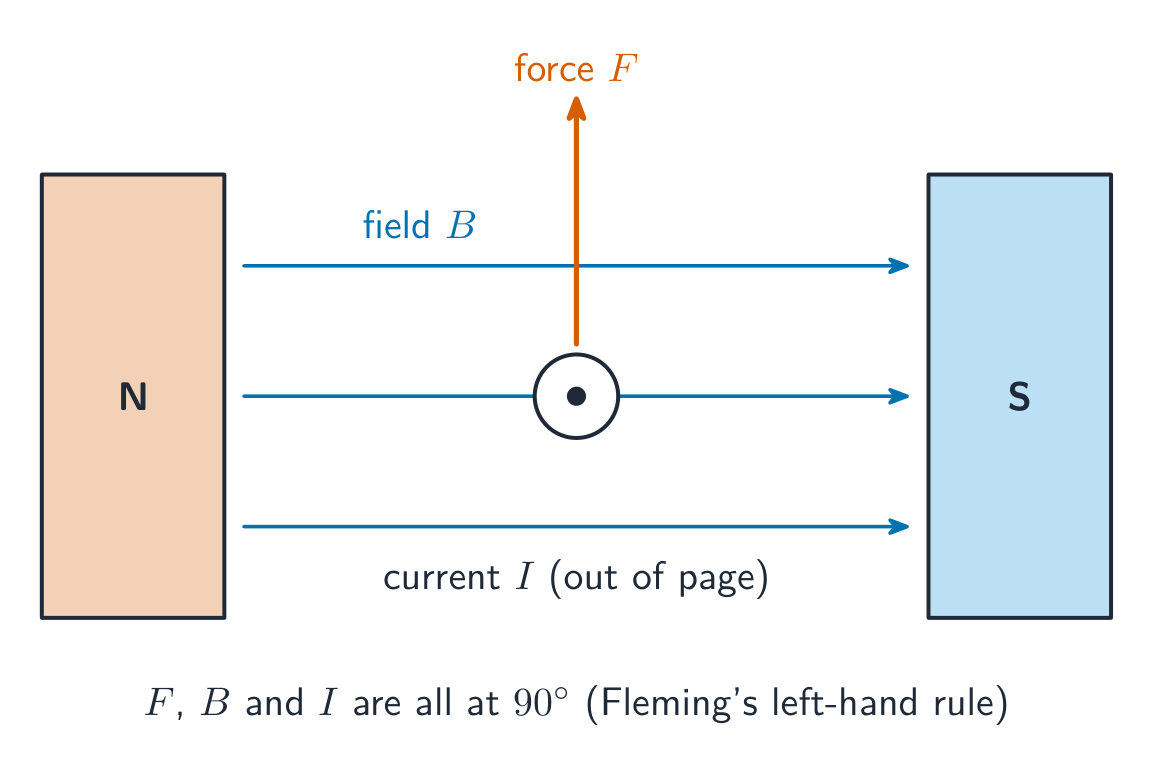
The force, the field and the current are at right angles to one another. You can find the force direction with Fleming's left-hand rule 弗莱明左手定则: thumb = force (motion), first finger = field (N to S), second finger = current.

Showing the force. Lay a stiff copper wire (or a strip of aluminium foil) between the poles of a U-shaped magnet and connect it to a cell through a switch. When the current flows, the wire jumps up or down. Reverse the cell and the wire jumps the other way; turn the magnet over and it reverses again. A bigger current or a stronger magnet gives a bigger jump.

A moving stream of charged particles is a current, so a magnetic field pushes it sideways too — it deflects 偏转 the beam. (Remember electrons flow opposite to the conventional current.)

The d.c. motor

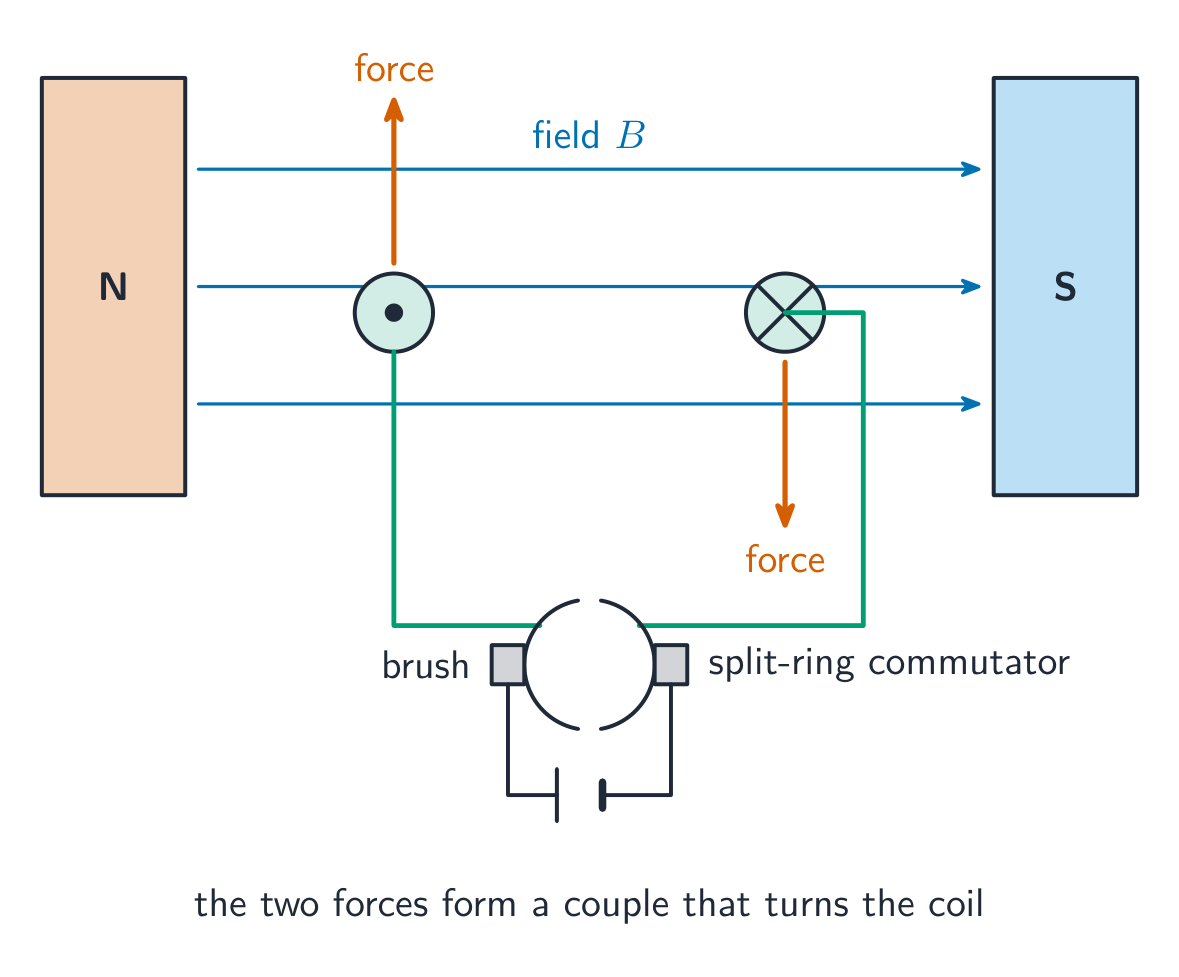
A coil carrying a current in a magnetic field feels a turning effect 转动效应, because the forces on its two sides act in opposite directions. This is a d.c. motor 直流电动机. The turning effect is bigger with more turns on the coil, a bigger current, or a stronger field.

A split-ring commutator 换向器 swaps the current direction in the coil every half-turn. This keeps the coil turning the same way instead of stopping after half a turn.

The transformer

A transformer changes the size of an a.c. voltage. It has two coils wound on a soft-iron core 软铁芯:

  • the primary coil 原线圈 takes in the a.c. voltage;
  • the secondary coil 副线圈 gives out the changed voltage.

The a.c. in the primary makes a changing magnetic field in the core. The core carries this field to the secondary, where it induces an a.c. e.m.f. The voltages and the numbers of turns are linked by:

$$\frac{V_p}{V_s} = \frac{N_p}{N_s}$$

Worked example. A transformer has $1200$ turns on the primary coil and $100$ turns on the secondary coil. The primary is connected to a $240\ \text{V}$ a.c. supply. Find the secondary voltage.

$$\frac{240}{V_s} = \frac{1200}{100} = 12 \quad\Rightarrow\quad V_s = \frac{240}{12} = 20\ \text{V}$$

Fewer turns on the secondary, so this is a step-down transformer.

If the secondary has more turns it is a step-up 升压 transformer (voltage rises); fewer turns make a step-down 降压 transformer (voltage falls). For example, a transformer changing $240\ \text{V}$ to $12\ \text{V}$ is a step-down type, and the primary has $20$ times as many turns as the secondary.

If a transformer is 100% efficient, the power in equals the power out:

$$I_p V_p = I_s V_s$$

So a step-up transformer raises the voltage but lowers the current.

Why we use high voltage to send power

Electricity is sent across the country by high-voltage transmission 高压输电. The power lost as heat in the cables is

$$P = I^2 R$$

where $R$ is the resistance of the cables. A step-up transformer raises the voltage and so lowers the current for the same power ($P = IV$). A smaller current means much less power wasted in the cables. A step-down transformer then lowers the voltage again to a safe value before it reaches homes.

ไทย
หม้อแปลง: อัตราจำนวนขดลวด
การเหนี่ยวนำแม่เหล็กไฟฟ้า

ผลแม่เหล็กของกระแสไฟฟ้า

กระแสไฟฟ้าในสายไฟจะสร้างสนามแม่เหล็กโดยรอบ

  • รอบๆ สายตรง เส้นสนามจะเป็นวงกลมรอบสายไฟ; สนามจะเข้มขึ้นใกล้กับสายไฟ หากกลับทิศทางกระแสไฟฟ้า สนามจะกลับทิศทางตามไปด้วย
  • โซเลนอยด์ (คอยล์ยาวของสายไฟ) สร้างสนามเหมือนแม่เหล็กแท่ง โดยมีขั้ว N ที่ปลายด้านหนึ่งและขั้ว S ที่อีกด้านหนึ่ง สนามภายในมีความเข้มและสม่ำเสมอ

คุณสามารถแสดงรูปแบบทั้งสองได้ด้วยผงเหล็กหรือเข็มทิศวัดสนาม แม่เหล็กจะเข้มขึ้นหากคุณเพิ่มกระแสไฟฟ้า เพิ่มจำนวนเกลียว หรือใส่แกนเหล็กอ่อนเข้าไปภายใน

สายตรงที่มีเส้นสนามวงกลมล้อมรอบ และโซเลนอยด์ที่มีสนามคล้ายแม่เหล็กแท่ง
กระแสไฟฟ้าสร้างเส้นสนามวงกลมรอบสายตรง และสร้างสนามคล้ายแม่เหล็กแท่งสำหรับโซเลนอยด์

ผลแม่เหล็กถูกนำไปใช้ในรีเลย์และลำโพง ในรีเลย์ กระแสไฟฟ้าขนาดเล็กในคอยล์จะทำให้แกนเหล็กอ่อนเกิดแม่เหล็กซึ่งดึงสวิตช์ให้ปิดในวงจรที่สอง วงจรที่สองสามารถส่งกระแสไฟฟ้าขนาดใหญ่ได้ ดังนั้นสวิตช์ขนาดเล็กหรือเซนเซอร์จึงสามารถควบคุมมอเตอร์หรือเครื่องทำความร้อนได้อย่างปลอดภัย (ตัวอย่างเช่น สวิตช์จุดระเบิดของรถยนต์เริ่มการทำงานของมอเตอร์ผ่านรีเลย์) ใน ลำโพง กระแสไฟฟ้าที่เปลี่ยนแปลงในคอยล์จะทำให้คอยล์ผลักและดึงกรวยกระดาษ ซึ่งเคลื่อนที่อากาศและสร้างเสียง

การเหนี่ยวนำแม่เหล็กไฟฟ้า

เมื่อสายไฟเคลื่อนที่ข้ามสนามแม่เหล็ก หรือสนามแม่เหล็กผ่านคอยล์มีการเปลี่ยนแปลง e.m.f. จะถูก เหนี่ยวนำ ในสายไฟ หากสายไฟเป็นส่วนหนึ่งของวงจรที่สมบูรณ์ e.m.f. นี้จะขับเคลื่อนให้เกิดกระแสไฟฟ้า นี่คือ การเหนี่ยวนำแม่เหล็กไฟฟ้า

เพื่อสาธิต: ขยับแม่เหล็กเข้า-ออกในคอยล์ที่เชื่อมต่อกับมิเตอร์ที่ไวต่อสัญญาณ แล้วดูเข็มกระตุก e.m.f. ที่เหนี่ยวนำจะมากขึ้นหากคุณใช้แม่เหล็กที่แข็งแรงขึ้น เคลื่อนไหวเร็วขึ้น หรือใช้จำนวนเกลียวมากขึ้น e.m.f. ที่เหนี่ยวนำจะกระทำเพื่อ ขัดขวาง การเปลี่ยนแปลงที่ทำให้มันเกิดขึ้น ทิศทางของกระแสไฟฟ้าที่เหนี่ยวนำกำหนดโดย กฎมือขวาของเฟมมิ่ง: ยึดนิ้วโป้ง นิ้วชี้ และนิ้วกลางของมือขวาให้ตั้งฉากกัน; นิ้วโป้งชี้ไปตามทิศทางการเคลื่อนที่ของสายไฟ นิ้วชี้ชี้ไปตามทิศทางสนาม (N ไป S) และนิ้วกลางจะบ่งบอกทิศทางของกระแสไฟฟ้าที่เหนี่ยวนำ

เครื่องกำเนิดไฟฟ้า a.c.

เครื่องกำเนิดไฟฟ้า a.c. เปลี่ยนการเคลื่อนที่ให้เป็นไฟฟ้า คอยล์หมุนในสนามแม่เหล็ก (หรือแม่เหล็กหมุนใกล้คอยล์) เมื่อหมุน สนามแม่เหล็กผ่านคอยล์จะเปลี่ยนแปลงอย่างต่อเนื่อง sehingga เกิด e.m.f. แบบสลับ

  • แหวนลื่น และแปรงถ่านนำกระแสไฟฟ้าออกจากคอยล์ไปยังวงจรในขณะที่คอยล์ยังหมุนอยู่
  • ค่า e.m.f. มีค่ามากที่สุดในขณะขดลวดราบ (เคลื่อนที่เร็วที่สุดข้ามสนามแม่เหล็ก) และเป็นศูนย์เมื่อขดลวดตั้งฉาก (เคลื่อนที่ตามเส้นสนามแม่เหล็ก) ดังนั้นกราฟ e.m.f.–เวลา จึงเป็นคลื่น: ยอด, ศูนย์, ยอดตรงข้าม, ศูนย์ สำหรับหนึ่งรอบการหมุน
ขดลวดหมุนระหว่างขั้วแม่เหล็ก เชื่อมต่อกันผ่านแหวนลื่นและแปรงถ่าน พร้อมเอาต์พุต a.c. แบบคลื่นไซน์
การหมุนขดลวดจะเหนี่ยวนำให้เกิดขึ้น e.m.f. สลับทิศทาง; แหวนลื่นนำเอาต์พุต a.c. ไปยังวงจร

แรงกระทำต่อตัวนำที่มีกระแสไหลผ่าน

เมื่อสายไฟที่มีกระแสไหลผ่านวางอยู่ในสนามแม่เหล็ก สนามของสายไฟและสนามของแม่เหล็กจะผลักกัน ทำให้สายไฟรู้สึกถึงแรง นี่คือ ผลมอเตอร์

  • กลับทิศกระแส หรือ กลับทิศสนาม แล้วแรงจะกลับทิศด้วย
  • เพิ่มขนาดกระแสหรือทำให้สนามแรงขึ้น แรงก็จะมากขึ้น

แรง สนาม และกระแส ตั้งฉากต่อกัน สามารถหาทิศของแรงได้ด้วย กฎมือซ้ายของเฟมมิ่ง: นิ้วโป้ง = แรง (การเคลื่อนที่), นิ้วชี้ = สนาม (N ไป S), นิ้วกลาง = กระแส

แสดงถึงแรง วางสายทองแดงแข็ง (หรือแถบฟอยล์อลูมิเนียม) ระหว่างขั้วของแม่เหล็กรูป U และเชื่อมต่อกับแบตเตอรี่ผ่านสวิตช์ เมื่อมีกระแสไหล สายไฟจะกระโดดขึ้นหรือลง ถ้ากลับขั้วแบตเตอรี่ สายไฟจะกระโดดในอีกทางหนึ่ง; หมุนแม่เหล็กกลับด้านแล้วจะกลับทิศอีกครั้ง กระแสที่ใหญ่ขึ้นหรือแม่เหล็กที่แรงกว่าจะทำให้กระโดดได้สูงขึ้น

สายไฟที่มีกระแสไหลอยู่ระหว่างขั้วแม่เหล็กสองขั้ว โดยแรงตั้งฉากกับทั้งสนามและกระแส
สายไฟที่มีกระแสไหลอยู่ในสนามแม่เหล็กจะรู้สึกถึงแรงที่ตั้งฉากกับทั้งสนามและกระแส

ลำอนุภาคที่มีประจุเคลื่อนที่คือกระแส ดังนั้นสนามแม่เหล็กจึงผลักมันข้างๆ — มัน เบี่ยงเบน รังสี (จำไว้ว่าอิเล็กตรอนไหลตรงข้ามกับกระแสไฟฟ้ามาตรฐาน)

มอเตอร์ d.c.

ขดลวดที่มีกระแสไหลอยู่ในสนามแม่เหล็กจะรู้สึกถึง แรงบิด เนื่องจากแรงที่กระทำต่อทั้งสองด้านของขดลวดมีทิศทางตรงกันข้าม นี่คือ มอเตอร์ d.c. แรงบิดจะมากขึ้นหากมีจำนวนรอบขดลวดมากขึ้น กระแสมากขึ้น หรือสนามแรงขึ้น

คอมมิวเตเตอร์แหวนแยก เปลี่ยนทิศกระแสในขดลวดทุกครึ่งรอบ การนี้ช่วยให้ขดลวดหมุนไปในทิศทางเดิมไม่หยุดหลังจากครึ่งรอบ

ขดลวดระหว่างขั้วแม่เหล็ก โดยมีแรงตรงข้ามกันสองด้าน คอมมิวเตเตอร์แหวนแยก แปรงถ่าน และแบตเตอรี่
แรงสองด้านของขดลวดสร้างคู่แรง; คอมมิวเตเตอร์แหวนแยกช่วยให้หมุนไปทางเดียว
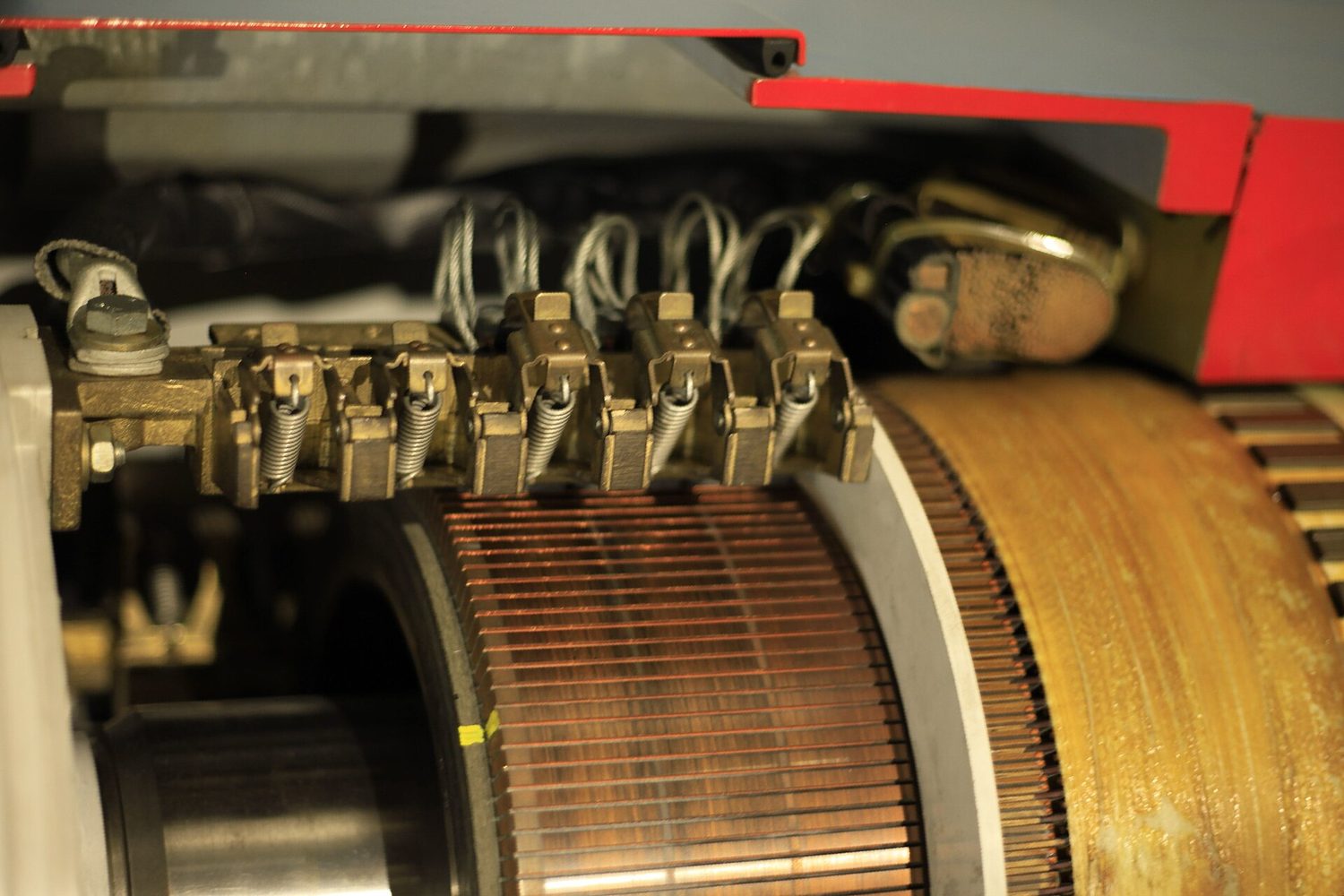
ภาพระยะใกล้ของแปรงถ่านบนสปริงกดทับแท่งทองแดงของคอมมิวเตเตอร์เครื่องจักร d.c.
ในเครื่องจักร d.c. จริง แปรงถ่านจะกดทับแท่งคอมมิวเตเตอร์ทองแดงเพื่อจ่ายกระแสให้กับขดลวดที่กำลังหมุน

เทรนส์ฟอร์เมอร์

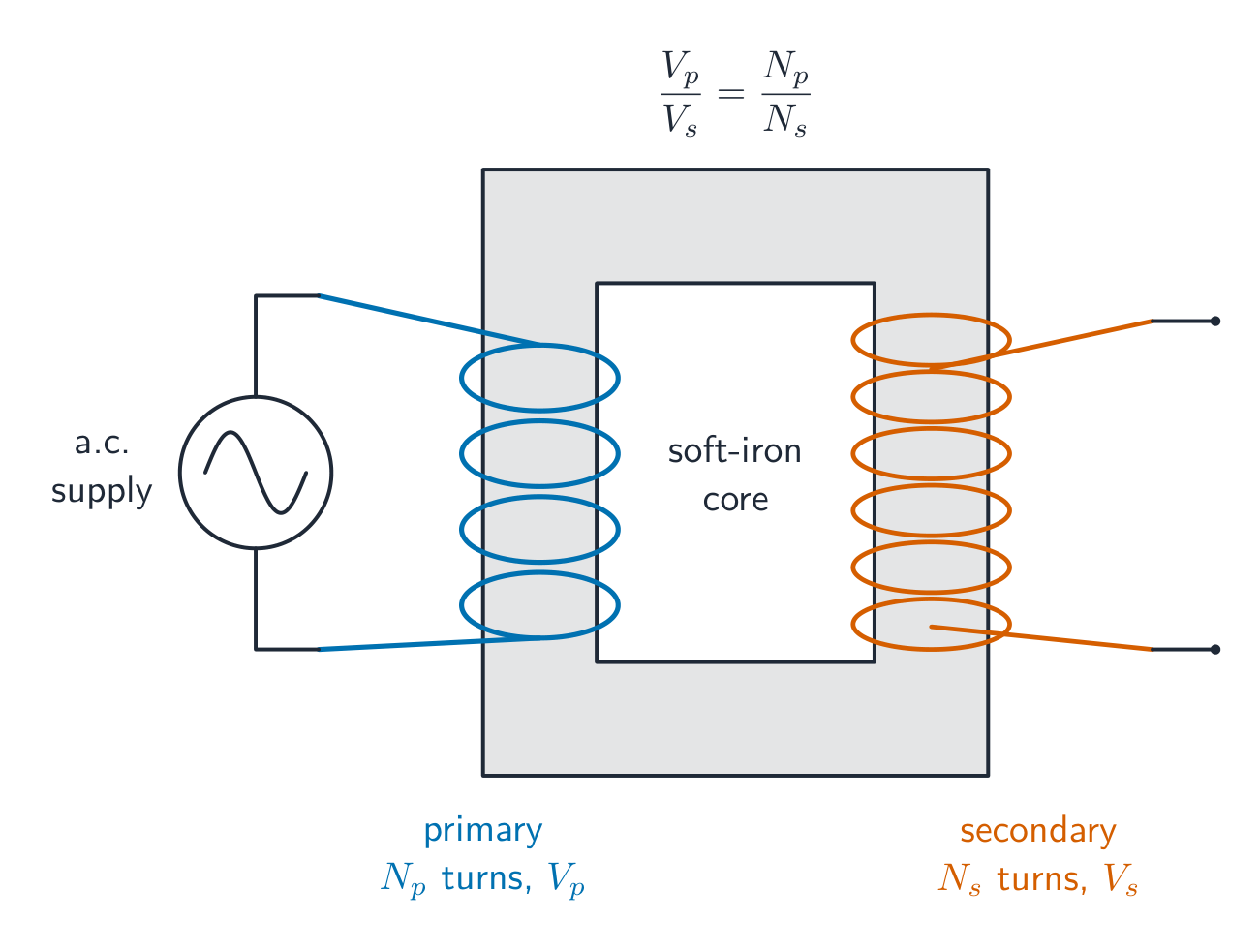
เทรนส์ฟอร์เมอร์ เปลี่ยนขนาดของแรงดันไฟฟ้า a.c.它有สองขดลวดพันอยู่บน แกนเหล็กอ่อน:

  • ขดลวดปฐมภูมิ รับแรงดัน a.c.;
  • ขดลวดทุติยภูมิ จ่ายแรงดันที่เปลี่ยนไปแล้วออก

a.c. ในขดลวดปฐมภูมิทำให้เกิดสนามแม่เหล็กเปลี่ยนแปลงในแกน แก่นนำสนามนี้ไปยังขดลวดทุติยภูมิ ซึ่งเหนี่ยวนำให้เกิด e.m.f. a.c. แรงดันและจำนวนรอบเชื่อมโยงกันโดย:

$$\frac{V_p}{V_s} = \frac{N_p}{N_s}$$

ตัวอย่างคำนวณ เทรนส์ฟอร์เมอร์มี $1200$ รอบในขดลวดปฐมภูมิและ $100$ รอบในขดลวดทุติยภูมิ ขดลวดปฐมภูมิเชื่อมต่อกับแหล่งจ่าย a.c. ขนาด $240\ \text{V}$ จงหาแรงดันขดลวดทุติยภูมิ

$$\frac{240}{V_s} = \frac{1200}{100} = 12 \quad\Rightarrow\quad V_s = \frac{240}{12} = 20\ \text{V}$$

จำนวนรอบในขดลวดทุติยภูมิน้อยกว่า ดังนั้นนี่คือเทรนส์ฟอร์เมอร์ลดแรงดัน (step-down transformer)

เทรนส์ฟอร์เมอร์: ขดลวดปฐมภูมิและขดลวดทุติยภูมิพันอยู่บนแกนเหล็กอ่อน พร้อมแหล่งจ่าย a.c. ที่ขดลวดปฐมภูมิ
สนามเปลี่ยนแปลงในแกนเชื่อมโยงขดลวดทั้งสอง; อัตราส่วนแรงดันเท่ากับอัตราส่วนจำนวนรอบ
เทรนส์ฟอร์เมอร์โลหะสีเทาติดตั้งบนเสาไฟฟ้าไม้ พร้อมสายเคเบิลฉนวนหนาเชื่อมต่อเข้าหา
เทรนส์ฟอร์เมอร์จริงบนเสาส่งกำลังลดแรงดันสูงในสายเคเบิลลงมาเป็นแรงดันที่ปลอดภัยสำหรับบ้าน

หากขดลวดทุติยภูมิมีจำนวนรอบมากกว่าจะเป็น เทรนส์ฟอร์เมอร์เพิ่มแรงดัน (step-up transformer; แรงดันเพิ่มขึ้น); จำนวนรอบน้อยกว่าจะเป็น เทรนส์ฟอร์เมอร์ลดแรงดัน (step-down transformer; แรงดันลดลง) ตัวอย่างเช่น เทรนส์ฟอร์เมอร์ที่เปลี่ยนจาก $240\ \text{V}$ เป็น $12\ \text{V}$ เป็นประเภทลดแรงดัน และขดลวดปฐมภูมิมี $20$ เท่าของจำนวนรอบขดลวดทุติยภูมิ

หากเทรนส์ฟอร์เมอร์มีประสิทธิภาพ 100% กำลังเข้าจะเท่ากับกำลังออก:

$$I_p V_p = I_s V_s$$

ดังนั้นเทรนส์ฟอร์เมอร์เพิ่มแรงดันจะยกแรงดันขึ้นแต่ลดกระแสลง

เหตุผลที่เราใช้แรงดันสูงในการส่งกำลังไฟฟ้า

ไฟฟ้าถูกส่งทั่วประเทศผ่าน ระบบส่งกำลังแรงดันสูง กำลังที่สูญเสียเป็นความร้อนในสายเคเบิลคือ

$$P = I^2 R$$

โดยที่ $R$ คือความต้านทานของสายเคเบิล เทรนส์ฟอร์เมอร์เพิ่มแรงดันจะยกแรงดันขึ้นและลดกระแสลงเพื่อให้ได้กำลังเท่าเดิม ($P = IV$) กระแสที่เล็กลงหมายถึงกำลังที่สูญหายในสายเคเบิลน้อยลงมาก จากนั้นเทรนส์ฟอร์เมอร์ลดแรงดันจะลดแรงดันลงให้เป็นค่าที่ปลอดภัยก่อนเข้าสู่บ้าน

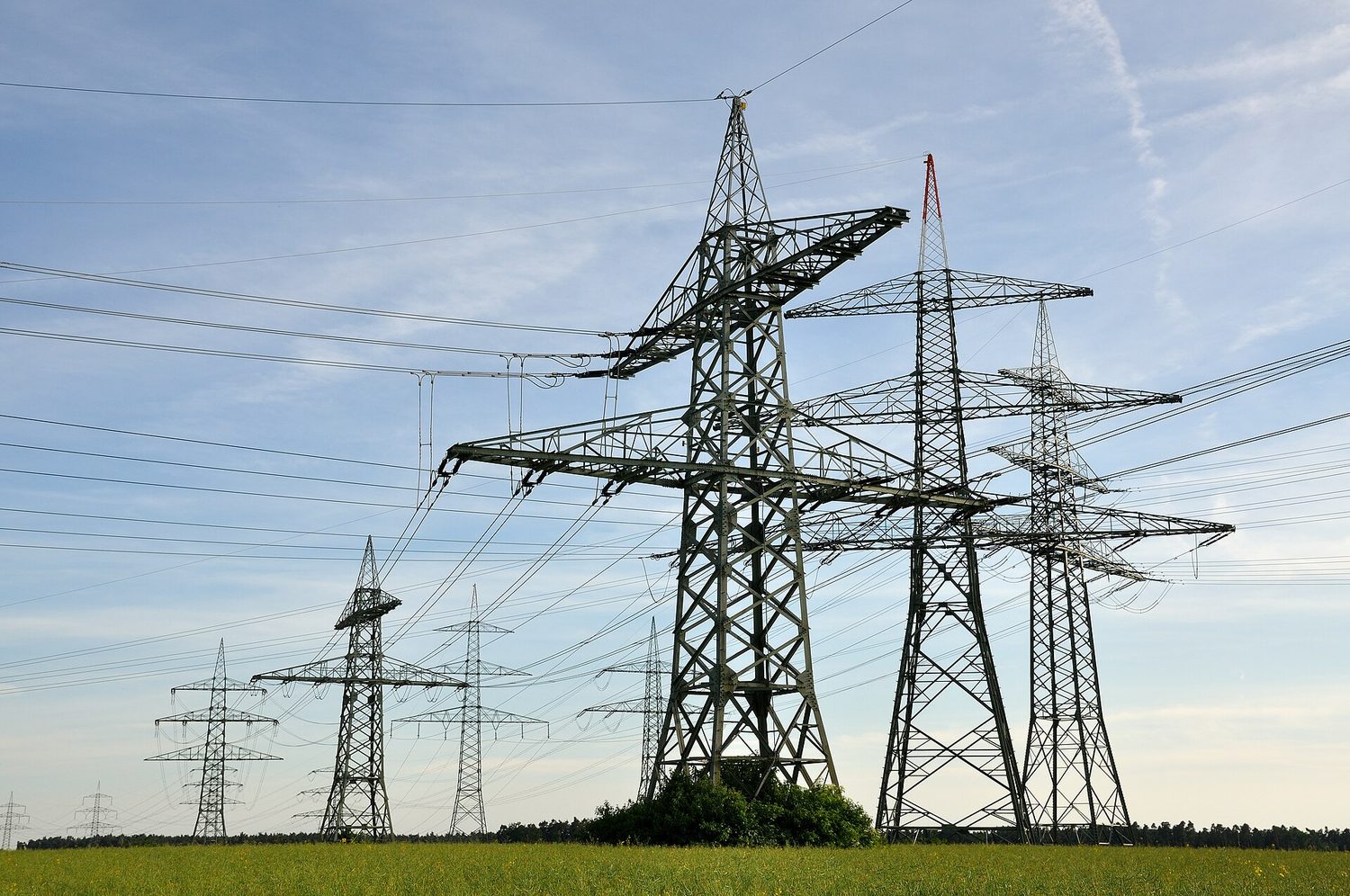
เสาโครงเหล็กสูงหลายเส้นพาดสายเคเบิลข้ามพื้นที่ชนบท
เสาโครงยึดสายเคเบิลที่ส่งไฟฟ้าด้วยแรงดันสูงมาก ซึ่งช่วยรักษากระแส — และกำลังที่สูญเสีย — ให้ต่ำ
Explore · ⁨สำรวจ⁩

The force that spins a motor · ⁨แรงที่ทำให้มอเตอร์หมุน⁩

A current in a magnetic field is pushed at right angles to both — reverse the current or flip the magnet and it pushes the other way. That is what turns a motor. · ⁨กระแสไฟฟ้าในสนามแม่เหล็กจะถูกผลักในแนวตั้งฉากกับทั้งสองด้าน — เปลี่ยนทิศทางกระแสหรือพลิกแม่เหล็กแล้วมันจะผลักไปอีกด้าน นั่นคือสิ่งที่ทำให้มอเตอร์หมุน⁩

Explore · ⁨สำรวจ⁩

The generator · ⁨เครื่องกำเนิดไฟฟ้า⁩

V = a sin(bt)

A spinning coil induces a sinusoidal voltage — the AC output. · ⁨คอยล์ที่หมุนจะเหนี่ยวนำแรงดันไฟฟ้าแบบ ไซน์ — ซึ่งเป็นเอาต์พุตกระแสสลับ⁩

Explore · ⁨สำรวจ⁩

Transformer · ⁨หม้อแปลง⁩

Add turns to the secondary to step the voltage up, fewer to step it down — Vs/Vp = Ns/Np, exactly how the grid moves power efficiently. · ⁨เพิ่มจำนวนขดลวดในขดลวด sekunderเพื่อเพิ่มแรงดัน หรือลดจำนวนลงเพื่อลดแรงดัน — Vs/Vp = Ns/Np นี่คือหลักการที่ระบบส่งกำลังไฟฟ้าทำงานได้อย่างมีประสิทธิภาพ⁩

Vocabulary · ⁨คำศัพท์⁩ Train · ⁨ฝึกฝน⁩
English ไทย
ion/ˈaɪɒn/ ไอออน
electric current/ɪˈlektrɪk ˈkʌrənt/ กระแสไฟฟ้า
motor/ˈməʊtə/ มอเตอร์
bell/bel/ กระดิ่ง / Bell
transformer/trænsˈfɔːmə/ หม้อแปลง
solenoid/ˈsəʊlənɔɪd/ โซเลนอยด์
coil/kɔɪl/ คอยล์
loudspeaker/ˈlaʊdspiːkə/ ลำโพง
electromagnetic induction/ɪˌlektrəʊməɡˈnetɪk ɪnˈdʌkʃn/ การเหนี่ยวนำแม่เหล็กไฟฟ้า
Fleming's right-hand rule/ˈflemɪŋz raɪt hænd ruːl/ กฎมือขวาของเฟลมิ่ง
a.c. generator/ˌeɪ ˈsiː ˈdʒenəreɪtə/ เครื่องกำเนิดไฟฟ้ากระแสสลับ (a.c. generator)
slip rings/slɪp rɪŋz/ วงแหวนลื่น (slip rings)
brushes/ˈbrʌʃɪz/ แปรงถ่าน
Fleming's left-hand rule/ˈflemɪŋz left hænd ruːl/ กฎมือซ้ายของเฟมิ่ง
deflect/dɪˈflekt/ เบี่ยงเบน
turning effect/ˈtɜːnɪŋ ɪˈfekt/ ผลบิด
d.c. motor/ˌdiː ˈsiː ˈməʊtə/ มอเตอร์กระแสตรง (d.c. motor)
split-ring commutator/splɪt rɪŋ ˈkɒmjuːteɪtə/ คอมมิวเตเตอร์แหวนแยก
soft-iron core/sɒft ˈaɪən kɔː/ แกนเหล็กอ่อน
primary coil/ˈpraɪməri kɔɪl/ คอยล์ปฐมภูมิ
secondary coil/ˈsekəndəri kɔɪl/ คอยล์ทุติยภูมิ
step-up/step ʌp/ เพิ่มแรงดัน
step-down/step daʊn/ ลดแรงดัน
high-voltage transmission/haɪ ˈvəʊltɪdʒ trænˈsmɪʃn/ ส่งผ่านไฟฟ้าแรงสูง
Watch lesson · ⁨ดูบทเรียน⁩
4.5

Exam tips · ⁨ข้อแนะนำสำหรับการสอบ⁩

English
  • Current is the same everywhere in a series circuit; in a parallel circuit it splits between the branches. Voltage (p.d.) is shared out in series, but is the same across every parallel branch.
  • Adding resistors in series increases the total resistance ($R_1 + R_2$); adding them in parallel makes the total less than the smallest single resistor.
  • An ammeter goes in series and has very low resistance; a voltmeter goes in parallel across a component and has very high resistance.
  • In a transformer $\dfrac{V_p}{V_s} = \dfrac{N_p}{N_s}$: more turns on the secondary steps the voltage up, fewer steps it down. Transformers only work on a.c.
  • Power is sent across country at high voltage so the current — and the heat wasted in the cables, $P = I^2R$ — is small.
  • Fit the switch and the fuse in the live wire, and choose a fuse rating just above the appliance's normal working current.
ไทย
  • กระแส มีค่าเท่ากันทุกจุดในวงจรแบบ อนุกรม; ในวงจรแบบ ขนาน กระแสจะแบ่งแยกไปตามกิ่งต่างๆ แรงดัน (p.d.) จะถูกแบ่งปันในวงจรอนุกรม แต่จะมีค่าเท่ากันตลอดทุกกิ่งขนาน
  • การต่อตัวต้านทานใน อนุกรม会增加ความต้านทานรวม ($R_1 + R_2$); การต่อ它们在 ขนาน ทำให้ความต้านทานรวม น้อยกว่า ตัวต้านทานเดี่ยวที่มีค่าน้อยที่สุด
  • แอมมิเตอร์ ต่อใน อนุกรม และมีค่าความต้านทานต่ำมาก; โวลต์มิเตอร์ ต่อใน ขนาน ข้ามองค์ประกอบและมีค่าความต้านทานสูงมาก
  • ใน เทรนส์ฟอร์เมอร์ $\dfrac{V_p}{V_s} = \dfrac{N_p}{N_s}$: จำนวนรอบขดลวดทุติยภูมิมากกว่าจะเพิ่มแรงดัน ขึ้น; จำนวนรอบน้อยกว่าจะลดแรงดัน ลง เทรนส์ฟอร์เมอร์ทำงานได้เฉพาะกับ a.c.
  • พลังงานถูกส่งผ่านประเทศด้วย แรงดันสูง เพื่อให้กระแสไฟฟ้า — และความร้อนที่สูญเสียในสายไฟ, $P = I^2R$ — มีค่าต่ำ
  • ติดตั้ง สวิตช์และฟิวส์ในสายไฟLive, และเลือกค่ากำลังของฟิวส์ให้สูงกว่ากระแสใช้งานปกติของอุปกรณ์เล็กน้อย

Interactive lessons on this topic · ⁨บทเรียนเชิงโต้ตอบสำหรับหัวข้อนี้⁩

Work through it step by step, with instant-check exercises. · ⁨ทำทีละขั้นตอน พร้อมแบบฝึกหัดตรวจสอบผลทันที⁩

Past Papers · ⁨ข้อสอบย้อนหลัง⁩

More topics in IGCSE Physics · ⁨Physics IGCSE⁩ · ⁨หัวข้อเพิ่มเติมใน IGCSE Physics · ⁨Physics IGCSE⁩⁩

Log in or create account · ⁨เข้าสู่ระบบหรือสร้างบัญชี⁩

IGCSE, A-Level & AP