The magnetic effect of a current and the motor
Introduced| English | Meaning |
|---|---|
| solenoid/ˈsəʊlənɔɪd/ | A coil of wire that produces a magnetic field when an electric current flows through it. |
| d.c. motor/ˌdiː ˈsiː ˈməʊtə/ | A current-carrying coil in a magnetic field that spins continuously using a split-ring commutator. |
| motor effect/ˈməʊtə ɪˈfekt/ | A wire carrying current in a field feels a force (left-hand rule). |
| left-hand rule/left hænd ruːl/ | left-hand rule |
| commutator/ˈkɒmjuːteɪtə/ | commutator |
Electricity makes magnetism
- A wire carrying a current creates a magnetic field around itself.
- Put that wire in another magnet's field and it feels a force — the idea behind every electric motor.
- This is where electricity and magnetism meet.
The magnetic effect of a current
- A current in a straight wire makes circular field lines around it; reverse the current and the field reverses.
- A solenoid 螺线管 (a long coil) makes a field just like a bar magnet, with a N and a S pole.
- Make it stronger by: more current, more turns, or a soft-iron core.
- Used in relays and loudspeakers.

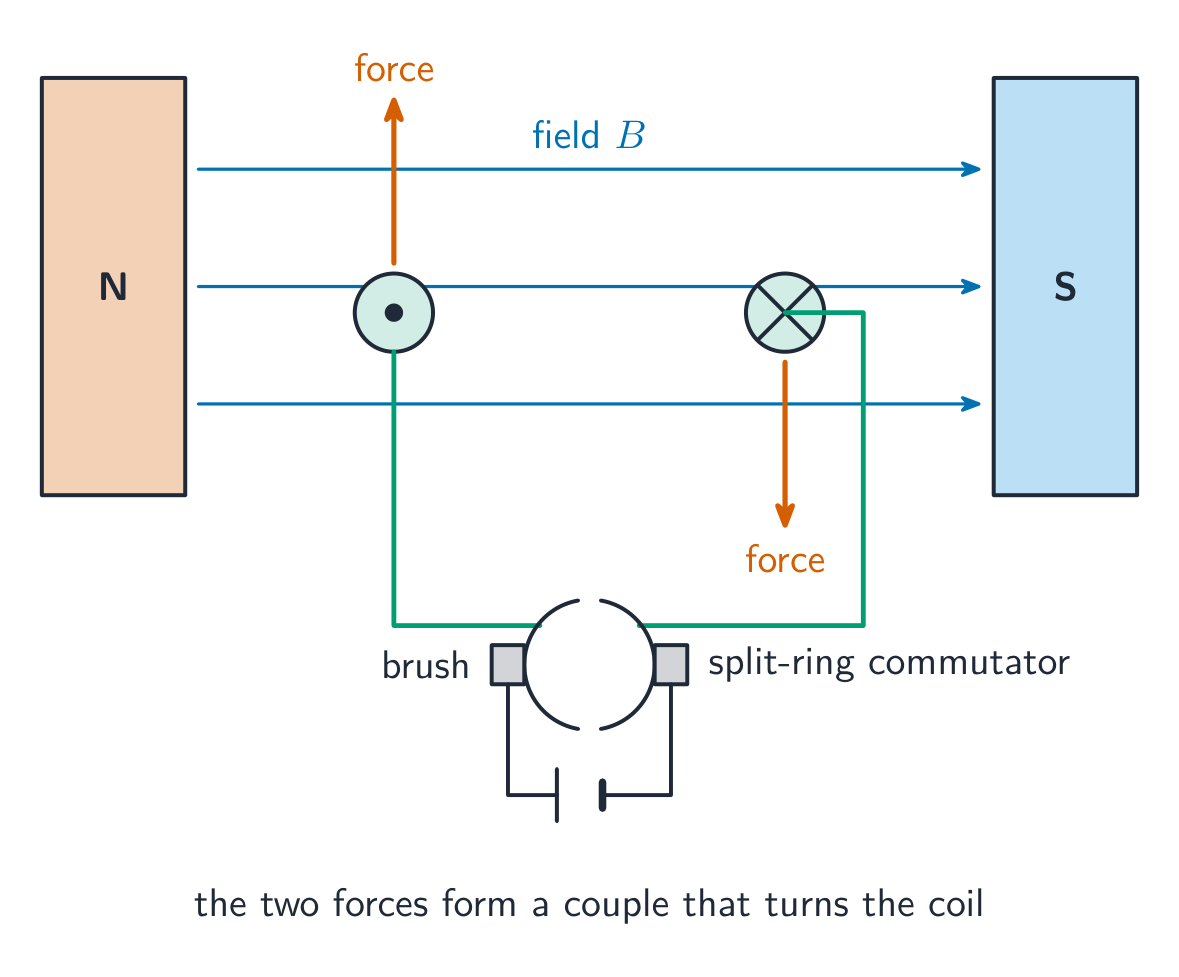
A d.c. motor 直流电动机
The force that spins a motor
A current in a magnetic field is pushed at right angles to both — reverse the current or flip the magnet and it pushes the other way. That is what turns a motor.
The magnetic field of a solenoid (a long coil carrying current) looks like the field of:
Difficulty 1/5 · 100 coins + a small bonus on first completion today
A solenoid produces a bar-magnet-like field, with a north pole at one end and a south at the other.
Which change makes an electromagnet stronger?
Difficulty 1/5 · 100 coins + a small bonus on first completion today
More current, more turns, and a soft-iron core all make the field stronger.
The motor effect 电动机效应
- A current-carrying wire in a magnetic field feels a force — the motor effect.
- Reverse the current, or reverse the field, and the force reverses.
- A bigger current or stronger field gives a bigger force; the force is greatest when the wire is at right angles to the field.
- Find the direction with the left-hand rule 左手定则: thumb = force, first finger = field (N→S), second finger = current.

In the motor effect, reversing the current direction:
Difficulty 1/5 · 100 coins + a small bonus on first completion today
Reversing either the current or the field reverses the force. Reversing both leaves it unchanged.
In Fleming's left-hand rule, the thumb points in the direction of the:
Difficulty 1/5 · 100 coins + a small bonus on first completion today
Thumb = force, first finger = field, second finger = current — all at right angles.
The force on a current-carrying wire is greatest when the wire is at right angles to the magnetic field.
Difficulty 1/5 · 100 coins + a small bonus on first completion today
The force is largest when the wire is perpendicular to the field, and zero when the wire lies along the field.
Match each idea to what it describes.
Difficulty 2/5 · 140 coins + a small bonus on first completion today
Each item links the term to its correct meaning.
The d.c. motor
- A current-carrying coil in a field feels a turning effect: the forces on its two sides act in opposite directions.
- A split-ring commutator 换向器 swaps the current direction every half-turn, so the coil keeps spinning the same way.
- The turning effect is bigger with more turns, a bigger current, or a stronger field.
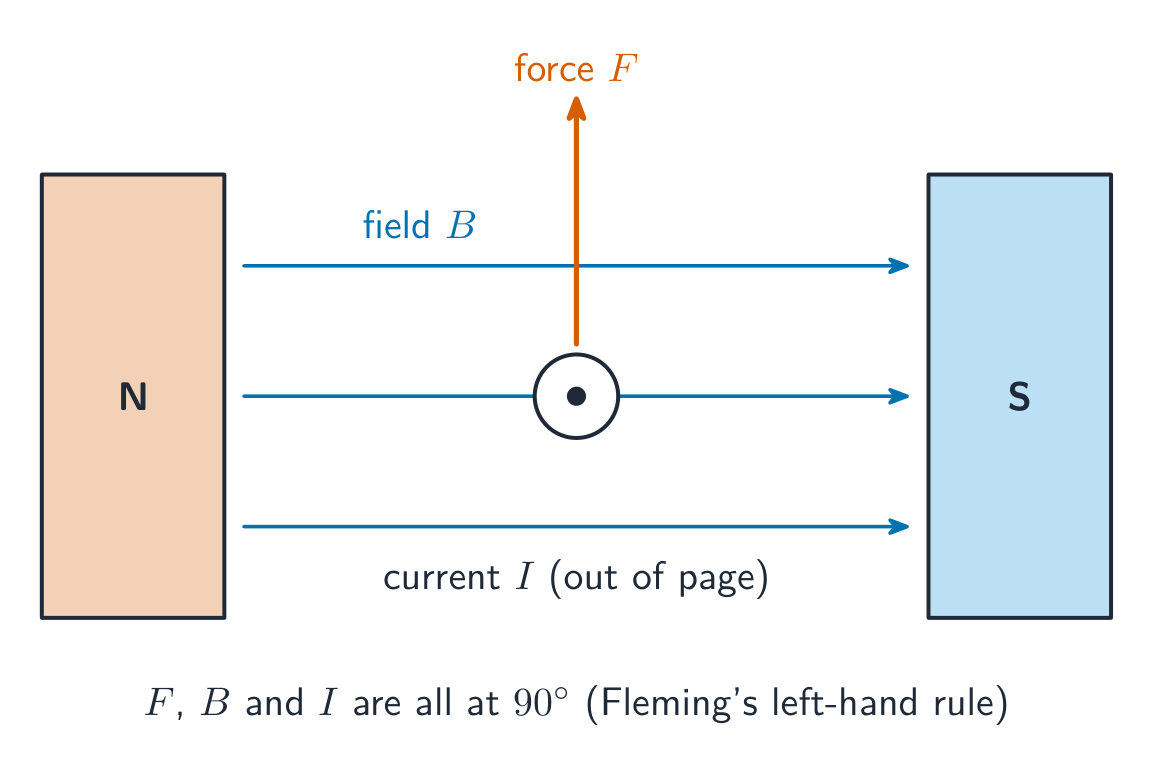
The motor effect on a current-carrying wire
What is the job of the split-ring commutator in a d.c. motor?
Difficulty 1/5 · 100 coins + a small bonus on first completion today
Without the commutator the coil would stop after half a turn. Swapping the current each half-turn keeps it rotating the same way.
You've got it
- a current makes a magnetic field: circles round a wire, bar-magnet field for a solenoid
- stronger electromagnet: more current, more turns, soft-iron core
- motor effect: a wire carrying current in a field feels a force (left-hand rule)
- a d.c. motor spins; the split-ring commutator reverses the current each half-turn