Static electricity
Introduced| English | Meaning |
|---|---|
| static electricity/ˈstætɪk ɪlekˈtrɪsɪti/ | static electricity |
| charge/tʃɑːdʒ/ | An electrical property that causes attraction or repulsion. |
| electrons/ɪˈlektrɒnz/ | Negatively charged subatomic particles found outside atomic nuclei. |
| coulombs/ˈkuːlɒmz/ | The SI unit of electric charge, equal to the charge transferred by a current of one ampere in one second. |
| conductor/kənˈdʌktə/ | A material through which electric charge or thermal energy can pass readily. |
| insulator/ˈɪnsjuːleɪtə/ | A material in which electric charge does not move readily under ordinary conditions. |
| electric field/ɪˈlektrɪk fiːld/ | A region in which an electric charge experiences an electric force. |
| ion/ˈaɪɒn/ | An atom or group of atoms with a net electric charge from losing or gaining electrons. |
Sparks and sticky balloons
- Rub a balloon on your hair and it sticks to the wall; lightning is the same effect, in giant form.
- Both come from static electricity 静电 — charge 电荷 that has built up and is not moving.
- It all comes down to tiny electrons 电子.
Electric charge
- There are two kinds of charge: positive and negative.
- The rule is like magnetic poles: same charges repel, different charges attract.
- Charge is measured in coulombs 库仑 (C).
Rub a balloon and watch it charge
Rubbing moves electrons onto the balloon, making it negative — then it attracts a neutral wall or your hair, but repels another negative balloon.
Two negative charges attract each other.
Difficulty 1/5 · 100 coins + a small bonus on first completion today
Like charges repel; only different charges (+ and −) attract.
Charging by friction
- Rub two different materials together and electrons (tiny negative particles) move from one to the other.
- The material that gains electrons becomes negative; the one that loses them becomes positive.
- Only the negative electrons move — the positive charge stays put.
- Example: a plastic rod rubbed with a cloth becomes negative (it gained electrons); the cloth is left positive.
When you rub a plastic rod with a cloth, the rod gains electrons. The rod becomes:
Difficulty 1/5 · 100 coins + a small bonus on first completion today
Gaining electrons (which are negative) makes the rod negative. The cloth, having lost electrons, is left positive.
During charging by friction, what actually moves between the materials?
Difficulty 1/5 · 100 coins + a small bonus on first completion today
Only the negative electrons move. The positive charge stays fixed in place.
Match each static-electricity idea to what it means.
Difficulty 2/5 · 140 coins + a small bonus on first completion today
Each item links the term to its correct meaning.
Conductors 导体 and insulators 绝缘体
- A conductor (copper and other metals) lets charge flow easily, because it has free electrons.
- An insulator (plastic, rubber, glass) does not — its electrons cannot move freely.
- Test it: put the material in a circuit with a lamp and a battery — the lamp lights only for a conductor.
Why is copper a good conductor of electricity?
Difficulty 1/5 · 100 coins + a small bonus on first completion today
A conductor has free electrons that can flow through it. Insulators have no free-moving charges.
Electric fields 电场 and ions 离子
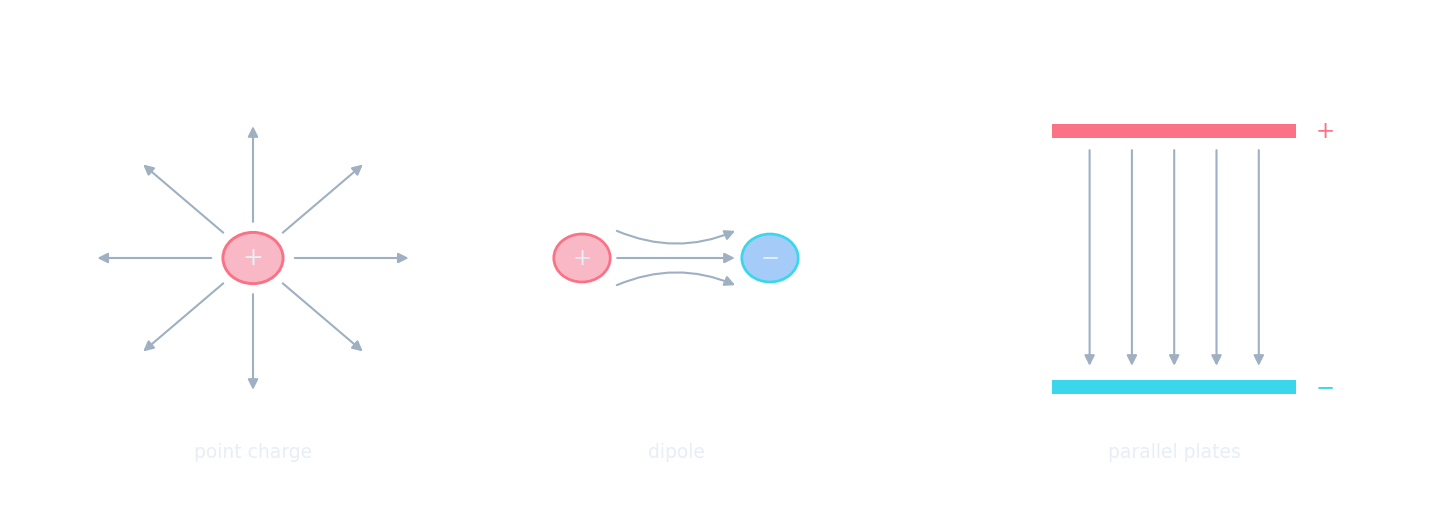
- An electric field is a region where a charge feels a force.
- Its direction at a point is the direction of the force on a positive charge.
- Field patterns: lines point away from + and toward −; between parallel plates the lines are straight and evenly spaced.
- An atom that loses electrons becomes a positive ion; one that gains electrons becomes a negative ion.
The direction of an electric field at a point is the direction of the force on:
Difficulty 1/5 · 100 coins + a small bonus on first completion today
By convention, the electric field direction is the direction of the force on a positive charge.
A neutral atom loses two electrons. It becomes:
Difficulty 1/5 · 100 coins + a small bonus on first completion today
Losing negative electrons leaves more positive charge, so the atom becomes a positive ion.
You've got it
- two charges: + and −; same repel, different attract
- charging by friction moves electrons only: gain → negative, lose → positive
- conductors have free electrons; insulators do not
- electric field direction = force on a positive charge; lose electrons → positive ion