Current, e.m.f. and potential difference
Introduced| English | Meaning |
|---|---|
| electric current/ɪˈlektrɪk ˈkʌrənt/ | The rate of flow of electric charge. |
| potential difference/pəˈtenʃl ˈdɪfrəns/ | The energy transferred per unit charge between two points. |
| amperes/ˈæmpeəz/ | The SI unit of electric current, equivalent to one coulomb of charge passing per second. |
| ammeter/ˈæmiːtə/ | An instrument connected in series to measure electric current. |
| conventional current/kənˈvenʃənl ˈkʌrənt/ | Electric current defined in the direction that positive charge would move. |
| direct current/daɪˈrekt ˈkʌrənt/ | Current flowing in one direction only, as supplied by a battery. |
| alternating current/ˈɔːltəneɪtɪŋ ˈkʌrənt/ | Current that repeatedly reverses direction, as supplied by the mains. |
| volts/vəʊlts/ | The SI unit of potential difference, equal to one joule of energy transferred per coulomb of charge. |
| voltmeter/ˈvəʊltmiːtə/ | An instrument connected across two points to measure their potential difference. |
What is flowing?
- Switch on a lamp and something flows through the wires — an electric current 电流.
- A cell gives that flow the push it needs.
- Three quantities describe it all: current, e.m.f. and potential difference 电势差.
Electric current
- An electric current is a flow of electric charge, measured in amperes 安培 (A) with an ammeter 电流表 joined in series.
- Current is the charge passing a point each second:
- $I$ in amperes, $Q$ in coulombs (C), $t$ in seconds.

Conventional current 常规电流 flows from the positive terminal to the negative terminal, through the external circuit. The ammeter (A) is connected in series to measure the current.
Worked example. A current of $2\ \text{A}$ flows for $30\ \text{s}$. Charge $= It = 2 \times 30 = 60\ \text{C}$.
Conventional current vs electron flow. Conventional current is drawn from $+$ to $-$, but the actual electrons in a metal wire drift the opposite way ($-$ to $+$). The convention was set before electrons were discovered, and we still use it today.
Ohm's law
V = IR
For an ohmic conductor the current is proportional to the voltage — the gradient is 1/resistance.
A charge of $30\ \text{C}$ flows past a point in $10\ \text{s}$. What is the current, in A?
Difficulty 2/5 · 140 coins + a small bonus on first completion today
$I = \dfrac{Q}{t} = \dfrac{30}{10} = 3.0\ \text{A}$.
A current of $2.0\ \text{A}$ flows for $5.0\ \text{s}$. How much charge passes, in C?
Difficulty 2/5 · 140 coins + a small bonus on first completion today
$Q = It = 2.0 \times 5.0 = 10\ \text{C}$.
How is an ammeter connected to measure the current through a lamp?
Difficulty 1/5 · 100 coins + a small bonus on first completion today
An ammeter goes in series so the same current flows through it and the lamp. (A voltmeter goes in parallel.)
Direction and type of current
- Conventional current flows from + to − round the outside of the cell.
- The free electrons in a metal really drift the other way (− to +).
- Direct current 直流电 (d.c.) always flows one way (a battery). Alternating current 交流电 (a.c.) keeps swapping direction (the mains).
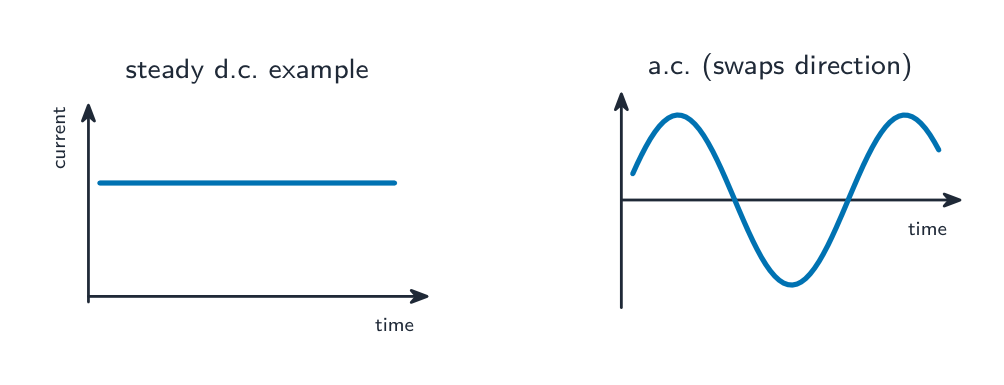
Direct current is steady in one direction; alternating current keeps swapping direction, crossing zero many times each second
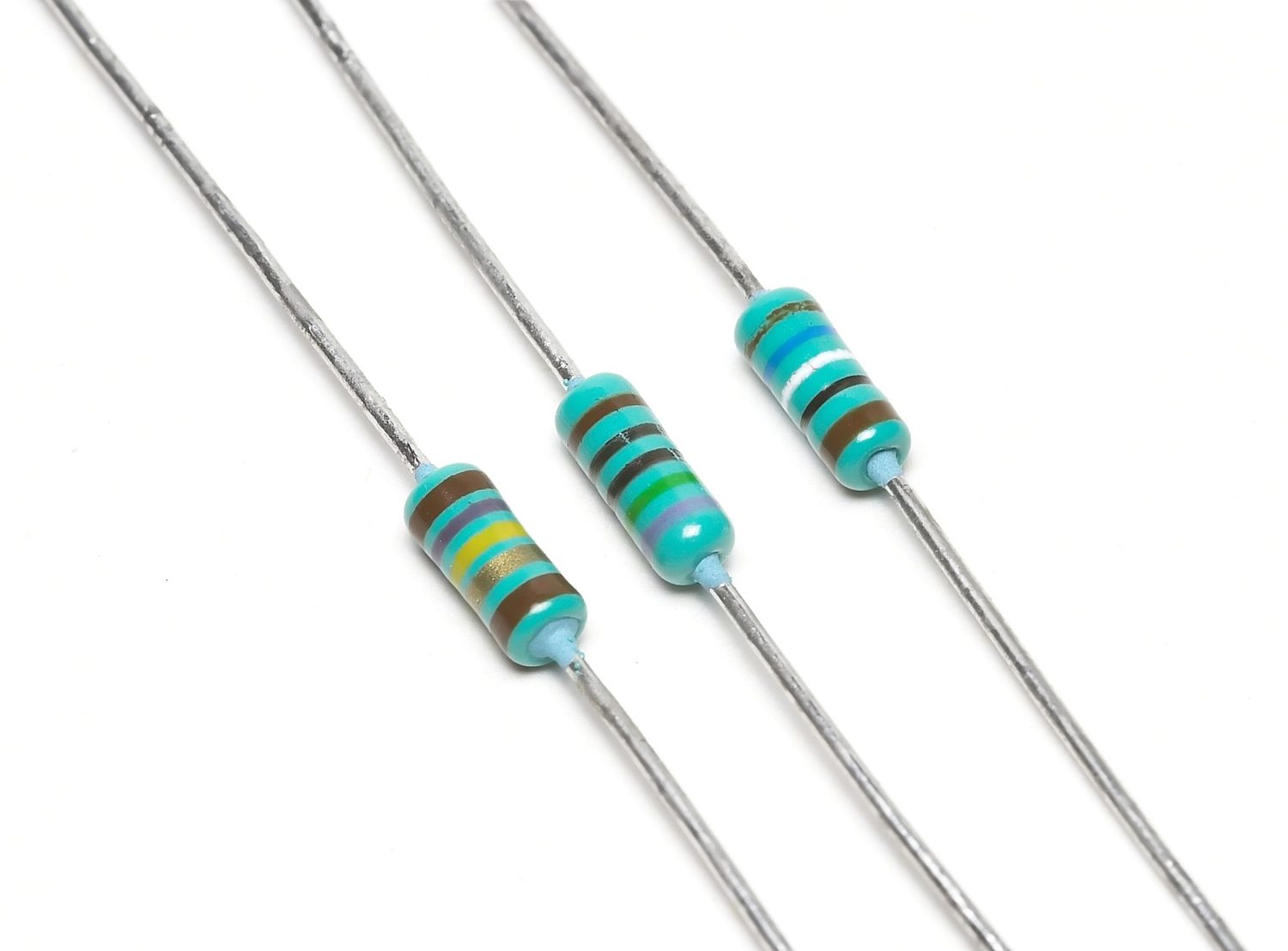
Resistors, components that control the current in a circuit
Conventional current flows around the outside of a cell from:
Difficulty 1/5 · 100 coins + a small bonus on first completion today
Conventional current is taken from + to −. The electrons themselves drift the opposite way (− to +).
E.m.f. and potential difference
- Both are measured in volts 伏特 (V) and both are work done per unit charge:
- e.m.f. is the energy a source gives each coulomb to drive it round the whole circuit.
- potential difference (p.d.) is the energy each coulomb gives up in one component.
- A voltmeter 电压表 measures them, joined in parallel (across the component).
A cell does $120\ \text{J}$ of work driving $60\ \text{C}$ of charge round a circuit. What is its e.m.f., in V?
Difficulty 2/5 · 140 coins + a small bonus on first completion today
$E = \dfrac{W}{Q} = \dfrac{120}{60} = 2.0\ \text{V}$.
A voltmeter is connected:
Difficulty 1/5 · 100 coins + a small bonus on first completion today
A voltmeter measures the p.d. across a component, so it is connected in parallel with it.
Match each electrical quantity to its meaning.
Difficulty 2/5 · 140 coins + a small bonus on first completion today
Each item links the term to its correct meaning.
You've got it
- current = flow of charge: $I = \dfrac{Q}{t}$; ammeter in series, in amperes
- conventional current + → −; electrons drift − → +; d.c. one way, a.c. swaps
- e.m.f. (whole circuit) and p.d. (one component) are both $\dfrac{W}{Q}$ in volts
- voltmeter in parallel