Transformers and power transmission
Introduced| English | Meaning |
|---|---|
| transformer/trænsˈfɔːmə/ | A device that changes alternating potential difference using electromagnetic induction between coils. |
| primary/ˈpraɪməri/ | primary |
| secondary/ˈsekəndəri/ | secondary |
| step-up/step ʌp/ | Describes a transformer with more secondary than primary turns, raising the voltage. |
| step-down/step daʊn/ | Describes a transformer with fewer secondary than primary turns, lowering the voltage. |
| transmission/trænˈsmɪʃn/ | transmission |
Sending power across the country
- Power stations are far from cities, yet very little energy is lost on the way.
- The secret is the transformer 变压器, which changes the size of an a.c. voltage.
- It lets us send power at very high voltage — and that is what keeps the loss small.
The transformer
- A transformer has two coils on a soft-iron core: a primary 初级 (input) and a secondary 次级 (output).
- The a.c. in the primary makes a changing field in the core, which induces an a.c. e.m.f. in the secondary.
- The voltages and turns are linked by:
- It only works on a.c. — a steady d.c. makes no changing field.
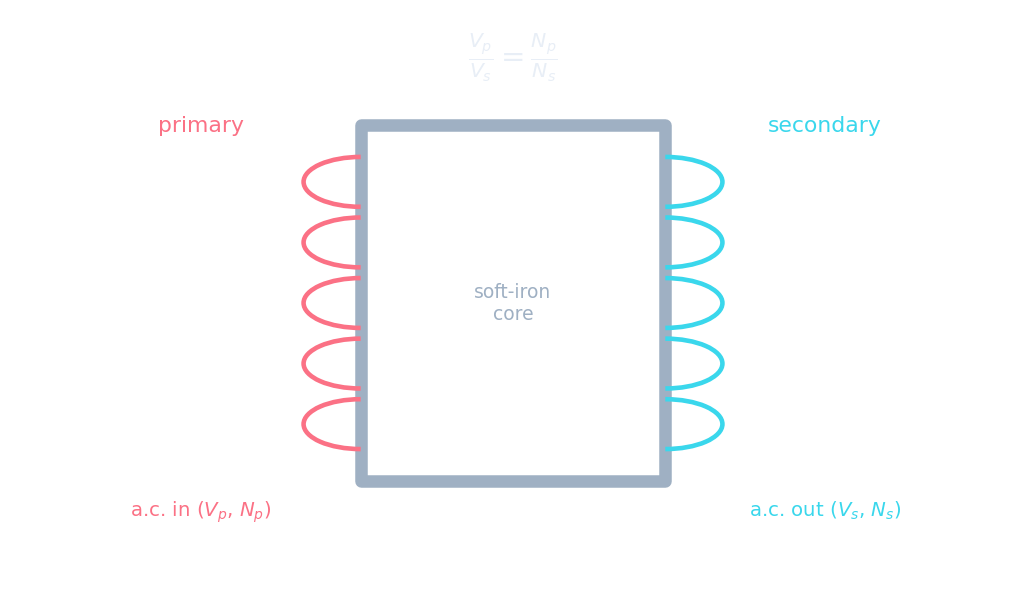
The transformer equation
Vs/Vp = Ns/Np
The voltage ratio equals the turns ratio — more turns on the secondary steps the voltage up.
A transformer works with a steady direct current (d.c.).
Difficulty 1/5 · 100 coins + a small bonus on first completion today
A transformer needs a changing magnetic field, so it works on a.c. only. A steady d.c. makes no change and induces nothing.
A transformer has $1000$ turns on the primary and $50$ on the secondary. The primary voltage is $240\ \text{V}$. What is the secondary voltage, in V?
Difficulty 2/5 · 140 coins + a small bonus on first completion today
$V_s = V_p \times \dfrac{N_s}{N_p} = 240 \times \dfrac{50}{1000} = 12\ \text{V}$ — a step-down transformer.
Step-up 升压 and step-down 降压
- More turns on the secondary → a step-up transformer (voltage rises).
- Fewer turns on the secondary → a step-down transformer (voltage falls).
- If 100% efficient, power in = power out:
- So a step-up transformer raises the voltage but lowers the current.

A real transformer changes the voltage of an a.c. supply
Transformer
Add turns to the secondary to step the voltage up, fewer to step it down — Vs/Vp = Ns/Np, exactly how the grid moves power efficiently.
A step-up transformer has:
Difficulty 1/5 · 100 coins + a small bonus on first completion today
More secondary turns gives a higher output voltage — a step-up transformer.
A 100%-efficient step-up transformer raises the voltage and lowers the current.
Difficulty 1/5 · 100 coins + a small bonus on first completion today
Power is conserved ($I_p V_p = I_s V_s$), so if the voltage goes up the current must come down.
Why high voltage for transmission 输电
- Power wasted as heat in the cables is $P = I^2 R$ ($R$ = cable resistance).
- A step-up transformer raises the voltage and so lowers the current for the same power ($P = IV$).
- A smaller current means much less wasted power in the cables.
- A step-down transformer then lowers the voltage to a safe value before it reaches homes.
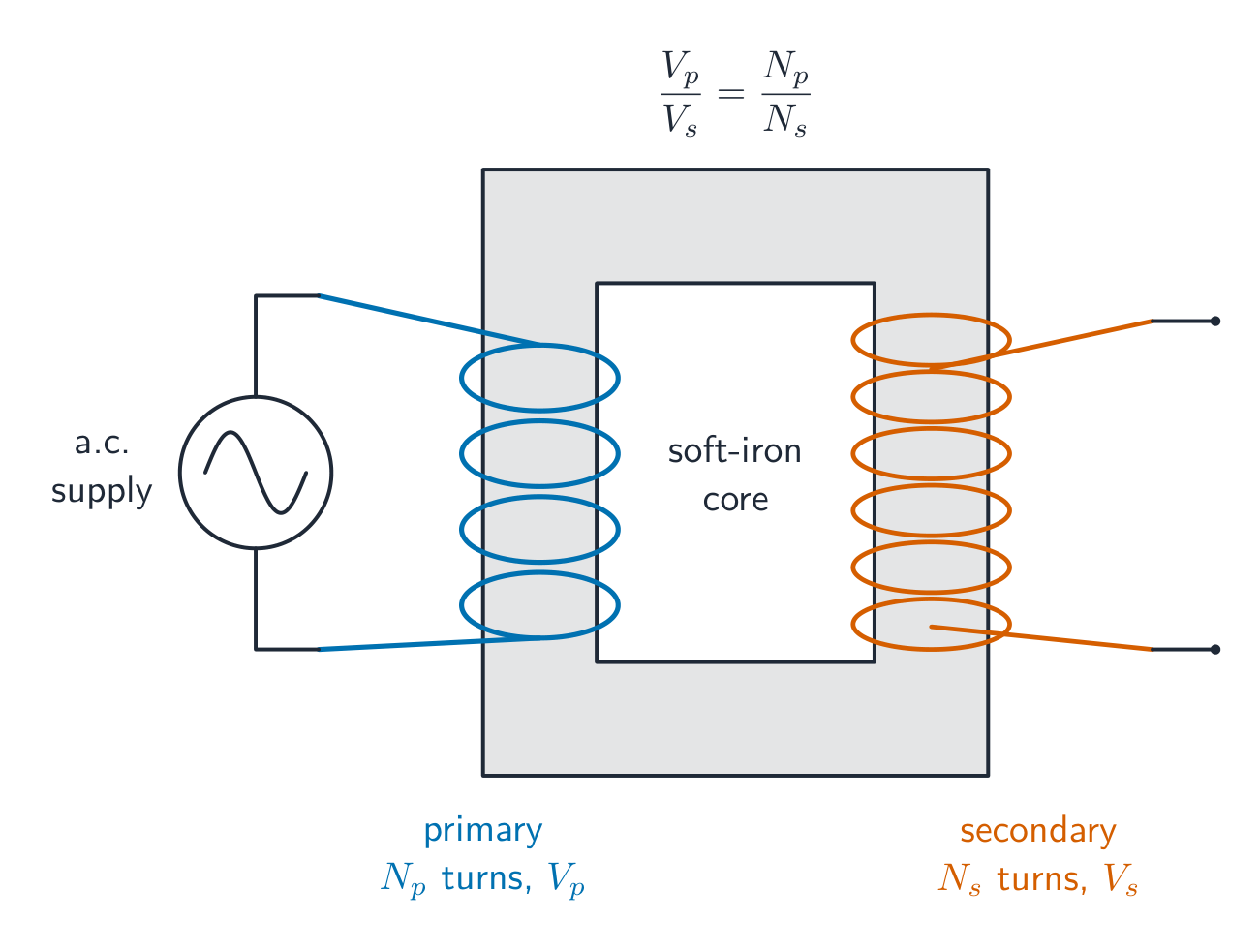
A transformer
Why is electricity sent across the country at very high voltage?
Difficulty 1/5 · 100 coins + a small bonus on first completion today
For a given power, raising the voltage lowers the current. Since the heat loss is $I^2R$, a smaller current wastes far less power.
A cable carries a current of $20\ \text{A}$ and has a resistance of $5.0\ \Omega$. How much power is wasted as heat, in W?
Difficulty 2/5 · 140 coins + a small bonus on first completion today
$P = I^2 R = 20^2 \times 5.0 = 400 \times 5.0 = 2000\ \text{W}$. Lowering the current would cut this sharply.
You've got it
- transformer: $\dfrac{V_p}{V_s} = \dfrac{N_p}{N_s}$; works on a.c. only
- more secondary turns = step-up (V↑); fewer = step-down (V↓)
- 100% efficient: $I_p V_p = I_s V_s$ — step-up raises V but lowers I
- transmit at high voltage → low current → less $I^2R$ loss in the cables