The nuclear atom
Introduced| English | Meaning |
|---|---|
| nucleus/ˈnjuːklɪəs/ | The small, dense central part of an atom, containing protons and usually neutrons. |
| nuclear model/ˈnjuːklɪə ˈmɒdl/ | nuclear model |
| neutral/ˈnjuːtrəl/ | Neither acidic nor alkaline when describing a solution, or having no net electric charge when describing a particle or object. |
| alpha particles/ˈælfə ˈpɑːtɪklz/ | alpha particles |
| gold foil/ɡəʊld fɔɪl/ | A thin gold sheet used in Rutherford’s alpha-scattering experiment. |
| nucleons/ˈnjuːklɪənz/ | A proton or neutron in an atomic nucleus. |
| protons/ˈprəʊtɒnz/ | Positively charged subatomic particles found in atomic nuclei. |
| neutrons/ˈnjuːtrɒnz/ | Electrically neutral subatomic particles found in most atomic nuclei. |
| isotopes/ˈaɪsətəʊps/ | Atoms with the same proton number but different neutron numbers. |
Mostly empty space
- If an atom were the size of a stadium, its nucleus 原子核 would be a pea in the centre.
- Almost all the atom is empty space — a surprising fact proved by a clever experiment.
- Let's build up the nuclear model 核模型 of the atom.
The nuclear atom
- An atom has a tiny central nucleus (positive) with electrons (negative) moving around it.
- The whole atom is neutral 中性的 — equal positive and negative charge.
- Almost all the mass is in the nucleus, which is tiny compared with the atom.
- Lose electrons → a positive ion; gain electrons → a negative ion.

A nuclear power station; the large towers release waste heat as steam
Inside the atom
A tiny dense nucleus sits at the centre with electrons in shells around it — drag the proton number and watch the shells fill outward.
Where is almost all of an atom's mass?
Difficulty 1/5 · 100 coins + a small bonus on first completion today
Almost all the mass is concentrated in the tiny, dense nucleus; the rest of the atom is mostly empty space.
An atom that loses an electron becomes a positive ion.
Difficulty 1/5 · 100 coins + a small bonus on first completion today
Losing a negative electron leaves the atom with more positive charge — a positive ion.
The alpha-scattering experiment
- Fast, positive alpha particles α粒子 were fired at very thin gold foil 金箔.
- Most went straight through → the atom is mostly empty space.
- A few were deflected → the nucleus is positive (it repels the alpha particles).
- A very few bounced back → the nucleus is tiny, dense and heavy.

In the alpha-scattering experiment, most alpha particles passed straight through the foil. This shows that:
Difficulty 1/5 · 100 coins + a small bonus on first completion today
If most pass straight through, there must be very little in the way — the atom is mostly empty space.
Inside the nucleus
- The nucleus is made of nucleons 核子: protons 质子 (charge $+1$) and neutrons 中子 (charge $0$).
- Proton number $Z$ = number of protons; nucleon number $A$ = protons + neutrons.
- So the number of neutrons is $A - Z$.
- We write a nucleus as $^{A}_{Z}\text{X}$ — for example $^{14}_{\ 6}\text{C}$ has $6$ protons and $14 - 6 = 8$ neutrons.

The nuclear model of the atom
The proton number (Z) of a nucleus is:
Difficulty 1/5 · 100 coins + a small bonus on first completion today
Z is the proton number (atomic number). The nucleon number A is protons + neutrons.
How many neutrons are in a nucleus of $^{14}_{\ 6}\text{C}$?
Difficulty 2/5 · 140 coins + a small bonus on first completion today
Neutrons $= A - Z = 14 - 6 = 8$.
Isotopes 同位素
- Isotopes are atoms of the same element (same $Z$) with different numbers of neutrons (different $A$).
- They behave the same in chemistry but differently in the nucleus.
- Example: $^{12}_{\ 6}\text{C}$ and $^{14}_{\ 6}\text{C}$ are both carbon.
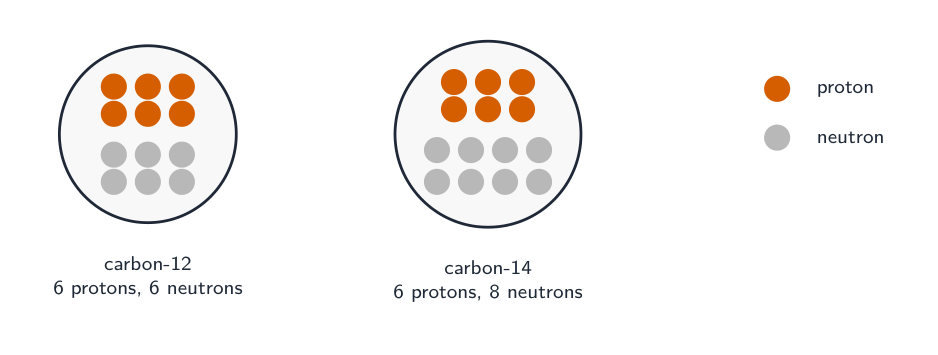
Isotopes have the same number of protons but different numbers of neutrons — the same element with a different mass
Isotopes of an element have:
Difficulty 1/5 · 100 coins + a small bonus on first completion today
Isotopes share the proton number Z (same element) but have different nucleon numbers A (different neutron counts).
You've got it
- atom = tiny positive nucleus + electrons; mostly empty space; almost all mass in the nucleus
- alpha-scattering: most pass through (empty), a few deflect (positive nucleus), a very few bounce back (small + dense)
- $Z$ = protons, $A$ = protons + neutrons, neutrons $= A - Z$; notation $^{A}_{Z}\text{X}$
- isotopes: same $Z$, different $A$