Magnetism
Introduced| English | Meaning |
|---|---|
| magnet/ˈmæɡnɪt/ | An object that produces a magnetic field and attracts magnetic materials. |
| poles/pəʊlz/ | The north and south regions of a magnet, where its magnetic effects are strongest. |
| magnetic field/mæɡˈnetɪk fiːld/ | A region in which magnetic materials, moving charges or currents experience magnetic forces. |
| permanent magnet/ˈpɜːmənənt ˈmæɡnɪt/ | An object that retains its magnetisation and produces a magnetic field without an external current or field being maintained. |
| induced magnetism/ɪnˈdjuːst ˈmæɡnɪtɪzəm/ | Temporary magnetism produced in a magnetic material while it is inside another magnetic field. |
| soft iron/sɒft ˈaɪən/ | Iron that magnetises and loses its magnetism easily, used where temporary magnetism is needed. |
| field lines/fiːld laɪnz/ | Imaginary curves whose tangents show a field's direction and whose spacing can indicate its relative strength. |
| electromagnets/ɪˌlektrəʊˈmæɡnɪts/ | A magnet produced by an electric current, often using a coil around an iron core. |
The pull of a magnet 磁体
- A fridge magnet sticks; a compass needle always swings to point north.
- A magnet has two ends, called poles 磁极: a north (N) and a south (S).
- Let's see the rules magnets follow — and how to picture their invisible field.
Poles and magnetic materials
- The pole rule is like the charge rule:
- Same poles (N–N or S–S) repel (push apart).
- Different poles (N–S) attract (pull together).
- A magnet attracts magnetic materials: iron, steel, cobalt, nickel. Copper, plastic and wood are not magnetic.

Iron filings line up along the magnetic field 磁场 of a bar magnet
Make the magnetic field visible
Compass needles trace the field from N to S; switch between attract and repel and watch the whole pattern reorganise, with a neutral point appearing for like poles.
Two north poles are brought close together. They:
Difficulty 1/5 · 100 coins + a small bonus on first completion today
Like poles repel. Only different poles (N and S) attract.
Which of these is a magnetic material (attracted by a magnet)?
Difficulty 1/5 · 100 coins + a small bonus on first completion today
Iron (also steel, cobalt, nickel) is magnetic. Copper, plastic and wood are not.
Induced, temporary and permanent magnets 永磁体
- Put iron near a magnet and the iron becomes a magnet itself — induced magnetism 感应磁性. The near end gains the opposite pole, so they attract.
- Soft iron 软铁 magnetises easily but loses it quickly → a temporary magnet (great for electromagnet cores).
- Steel is harder to magnetise but keeps it → a permanent magnet (great for bar magnets).

The magnetic field of a bar magnet
Which material is best for a permanent magnet?
Difficulty 1/5 · 100 coins + a small bonus on first completion today
Steel is hard to magnetise but keeps it, so it makes a permanent magnet. Soft iron loses magnetism quickly, so it suits temporary magnets and electromagnet cores.
Match each magnetism idea to what it means.
Difficulty 2/5 · 140 coins + a small bonus on first completion today
Each item links the term to its correct meaning.
Magnetic fields
- A magnetic field is a region where a magnetic pole feels a force.
- We draw it with field lines 磁感线 that come out of N and go into S.
- Where the lines are close together, the field is strong.
- Show the pattern with iron filings or a small plotting compass (the needle points along the field).

Magnetic field lines around a bar magnet point:
Difficulty 1/5 · 100 coins + a small bonus on first completion today
By convention, field lines come out of N and go into S; the closer together they are, the stronger the field.
Where the field lines are closer together, the magnetic field is stronger.
Difficulty 1/5 · 100 coins + a small bonus on first completion today
Closely spaced field lines mean a strong field — that is why the field is strongest near the poles.
Uses of magnets
- Permanent magnets: fridge catches, compass needles, loudspeakers.
- Electromagnets 电磁铁 (magnetic only while a current flows): scrap-yard cranes, electric bells, relays.
- An electromagnet's big advantage: you can switch it on and off and make it stronger — a permanent magnet cannot.
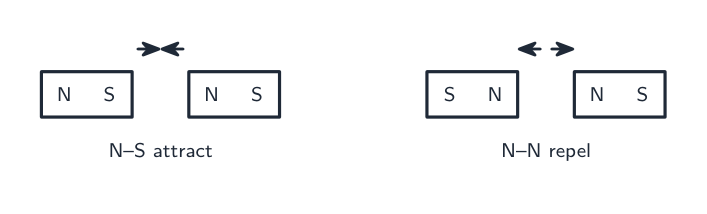
Like poles repel; unlike poles attract
What can an electromagnet do that a permanent magnet cannot?
Difficulty 1/5 · 100 coins + a small bonus on first completion today
An electromagnet is magnetic only while a current flows, so it can be switched on/off and made stronger by increasing the current or turns.
You've got it
- like poles repel, unlike poles attract; magnetic materials = iron, steel, cobalt, nickel
- soft iron = temporary magnet; steel = permanent magnet
- field lines go out of N, into S; closer lines = stronger field
- electromagnets can be switched on/off and made stronger
Write from 4 poles
- One bar magnet is cut into 2 pieces.
- Say how many poles there are. Say why an electromagnet core is soft iron rather than steel.
A bar magnet is cut into 2 pieces. How many poles are there in total, and why is soft iron used for an electromagnet core?
Two magnets have two poles each. Field lines leave a north pole and enter a south pole.
What does cutting the magnet into 2 pieces produce?
Difficulty 1/5 · 100 coins + a small bonus on first completion today
2 times 2 is 4 poles, and each piece still has both poles.