Everything around you is made of atoms — yet an atom is almost entirely empty space. If the nucleus were the size of a marble, the whole atom would be the size…
English narration · English + 中文 subtitles burned in
5.1
The atom
Syllabus
5.1.1 The atom
Core
Supplement
1 Describe the structure of an atom in terms of a positively charged nucleus and negatively charged electrons in orbit around the nucleus
3 Describe how the scattering of alpha ($\alpha$) particles by a sheet of thin metal supports the nuclear model of the atom, by providing evidence for: (a) a very small nucleus surrounded by mostly empty space (b) a nucleus containing most of the mass of the atom (c) a nucleus that is positively charged
2 Know how atoms may form positive ions by losing electrons or form negative ions by gaining electrons
5.1.2 The nucleus
Core
Supplement
1 Describe the composition of the nucleus in terms of protons and neutrons
6 Describe the processes of nuclear fission and nuclear fusion as the splitting or joining of nuclei, to include the nuclide equation and qualitative description of mass and energy changes without values
2 State the relative charges of protons, neutrons and electrons as +1, 0 and –1 respectively
3 Define the terms proton number (atomic number) $Z$ and nucleon number (mass number) $A$ and be able to calculate the number of neutrons in a nucleus
7 Know the relationship between the proton number and the relative charge on a nucleus
8 Know the relationship between the nucleon number and the relative mass of a nucleus
4 Use the nuclide notation $^{A}_{Z}\text{X}$
5 Explain what is meant by an isotope and state that an element may have more than one isotope
Source: Cambridge International syllabus
An atom 原子 is made of a tiny central nucleus 原子核 with electrons 电子 moving around it (in orbit 轨道, like planets around the Sun).
The nucleus has a positive charge 电荷.
The electrons have a negative charge.
The atom as a whole is neutral, because the positive and negative charges are equal.
Almost all the mass 质量 is in the nucleus, but the nucleus is very small compared with the whole atom. So an atom is mostly empty space.
The nuclear atom: a tiny dense nucleus of protons and neutrons, with electrons in orbits around it
Ions
An atom is neutral, but it can gain or lose electrons to become an ion 离子.
Lose one or more electrons → a positive ion (now there are more protons than electrons).
Gain one or more electrons → a negative ion.
Worked comparison. A neutral sodium atom has 11 protons, 12 neutrons and 11 electrons. Losing one electron leaves 10 electrons, so the ion has one more positive charge than negative charge: it is $\mathrm{Na}^{+}$. A neutral chlorine atom with 17 protons, 18 neutrons and 17 electrons gains one electron. It now has 18 electrons and one extra negative charge: $\mathrm{Cl}^{-}$. In both cases only the electron count changes. The nucleus, proton number, nucleon number and identity of the element stay the same.
The alpha-scattering experiment
This experiment gave the evidence for the nuclear model. Alpha particles α粒子 (small, fast, positive) were fired at a very thin gold foil 金箔, and the scattering 散射 (the way they bounced off) was watched.
The results and what they tell us:
Almost all the alpha particles went straight through. → The atom is mostly empty space.
A few were deflected 偏转 (bent) through small angles. → The nucleus has a positive charge, which pushes the positive alpha particles away.
A very few bounced almost straight back. → The nucleus is very small and very heavy, and holds most of the mass of the atom.
Most alpha particles pass straight through; a few are deflected and a very few bounce back off the tiny dense nucleus
Explore
Inside the atom
A tiny dense nucleus sits at the centre with electrons in shells around it — drag the proton number and watch the shells fill outward.
The nucleus is made of two kinds of particle, together called nucleons 核子:
protons 质子, which have a relative 相对 charge of $+1$;
neutrons 中子, which have a relative charge of $0$ (they are neutral).
An electron has a relative charge of $-1$. A proton and a neutron each have a relative mass of about $1$; an electron is almost massless in comparison.
Two numbers describe a nucleus:
the proton number 质子数$Z$ (also called the atomic number) — the number of protons;
the nucleon number 核子数$A$ (also called the mass number) — the number of protons plus neutrons.
So the number of neutrons is $A - Z$.
Worked example. A neutral boron atom has nucleon number 11 and proton number 5. Its nucleus contains five protons. Subtract the protons from the total number of nucleons to find its neutrons:
$$N=A-Z=11-5=6$$
There are six neutrons. Neutrality means it also has five electrons. Do not subtract electrons from the nucleon number: electrons are outside the nucleus and are not nucleons.
We write a nucleus in nuclide 核素 notation:
$$^{A}_{Z}\text{X}$$
where X is the chemical symbol. For example, $^{197}_{\ 79}\text{Au}$ has $79$ protons and $197 - 79 = 118$ neutrons. The relative charge of the whole nucleus is just $+Z$ (here $+79$), and its relative mass is about $A$.
Isotopes
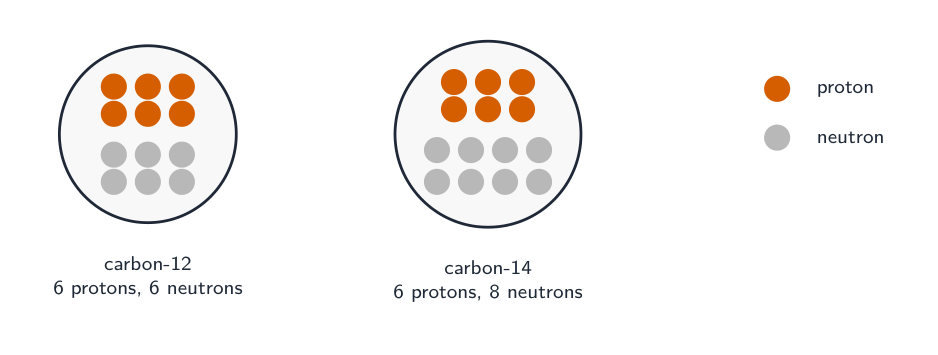
Isotopes 同位素 are atoms of the same element (the same $Z$) but with different numbers of neutrons (different $A$). They behave the same in chemistry but differently in the nucleus. For example, $^{12}_{\ 6}\text{C}$ and $^{14}_{\ 6}\text{C}$ are both carbon.
Isotopes of carbon have the same six protons but different numbers of neutrons, so they are the same element with a different mass
Nuclear fission and fusion
In nuclear fission 核裂变, a heavy nucleus absorbs a neutron and then splits into two smaller nuclei, giving out two or three neutrons and a lot of energy 能量:
A neutron splits a U-235 nucleus into two smaller nuclei, releasing more neutrons and energy
The top numbers (nucleon numbers) balance on both sides, and so do the bottom numbers (proton numbers). You can use this to find a missing number — for example, how many neutrons are released.
In nuclear fusion 核聚变, two light nuclei join to make a heavier one, also giving out energy. This is how the Sun makes its energy, joining hydrogen 氢 nuclei to make helium 氦. The reaction below — two heavy forms of hydrogen (deuterium and tritium) joining into helium — is the one used in fusion reactors on Earth:
2 Know the sources that make a significant contribution to background radiation including: (a) radon gas (in the air) (b) rocks and buildings (c) food and drink (d) cosmic rays
3 Know that ionising nuclear radiation can be measured using a detector connected to a counter
4 Use count rate measured in counts / s or counts / minute
5 Use measurements of background radiation to determine a corrected count rate
5.2.2 The three types of nuclear emission
Core
Supplement
1 Describe the emission of radiation from a nucleus as spontaneous and random in direction
2 Identify alpha ($\alpha$), beta ($\beta$) and gamma ($\gamma$) emissions from the nucleus by recalling: (a) their nature (b) their relative ionising effects (c) their relative penetrating abilities ($\beta^+$ are not included, $\beta$-particles will be taken to refer to $\beta^-$)
3 Describe the deflection of $\alpha$-particles, $\beta$-particles and $\gamma$-radiation in electric fields and magnetic fields
4 Explain their relative ionising effects with reference to: (a) kinetic energy (b) electric charge
5.2.3 Radioactive decay
Core
Supplement
1 Know that radioactive decay is a change in an unstable nucleus that can result in the emission of $\alpha$-particles or $\beta$-particles and/or $\gamma$-radiation and know that these changes are spontaneous and random
3 Know that isotopes of an element may be radioactive due to an excess of neutrons in the nucleus and/or the nucleus being too heavy
2 State that during $\alpha$-decay or $\beta$-decay, the nucleus changes to that of a different element
4 Describe the effect of $\alpha$-decay, $\beta$-decay and $\gamma$-emissions on the nucleus, including an increase in stability and a reduction in the number of excess neutrons; the following change in the nucleus occurs during $\beta$-emission neutron $\rightarrow$ proton + electron
5 Use decay equations, using nuclide notation, to show the emission of $\alpha$-particles, $\beta$-particles and $\gamma$-radiation
5.2.4 Half-life
Core
Supplement
1 Define the half-life of a particular isotope as the time taken for half the nuclei of that isotope in any sample to decay; recall and use this definition in simple calculations, which might involve information in tables or decay curves (calculations will not include background radiation)
2 Calculate half-life from data or decay curves from which background radiation has not been subtracted
3 Explain how the type of radiation emitted and the half-life of an isotope determine which isotope is used for applications including: (a) household fire (smoke) alarms (b) irradiating food to kill bacteria (c) sterilisation of equipment using gamma rays (d) measuring and controlling thicknesses of materials with the choice of radiations used linked to penetration and absorption (e) diagnosis and treatment of cancer using gamma rays
5.2.5 Safety precautions
Core
Supplement
1 State the effects of ionising nuclear radiations on living things, including cell death, mutations and cancer
2 Describe how radioactive materials are moved, used and stored in a safe way
3 Explain safety precautions for all ionising radiation in terms of reducing exposure time, increasing distance between source and living tissue and using shielding to absorb radiation
Source: Cambridge International syllabus
Radioactive decay & half-life
A nucleus that is unstable 不稳定 will sooner or later break down and give out radiation 辐射. This is radioactive 放射性decay 衰变. A nucleus may be unstable because it has too many neutrons, or because it is too heavy.
Decay is spontaneous 自发 (it happens on its own, and you cannot speed it up or slow it down) and random 随机 (you cannot say which nucleus will decay next, or exactly when).
Background radiation
Some radiation is around us all the time. This is background radiation 背景辐射. Its main sources are:
radon 氡 gas in the air (usually the biggest source);
rocks and buildings;
food and drink;
cosmic rays 宇宙射线 from space.
Measuring radiation
Radiation can be measured with a detector 探测器 joined to a counter 计数器. The count rate 计数率 is the number of counts each second (or each minute).
To find the true count rate from a source, first measure the background count rate on its own, then subtract it. The answer is the corrected 修正 count rate:
Worked example. A detector placed next to a source reads $250$ counts/min. With the source taken away, the background count rate is $30$ counts/min. Find the corrected count rate.
$$250 - 30 = 220\ \text{counts/min}$$
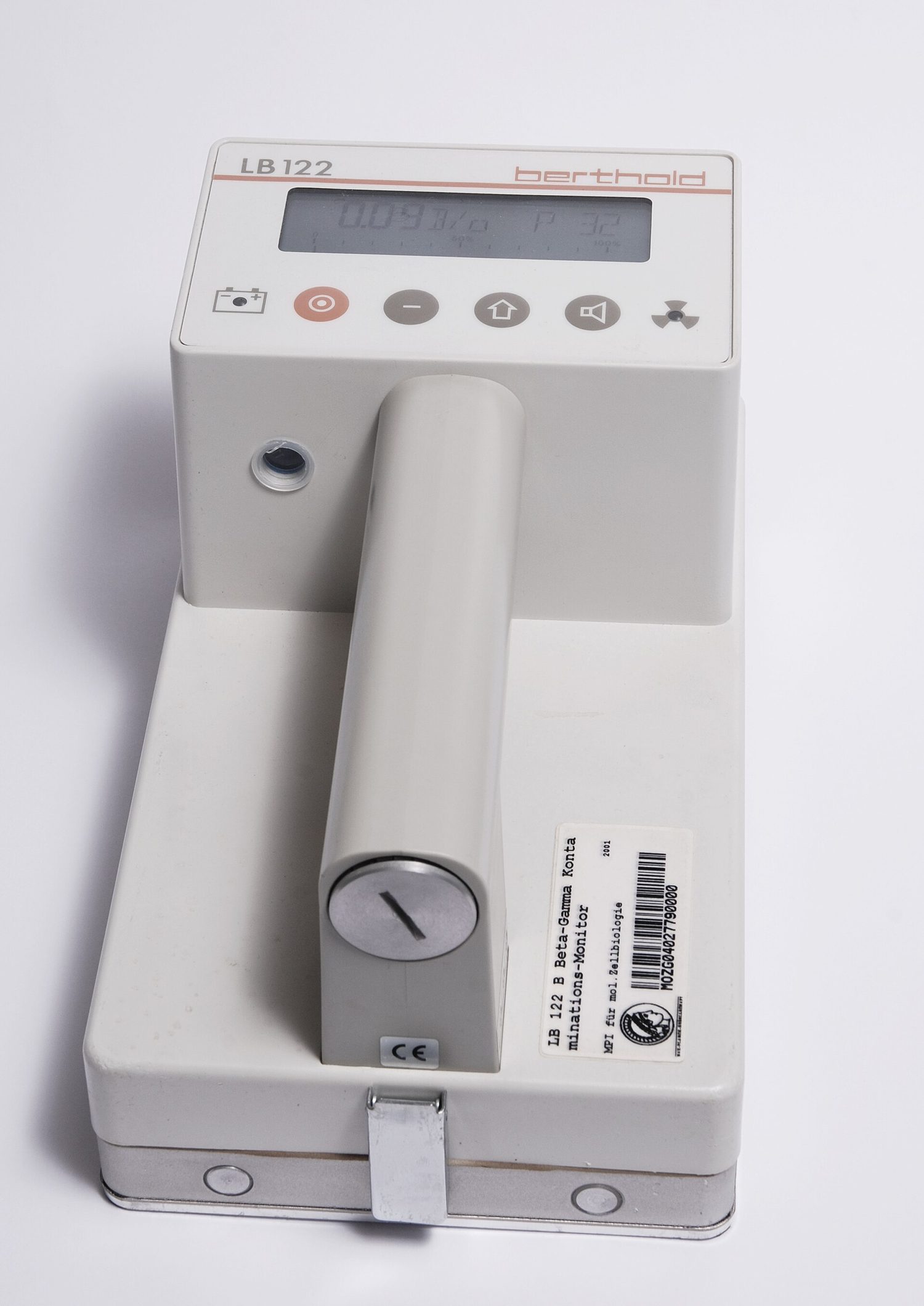
A portable Geiger counter detects ionising radiation and shows the count rate on its screen
Explore
Radioactive decay
N = N₀·bᵗ
The number of unstable nuclei decays exponentially.
The radiation can be one of three types. Each type is ionising 电离, which means it can knock electrons off atoms in its path.
Type
What it is
Ionising effect
Stopped by
alpha (α)
a helium nucleus: 2 protons + 2 neutrons, charge $+2$
strongest
a sheet of paper, or a few cm of air
beta (β)
a fast-moving electron, charge $-1$
medium
a few mm of aluminium 铝
gamma (γ)
a high-energy electromagnetic wave 电磁波, no charge
weakest
thick lead 铅 or concrete (only reduced, never fully stopped)
So an alpha particle is the most ionising but the least penetrating 穿透 (it is easily absorbed 吸收). A beta particle β粒子 is in the middle. Gamma radiation γ射线 is the least ionising but the most penetrating.
Paper stops alpha, a few millimetres of aluminium stops beta, and thick lead only reduces gamma
We can explain the ionising effects from charge and kinetic energy 动能: an alpha particle has a large charge ($+2$) and is slow and heavy, so it pulls strongly on the electrons it passes and ionises a lot. A beta particle has a smaller charge and moves faster, so it ionises less.
Deflection in fields
Because alpha and beta particles are charged, they are deflected by an electric field 电场 and by a magnetic field 磁场. They bend in opposite directions, because their charges have opposite signs, and the lighter beta particle bends more. Gamma rays have no charge, so they are not deflected at all.
Alpha and beta bend in opposite directions; the lighter beta bends more, and uncharged gamma is not deflected
Gamma emission — the nucleus loses only energy, so $A$ and $Z$ do not change. Alpha and beta decay leave the nucleus more stable 稳定; gamma is often given out at the same time to carry away spare energy.
Because decay is random, we cannot follow one nucleus. Instead we describe a large sample 样品 using its half-life.
The half-life 半衰期 of an isotope is the time taken for half the unstable nuclei in a sample to decay. After each half-life, the count rate (or the number of unstable nuclei left) falls to half.
For example, if a source has a count rate of $800$ counts/min and a half-life of $3$ hours:
Time / hours
0
3
6
9
Count rate / (counts/min)
800
400
200
100
After $6$ hours (two half-lives) the count rate has halved twice: $800 \to 400 \to 200$. You can read a half-life off a decay graph by finding the time for the count rate to drop from any value to half of it. If the readings include background radiation, subtract the background count rate from every reading first, then find the half-life from the corrected values.
Worked example. The activity of a source falls from $800$ counts/min to $100$ counts/min. Its half-life is $5$ days. How long did this take?
Count the halvings: $800 \to 400 \to 200 \to 100$ is three half-lives, so the time is $3 \times 5 = 15\ \text{days}$.
Each half-life $T$ the count rate halves: $N_0 \to N_0/2 \to N_0/4 \to N_0/8$
Explore
Half-life — watch the nuclei decay
Each nucleus has a fixed chance of decaying, at random. Move time forward: about half the remaining nuclei decay every half-life — so the count halves, then halves again.
The isotope chosen for a job depends on its type of radiation and its half-life:
smoke alarms 烟雾报警器 use an alpha source (alpha is easily blocked, so it is safe outside the alarm, and a long half-life means it lasts for years);
using radiation on food, or on equipment, kills bacteria 细菌 and germs — this needs penetrating gamma rays to sterilise 消毒 the sealed item;
measuring and controlling the thickness of paper or metal sheets uses a beta source (the amount that passes through changes with the thickness);
a medical tracer 医用示踪剂 is a small amount of a gamma-emitting isotope with a short half-life, injected into the body: a detector outside the body follows where it goes, gamma rays escape from the body easily, and the activity soon falls to a safe level;
gamma rays are used to find and to treat cancer 癌症 inside the body, because they can pass out of (or into) the body.
Radiotherapy: a mesh mask holds the patient still while alignment lasers aim gamma rays precisely at a tumour to treat cancer
The nucleon number (top) is protons + neutrons; the proton number (bottom) is protons only. Number of neutrons = nucleon number − proton number.
Isotopes have the same proton number but different nucleon numbers — the same element with a different number of neutrons.
Rank the radiations two ways: alpha is the most ionising but least penetrating (stopped by paper); gamma is the least ionising but most penetrating (needs thick lead). Beta is in between (stopped by a few mm of aluminium).
In every decay equation the top numbers must balance and the bottom numbers must balance. Alpha decay: $A-4$, $Z-2$. Beta decay: $A$ unchanged, $Z+1$.
Always subtract the background count rate before using a source's readings. After $n$ half-lives the count rate has halved $n$ times — count the halvings rather than guessing from the total time.
Interactive lessons on this topic
Work through it step by step, with instant-check exercises.