English
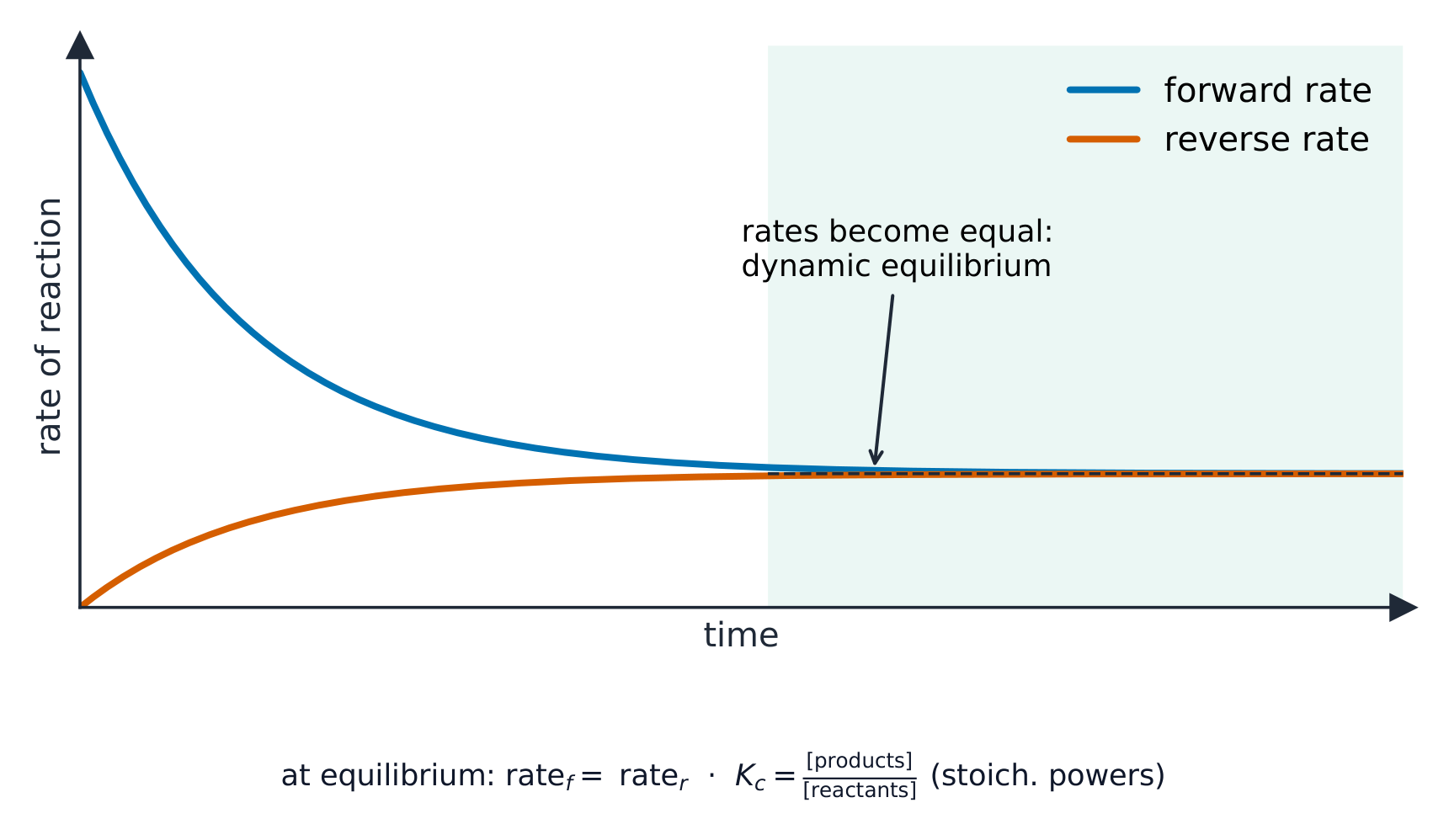
- (a) understand what is meant by a reversible reaction (b) understand what is meant by dynamic equilibrium in terms of the rate of forward and reverse reactions being equal and the concentration of reactants and products remaining constant (c) understand the need for a closed system in order to establish dynamic equilibrium
- define Le Chatelier’s principle as: if a change is made to a system at dynamic equilibrium, the position of equilibrium moves to minimise this change
- use Le Chatelier’s principle to deduce qualitatively (from appropriate information) the effects of changes in temperature, concentration, pressure or presence of a catalyst on a system at equilibrium
- deduce expressions for equilibrium constants in terms of concentrations, $K_c$
- use the terms mole fraction and partial pressure
- deduce expressions for equilibrium constants in terms of partial pressures, $K_p$ (use of the relationship between $K_p$ and $K_c$ is not required)
- use the $K_c$ and $K_p$ expressions to carry out calculations (such calculations will not require the solving of quadratic equations)
- calculate the quantities present at equilibrium, given appropriate data
- state whether changes in temperature, concentration or pressure or the presence of a catalyst affect the value of the equilibrium constant for a reaction
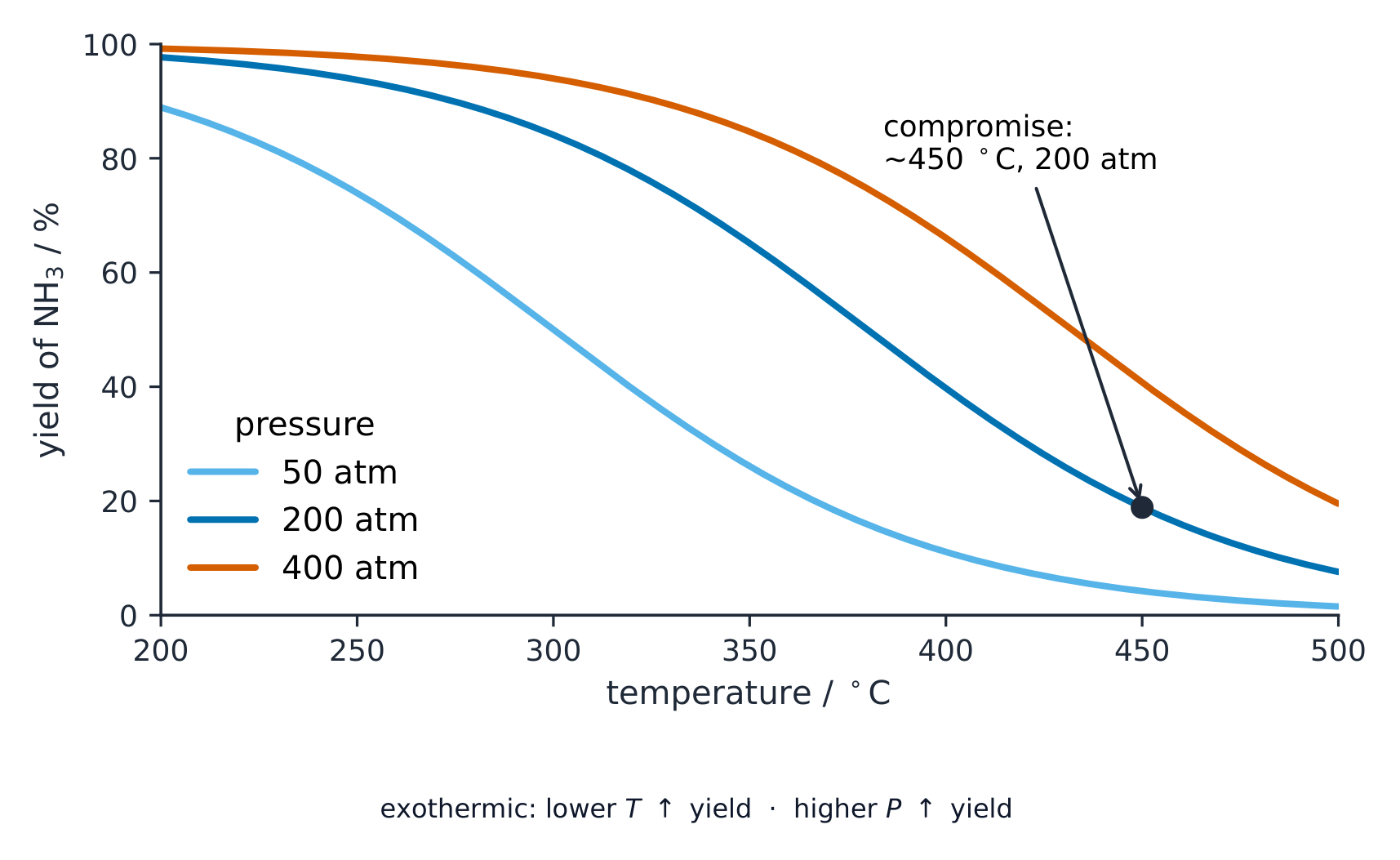
- describe and explain the conditions used in the Haber process and the Contact process, as examples of the importance of an understanding of dynamic equilibrium in the chemical industry and the application of Le Chatelier’s principle
ไทย
- (ก) เข้าใจความหมายของ ปฏิกิริยาที่ย้อนกลับได้ (ข) เข้าใจความหมายของ สมดุลพลวัต ในแง่ที่อัตราของปฏิกิริยารวมไปและปฏิกิริยาย้อนกลับมีค่าเท่ากัน และความเข้มข้นของสารตั้งต้นและผลิตภัณฑ์คงที่ (ค) เข้าใจความจำเป็นของการใช้ระบบปิดเพื่อให้เกิดขึ้นสมดุลพลวัต
- นิยาม กฎของเลอชาเตอลิเยร์ ว่า: หากมีการเปลี่ยนแปลงกับระบบที่อยู่ในสมดุลพลวัต ตำแหน่งสมดุลจะเคลื่อนที่เพื่อลดทอนการเปลี่ยนแปลงนั้น
- ใช้กฎของเลอชาเตอลิเยร์เพื่อหาผลกระทบเชิงคุณภาพ (จากข้อมูลที่เหมาะสม) ของการเปลี่ยนแปลงอุณหภูมิ ความเข้มข้น ความดัน หรือการมีตัวเร่งปฏิกิริยาต่อระบบที่อยู่ภายใต้สมดุล
- หาสมการสำหรับ ค่าคงที่สมดุล ในรูปของความเข้มข้น, $K_c$
- ใช้คำว่า เศษส่วนโมล และ ความดันย่อย
- หาสมการสำหรับค่าคงที่สมดุลในรูปของความดันย่อย, $K_p$ (ไม่จำเป็นต้องใช้ความสัมพันธ์ระหว่าง $K_p$ และ $K_c$)
- ใช้ $K_c$ และ $K_p$ เพื่อทำการคำนวณ (การคำนวณดังกล่าวจะไม่ต้องการการแก้สมการกำลังสอง)
- คำนวณปริมาณที่มีอยู่เมื่อถึงสมดุล จากข้อมูลที่เหมาะสม
- ระบุว่าการเปลี่ยนแปลงอุณหภูมิ ความเข้มข้น หรือความดัน หรือการมีตัวเร่งปฏิกิริยา มีผลต่อค่าคงที่สมดุลของปฏิกิริยาหรือไม่
- อธิบายและอธิบายเงื่อนไขที่ใช้ใน กระบวนการฮาเบอร์ และ กระบวนการคอนแทค เป็นตัวอย่างถึงความสำคัญของการเข้าใจสมดุลพลวัตในอุตสาหกรรมเคมีและการประยุกต์ใช้กฎของเลอชาเตอลิเยร์