옆방에서 커피를 타는 사람이 있을 때 방 안에 앉으십시오. 곧 방 전체를 건너서도 냄새를 맡게 됩니다. 어떻게 될까요? 주변 모든 것은 미립자들로 구성되어 있으며, 그보다 훨씬…
English narration · English + 中文 subtitles burned in · 영어 내레이션 · 영어 + 중국어 자막 burned-in
1.1
The three states of matter · 물질의 세 가지 상태
Syllabus
English
Core
Supplement
1 State the distinguishing properties of solids, liquids and gases
2 Describe the structures of solids, liquids and gases in terms of particle separation, arrangement and motion
3 Describe changes of state in terms of melting, boiling, evaporating, freezing and condensing
5 Explain changes of state in terms of kinetic particle theory, including the interpretation of heating and cooling curves
4 Describe the effects of temperature and pressure on the volume of a gas
6 Explain, in terms of kinetic particle theory, the effects of temperature and pressure on the volume of a gas
한국어
핵심
보충
1 고체, 액체 및 기체의 구별되는 성질을 서술하라
2 입자의 간격, 배열 및 운동 관점에서 고체, 액체 및 기체의 구조를 서술하라
3 융해, 끓임, 증발, 응고 및 응축을 통해 상태 변화를 서술하라
5 운동론적 입자 이론에 의한 상태 변화를 설명하고, 가열 및 냉각 곡선을 해석하라
4 온도와 압력이 기체의 부피에 미치는 영향을 서술하라
6 운동론적 입자 이론에 의해 온도와 압력이 기체의 부피에 미치는 영향을 설명하라
Source: Cambridge International syllabus · 출처: Cambridge International syllabus
English
Solid, liquid, gas: particle motion
Everything around you is made of tiny particles 粒子 — these can be atoms 原子, molecules 分子, or ions 离子. The kinetic particle theory 粒子动理论 says these particles are always moving. How close the particles are, how they are arranged, and how they move decides whether matter is a solid 固体, a liquid 液体, or a gas 气体.
Properties you can observe
You do not need a microscope to tell the three states apart. They behave in different ways:
A solid has a fixed shape and a fixed volume 体积. It does not flow and you cannot compress 压缩 it (squeeze it smaller).
A liquid has a fixed volume but no fixed shape. It flows and takes the shape of its container. It is almost impossible to compress.
A gas has no fixed shape and no fixed volume. It flows and spreads out to fill the whole container. A gas is easy to compress.
The table below sums up these properties. Density 密度 means how much mass 质量 is packed into a given volume.
Property
Solid
Liquid
Gas
Shape
fixed
takes the shape of the container
fills the whole container
Volume
fixed
fixed
fills the whole container
Can it be compressed?
no
almost none
yes, easily
Does it flow?
no
yes
yes
Density
high
high
low
The particle picture
The kinetic particle theory explains these properties by looking at three things: the separation 间距 of the particles (how far apart they are), their arrangement 排列 (the pattern), and their motion 运动 (how they move).
Solid
Liquid
Gas
Separation
touching, very close
close together
far apart
Arrangement
regular 规则 pattern
random, no pattern
random, no pattern
Motion
vibrate 振动 about fixed positions
move and slide past each other
move quickly in all directions
Strong forces of attraction 引力 hold the particles together. In a solid these forces are strong enough to hold every particle in place, so a solid keeps its shape. In a liquid the forces are weaker, so particles can move around. In a gas the particles move so fast that the forces hardly act at all, so the gas spreads out.
한국어
고체, 액체, 기체: 입자 운동
주변의 모든 것은 미세한 **입자(particles)**로 이루어져 있습니다. 이 입자는 원자(atoms), 분자(molecules), 또는 **이온(ions)**일 수 있습니다. **운동 입자 이론(kinetic particle theory)**은 이러한 입자가 항상 움직이고 있다고 말합니다. 입자들이 얼마나 밀집해 있는지, 어떻게 배열되어 있는지, 그리고 어떻게 움직이는지가 물질을 고체(solid), 액체(liquid), 혹은 **기체(gas)**로 구분하는 요인이 됩니다.
관찰 가능한 성질
세 가지 상태를 구분하기 위해 현미경이 필요하지 않습니다. 이들은 서로 다른 방식으로 거동합니다:
고체는 고정된 형태와 고정된 **부피(volume)**를 가집니다. 흐르지 않으며, **압축(compress)**할 수 없습니다(작게 누를 수 없음).
액체는 고정된 부피는 있으나 고정된 형태가 없습니다. 흐르며 용기의 모양을 따릅니다. 압축하는 것이 거의 불가능합니다.
기체는 고정된 형태와 고정된 부피가 없습니다. 흐르며 퍼져 나간 뒤 용기 전체를 채웁니다. 기체는 쉽게 압축됩니다.
아래 표는 이러한 성질들을 요약한 것입니다. **밀도(density)**란 주어진 부피 내에 **질량(mass)**이 얼마나 밀집해 있는지를 의미합니다.
성질
고체
액체
기체
형태
고정됨
용기의 형태를 따름
용기 전체를 채움
부피
고정됨
고정됨
용기 전체를 채움
압축 가능 여부
아니오
거의 없음
네, 쉽게
흐름
아니오
네
네
밀도
높음
높음
낮음
입자의 그림
운동 입자 이론은 세 가지 요소를 통해 이러한 성질을 설명합니다: 입자들의 격리(separation) (서로 얼마나 떨어져 있는지), 배열(arrangement) (패턴), 그리고 운동(motion) (어떻게 움직이는지).
고체
액체
기체
격리
닿아 있음, 매우 가까움
서로 가까움
멀리 떨어짐
배열
규칙적(regular) 패턴
무작위, 패턴 없음
무작위, 패턴 없음
운동
고정된 위치에서 진동(vibrate)
서로 이동하며 미끄러짐
모든 방향으로 빠르게 이동
강한 **인력(strong forces of attraction)**이 입자들을 함께 유지합니다. 고체에서는 이 인력이 강력하여 각 입자를 제자리에 고정시키므로 고체의 형태를 유지합니다. 액체에서는 인력이 약하여 입자들이 이동할 수 있습니다. 기체에서는 입자가 너무 빠르게 움직여 인력이 거의 작용하지 않으므로 기체가 퍼져 나갑니다.
고체에서는 입자가 밀집되고 규칙적이며, 액체에서는 가까이 있고 무작위이며, 기체에서는 멀리 떨어져 있음
Explore · 탐색하기
States of matter · 물질의 상태
Heat the box and watch the particles break free: a vibrating solid melts to a flowing liquid, then spreads out as a gas. Same particles — just more energy. · 상자를 가열하여 입자가 풀려나가는 과정을 관찰하십시오: 진동하는 고체가 녹아 흐르는 액체가 되고, 다시 기체로 퍼져 나갑니다. 같은 입자이지만 에너지가 더 많습니다.
When you heat or cool a substance, it can change from one state to another. You must know the name of each change.
Change
What happens
Name
solid → liquid
melting 熔化
melting
liquid → solid
freezing 凝固
freezing
liquid → gas (at the surface, below the boiling point)
evaporating 蒸发
evaporation
liquid → gas (all through the liquid)
boiling 沸腾
boiling
gas → liquid
condensing 凝结
condensation
A pure solid melts at one fixed temperature, the melting point 熔点. A pure liquid boils at one fixed temperature, the boiling point 沸点. The same substance freezes at its melting point and condenses at its boiling point.
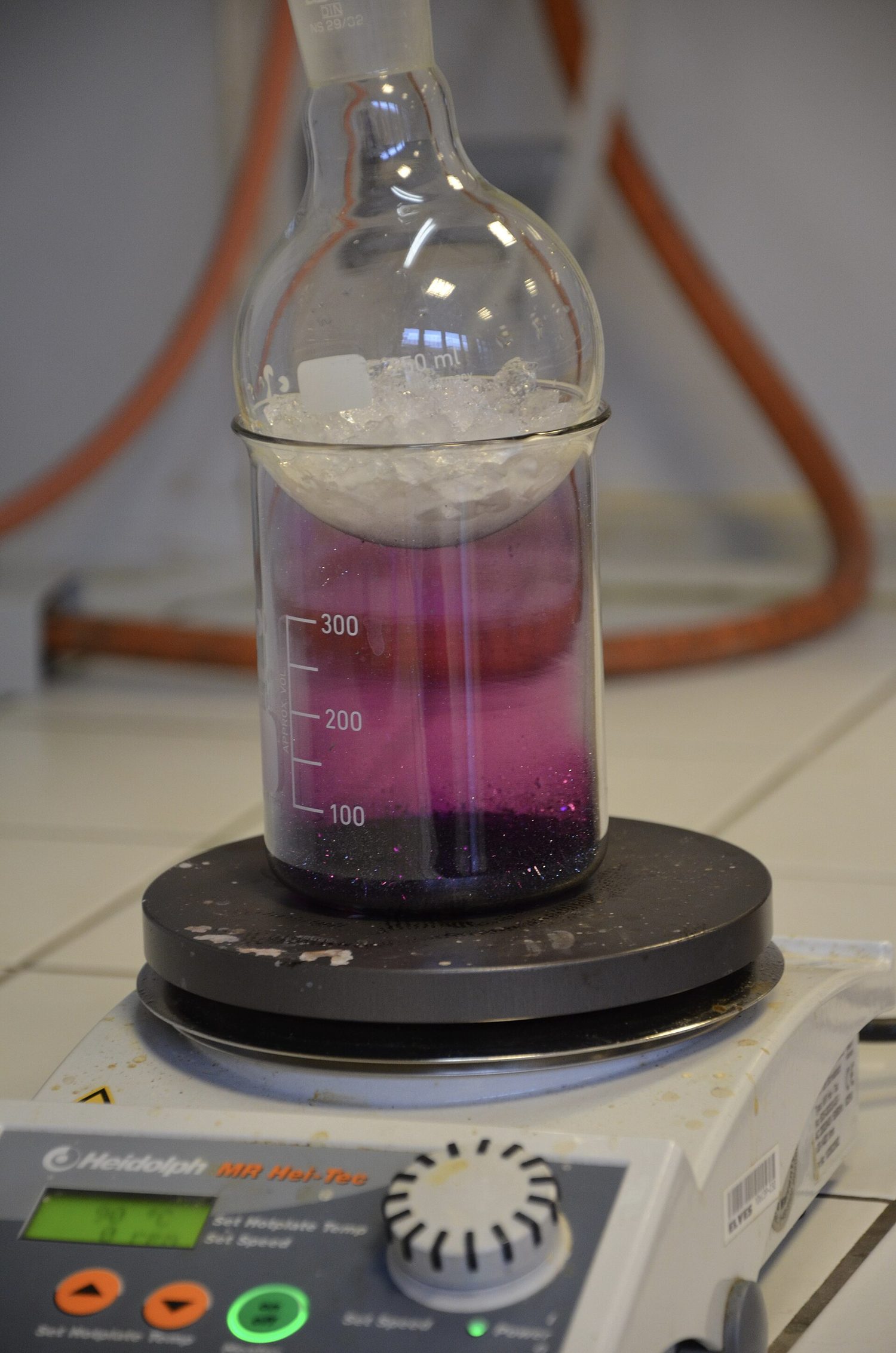
A few substances change straight from solid to gas without melting first. This is called sublimation 升华. In the photo below, warmed solid iodine in a beaker turns directly into a purple gas; the gas then cools on the round flask of ice above and turns back into a solid.
Explaining changes of state with the particle theory
Each change of state is really a change in the energy 能量 of the particles.
When you heat a solid, the particles gain energy and vibrate faster. At the melting point the particles have enough energy to break away from their fixed places and slide around — the solid melts.
When you heat a liquid, the particles move faster. At the boiling point they have enough energy to fully escape the forces of attraction and become a gas.
Cooling does the opposite. The particles lose energy, move more slowly, and the forces of attraction pull them back together.
During a change of state the energy goes into breaking the forces of attraction, not into making the particles move faster. This is why the temperature stays the same while a substance is melting or boiling.
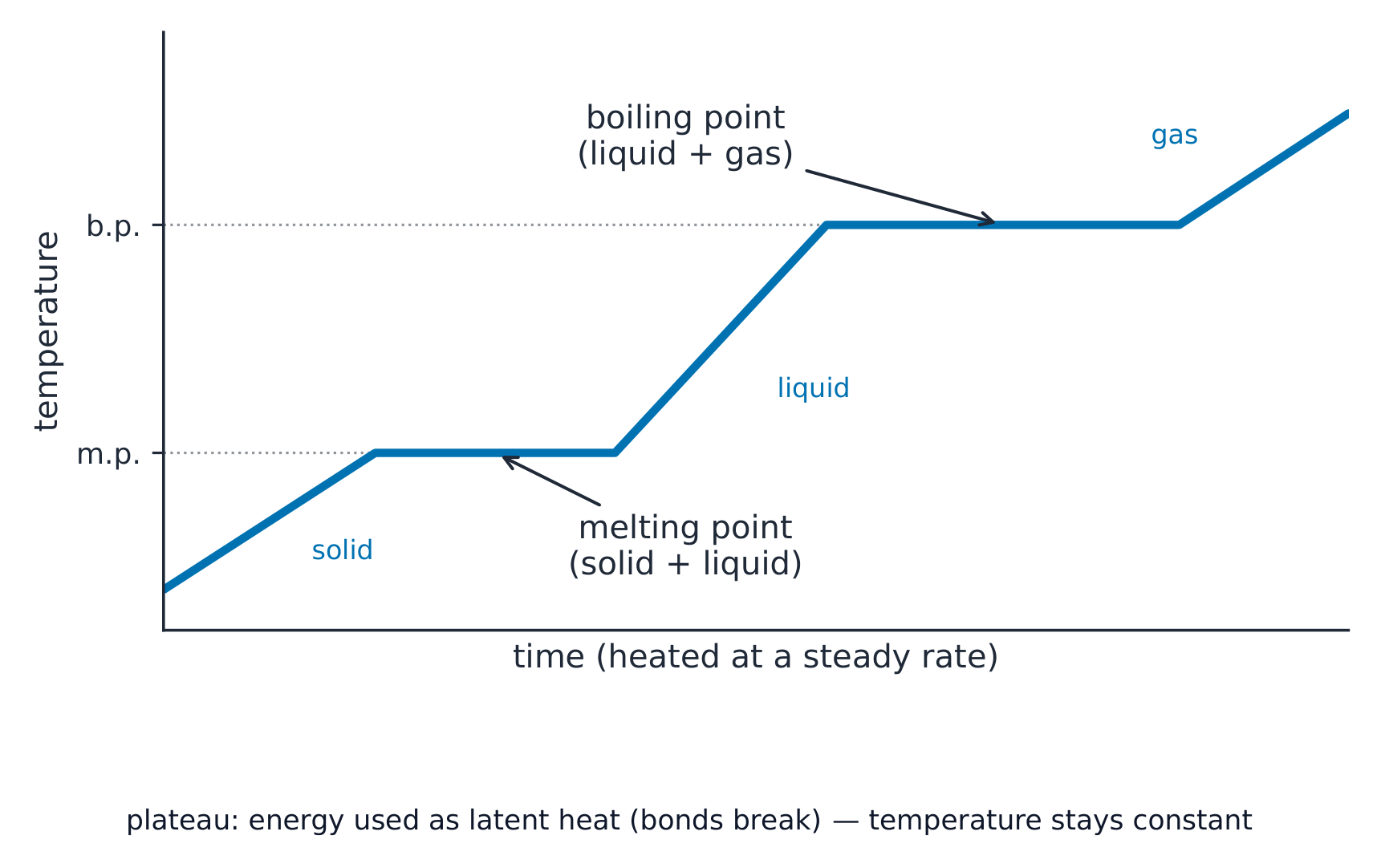
Heating and cooling curves
A heating curve 加热曲线 is a graph of temperature against time as you heat a substance steadily. A cooling curve 冷却曲线 is the same graph as the substance cools.
On a heating curve there are two flat (level) parts:
The first flat part is at the melting point. Here solid and liquid are both present. The heat energy breaks the forces holding the solid together, so the temperature does not rise.
The second flat part is at the boiling point. Here liquid and gas are both present, and the temperature again stays constant.
A cooling curve is the reverse. It has a flat part at the boiling point (the gas condenses) and a flat part at the melting point (the liquid freezes). As the particles slow down, thermal energy 热能 is released to the surroundings.
한국어
얼음이 물로 녹는 것: 고체가 따뜻해지면서 일어나는 상 변화입니다.
물질을 가열하거나 냉각하면 하나의 상태에서 다른 상태로 바뀔 수 있습니다. 각 변화의 이름을 알고 있어야 합니다.
변화
发生了什么
이름
고체 → 액체
녹음(melting)
녹음
액체 → 고체
응고(freezing)
응고
액체 → 기체(표면에서, 끓는점 이하)
증발(evaporating)
증발
액체 → 기체(액체 전체를 통해)
끓임(boiling)
끓임
기체 → 액체
응축(condensing)
응축
순수한 고체는 단일 고정된 온도인 **융점(melting point)**에서 녹습니다. 순수한 액체는 단일 고정된 온도인 **끓는점(boiling point)**에서 끓습니다. 같은 물질은 융점에서 응고하며, 끓는점에서 응축합니다.
가열: 고체 → 액체 → 기체; 냉각은 각 변화를 역으로 함
약간의 물질들은 먼저 녹지 않고 고체에서 바로 기체로 변합니다. 이를 **승화(sublimation)**라고 합니다. 아래 사진처럼 유리병 속 가열된 고체요오드가 직접 보라색 기체로 변하고, 위쪽의 얼음entered 원형 플라스크에서 기체가 식으면서 다시 고체로 돌아옵니다.
가열된 고체 요오드가 바로 보라색 기체로 변함(승화)일상적인 예시: 드라이 아이스는 고체 탄산가스이며, 역시 승화합니다 — 물 자국도 남기지 않습니다
입자 이론을 통한 상 변화 설명
각 상 변화는 실은 입자의 에너지(energy) 변화입니다.
고체를 가열하면 입자가 에너지를 얻어 진동(vibrate) 속도가 빨라집니다. 융점에 도달하면 입자가 고정된 자리에서 벗어나 이동할 수 있을 만큼 충분한 에너지를 갖게 되어 — 고체가 녹습니다.
액체를 가열하면 입자가 더 빠르게 움직입니다. 끓는점에 도달하면 입자는 인력에 완전히挣脱(逃脱)할 수 있는 충분한 에너지를 얻어 기체가 됩니다.
냉각은 그 반대의 일을 합니다. 입자가 에너지를 잃고 느려지며, 인력이 다시 입자들을 모아 묶습니다.
상 변화 동안 에너지는 입자를 더 빠르게 움직이게 하는 데 쓰이지 않고, 인력을 끊는 데 사용됩니다. 이것이 물질이 녹거나 끓는 동안 온도가 일정하게 유지되는 이유입니다.
가열 및 냉각 곡선
**가열 곡선(heating curve)**은 물질을 일정하게 가열할 때 온도를 시간에 대해 그래프로 나타낸 것입니다. **냉각 곡선(cooling curve)**은的物质이 냉각될 때의 동일한 그래프입니다.
가열 곡선에는 두 개의 평평한(수평) 부분이 있습니다:
첫 번째 수평 구간은 융점입니다. 여기서 고체와 액체가 공존합니다. 열에너지가 고체를 유지하는 결합력을 끊어내므로 온도는 상승하지 않습니다.
두 번째 수평 구간은 비점입니다. 여기서 액체와 기체가 공존하며, 온도 역시 일정하게 유지됩니다.
냉각 곡선은 그 반대의 형태를 띱니다. 비점에서 수평 구간이 있으며(기체가 응축됨), 융점에서도 수평 구간이 있습니다(액체가 동결됨). 입자의 운동 속도가 느려지면서 열에너지가 주변으로 방출됩니다.
융점과 비점에서 온도는 일정하며, 이 과정에서 인력이 끊어집니다
Explore · 탐색하기
Heating a substance through its states · 物质의 상태를 거슬러 가열하기
Step up the temperature. Adding heat gives the particles more energy until they break free — and the temperature pauses at each change of state while the energy does that work. · 온도를 높여보십시오. 열을 추가하면 입자에 더 많은 에너지를 주어 입자가 풀려나게 하며, 에너지가 이 일을 하는 동안 각 상태 변화 시 온도가 멈춥니다.
Gases: temperature, pressure and volume · 기체: 온도, 압력 및 부피
English
A gas pushes on the walls of its container. This push, spread over the area of the wall, is the pressure 压强 of the gas. Pressure comes from the gas particles hitting the walls.
Effect of temperature
If you heat a fixed mass of gas while keeping the pressure the same, its volume increases.
Using the particle theory: heating gives the particles more kinetic energy 动能, so they move faster. They hit the walls harder and more often. To keep the pressure the same, the gas must take up more space, so the volume gets bigger.
If instead the volume is fixed (a sealed, rigid container), heating the gas makes the pressure rise, because the faster particles collide 碰撞 with the walls harder and more often.
Effect of pressure
If you increase the pressure on a fixed mass of gas while keeping the temperature the same, its volume decreases. Squeezing the gas into a smaller space means the particles hit the walls more often, which is what a higher pressure means.
한국어
기체는 용기의 벽에 힘을 가합니다. 이 힘은 벽 전체 면적에 분포되어 압력을 형성합니다. 압력은 기체 입자가 벽에 충돌함으로써 발생합니다.
온도의 영향
압력을 일정하게 유지하면서 일정한 질량의 기체에 열을 가하면 부피가 증가합니다.
가열된 기체: 입자가 빨라져 퍼져 나가며 더 많은 공간을 차지함
입자설을 적용하면: 가열로 인해 입자에 더 많은 운동 에너지가 주어져 더 빠르게 움직입니다. 이는 벽에 더 세게, 더 자주 충돌함을 의미합니다. 압력을 일정하게 유지하려면 기체가 더 많은 공간을 차지해야 하므로 부피는 커집니다.
반면 부피가 고정된 경우(밀폐된 강성 용기)에는 가열로 인해 입자가 더 빠르며 벽에 더 세게, 더 자주 충돌하므로 압력이 상승합니다.
압력의 영향
온도를 일정하게 유지하면서 일정한 질량의 기체에 압력을 가하면 부피가 감소합니다. 기체를 더 작은 공간으로 압축하면 입자가 벽에 더 자주 충돌하게 되는데, 이것이 더 높은 압력을 의미합니다.
기체를 더 작은 부피로 압축하면 입자가 벽에 더 자주 충돌하므로 압력이 상승합니다
Explore · 탐색하기
Gases, pressure & volume · 기체, 압력 & 부피
p = k / V
Squeeze the volume and the pressure rises (Boyle's law). · 부피를 줄이면 압력이 상승합니다 (보일의 법칙).
1 Describe and explain diffusion in terms of kinetic particle theory
2 Describe and explain the effect of relative molecular mass on the rate of diffusion of gases
한국어
핵심
보충
1 운동론적 입자 이론에 의해 확산을 서술하고 설명하라
2 ** 상대 분자 질량**이 기체의 확산 속도에 미치는 영향을 서술하고 설명하라
Source: Cambridge International syllabus · 출처: Cambridge International syllabus
English
Diffusion: random motion, one-way flow
Diffusion 扩散 is the spreading of particles from a region where they are crowded to a region where they are spread out — that is, from high concentration 浓度 to low concentration. It happens because particles are always moving in random directions.
Diffusion explains why you can smell food from across a room: the smell particles move and mix with the air until they reach your nose. Diffusion happens in gases and in liquids, but not in solids, because solid particles cannot move from place to place.
Rate of diffusion and molecular mass
Lighter gas particles move faster than heavier ones at the same temperature. So a gas with a smaller relative molecular mass 相对分子质量 (a smaller mass for each molecule) has a faster rate 速率 of diffusion.
A classic experiment shows this. Cotton wool soaked in ammonia 氨气 ($\text{NH}_3$) is put at one end of a long glass tube. Cotton wool soaked in hydrogen chloride 氯化氢 ($\text{HCl}$) is put at the other end. Both gases diffuse along the tube and meet to form a white ring of ammonium chloride 氯化铵 ($\text{NH}_4\text{Cl}$).
Ammonia has $M_r = 17$ and hydrogen chloride has $M_r = 36.5$. Ammonia is lighter, so it diffuses faster and travels further along the tube. The white ring forms nearer the hydrogen chloride end.
Worked example. Bromine ($M_r = 160$) and ammonia ($M_r = 17$) are released at the same moment from opposite ends of a long tube. Which travels further before they meet? Compare the relative molecular masses. Ammonia's $M_r$ is far smaller, so its molecules move faster at the same temperature and it diffuses more quickly. Ammonia therefore travels the greater distance, and the two gases meet nearer the bromine end. The rule is always "lighter means faster" - argue from $M_r$, never from how big the formula looks on paper.
한국어
확산: 무작위 운동, 일방 흐름
확산은 입자가 밀집된 영역에서 흩어진 영역으로 퍼지는 현상 — 즉, 높은 농도에서 낮은 농도로 이동하는 것입니다. 입자가 항상 무작위 방향으로 움직이기 때문에 발생합니다.
입자는 농도가 균일해질 때까지 높은 농도에서 낮은 농도로 확산됩니다
확산은 방 안의 다른 쪽에서 음식 냄새를 맡을 수 있는 이유를 설명해 줍니다. 냄새 입자가 공기 중으로 이동하고 섞여 코까지 도달하기 때문입니다. 확산은 기체와 액체에서는 일어나지만 고체에서는 일어나지 않는데, 고체 입자는 위치를 바꿀 수 없기 때문입니다.
확산 속도와 분자량
같은 온도에서 가벼운 기체 입자는 무거운 입자보다 더 빠르게 움직입니다. 따라서 각 분자의 질량이 더 작은 분자량(더 작은 분자당 질량)을 가진 기체는 더 빠른 확산 속도를 보입니다.
고전적인 실험에서 이를 확인할 수 있습니다. 암모니아($\text{NH}_3$)에 적신 면화 뭉치를 긴 유리관의 한쪽에 배치합니다. 염화수소($\text{HCl}$)에 적신 면화 뭉치를 다른 쪽에 배치합니다. 두 기체가 관을 따라 확산하여 만나 암모늄 염化物($\text{NH}_4\text{Cl}$)의 흰색 고리(백색 고리)를 형성합니다.
암모니아는 $M_r = 17$이고 염화수소는 $M_r = 36.5$입니다. 암모니아가 더 가벼워 확산 속도가 빠르고 관을 더 멀리 이동합니다. 흰색 고리는 염화수소 쪽 끝에 더 가깝게 형성됩니다.
암모니아($M_r=17$)는 더 가벼워 확산 속도가 빠르고 더 멀리 이동하며, 흰색 고리는 HCl 쪽 끝에 더 가깝게 형성됩니다
풀이 예제. 브롬($M_r = 160$)과 암모니아($M_r = 17$)가 긴 튜브의 양 끝에서 동시에 방출됩니다. 두 기체가 만나는 지점까지 어느 것이 더 멀리 이동합니까? 분자량을 비교하십시오. 암모니아의 $M_r$이 훨씬 작으므로 같은 온도에서 분자가 더 빠르게 움직이며 확산 속도가 빠릅니다. 따라서 암모니아가 더 긴 거리를 이동하고, 두 기체는 브롬 쪽 끝에 더 가깝게 만납니다. 규칙은 항상 "가볍다는 것은 빠르다"이며, $M_r$에서 논理적으로 arguing해야 하며, 표면에 보이는 식의 크기만으로 추측해서는 안 됩니다.
Explore · 탐색하기
Diffusion · 확산
Release the cloud and the particles spread on their own from the crowded corner until they fill the box evenly — diffusion, sped up by heat. · 구름을 방출하면 입자가 몰린 모서리에서 스스로 퍼져 상자가 균일하게 채워집니다 — 이는 열에 의해 가속화된 확산입니다.
Explore · 탐색하기
Diffusion · 확산
Set the concentration on each side. Particles spread from high to low concentration until evenly mixed. · 양측의 농도를 설정하십시오. 입자는 높은 곳에서 낮은 곳으로 농도 차이를 줄여 고르게 섞일 때까지 퍼집니다.
During melting and boiling the temperature stays constant (the flat parts of a heating curve), because the energy breaks the forces between particles instead of making them move faster.
Evaporation happens only at the surface and at any temperature; boiling happens throughout the liquid at one fixed temperature.
Explain gas behaviour with the particle theory: heating a gas at fixed volume raises the pressure because the particles hit the walls harder and more often — the particles themselves do not get bigger.
Diffusion is faster for lighter particles (smaller $M_r$) and cannot happen in solids. In the ammonia/hydrogen chloride tube the lighter ammonia travels further, so the white ring forms nearer the HCl end.
한국어
융해 및 끓임 동안 온도는 일정합니다(가열 곡선의 수평 구간). 이는 에너지가 입자의 운동을 가속시키는 대신 입자 사이의 결합력을 끊어내기 때문입니다.
증발은 표면에서만 발생하며 모든 온도에서 일어날 수 있습니다. 반면 끓임은 특정 고정된 온도에서 액체 전체에서 발생합니다.
입자 이론으로 기체의 거동을 설명하십시오: 일정한 부피에서 기체를 가열하면 압력이 상승하는데, 이는 입자가 벽에 더 강하고 자주 부딪히기 때문입니다. 단, 입자 자체의 크기는变大하지 않습니다.
확산은 가벼운 입자(작은 $M_r$)일수록 빠르며, 고체에서는 일어나지 않습니다. 암모니아/염화수소 튜브 실험에서 가벼운 암모니아가 더 멀리 이동하므로, 흰 고리(HCl)는 염화수소 쪽에 더 가깝게 형성됩니다.
Interactive lessons on this topic · 이 주제에 대한 인터랙티브 수업
Work through it step by step, with instant-check exercises. · 즉시 체크 기능 exercises를 통해 단계별로 진행하세요.