Changes of state
Introduced| English | Meaning |
|---|---|
| melting/ˈmeltɪŋ/ | The change of a substance from solid to liquid. |
| boiling/ˈbɔɪlɪŋ/ | Vaporisation throughout a liquid when its vapour pressure matches the surrounding pressure. |
| changes of state/ˈtʃeɪndʒɪz ɒv steɪt/ | changes of state |
| freezing/ˈfriːzɪŋ/ | The change of state from liquid to solid. |
| evaporating/ɪˈvæpəreɪtɪŋ/ | Changing from liquid to gas at the liquid's surface. |
| condensing/kənˈdensɪŋ/ | Changing from gas to liquid. |
| subliming/sʌˈblaɪmɪŋ/ | subliming |
| boiling point/ˈbɔɪlɪŋ pɔɪnt/ | The temperature at which a liquid's vapour pressure equals the surrounding pressure. |
| melting point/ˈmeltɪŋ pɔɪnt/ | The temperature at which a solid and its liquid phase can coexist in equilibrium at a specified pressure. |
Melting 熔化, boiling 沸腾 and back again
- Heat ice and it melts; heat water and it boils. Cool steam and it turns back.
- These changes of state 状态变化 are all about giving or taking energy from the particles.
The change from solid to liquid is called:
Difficulty 1/5 · 100 coins + a small bonus on first completion today
Solid → liquid is melting.
The change from gas to liquid is called:
Difficulty 1/5 · 100 coins + a small bonus on first completion today
Gas → liquid is condensing.
The named changes
- Melting (solid → liquid) and freezing 凝固 (liquid → solid).
- Evaporating 蒸发/boiling (liquid → gas) and condensing 凝结 (gas → liquid).
- Subliming 升华 (solid → gas directly).

Heating moves matter solid to liquid to gas; cooling reverses each change
Heating a substance through its states
Step up the temperature. Adding heat gives the particles more energy until they break free — and the temperature pauses at each change of state while the energy does that work.
Heating a substance gives its particles:
Difficulty 1/5 · 100 coins + a small bonus on first completion today
Heat increases particle energy and movement.
Energy and changes of state
- Heating gives particles more energy, so they move more and break apart — melting then boiling.
- Cooling removes energy, so particles move less and come together — condensing then freezing.

Ice melting to water: a change of state as the solid warms
During melting, the temperature stays constant until all the solid has melted.
Difficulty 1/5 · 100 coins + a small bonus on first completion today
The energy is used to separate particles, not raise temperature.
A pure substance boils at a fixed temperature called its ______ point.
Difficulty 1/5 · 100 coins + a small bonus on first completion today
Pure substances have sharp melting and boiling points.
Melting and boiling points 沸点
- A pure substance melts and boils at fixed temperatures — its melting point 熔点 and boiling point.
- During a change of state, the temperature stays constant while the energy breaks the bonds between particles.
Worked example. When ice at 0 °C melts, you add heat but the temperature stays at 0 °C until all the ice has melted. The energy is used to separate the particles, not to raise the temperature.
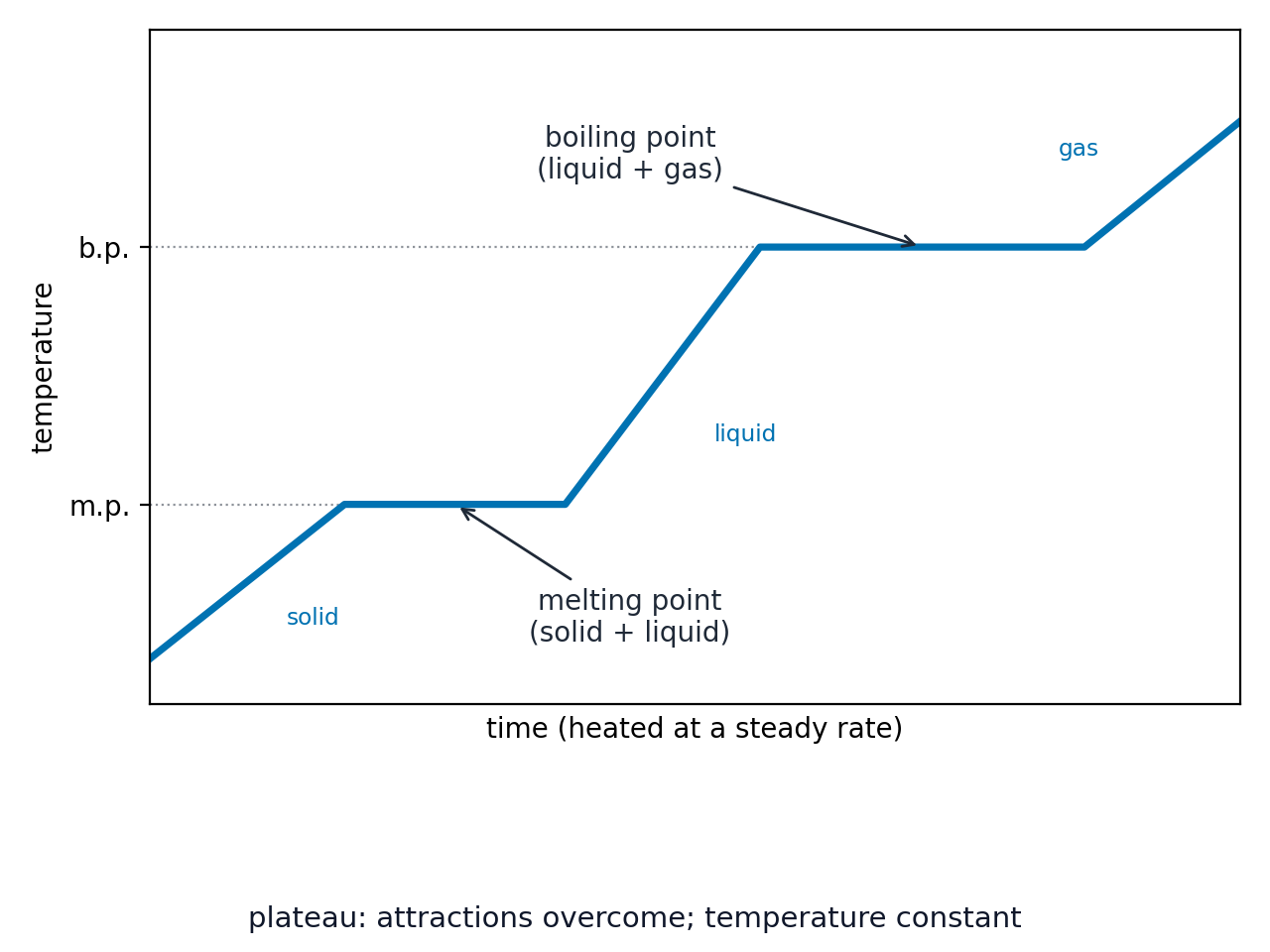
While the substance melts and while it boils the temperature stays flat, even though energy is still being added
You've got it
- melting/freezing, boiling/condensing, subliming are changes of state
- heating adds energy (particles separate); cooling removes it (particles come together)
- temperature stays constant during a change of state (energy breaks bonds)