| Core | Supplement |
|---|---|
| 1 State the distinguishing properties of solids, liquids and gases | |
| 2 Describe the structures of solids, liquids and gases in terms of particle separation, arrangement and motion | |
| 3 Describe changes of state in terms of melting, boiling, evaporating, freezing and condensing | 5 Explain changes of state in terms of kinetic particle theory, including the interpretation of heating and cooling curves |
| 4 Describe the effects of temperature and pressure on the volume of a gas | 6 Explain, in terms of kinetic particle theory, the effects of temperature and pressure on the volume of a gas |
States of matter
IGCSE Chemistry · Topic 1
 13:32
13:32
States of Matter
Sit in a room while someone makes coffee next door. Soon you can smell it, even from across the room. How? Everything around you is made of tiny particles, far…
English narration · English + 中文 subtitles burned in
1.1
The three states of matter

Syllabus
Source: Cambridge International syllabus
Everything around you is made of tiny particles 粒子 — these can be atoms 原子, molecules 分子, or ions 离子. The kinetic particle theory 粒子动理论 says these particles are always moving. How close the particles are, how they are arranged, and how they move decides whether matter is a solid 固体, a liquid 液体, or a gas 气体.
Properties you can observe
You do not need a microscope to tell the three states apart. They behave in different ways:
- A solid has a fixed shape and a fixed volume 体积. It does not flow and you cannot compress 压缩 it (squeeze it smaller).
- A liquid has a fixed volume but no fixed shape. It flows and takes the shape of its container. It is almost impossible to compress.
- A gas has no fixed shape and no fixed volume. It flows and spreads out to fill the whole container. A gas is easy to compress.
The table below sums up these properties. Density 密度 means how much mass 质量 is packed into a given volume.
| Property | Solid | Liquid | Gas |
|---|---|---|---|
| Shape | fixed | takes the shape of the container | fills the whole container |
| Volume | fixed | fixed | fills the whole container |
| Can it be compressed? | no | almost none | yes, easily |
| Does it flow? | no | yes | yes |
| Density | high | high | low |
The particle picture
The kinetic particle theory explains these properties by looking at three things: the separation 间距 of the particles (how far apart they are), their arrangement 排列 (the pattern), and their motion 运动 (how they move).
| Solid | Liquid | Gas | |
|---|---|---|---|
| Separation | touching, very close | close together | far apart |
| Arrangement | regular 规则 pattern | random, no pattern | random, no pattern |
| Motion | vibrate 振动 about fixed positions | move and slide past each other | move quickly in all directions |
Strong forces of attraction 引力 hold the particles together. In a solid these forces are strong enough to hold every particle in place, so a solid keeps its shape. In a liquid the forces are weaker, so particles can move around. Gas particles are far apart and move randomly; attractions have little effect in this simple model, so the gas spreads through its container.
Explore
States of matter
Heat the box and watch the particles break free: a vibrating solid melts to a flowing liquid, then spreads out as a gas. Same particles — just more energy.
Vocabulary
Train
| English |
|---|
| particles/ˈpɑːtɪklz/ |
| atoms/ˈætəmz/ |
| molecules/ˈmɒlɪkjuːlz/ |
| ions/ˈaɪɒnz/ |
| kinetic particle theory/kɪˈnetɪk ˈpɑːtɪkl ˈθɪəri/ |
| solid/ˈsɒlɪd/ |
| liquid/ˈlɪkwɪd/ |
| gas/ɡæs/ |
| volume/ˈvɒljuːm/ |
| compress/kəmˈpres/ |
| density/ˈdensɪti/ |
| mass/mæs/ |
| separation/ˌsepəˈreɪʃn/ |
| arrangement/əˈreɪndʒmənt/ |
| motion/ˈməʊʃn/ |
| regular/ˈreɡjʊlə/ |
| vibrate/vaɪˈbreɪt/ |
| forces of attraction/ˈfɔːsɪz ɒv əˈtrækʃn/ |
1.1
Changes of state

When you heat or cool a substance, it can change from one state to another. You must know the name of each change.
| Change | What happens | Name |
|---|---|---|
| solid → liquid | melting 熔化 | melting |
| liquid → solid | freezing 凝固 | freezing |
| liquid → gas (at the surface, below the boiling point) | evaporating 蒸发 | evaporation |
| liquid → gas (all through the liquid) | boiling 沸腾 | boiling |
| gas → liquid | condensing 凝结 | condensation |
At a fixed pressure, a pure solid melts at one fixed temperature, the melting point 熔点. At a fixed pressure, a pure liquid boils at one fixed temperature, the boiling point 沸点. The same substance freezes at its melting point and condenses at its boiling point.

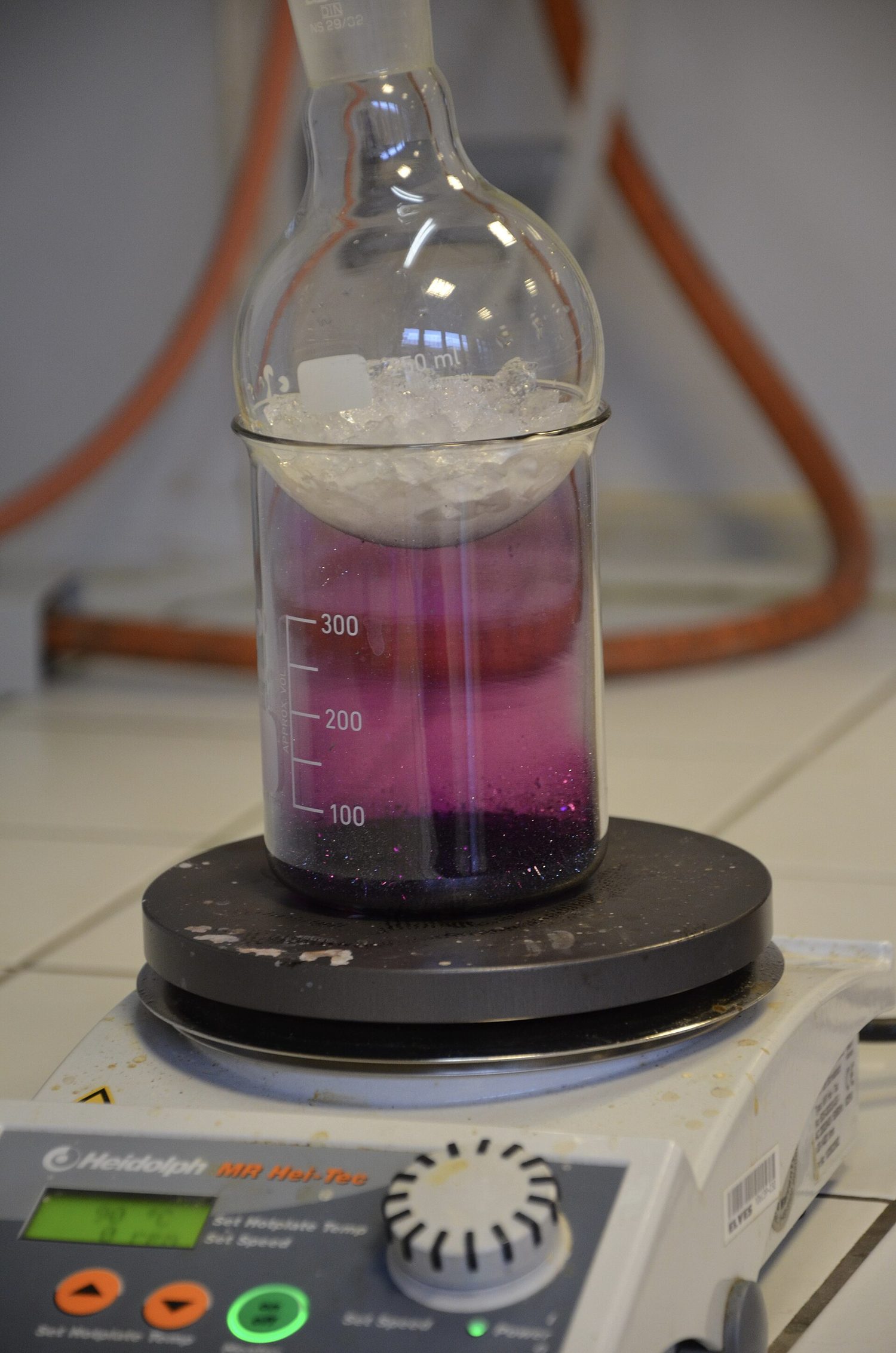
A few substances change straight from solid to gas without melting first. This is called sublimation 升华. In the photo below, warmed solid iodine in a beaker turns directly into a purple gas; the gas then cools on the round flask of ice above and turns back into a solid.

Explaining changes of state with the particle theory
Each change of state is really a change in the energy 能量 of the particles.
- When you heat a solid, the particles gain energy and vibrate faster. At the melting point the particles have enough energy to break away from their fixed places and slide around — the solid melts.
- When you heat a liquid, the particles move faster. At the boiling point they have enough energy to fully escape the forces of attraction and become a gas.
- Cooling does the opposite. The particles lose energy, move more slowly, and the forces of attraction pull them back together.
During melting or boiling of a pure substance at fixed pressure, supplied energy overcomes forces of attraction between particles rather than increasing their average kinetic energy. Temperature stays constant during the change. This does not mean bonds within molecules break: melting ice still gives water, not hydrogen and oxygen.
Heating and cooling curves
A heating curve 加热曲线 is a graph of temperature against time as you heat a substance steadily. A cooling curve 冷却曲线 is the same graph as the substance cools.
For a pure substance heated from solid through liquid to gas at fixed pressure, the ideal heating curve has two flat parts:
- The first flat part is at the melting point. Here solid and liquid are both present. The supplied energy overcomes the forces holding particles in fixed positions, so the temperature does not rise.
- The second flat part is at the boiling point. Here liquid and gas are both present, and the temperature again stays constant.
A cooling curve is the reverse. It has a flat part at the boiling point (the gas condenses) and a flat part at the melting point (the liquid freezes). On falling single-state sections, average kinetic energy decreases. During the freezing and condensing plateaux, temperature stays constant while thermal energy 热能 is transferred to the surroundings.
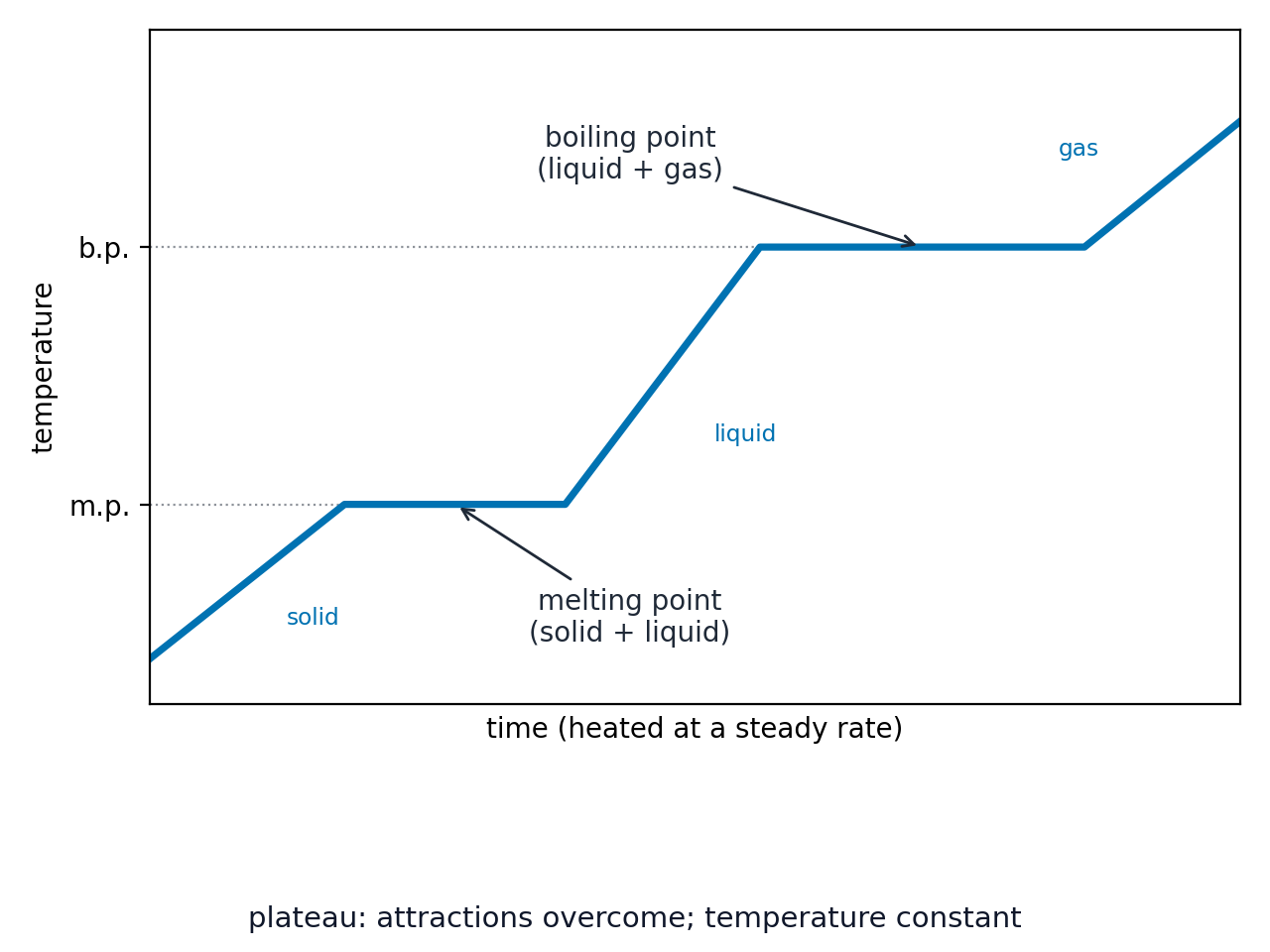
Worked original curves: on 0620/22 November 2025 Q2, Q–R is melting: particles leave fixed positions and become mobile (option B). P–Q warms solid; S–T is boiling. On 0620/22 March 2025 Q2, W–X is liquid cooling: particles are close and randomly arranged (option C). V–W is condensation and X–Y is freezing. Cooling transfers energy out, including during the plateaux; a flat section does not mean no energy transfer.
Melting is different from dissolving: ice becoming liquid water is melting. A soluble solid added to water becomes an aqueous solution by dissolving, the third physical change in 0620/42 November 2025 Q1(b). Heating the solid is not required for dissolving. Gas becoming liquid is condensation.
Explore
Heating a substance through its states
Step up the temperature. Adding heat gives the particles more energy until they break free — and the temperature pauses at each change of state while the energy does that work.
Vocabulary
Train
| English |
|---|
| melting/ˈmeltɪŋ/ |
| freezing/ˈfriːzɪŋ/ |
| evaporating/ɪˈvæpəreɪtɪŋ/ |
| boiling/ˈbɔɪlɪŋ/ |
| condensing/kənˈdensɪŋ/ |
| melting point/ˈmeltɪŋ pɔɪnt/ |
| boiling point/ˈbɔɪlɪŋ pɔɪnt/ |
| sublimation/ˌsʌblɪˈmeɪʃn/ |
| energy/ˈenədʒi/ |
| heating curve/ˈhiːtɪŋ kɜːv/ |
| cooling curve/ˈkuːlɪŋ kɜːv/ |
| thermal energy/ˈθɜːml ˈenədʒi/ |
1.1
Gases: temperature, pressure and volume

A gas pushes on the walls of its container. This push, spread over the area of the wall, is the pressure 压强 of the gas. Pressure comes from the gas particles hitting the walls.
Effect of temperature
If you heat a fixed mass of gas while keeping the pressure the same, its volume increases.
Using the particle theory: heating gives the particles more kinetic energy 动能, so they move faster. They hit the walls harder and more often. To keep the pressure the same, the gas must take up more space, so the volume gets bigger.
If instead the volume is fixed (a sealed, rigid container), heating the gas makes the pressure rise, because the faster particles collide 碰撞 with the walls harder and more often.
Effect of pressure
If you increase the pressure on a fixed mass of gas while keeping the temperature the same, its volume decreases. Squeezing the gas into a smaller space means the particles hit the walls more often, which is what a higher pressure means.

Explore
Gases, pressure & volume
p = k / V
Squeeze the volume and the pressure rises (Boyle's law).
Vocabulary
Train
| English |
|---|
| pressure/ˈpreʃə/ |
| kinetic energy/kɪˈnetɪk ˈenədʒi/ |
| collide/kəˈlaɪd/ |
1.2
Diffusion
Syllabus
| Core | Supplement |
|---|---|
| 1 Describe and explain diffusion in terms of kinetic particle theory | 2 Describe and explain the effect of relative molecular mass on the rate of diffusion of gases |
Source: Cambridge International syllabus
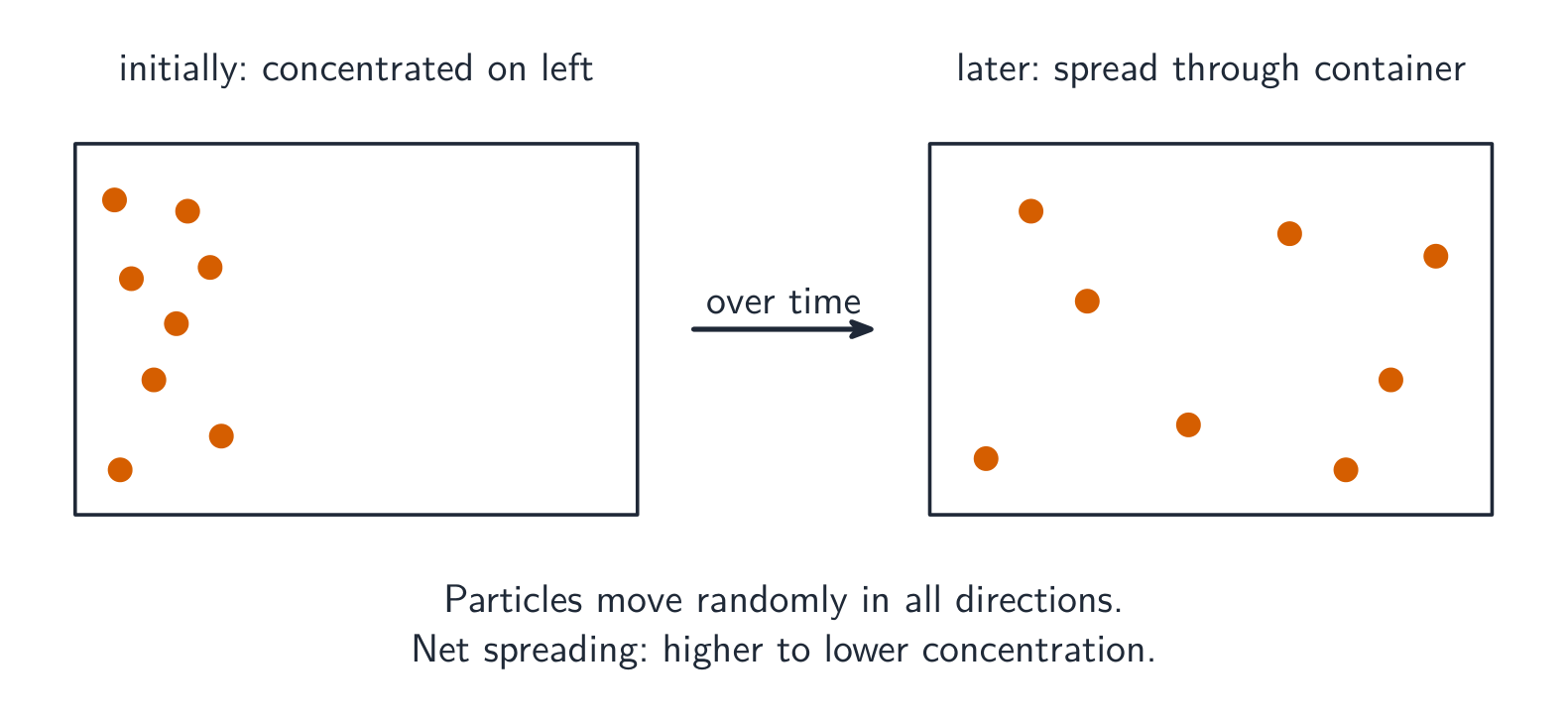
Diffusion 扩散 is the net spreading of particles from a region where they are crowded to a region where they are spread out — that is, from high concentration 浓度 to low concentration. It happens because particles are always moving in random directions.
Diffusion explains why you can smell food from across a room: the smell particles move and mix with the air until they reach your nose. Diffusion happens in gases and in liquids, but not in solids, because solid particles cannot move from place to place.
Rate of diffusion and molecular mass
Lighter gas particles move faster than heavier ones at the same temperature. So a gas with a smaller relative molecular mass 相对分子质量 (a smaller mass for each molecule) has a faster rate 速率 of diffusion.
A classic experiment shows this. Cotton wool soaked in ammonia 氨气 ($\text{NH}_3$) is put at one end of a long glass tube. Cotton wool soaked in hydrogen chloride 氯化氢 ($\text{HCl}$) is put at the other end. Both gases diffuse along the tube and meet to form a white ring of ammonium chloride 氯化铵 ($\text{NH}_4\text{Cl}$).
$$\text{NH}_3 + \text{HCl} \rightarrow \text{NH}_4\text{Cl}$$
Ammonia has $M_r = 17$ and hydrogen chloride has $M_r = 36.5$. Ammonia is lighter, so it diffuses faster and travels further along the tube. The white ring forms nearer the hydrogen chloride end.

Worked example. Bromine ($M_r = 160$) and ammonia ($M_r = 17$) are released at the same moment from opposite ends of a long tube. Which travels further before they meet? Compare the relative molecular masses. Ammonia's $M_r$ is far smaller, so its molecules move faster at the same temperature and it diffuses more quickly. Ammonia therefore travels the greater distance, and the two gases meet nearer the bromine end. Compare gases at the same temperature using $M_r$, rather than the length of their chemical formulae.
A reaction is not just deposition: ammonia and hydrogen chloride form a new substance, solid ammonium chloride: $\text{NH}_3(g) + \text{HCl}(g) \rightarrow \text{NH}_4\text{Cl}(s)$. This is a chemical reaction. Gas becoming solid is a physical change only when the substance stays the same, for example iodine vapour forming solid iodine. Ammonia and bromine do not provide chlorine atoms and cannot form ammonium chloride.
Explore
Diffusion
Release the cloud and the particles spread on their own from the crowded corner until they fill the box evenly — diffusion, sped up by heat.
Explore
Diffusion
Set the concentration on each side. Particles spread from high to low concentration until evenly mixed.
Vocabulary
Train
| English |
|---|
| diffusion/dɪˈfjuːʒn/ |
| concentration/ˌkɒnsənˈtreɪʃn/ |
| relative molecular mass/ˈrelətɪv məˈlekjʊlə mæs/ |
| rate/reɪt/ |
| ammonia/æˈməʊnɪə/ |
| hydrogen chloride/ˈhaɪdrədʒn ˈklɔːraɪd/ |
| ammonium chloride/æˈməʊnɪəm ˈklɔːraɪd/ |
1.2
Exam tips
- During melting and boiling the temperature stays constant (the flat parts of a heating curve), because the energy overcomes attractions between particles instead of increasing their average kinetic energy. For a pure substance, compare at fixed pressure.
- Evaporation happens only at the surface and at any temperature; boiling happens throughout the liquid at one fixed temperature.
- Explain gas behaviour with the particle theory: heating a gas at fixed volume raises the pressure because the particles hit the walls harder and more often — the particles themselves do not get bigger.
- Diffusion in gases is faster for lighter particles (smaller $M_r$) at the same temperature. In the solid particle model, particles vibrate about fixed positions rather than moving through the solid. In the ammonia/hydrogen chloride tube the lighter ammonia travels further, so the white ring forms nearer the HCl end.
Interactive lessons on this topic
Work through it step by step, with instant-check exercises.