| Core | Supplement |
|---|---|
| 1 Describe the differences between elements, compounds and mixtures |
Atoms, elements and compounds
IGCSE Chemistry · Topic 2
 16:46
16:46
Atoms & Bonding
Look at these two things. A diamond — the hardest material you can buy. And the soft, grey lead in a pencil. They could not seem more different. Yet both are…
English narration · English + 中文 subtitles burned in
2.1
Elements, compounds and mixtures

Syllabus
Source: Cambridge International syllabus
All substances are made from about 100 simple building blocks. Knowing how they are joined lets you sort every substance into one of three groups.
- An element 元素 is a substance made of only one type of atom 原子. You cannot break it into anything simpler by a chemical reaction. Examples: copper, oxygen, carbon.
- A compound 化合物 is two or more elements chemically joined (bonded) together. The atoms are joined in a fixed ratio. Examples: water, carbon dioxide. A compound has different properties from the elements in it.
- A mixture 混合物 is two or more substances that are just mixed, not chemically joined. The parts keep their own properties and can be separated by physical methods. Example: air.
The key difference: in a compound the elements are bonded and can only be separated by chemical reactions; in a mixture they are not bonded and are easy to separate.

Explore
Elements, compounds and mixtures lab
Classify everyday particle examples by composition.
Vocabulary
Train
| English |
|---|
| element/ˈelɪmənt/ |
| atom/ˈætəm/ |
| compound/ˈkɒmpaʊnd/ |
| mixture/ˈmɪkstʃə/ |
2.2
Atomic structure

Syllabus
| Core | Supplement |
|---|---|
| 1 Describe the structure of the atom as a central nucleus containing neutrons and protons surrounded by electrons in shells | |
| 2 State the relative charges and relative masses of a proton, a neutron and an electron | |
| 3 Define proton number/atomic number as the number of protons in the nucleus of an atom | |
| 4 Define mass number/nucleon number as the total number of protons and neutrons in the nucleus of an atom | |
| 5 Determine the electronic configuration of elements and their ions with proton number 1 to 20, e.g. 2,8,3 | |
| 6 State that: (a) Group VIII noble gases have a full outer electron shell (b) the number of outer shell electrons is equal to the group number in Groups I to VII (c) the number of occupied electron shells is equal to the period number |
Source: Cambridge International syllabus
Inside the atom
Every atom has a small, dense centre called the nucleus 原子核. Around it, electrons 电子 move in shells 电子层 (energy levels). The nucleus contains two kinds of particle: protons 质子 and neutrons 中子.
Each particle has a relative mass and a relative charge 电荷. You must learn these values:
| Particle | Relative mass | Relative charge |
|---|---|---|
| proton | 1 | $+1$ |
| neutron | 1 | $0$ |
| electron | $\frac{1}{1840}$ (almost 0) | $-1$ |
An atom has no overall charge because it has equal numbers of protons ($+1$ each) and electrons ($-1$ each).
Proton number and mass number
Two numbers describe an atom:
- The proton number 质子数 (also called the atomic number 原子序数) is the number of protons in the nucleus. It tells you which element the atom is.
- The mass number 质量数 (also called the nucleon number 核子数) is the total number of protons and neutrons in the nucleus.
So the number of neutrons $=$ mass number $-$ proton number.
Electronic configuration
The electrons fill the shells from the inside out. The first shell holds up to 2 electrons; the next shells hold up to 8 each (for the first 20 elements). The electronic configuration 电子排布 lists how many electrons are in each shell, starting from the inside.
For example, an atom with 13 electrons has the configuration $2,8,3$. Sodium (proton number 11) is $2,8,1$. Calcium (proton number 20) is $2,8,8,2$.
The configuration links to the Periodic Table 周期表:
- A Group 族 number (Groups I to VII) equals the number of electrons in the outer shell. So $2,8,1$ is in Group I.
- A Period 周期 number equals the number of shells that hold electrons. So $2,8,1$ has three shells, so it is in Period 3.
- The noble gases 稀有气体 in Group VIII (or 0) have a full outer shell, which makes them very unreactive.

Explore
Electron shells
Change the atomic number and watch the shells fill (2, 8, 8) — the electron arrangement of the first 20 elements.
Vocabulary
Train
| English |
|---|
| nucleus/ˈnjuːklɪəs/ |
| electrons/ɪˈlektrɒnz/ |
| shells/ʃelz/ |
| protons/ˈprəʊtɒnz/ |
| neutrons/ˈnjuːtrɒnz/ |
| charge/tʃɑːdʒ/ |
| proton number/ˈprəʊtɒn ˈnʌmbə/ |
| atomic number/əˈtɒmɪk ˈnʌmbə/ |
| mass number/mæs ˈnʌmbə/ |
| nucleon number/ˈnjuːklɪən ˈnʌmbə/ |
| electronic configuration/ɪlekˈtrɒnɪk kənˌfɪɡjəˈreɪʃn/ |
| Periodic Table/ˌpɪərɪˈɒdɪk ˈteɪbl/ |
| Group/ɡruːp/ |
| Period/ˈpɪərɪəd/ |
| noble gases/ˈnəʊbl ˈɡæsɪz/ |
2.3
Isotopes

Syllabus
| Core | Supplement |
|---|---|
| 1 Define isotopes as different atoms of the same element that have the same number of protons but different numbers of neutrons | 3 State that isotopes of the same element have the same chemical properties because they have the same number of electrons and therefore the same electronic configuration |
| 2 Interpret and use symbols for atoms, e.g. $^{12}_{6}\text{C}$, and ions, e.g. $^{35}_{17}\text{Cl}^-$ | 4 Calculate the relative atomic mass of an element from the relative masses and abundances of its isotopes |
Source: Cambridge International syllabus
Isotopes 同位素 are atoms of the same element that have the same number of protons but different numbers of neutrons. Because the proton number is the same, they are the same element. Because the neutron number is different, they have different mass numbers.
You write an atom with its mass number on top and proton number below, like $^{12}_{6}\text{C}$. For an ion you add the charge, like $^{35}_{17}\text{Cl}^{-}$.
Isotopes of an element have the same chemical properties. This is because chemical reactions only involve electrons, and isotopes have the same number of electrons and the same electronic configuration. (The extra neutrons change only the mass.)
Calculating relative atomic mass
The relative atomic mass 相对原子质量 ($A_r$) of an element is the average mass of its atoms, taking into account how common each isotope is. The abundance 丰度 is the percentage of each isotope.
$$A_r = \frac{\sum (\text{isotope mass} \times \text{abundance})}{100}$$
For example, chlorine is 75% $^{35}\text{Cl}$ and 25% $^{37}\text{Cl}$:
$$A_r = \frac{(35 \times 75) + (37 \times 25)}{100} = 35.5$$
Worked example. Boron has two isotopes, $^{10}\text{B}$ and $^{11}\text{B}$, and its $A_r$ is 10.8. Find the percentage of each. Let the abundance of $^{11}\text{B}$ be $x$, so the abundance of $^{10}\text{B}$ is $(100 - x)$. Then
$$\frac{11x + 10(100 - x)}{100} = 10.8$$
so $11x + 1000 - 10x = 1080$, giving $x = 80$. Boron is 80% $^{11}\text{B}$ and 20% $^{10}\text{B}$. Check it against common sense: 10.8 lies closer to 11, so the heavier isotope must be the more common one. If your answer gives the majority to the isotope further from $A_r$, you have them the wrong way round.
Explore
Protons, neutrons & isotopes
Change the neutrons to make isotopes (same element, different mass number); change the electrons to make ions.
Explore
Isotope lab
Classify isotope facts by proton, neutron and mass number.
Vocabulary
Train
| English |
|---|
| isotopes/ˈaɪsətəʊps/ |
| relative atomic mass/ˈrelətɪv əˈtɒmɪk mæs/ |
| abundance/əˈbʌndəns/ |
2.4
Ions and ionic bonds

Syllabus
| Core | Supplement |
|---|---|
| 1 Describe the formation of positive ions, known as cations, and negative ions, known as anions | 5 Describe the giant lattice structure of ionic compounds as a regular arrangement of alternating positive and negative ions |
| 2 State that an ionic bond is a strong electrostatic attraction between oppositely charged ions | 6 Describe the formation of ionic bonds between ions of metallic and non-metallic elements, including the use of dot-and-cross diagrams |
| 3 Describe the formation of ionic bonds between elements from Group I and Group VII, including the use of dot-and-cross diagrams | 7 Explain in terms of structure and bonding the properties of ionic compounds: (a) high melting points and boiling points (b) good electrical conductivity when aqueous or molten and poor when solid |
| 4 Describe the properties of ionic compounds: (a) high melting points and boiling points (b) good electrical conductivity when aqueous or molten and poor when solid |
Source: Cambridge International syllabus
An ion 离子 is an atom (or group of atoms) that has lost or gained electrons, so it has an electric charge.
- A metal atom loses electrons to form a positive ion, called a cation 阳离子.
- A non-metal atom gains electrons to form a negative ion, called an anion 阴离子.
Atoms do this to get a full outer shell, like a noble gas.
How an ionic bond forms
An ionic bond 离子键 is a strong electrostatic attraction 静电引力 between oppositely charged ions (a $+$ ion and a $-$ ion pull together).
Ionic bonds form between a metal 金属 and a non-metal 非金属. Take sodium chloride, $\text{NaCl}$. Sodium ($2,8,1$) gives its one outer electron to chlorine ($2,8,7$). Now sodium is $\text{Na}^{+}$ ($2,8$) and chlorine is $\text{Cl}^{-}$ ($2,8,8$). Both have full outer shells, and the opposite charges attract.
You can show this with a dot-and-cross diagram: draw each atom's outer-shell electrons as dots for one element and crosses for the other, then show the electron moving from the metal to the non-metal.
The structure and properties of ionic compounds
An ionic compound 离子化合物 is not made of separate molecules 分子. The ions pack together into a giant lattice 晶格 — a regular pattern of huge numbers of alternating 交替 positive and negative ions.


This structure explains the properties:
| Property | Reason |
|---|---|
| high melting point 熔点 and boiling point 沸点 | the strong electrostatic attraction between ions needs a lot of energy to break |
| poor electrical conductivity 导电性 when solid | the ions are fixed in place and cannot move |
| good conductor when molten 熔融 or aqueous 水溶液 | the ions are now free to move and carry charge |
Explore
Forming an ionic bond (NaCl)
Step through it. A metal hands its outer electron to a non-metal; the oppositely charged ions then attract and pack into a giant lattice.
Explore
Ionic bonding (electron transfer)
Step through it: the metal hands its outer electron(s) to the non-metal, both reach full shells, and the resulting + and − ions attract — an ionic bond.
Vocabulary
Train
| English |
|---|
| ion/ˈaɪɒn/ |
| cation/ˈkætaɪən/ |
| anion/ˈænaɪən/ |
| ionic bond/aɪˈɒnɪk bɒnd/ |
| electrostatic attraction/ɪˌlektrəʊˈstætɪk əˈtrækʃn/ |
| metal/ˈmetl/ |
| non-metal/nɒn ˈmetl/ |
| ionic compound/aɪˈɒnɪk ˈkɒmpaʊnd/ |
| molecules/ˈmɒlɪkjuːlz/ |
| lattice/ˈlætɪs/ |
| alternating/ˈɔːltəneɪtɪŋ/ |
| melting point/ˈmeltɪŋ pɔɪnt/ |
| boiling point/ˈbɔɪlɪŋ pɔɪnt/ |
| electrical conductivity/ɪˈlektrɪkl kɒndəkˈtɪvɪti/ |
| molten/ˈməʊltn/ |
| aqueous/ˈeɪkwɪəs/ |
2.5
Simple molecules and covalent bonds

Syllabus
| Core | Supplement |
|---|---|
| 1 State that a covalent bond is formed when a pair of electrons is shared between two atoms leading to noble gas electronic configurations | |
| 2 Describe the formation of covalent bonds in simple molecules, including $\text{H}_2$, $\text{Cl}_2$, $\text{H}_2\text{O}$, $\text{CH}_4$, $\text{NH}_3$ and $\text{HCl}$. Use dot-and-cross diagrams to show the electronic configurations in these and similar molecules | 4 Describe the formation of covalent bonds in simple molecules, including $\text{CH}_3\text{OH}$, $\text{C}_2\text{H}_4$, $\text{O}_2$, $\text{CO}_2$ and $\text{N}_2$. Use dot-and-cross diagrams to show the electronic configurations in these and similar molecules |
| 3 Describe in terms of structure and bonding the properties of simple molecular compounds: (a) low melting points and boiling points (b) poor electrical conductivity | 5 Explain in terms of structure and bonding the properties of simple molecular compounds: (a) low melting points and boiling points in terms of weak intermolecular forces (specific types of intermolecular forces are not required) (b) poor electrical conductivity |
Source: Cambridge International syllabus
A covalent bond 共价键 forms when two atoms share a pair of electrons. By sharing, each atom gets a full outer shell (a noble gas configuration). Covalent bonds form between non-metal atoms.
Some molecules to know:
- $\text{H}_2$ — two hydrogen atoms share one pair of electrons (a single bond).
- $\text{Cl}_2$, $\text{HCl}$ — one shared pair each.
- $\text{H}_2\text{O}$ — oxygen shares one pair with each of two hydrogen atoms.
- $\text{NH}_3$ — nitrogen shares a pair with each of three hydrogen atoms.
- $\text{CH}_4$ — carbon shares a pair with each of four hydrogen atoms.
- $\text{O}_2$ and $\text{CO}_2$ have double bonds (two shared pairs); $\text{N}_2$ has a triple bond (three shared pairs); $\text{C}_2\text{H}_4$ and $\text{CH}_3\text{OH}$ also use shared pairs.
In a dot-and-cross diagram for a molecule, you draw the outer electrons of each atom and show which pairs are shared in the overlap between the atoms.

Properties of simple molecular compounds
These substances are made of small, separate molecules.
- They have low melting points and boiling points. The covalent bonds inside each molecule are strong, but the intermolecular forces 分子间作用力 (the forces between one molecule and the next) are weak, so little energy is needed to separate the molecules.
- They are poor conductors of electricity, because the molecules have no overall charge and no free electrons or ions to carry charge.
Explore
Why a molecule has its shape
Shared electron pairs repel one another and spread out as far apart as they can. Four bonding pairs and no lone pairs gives a tetrahedral shape, like methane (CH4).
Explore
Covalent bonding (sharing)
Step through it: two non-metal atoms overlap and share a pair of electrons — counting for both — so each reaches a full outer shell. That shared pair is the covalent bond; O₂ shares two pairs (a double bond).
Vocabulary
Train
| English |
|---|
| covalent bond/ˈkəʊvələnt bɒnd/ |
| intermolecular forces/ˌɪntəməˈlekjʊlə ˈfɔːsɪz/ |
2.6
Giant covalent structures

Syllabus
| Core | Supplement |
|---|---|
| 1 Describe the giant covalent structures of graphite and diamond | 3 Describe the giant covalent structure of silicon(IV) oxide, $\text{SiO}_2$ |
| 2 Relate the structures and bonding of graphite and diamond to their uses, limited to: (a) graphite as a lubricant and as an electrode (b) diamond in cutting tools | 4 Describe the similarity in properties between diamond and silicon(IV) oxide, related to their structures |
Source: Cambridge International syllabus
Some covalent substances are not small molecules. Instead, millions of atoms are joined by covalent bonds into one giant covalent structure 巨型共价结构. The two you must know are both forms of carbon.
Diamond 金刚石: each carbon atom is bonded to four other carbon atoms. This makes a very strong, rigid 3-D network. Diamond is extremely hard, so it is used in cutting tools 切割工具.
Graphite 石墨: each carbon atom is bonded to only three others, forming flat layers 层. There are weak forces between the layers, so the layers can slide over each other — this makes graphite a good lubricant 润滑剂. The fourth outer electron of each carbon is free; these delocalised electrons 离域电子 can move, so graphite conducts electricity and is used as an electrode 电极.

Silicon(IV) oxide 二氧化硅 ($\text{SiO}_2$) has a giant covalent structure like diamond, so it is also very hard and has a very high melting point.
Explore
Giant covalent lab
Compare giant covalent structures by bonding and properties.
Vocabulary
Train
| English |
|---|
| giant covalent structure/ˈdʒaɪənt ˈkəʊvələnt ˈstrʌktʃə/ |
| diamond/ˈdaɪəmənd/ |
| cutting tools/ˈkʌtɪŋ tuːlz/ |
| graphite/ˈɡræfaɪt/ |
| layers/ˈleɪəz/ |
| lubricant/ˈluːbrɪkənt/ |
| delocalised electrons/dɪˈlɒkəlaɪzd ɪˈlektrɒnz/ |
| electrode/ɪˈlektrəʊd/ |
| silicon(IV) oxide/ˈsɪlɪkən ˈɒksaɪd/ |
2.7
Metallic bonding
Syllabus
| Core | Supplement |
|---|---|
| 1 Describe metallic bonding as the electrostatic attraction between the positive ions in a giant metallic lattice and a ‘sea’ of delocalised electrons | |
| 2 Explain in terms of structure and bonding the properties of metals: (a) good electrical conductivity (b) malleability and ductility |
Source: Cambridge International syllabus
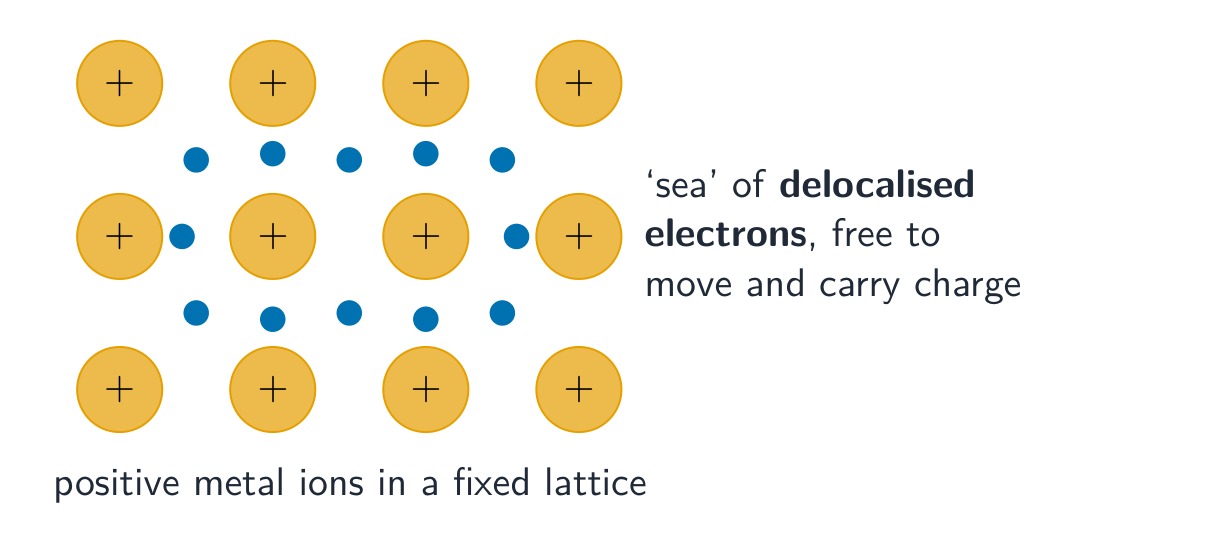
A metal is a giant structure of positive ions surrounded by a 'sea' of delocalised electrons that are free to move through the whole metal. Metallic bonding 金属键 is the strong electrostatic attraction between these positive ions and the sea of electrons.
This explains two key properties of metals:
- Good electrical conductivity: the delocalised electrons are free to move and carry charge through the metal.
- Malleability 展性 (can be hammered into sheets) and ductility 延性 (can be pulled into wires): the layers of positive ions can slide over each other without breaking the metallic bond, so the metal changes shape instead of shattering.
Explore
Inside a metal — and why it behaves that way
Step through it. Positive ions sit in a shared sea of delocalised electrons — that one picture explains conduction and why metals bend instead of snapping.
Vocabulary
Train
| English |
|---|
| metallic bonding/məˈtælɪk ˈbɒndɪŋ/ |
| malleability/ˌmæləˈbɪlɪti/ |
| ductility/dʌkˈtɪlɪti/ |
2.7
Exam tips
- Number of neutrons = mass number − proton number. The proton number is what decides which element an atom is.
- Isotopes have the same chemical properties because reactions involve only electrons, and isotopes share the same electron configuration; only the mass differs.
- Match structure to properties: ionic = giant lattice (high melting point; conducts only when molten or aqueous); simple molecular = weak forces between molecules (low melting point; no conduction); giant covalent = very hard, very high melting point.
- Graphite conducts and is slippery (one free electron per carbon; layers slide); diamond does neither (all four electrons bonded, so hard and non-conducting). Metals conduct and bend thanks to the sea of delocalised electrons.
- For relative atomic mass, take the weighted average: $A_r = \dfrac{\sum(\text{isotope mass} \times \text{abundance})}{100}$.
Interactive lessons on this topic
Work through it step by step, with instant-check exercises.