Gases, pressure and volume
Introduced| English | Meaning |
|---|---|
| pressure/ˈpreʃə/ | Force acting normally per unit area. |
| volume/ˈvɒljuːm/ | The amount of three-dimensional space occupied. |
| Boyle's law/bɔɪlz lɔː/ | For a fixed amount of gas at constant temperature, pressure is inversely proportional to volume in the ideal-gas approximation. |
Squeezing a gas
- Push a bicycle pump with your finger over the end and you can feel the gas push back harder as you squeeze.
- For a fixed amount of gas at constant temperature, pressure 压强 and volume 体积 are linked.
Gas pressure is caused by particles:
Difficulty 1/5 · 100 coins + a small bonus on first completion today
Collisions with the walls create pressure.
Pressure from particles
- Gas pressure comes from particles colliding with the container walls.
- More frequent or harder collisions mean higher pressure.

A heated gas: faster particles spread out and take up more space
Gases, pressure & volume
p = k / V
Squeeze the volume and the pressure rises (Boyle's law).
At constant temperature, if the volume of a gas decreases, the pressure:
Difficulty 1/5 · 100 coins + a small bonus on first completion today
Smaller volume → more frequent collisions → higher pressure.
At constant temperature, pressure × volume stays constant for a fixed mass of gas.
Difficulty 1/5 · 100 coins + a small bonus on first completion today
This is Boyle's law.
Pressure and volume
- Squeeze a gas into a smaller volume and the particles hit the walls more often → higher pressure.
- Pressure × volume = constant (at fixed temperature) — this is Boyle's law 玻意耳定律.
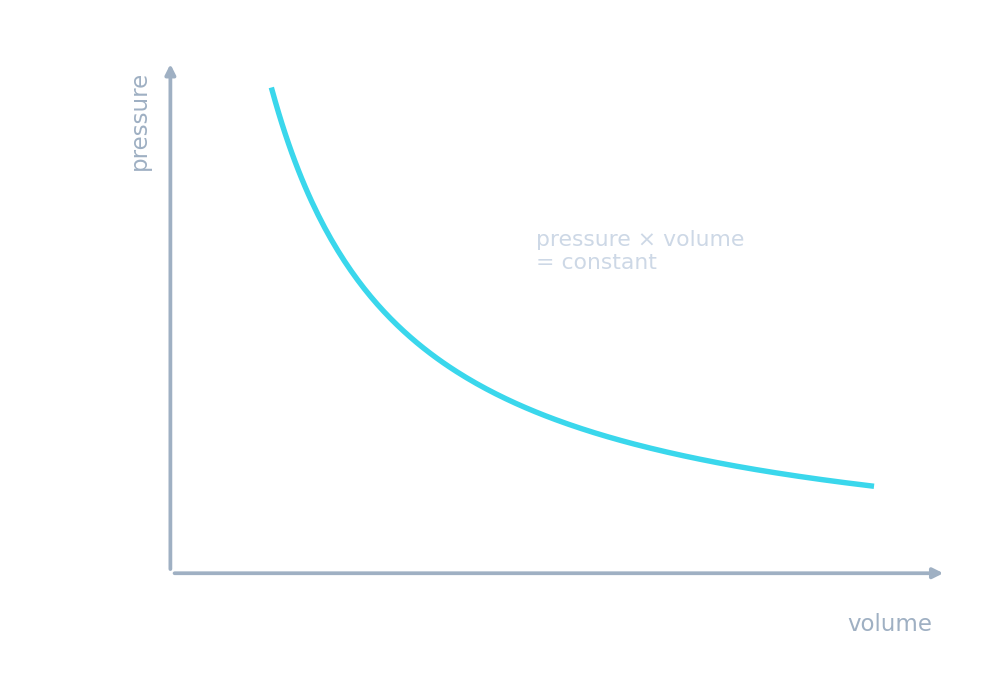
As volume decreases, pressure increases — their product stays constant.
A gas at pressure 200 and volume 4 is compressed to volume 2. What is the new pressure?
Difficulty 2/5 · 140 coins + a small bonus on first completion today
200 × 4 = p × 2, so p = 800 ÷ 2 = 400.
If you halve the volume of a gas at constant temperature, the pressure will ______.
Difficulty 1/5 · 100 coins + a small bonus on first completion today
Pressure and volume are inversely related.
Using the relationship
- If you halve the volume, the pressure doubles.
- So p₁V₁ = p₂V₂ lets you find a new pressure or volume.
Worked example. A gas at pressure 100 in a volume of 6 is squeezed to a volume of 2. Since pV is constant: 100 × 6 = p × 2, so p = 600 ÷ 2 = 300. Third the volume, triple the pressure.
You've got it
- gas pressure comes from particles colliding with the walls
- pressure × volume = constant at fixed temperature (Boyle's law)
- halve the volume → double the pressure (p₁V₁ = p₂V₂)