Diffusion
Introduced| English | Meaning |
|---|---|
| diffusion/dɪˈfjuːʒn/ | The net movement of particles from higher to lower concentration due to their random motion. |
| concentration/ˌkɒnsənˈtreɪʃn/ | The amount of a substance per unit volume of a mixture or solution. |
Spreading out by themselves
- Open a bottle of perfume and soon the whole room smells of it — without any fan.
- The particles spread out on their own. This is diffusion 扩散.
Diffusion is the movement of particles from a region of:
Difficulty 1/5 · 100 coins + a small bonus on first completion today
Particles spread down the concentration gradient.
What diffusion is
- Diffusion is the spreading of particles from a region of high concentration 浓度 to a region of low concentration.
- It happens because particles are constantly moving and mixing.
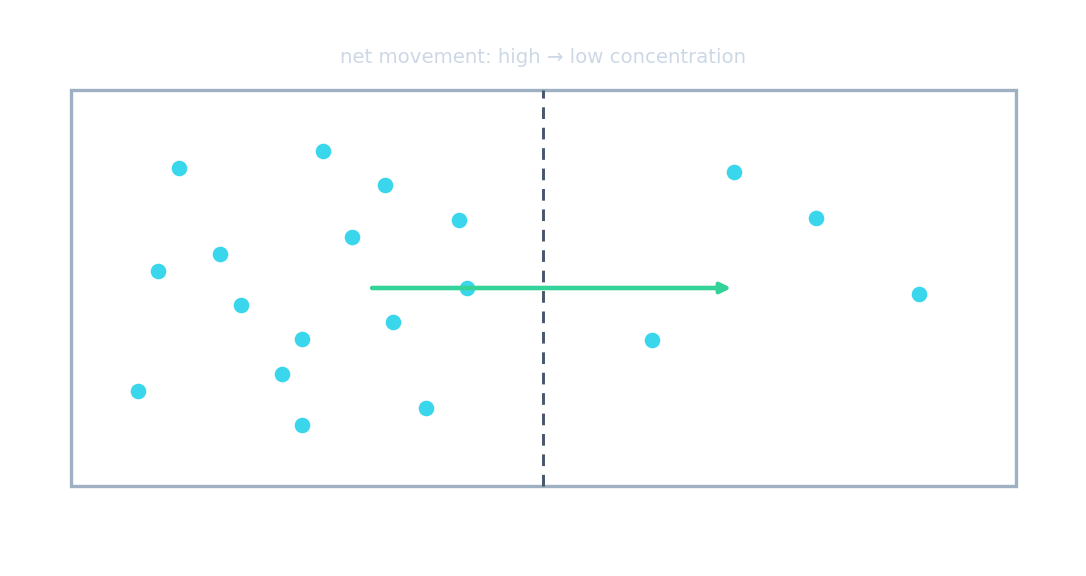
Particles move down the concentration gradient until evenly spread.
Watch particles diffuse
Set up a concentration difference and watch the particles spread out. Diffusion is the net movement of particles from where they are crowded to where they are not — driven by their own random motion, no stirring needed.
Diffusion
Release the cloud and the particles spread on their own from the crowded corner until they fill the box evenly — diffusion, sped up by heat.
Diffusion happens faster when the temperature is:
Difficulty 1/5 · 100 coins + a small bonus on first completion today
Hotter particles move faster, so they diffuse faster.
Which particles diffuse faster?
Difficulty 1/5 · 100 coins + a small bonus on first completion today
Lighter particles move faster, so they diffuse faster.
What affects the rate
- Higher temperature → faster diffusion (particles move faster).
- Lighter (lower mass) particles diffuse faster than heavier ones.

Ammonia is lighter, so it diffuses faster and further; the white ring forms nearer the HCl end
Diffusion is evidence that particles are in constant random motion.
Difficulty 1/5 · 100 coins + a small bonus on first completion today
They mix without any outside force.
Diffusion is fastest in a ______, where particles are far apart and fast.
Difficulty 1/5 · 100 coins + a small bonus on first completion today
Gases diffuse fastest; solids barely at all.
Diffusion shows particles move
- Diffusion is evidence that particles are in constant random motion.
- Gases diffuse fastest (particles far apart and fast); liquids more slowly; solids barely at all.
Worked example. Two gases released at opposite ends of a tube meet closer to the heavier gas's end — because the lighter gas diffuses faster. Diffusion rate depends on particle mass.
You've got it
- diffusion = particles spreading from high to low concentration
- rate increases with higher temperature and lighter particles
- diffusion is evidence that particles are in constant random motion