| Core | Supplement |
|---|---|
| 1 Define electrolysis as the decomposition of an ionic compound, when molten or in aqueous solution, by the passage of an electric current | 8 Describe the transfer of charge during electrolysis to include: (a) the movement of electrons in the external circuit (b) the loss or gain of electrons at the electrodes (c) the movement of ions in the electrolyte |
| 2 Identify in simple electrolytic cells: (a) the anode as the positive electrode (b) the cathode as the negative electrode (c) the electrolyte as the molten or aqueous substance that undergoes electrolysis | |
| 3 Identify the products formed at the electrodes and describe the observations made during the electrolysis of: (a) molten lead(II) bromide (b) concentrated aqueous sodium chloride (c) dilute sulfuric acid using inert electrodes made of platinum or carbon/graphite | 9 Identify the products formed at the electrodes and describe the observations made during the electrolysis of aqueous copper(II) sulfate using inert carbon/graphite electrodes and when using copper electrodes |
| 4 State that metals or hydrogen are formed at the cathode and that non-metals (other than hydrogen) are formed at the anode | |
| 5 Predict the identity of the products at each electrode for the electrolysis of a binary compound in the molten state | 10 Predict the identity of the products at each electrode for the electrolysis of a halide compound in dilute or concentrated aqueous solution |
| 11 Construct ionic half-equations for reactions at the anode (to show oxidation) and at the cathode (to show reduction) | |
| 6 State that metal objects are electroplated to improve their appearance and resistance to corrosion | |
| 7 Describe how metals are electroplated |
Electrochemistry
IGCSE Chemistry · Topic 4
 10:25
10:25
Electrolysis
Electricity can do something amazing: it can tear a compound apart. Pass a current through a melted or dissolved compound, and it splits into its elements.…
English narration · English + 中文 subtitles burned in
4.1
Electrolysis

Syllabus
Source: Cambridge International syllabus
Electrolysis 电解 is the breaking down (decomposition 分解) of an ionic compound 离子化合物 — when it is molten 熔融 or in aqueous 水溶液 solution — by passing an electric current 电流 through it.
It only works when the substance is molten or dissolved, because then the ions 离子 are free to move and carry the charge. A solid ionic compound cannot be electrolysed because its ions are locked in place.

The electrolytic cell
The set-up is called an electrolytic cell 电解池. Two electrodes 电极 (solid conductors) dip into the electrolyte 电解质 — the molten or aqueous substance being broken down.
- The anode 阳极 is the positive ($+$) electrode.
- The cathode 阴极 is the negative ($-$) electrode.
The electrodes are often inert 惰性 (they do not react), such as platinum 铂 or carbon/graphite 石墨.
What is formed at each electrode
There is a simple rule:
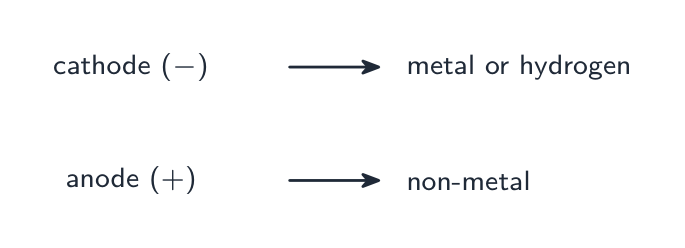
- Metals 金属 or hydrogen 氢气 are formed at the cathode.
- Non-metals 非金属 (other than hydrogen) are formed at the anode.
For aqueous solutions, the product can depend on whether the solution is dilute 稀 or concentrated 浓. Here are the three Core examples:
| Electrolyte | At the cathode ($-$) | At the anode ($+$) |
|---|---|---|
| molten lead(II) bromide, $\text{PbBr}_2$ | lead 铅 (silvery liquid) | bromine 溴 (red-brown vapour) |
| concentrated aqueous sodium chloride | hydrogen (bubbles of gas) | chlorine 氯气 (pale green gas) |
| dilute sulfuric acid 硫酸 | hydrogen (bubbles of gas) | oxygen 氧气 (bubbles of gas) |
Worked example. Predict the products of electrolysing molten zinc chloride, $\text{ZnCl}_2$. Because it is molten, only zinc ions and chloride ions are present - there is no water to complicate things. Zinc is a metal, so it forms at the cathode: $\text{Zn}^{2+}$ ions gain electrons and silvery zinc appears. Chlorine is a non-metal, so it forms at the anode: pale green chlorine gas bubbles off. Always check the state first. A molten compound simply gives you its own two elements, while an aqueous one brings water into the competition - which is why concentrated sodium chloride solution gives hydrogen at the cathode rather than sodium.
How the charge moves
During electrolysis:
- Electrons 电子 move through the wires (the external circuit 外电路) from the power supply.
- At the cathode, positive ions gain electrons. Gaining electrons is reduction 还原.
- At the anode, negative ions lose electrons. Losing electrons is oxidation 氧化.
- Inside the electrolyte, the ions move: positive ions go to the cathode and negative ions go to the anode.
You can write a half-equation 半反应式 for each electrode. For molten lead(II) bromide:
$$\text{Pb}^{2+} + 2e^{-} \rightarrow \text{Pb} \quad (\text{cathode, reduction})$$
$$2\text{Br}^{-} \rightarrow \text{Br}_2 + 2e^{-} \quad (\text{anode, oxidation})$$

Electrolysis of copper(II) sulfate
The product at the anode depends on the electrode:
- With inert carbon electrodes: copper 铜 forms at the cathode and oxygen forms at the anode. The blue colour of the solution slowly fades as copper is removed.
- With copper electrodes: copper forms at the cathode, while the anode itself dissolves into the solution. The blue colour stays the same. This is used to purify copper.
Electroplating
Electroplating 电镀 means covering a metal object with a thin layer of another metal. This improves its appearance and its resistance to corrosion 腐蚀 (rusting and wearing away).
To electroplate an object:
- the object to be coated is made the cathode;
- the plating metal is made the anode;
- the electrolyte is a solution containing ions of the plating metal.

Explore
Inside an electrolysis cell
Pick an electrolyte and watch ions move: positive ions to the cathode, negative ions to the anode.
Vocabulary
Train
| English |
|---|
| electrolysis/ɪlekˈtrɒləsɪs/ |
| decomposition/ˌdiːkɒmpəˈzɪʃn/ |
| ionic compound/aɪˈɒnɪk ˈkɒmpaʊnd/ |
| molten/ˈməʊltn/ |
| aqueous/ˈeɪkwɪəs/ |
| electric current/ɪˈlektrɪk ˈkʌrənt/ |
| ions/ˈaɪɒnz/ |
| electrolytic cell/ɪˌlektrəˈlɪtɪk sel/ |
| electrodes/ɪˈlektrəʊdz/ |
| electrolyte/ɪˈlektrəlaɪt/ |
| anode/ˈænəʊd/ |
| cathode/ˈkæθəʊd/ |
| inert/ɪˈnɜːt/ |
| platinum/ˈplætɪnəm/ |
| graphite/ˈɡræfaɪt/ |
| metals/ˈmetlz/ |
| hydrogen/ˈhaɪdrədʒn/ |
| non-metals/nɒn ˈmetlz/ |
| dilute/daɪˈluːt/ |
| concentrated/ˈkɒnsəntreɪtɪd/ |
| lead/liːd/ |
| bromine/ˈbrəʊmaɪn/ |
| chlorine/ˈklɔːriːn/ |
| sulfuric acid/sʌlˈfjʊərɪk ˈæsɪd/ |
| oxygen/ˈɒksɪdʒn/ |
| electrons/ɪˈlektrɒnz/ |
| external circuit/ekˈstɜːnl ˈsɜːkɪt/ |
| reduction/rɪˈdʌkʃn/ |
| oxidation/ˌɒksɪˈdeɪʃn/ |
| half-equation/hɑːf ɪˈkweɪʒn/ |
| copper/ˈkɒpə/ |
| electroplating/ɪˌlektrəʊˈpleɪtɪŋ/ |
| corrosion/kəˈrəʊʒn/ |
4.2
Hydrogen–oxygen fuel cells

Syllabus
| Core | Supplement |
|---|---|
| 1 State that a hydrogen–oxygen fuel cell uses hydrogen and oxygen to produce electricity with water as the only chemical product | 2 Describe the advantages and disadvantages of using hydrogen–oxygen fuel cells in comparison with gasoline/petrol engines in vehicles |
Source: Cambridge International syllabus
A fuel cell 燃料电池 uses hydrogen and oxygen to make electricity directly. The only chemical product is water.
$$2\text{H}_2 + \text{O}_2 \rightarrow 2\text{H}_2\text{O}$$
It is useful to compare a fuel cell with a normal petrol (gasoline) engine in a vehicle.
| Hydrogen–oxygen fuel cell | Petrol engine | |
|---|---|---|
| Main product | water only | carbon dioxide and pollutants 污染物 |
| Effect on air | clean | adds to air pollution |
| Fuel storage | hydrogen is hard and dangerous to store (flammable, needs high pressure) | petrol is easy to store |
| Source | hydrogen may be made using fossil fuels | made from crude oil |
Advantages of the fuel cell: the only product is water, so it does not pollute the air, and it changes chemical energy into electricity efficiently. Disadvantages: hydrogen is hard to store and transport safely, and producing the hydrogen can still use energy from fossil fuels.
Explore
Inside a hydrogen–oxygen fuel cell
Step through a fuel cell. Hydrogen and oxygen combine to make water, and the energy of that reaction is released as electricity — with no carbon dioxide.
Vocabulary
Train
| English |
|---|
| fuel cell/ˈfjuːəl sel/ |
| pollutants/pəˈluːtənts/ |
4.2
Exam tips
- At the cathode (negative) you get a metal or hydrogen; at the anode (positive) you get a non-metal. Positive ions move to the cathode, negative ions to the anode.
- A molten compound just gives its two elements. An aqueous solution can give something different (concentrated sodium chloride gives hydrogen and chlorine, not sodium).
- Reduction is gain of electrons (at the cathode); oxidation is loss of electrons (at the anode). Remember OIL RIG.
- In a half-equation the atoms and the charges must balance, with the electrons on the correct side: $\text{Pb}^{2+} + 2e^- \rightarrow \text{Pb}$ (cathode).
- To electroplate an object, make it the cathode, make the plating metal the anode, and use a solution containing ions of the plating metal.
Interactive lessons on this topic
Work through it step by step, with instant-check exercises.