Solids, liquids and gases
Introduced| English | Meaning |
|---|---|
| particles/ˈpɑːtɪklz/ | Small units of matter, such as atoms, molecules, ions or subatomic entities. |
| particle model/ˈpɑːtɪkl ˈmɒdl/ | particle model |
| vibrate/vaɪˈbreɪt/ | To move repeatedly to and fro about an equilibrium position. |
| solid/ˈsɒlɪd/ | A state of matter with a definite shape and volume; its particles vibrate around fixed positions in the simple particle model. |
| liquid/ˈlɪkwɪd/ | A state of matter with a definite volume but no fixed shape, which flows to fit its container. |
| gas/ɡæs/ | A state of matter with neither a fixed shape nor a fixed volume, which expands to fill its container. |
Everything is made of particles 粒子
- Ice, water and steam look completely different, yet they're all the same stuff — water.
- The difference is how their tiny particles are arranged. This is the particle model 粒子模型 of matter.
In a solid, the particles:
Difficulty 1/5 · 100 coins + a small bonus on first completion today
Solids have closely packed, vibrating particles.
The idea that all matter is made of tiny moving particles is the ______ model.
Difficulty 1/5 · 100 coins + a small bonus on first completion today
The particle model explains the three states.
Solids 固体
- In a solid, particles are packed closely in a fixed, regular pattern.
- They only vibrate 振动 in place, so a solid has a fixed shape and volume.

Particles are packed and regular in a solid, close and random in a liquid 液体, and far apart in a gas 气体
States of matter
Heat the box and watch the particles break free: a vibrating solid melts to a flowing liquid, then spreads out as a gas. Same particles — just more energy.
A liquid takes the shape of its container because its particles:
Difficulty 1/5 · 100 coins + a small bonus on first completion today
Liquid particles slide, so liquids flow.
Liquids
- In a liquid, particles are still close but not in a fixed pattern.
- They can slide past each other, so a liquid flows and takes the shape of its container.
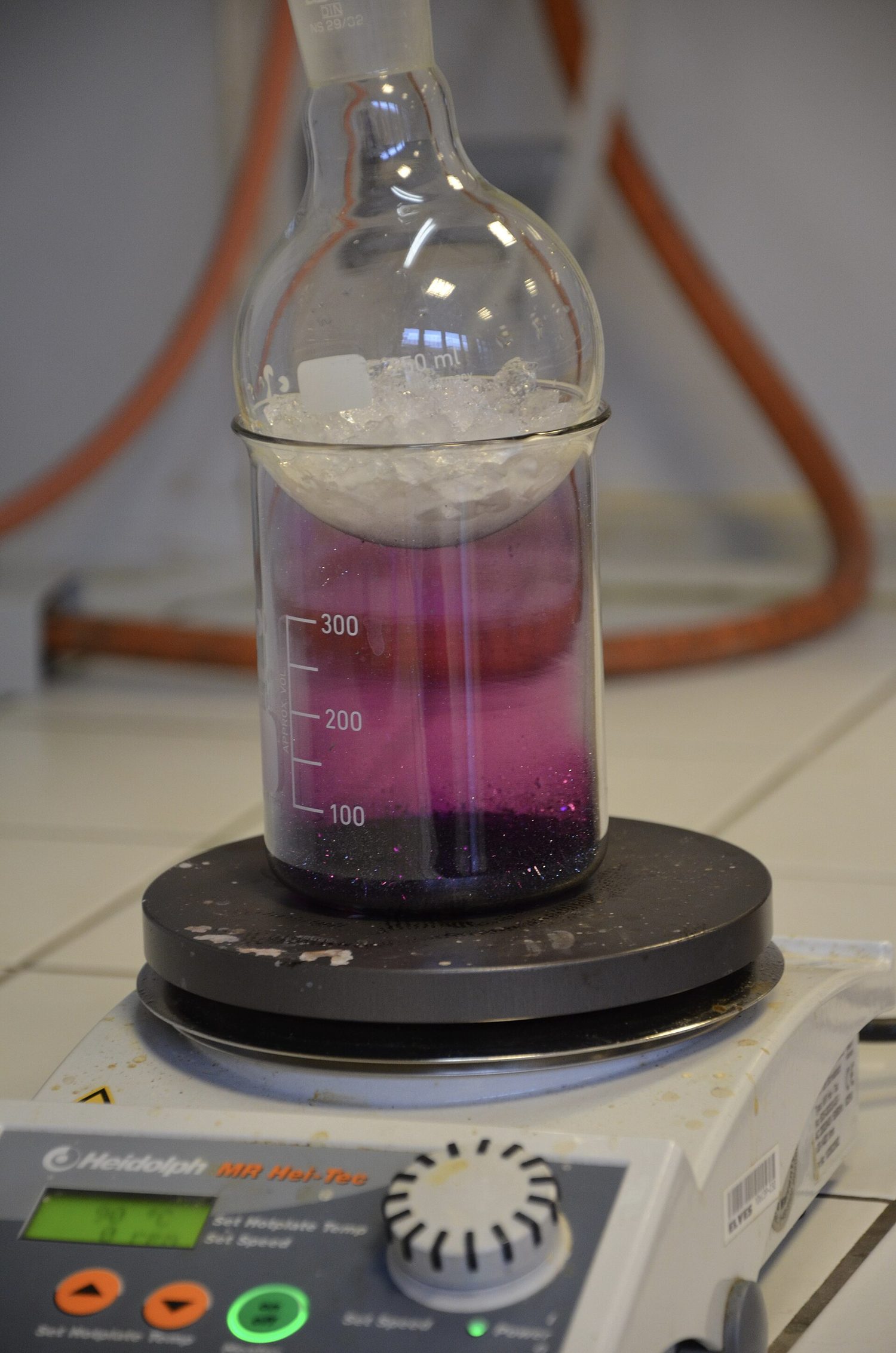
Warmed solid iodine turns straight into a purple gas (sublimation)
A gas spreads to fill its container because its particles are:
Difficulty 1/5 · 100 coins + a small bonus on first completion today
Fast, widely spaced particles fill the available space.
Ice, water and steam are made of the same particles.
Difficulty 1/5 · 100 coins + a small bonus on first completion today
Only the arrangement and energy differ, not the substance.
Gases
- In a gas, particles are far apart and move quickly in all directions.
- A gas spreads out to fill any container and can be compressed.
It's the same particles in all three states. Melting ice doesn't change the water particles — only how they are arranged and how much energy they have. The substance is identical.
You've got it
- the particle model: matter is made of tiny moving particles
- solid = closely packed, fixed, vibrating; liquid = close, sliding, flows; gas = far apart, fast, fills space
- the same particles make all three states — only arrangement and energy differ