| Core | Supplement |
|---|---|
| 1 Identify physical and chemical changes, and describe the differences between them |
Chemical reactions
IGCSE Chemistry · Topic 6
 15:53
15:53
Rates & Equilibrium
Milk on the counter spoils in a day. In the fridge, it lasts a week. Same milk — but the reaction runs at a different speed. First, a quick check: a chemical…
English narration · English + 中文 subtitles burned in
6.1
Physical and chemical changes

Syllabus
Source: Cambridge International syllabus
A physical change 物理变化 does not make a new substance. The substance only changes its state or shape, and the change can usually be reversed. Melting ice and dissolving sugar are physical changes.
A chemical change 化学变化 (a chemical reaction) makes one or more new substances and is usually hard to reverse. Signs of a chemical change include a colour change, a gas being given off, an energy change, or a precipitate 沉淀 (a solid) forming.
| Physical change | Chemical change |
|---|---|
| no new substance made | new substance(s) made |
| easy to reverse | usually hard to reverse |
| e.g. melting, boiling, dissolving | e.g. burning, rusting |
Explore
Physical change vs chemical change
Step through the difference. A physical change makes no new substance and is usually easy to reverse; a chemical change makes a new substance and is hard to undo.
Vocabulary
Train
| English |
|---|
| physical change/ˈfɪzɪkl tʃeɪndʒ/ |
| chemical change/ˈkemɪkl tʃeɪndʒ/ |
| precipitate/prɪˈsɪpɪteɪt/ |
6.2
Rate of reaction

Syllabus
| Core | Supplement |
|---|---|
| 5 Describe collision theory in terms of: (a) number of particles per unit volume (b) frequency of collisions between particles (c) kinetic energy of particles (d) activation energy, $E_a$ | |
| 1 Describe the effect on the rate of reaction of: (a) changing the concentration of solutions (b) changing the pressure of gases (c) changing the surface area of solids (d) changing the temperature (e) adding or removing a catalyst, including enzymes | 6 Describe and explain the effect on the rate of reaction of: (a) changing the concentration of solutions (b) changing the pressure of gases (c) changing the surface area of solids (d) changing the temperature (e) adding or removing a catalyst, including enzymes using collision theory |
| 2 State that a catalyst increases the rate of a reaction and is unchanged at the end of a reaction | 7 State that a catalyst decreases the activation energy, $E_a$, of a reaction |
| 3 Describe practical methods for investigating the rate of a reaction including change in mass of a reactant or a product and the formation of a gas | 8 Evaluate practical methods for investigating the rate of a reaction including change in mass of a reactant or a product and the formation of a gas |
| 4 Interpret data, including graphs, from rate of reaction experiments |
Source: Cambridge International syllabus
The rate of reaction 反应速率 tells you how fast the reactants 反应物 change into products 生成物.
Collision theory
Collision theory 碰撞理论 explains what controls the rate. For a reaction to happen, the particles 粒子 must collide 碰撞, and they must collide with enough energy. The least energy they need is the activation energy 活化能 ($E_a$). A faster rate happens when the particles have successful collisions more often.
What changes the rate
| Change | Effect | Reason (collision theory) |
|---|---|---|
| increase concentration 浓度 of a solution | faster | more particles in the same volume, so collisions happen more often |
| increase pressure 压强 of gases | faster | particles are pushed closer, so collisions happen more often |
| increase surface area 表面积 of a solid | faster | more particles are exposed, so collisions happen more often |
| increase temperature | faster | particles gain kinetic energy 动能 and move faster, so collisions are more frequent and more of them have enough energy |
| add a catalyst 催化剂 | faster | the catalyst lowers the activation energy, so more collisions are successful |

Catalysts
A catalyst speeds up a reaction but is not used up — it is unchanged at the end. It works by lowering the activation energy. Enzymes 酶 are biological catalysts (catalysts that work in living things).

Measuring the rate
You can follow a reaction over time in these ways:
- Change in mass: stand the flask on a balance. If a gas escapes, the mass falls. Record the mass at regular times.
- Volume of gas: collect the gas in a gas syringe 注射器 and read its volume at regular times.
- Formation of a precipitate: in a reaction that turns cloudy, time how long it takes for a mark under the flask to disappear.

On a graph of product against time, the line is steepest at the start (fastest rate), becomes less steep as reactants are used up, and goes flat when the reaction has finished.

Explore
Rate from a gas-volume graph
The gradient of the volume–time curve is the rate; it is steepest at the start and flattens as reactants run out.
Explore
Rate of reaction
conc = c₀·bᵗ
Concentration falls over time — fast at first, then slower.
Explore
Collision theory in action
Watch the particles collide. Heat speeds them up so they collide more often and harder; more particles or a catalyst give more successful collisions — the rate climbs.
Vocabulary
Train
| English |
|---|
| rate of reaction/reɪt ɒv rɪˈækʃn/ |
| reactants/rɪˈæktənts/ |
| products/ˈprɒdʌkts/ |
| collision theory/kəˈlɪʒn ˈθɪəri/ |
| particles/ˈpɑːtɪklz/ |
| collide/kəˈlaɪd/ |
| activation energy/ˌæktɪˈveɪʃn ˈenədʒi/ |
| concentration/ˌkɒnsənˈtreɪʃn/ |
| pressure/ˈpreʃə/ |
| surface area/ˈsɜːfɪs ˈeərɪə/ |
| kinetic energy/kɪˈnetɪk ˈenədʒi/ |
| catalyst/ˈkætəlɪst/ |
| enzymes/ˈenzaɪmz/ |
| syringe/sɪˈrɪndʒ/ |
6.3
Reversible reactions and equilibrium

Syllabus
| Core | Supplement |
|---|---|
| 1 State that some chemical reactions are reversible as shown by the symbol $\rightleftharpoons$ | 3 State that a reversible reaction in a closed system is at equilibrium when: (a) the rate of the forward reaction is equal to the rate of the reverse reaction (b) the concentrations of reactants and products are no longer changing |
| 2 Describe how changing the conditions can change the direction of a reversible reaction for: (a) the effect of heat on hydrated compounds (b) the addition of water to anhydrous compounds limited to copper(II) sulfate and cobalt(II) chloride | 4 Predict and explain, for a reversible reaction, how the position of equilibrium is affected by: (a) changing temperature (b) changing pressure (c) changing concentration (d) using a catalyst using information provided |
| 5 State the symbol equation for the production of ammonia in the Haber process, $\text{N}_2\text{(g)} + 3\text{H}_2\text{(g)} \rightleftharpoons 2\text{NH}_3\text{(g)}$ | |
| 6 State the sources of the hydrogen (methane) and nitrogen (air) in the Haber process | |
| 7 State the typical conditions in the Haber process as $450\text{ }^{\circ}\text{C}$, $20\,000\text{ kPa}/200\text{ atm}$ and an iron catalyst | |
| 8 State the symbol equation for the conversion of sulfur dioxide to sulfur trioxide in the Contact process, $2\text{SO}_2\text{(g)} + \text{O}_2\text{(g)} \rightleftharpoons 2\text{SO}_3\text{(g)}$ | |
| 9 State the sources of the sulfur dioxide (burning sulfur or roasting sulfide ores) and oxygen (air) in the Contact process | |
| 10 State the typical conditions for the conversion of sulfur dioxide to sulfur trioxide in the Contact process as $450\text{ }^{\circ}\text{C}$, $200\text{ kPa}/2\text{ atm}$ and a vanadium(V) oxide catalyst | |
| 11 Explain, in terms of rate of reaction and position of equilibrium, why the typical conditions stated are used in the Haber process and in the Contact process, including safety considerations and economics |
Source: Cambridge International syllabus
Some reactions are reversible 可逆反应: the products can react to form the reactants again. We show this with the symbol $\rightleftharpoons$.
Changing the direction
A clear example uses hydrated 水合 and anhydrous 无水 compounds:
- Blue hydrated copper(II) sulfate, when heated, loses its water to become white anhydrous copper(II) sulfate. Adding water turns it blue again.
- Pink hydrated cobalt(II) chloride loses water when heated to become blue anhydrous cobalt(II) chloride. Adding water turns it pink again.
Adding water to the anhydrous solid (and seeing the colour return) is used as a test for water.
Equilibrium
In a closed system 密闭系统 (where nothing enters or leaves), a reversible reaction reaches equilibrium 平衡 when:
- the rate of the forward reaction 正反应 equals the rate of the reverse reaction 逆反应, and
- the concentrations of the reactants and products are no longer changing.
Changing the position of equilibrium
The position of equilibrium 平衡位置 tells you whether there are more reactants or more products. You can move it:
- Temperature: heating moves the equilibrium in the direction that takes in heat (the endothermic 吸热反应 direction); cooling moves it in the direction that gives out heat (the exothermic 放热反应 direction).
- Pressure (gases): more pressure moves the equilibrium to the side with fewer gas molecules.
- Concentration: adding more of a substance moves the equilibrium to the other side, to use it up.
- A catalyst does not move the position of equilibrium. It only helps the reaction reach equilibrium faster.
The Haber process
The Haber process 哈伯法 makes ammonia:
$$\text{N}_2(g) + 3\text{H}_2(g) \rightleftharpoons 2\text{NH}_3(g)$$
- The hydrogen 氢气 comes from methane 甲烷 (natural gas); the nitrogen 氮气 comes from the air.
- Typical conditions: a temperature of $450\,{}^{\circ}\text{C}$, a pressure of about $200$ atm ($20\,000$ kPa), and an iron 铁 catalyst.
The Contact process
The Contact process 接触法 turns sulfur dioxide into sulfur trioxide:
$$2\text{SO}_2(g) + \text{O}_2(g) \rightleftharpoons 2\text{SO}_3(g)$$
- The sulfur dioxide comes from burning sulfur 硫 (or roasting sulfide ores); the oxygen 氧气 comes from the air.
- Typical conditions: a temperature of $450\,{}^{\circ}\text{C}$, a pressure of about $2$ atm ($200$ kPa), and a vanadium(V) oxide 五氧化二钒 catalyst.
Why these conditions are chosen
The conditions are a compromise 折中:
- A higher pressure would give more product, but very high pressure is dangerous and expensive, so a medium pressure is used.
- A lower temperature would give more product (both forward reactions are exothermic), but the reaction would be too slow, so a fairly high temperature is used to keep a good rate.
- The catalyst speeds up the reaction without changing the position of equilibrium, which lowers cost.
Explore
Shifting an equilibrium
Change temperature, pressure or concentration and watch a reversible reaction shift to a new balance.
Vocabulary
Train
| English |
|---|
| reversible reaction/rɪˈvɜːsɪbl rɪˈækʃn/ |
| hydrated/haɪˈdreɪtɪd/ |
| anhydrous/ænˈhaɪdrəs/ |
| closed system/kləʊzd ˈsɪstəm/ |
| equilibrium/ˌiːkwɪˈlɪbrɪəm/ |
| forward reaction/ˈfɔːwəd rɪˈækʃn/ |
| reverse reaction/rɪˈvɜːs rɪˈækʃn/ |
| position of equilibrium/pəˈzɪʃn ɒv ˌiːkwɪˈlɪbrɪəm/ |
| endothermic/ˌendəʊˈθɜːmɪk/ |
| exothermic/eɡzəˈðɜːmɪk/ |
| Haber process/ˈheɪbə ˈprəʊses/ |
| hydrogen/ˈhaɪdrədʒn/ |
| methane/ˈmiːθeɪn/ |
| nitrogen/ˈnaɪtrədʒn/ |
| iron/ˈaɪən/ |
| Contact process/ˈkɒntækt ˈprəʊses/ |
| sulfur/ˈsʌlfɜː/ |
| oxygen/ˈɒksɪdʒn/ |
| vanadium(V) oxide/væˈneɪdɪəm ˈɒksaɪd/ |
| compromise/ˈkɒmprəmaɪz/ |
6.4
Redox

Syllabus
| Core | Supplement |
|---|---|
| 1 Use a Roman numeral to indicate the oxidation number of an element in a compound | |
| 2 Define redox reactions as involving simultaneous oxidation and reduction | |
| 3 Define oxidation as gain of oxygen and reduction as loss of oxygen | 6 Define oxidation in terms of: (a) loss of electrons (b) an increase in oxidation number |
| 7 Define reduction in terms of: (a) gain of electrons (b) a decrease in oxidation number | |
| 4 Identify redox reactions as reactions involving gain and loss of oxygen | 8 Identify redox reactions as reactions involving gain and loss of electrons |
| 5 Identify oxidation and reduction in redox reactions | 9 Identify redox reactions by changes in oxidation number using: (a) the oxidation number of elements in their uncombined state is zero (b) the oxidation number of a monatomic ion is the same as the charge on the ion (c) the sum of the oxidation numbers in a compound is zero (d) the sum of the oxidation numbers in an ion is equal to the charge on the ion |
| 10 Identify redox reactions by the colour changes involved when using acidified aqueous potassium manganate(VII) or aqueous potassium iodide | |
| 11 Define an oxidising agent as a substance that oxidises another substance and is itself reduced | |
| 12 Define a reducing agent as a substance that reduces another substance and is itself oxidised | |
| 13 Identify oxidising agents and reducing agents in redox reactions |
Source: Cambridge International syllabus
Oxidation 氧化 and reduction 还原 always happen at the same time, in what is called a redox reaction 氧化还原反应. ('Redox' is short for reduction–oxidation.)
There are three ways to describe oxidation and reduction:
- Oxygen: oxidation is the gain of oxygen; reduction is the loss of oxygen.
- Electrons 电子: oxidation is the loss of electrons; reduction is the gain of electrons.
- Oxidation number 氧化数: in oxidation the oxidation number goes up; in reduction it goes down.
A useful memory aid is OIL RIG: Oxidation Is Loss, Reduction Is Gain — of electrons.
Oxidation number rules
The oxidation number is shown by a Roman numeral, as in iron(II) and iron(III). The rules are:
- An element that is not combined has an oxidation number of $0$.
- A single-atom ion has an oxidation number equal to its charge (so $\text{Na}^{+}$ is $+1$).
- The oxidation numbers in a compound add up to $0$.
- The oxidation numbers in an ion add up to the charge on the ion.
Worked example. Find the oxidation number of manganese in the manganate(VII) ion, $\text{MnO}_4^{-}$. Each oxygen is $-2$, and there are four of them, giving $4 \times (-2) = -8$. The oxidation numbers in an ion must add up to the charge on the ion, which here is $-1$. So if manganese is $x$, then $x + (-8) = -1$, giving $x = +7$ - exactly what the (VII) in the name tells you. Set the total to the ion's charge, not to zero: zero is only for a neutral compound.
Oxidising and reducing agents
- An oxidising agent 氧化剂 oxidises another substance, and is itself reduced.
- A reducing agent 还原剂 reduces another substance, and is itself oxidised.
Some redox reactions show clear colour changes:
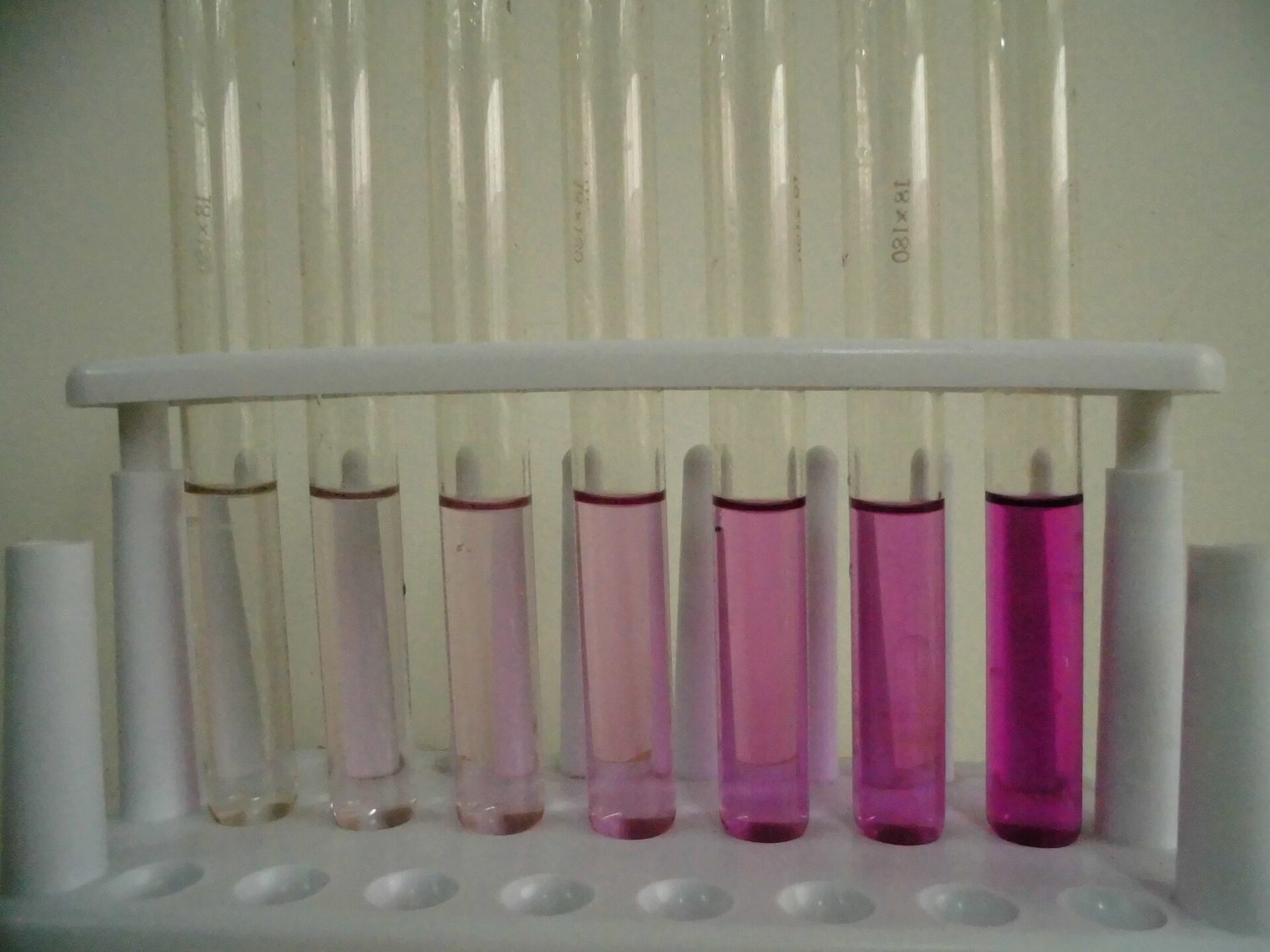
- Acidified potassium manganate(VII) 高锰酸钾 is purple. When it acts as an oxidising agent it is reduced, and the purple colour fades to colourless.
- Potassium iodide 碘化钾 is colourless. When it is oxidised, red-brown iodine 碘 is formed.
Explore
Oxidation and reduction happen together
Step through a redox reaction. One substance loses electrons while another gains them — you can never have one without the other.
Vocabulary
Train
| English |
|---|
| oxidation/ˌɒksɪˈdeɪʃn/ |
| reduction/rɪˈdʌkʃn/ |
| redox reaction/rɪˈdɒks rɪˈækʃn/ |
| electrons/ɪˈlektrɒnz/ |
| oxidation number/ˌɒksɪˈdeɪʃn ˈnʌmbə/ |
| oxidising agent/ˈɒksɪdaɪzɪŋ ˈeɪdʒənt/ |
| reducing agent/rɪˈdjuːsɪŋ ˈeɪdʒənt/ |
| potassium manganate(VII)/pəˈtæsɪəm ˈmæŋɡəneɪt/ |
| potassium iodide/pəˈtæsɪəm ˈaɪədaɪd/ |
| iodine/ˈaɪədiːn/ |
6.4
Exam tips
- Explain a faster rate with collision theory: successful collisions happen more often. Concentration, pressure and surface area all raise how often particles collide; a higher temperature does that and gives more particles enough energy.
- A catalyst lowers the activation energy and speeds the reaction up, but is not used up and does not change $\Delta H$ or the position of equilibrium.
- At equilibrium the forward and reverse rates are equal and the concentrations stop changing — it does not mean the amounts of reactant and product are equal.
- Use Le Chatelier's principle: raising temperature favours the endothermic direction; raising pressure favours the side with fewer gas molecules; adding a substance shifts the equilibrium away from it.
- Redox — OIL RIG: Oxidation Is Loss, Reduction Is Gain of electrons. They always happen together, and an oxidising agent is itself reduced.
Interactive lessons on this topic
Work through it step by step, with instant-check exercises.