| Core | Supplement |
|---|---|
| 1 Describe the Periodic Table as an arrangement of elements in periods and groups and in order of increasing proton number/atomic number | |
| 2 Describe the change from metallic to non‑metallic character across a period | |
| 3 Describe the relationship between group number and the charge of the ions formed from elements in that group | |
| 4 Explain similarities in the chemical properties of elements in the same group of the Periodic Table in terms of their electronic configuration | |
| 5 Explain how the position of an element in the Periodic Table can be used to predict its properties | 6 Identify trends in groups, given information about the elements |
The Periodic Table
IGCSE Chemistry · Topic 8
 11:15
11:15
The Periodic Table
This is the most powerful chart in all of chemistry: the Periodic Table. It looks like a jumble of boxes, but it hides a beautiful secret. The elements are…
English narration · English + 中文 subtitles burned in
8.1
Arrangement of the elements

Syllabus
Source: Cambridge International syllabus
The Periodic Table 周期表 arranges all the elements 元素 in order of increasing proton number 质子数 (the atomic number 原子序数). The horizontal rows are called periods 周期 and the vertical columns are called groups 族.
A few key patterns:
- Across a period, the elements change from metals 金属 on the left to non-metals 非金属 on the right.
- The group number tells you the charge of the ions 离子 that the elements form. Group I forms $+1$ ions, Group II forms $+2$ ions, and Group VII forms $-1$ ions.
- Elements in the same group have similar chemical properties. This is because they have the same number of outer-shell electrons 电子 (the same outer electronic configuration 电子排布).
Because of these patterns, you can use an element's position to predict its properties.

Explore
Spot a trend across a period
Reading across a period, properties change in a regular, repeating pattern. Switch the trend to watch atomic radius, ionisation energy or melting point change element by element.
Vocabulary
Train
| English |
|---|
| Periodic Table/ˌpɪərɪˈɒdɪk ˈteɪbl/ |
| elements/ˈelɪmənts/ |
| proton number/ˈprəʊtɒn ˈnʌmbə/ |
| atomic number/əˈtɒmɪk ˈnʌmbə/ |
| periods/ˈpɪərɪədz/ |
| groups/ɡruːps/ |
| metals/ˈmetlz/ |
| non-metals/nɒn ˈmetlz/ |
| ions/ˈaɪɒnz/ |
| electrons/ɪˈlektrɒnz/ |
| electronic configuration/ɪlekˈtrɒnɪk kənˌfɪɡjəˈreɪʃn/ |
8.2
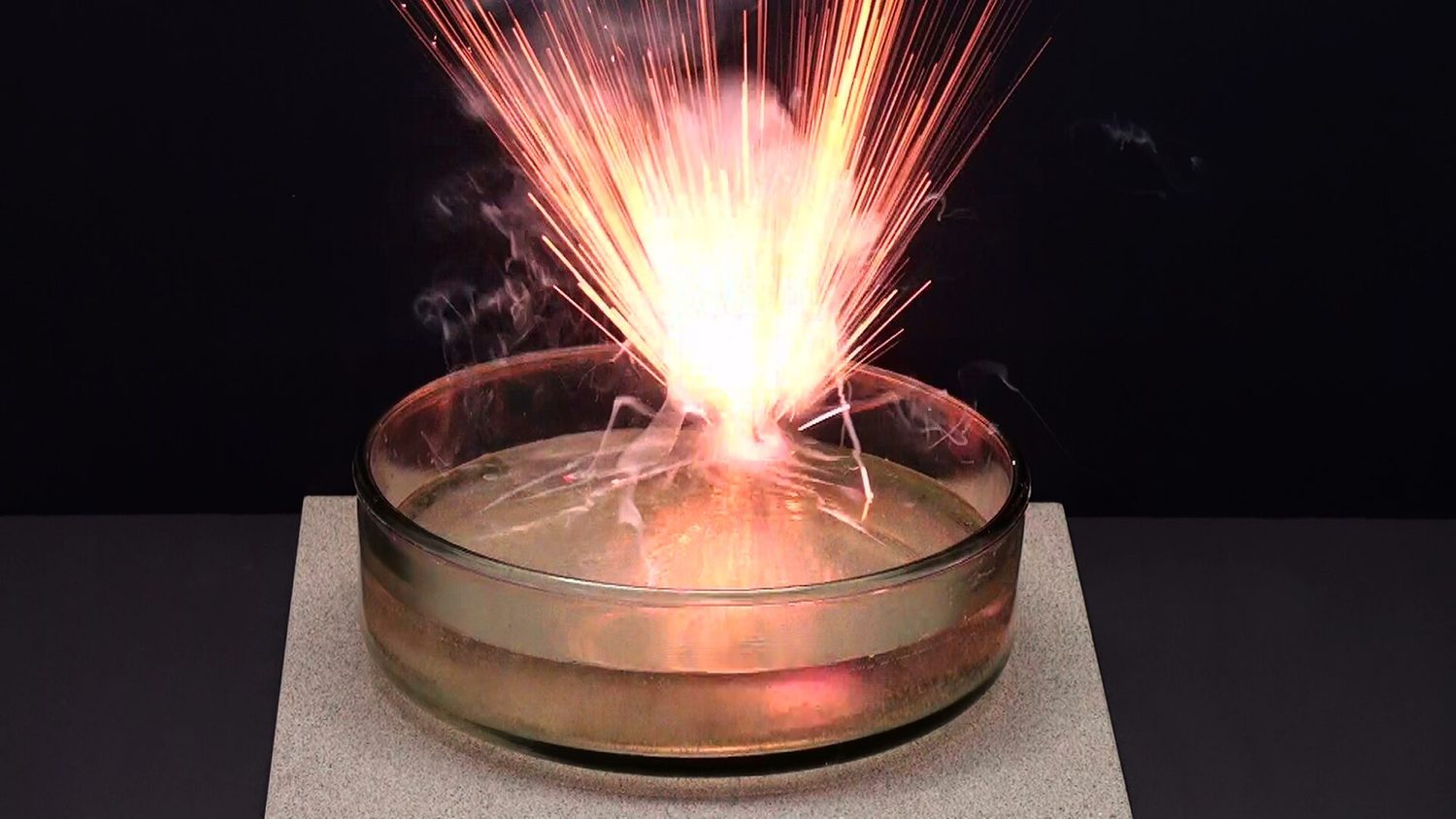
Group I — the alkali metals
Syllabus
| Core | Supplement |
|---|---|
| 1 Describe the Group I alkali metals, lithium, sodium and potassium, as relatively soft metals with general trends down the group, limited to: (a) decreasing melting point (b) increasing density (c) increasing reactivity | |
| 2 Predict the properties of other elements in Group I, given information about the elements |
Source: Cambridge International syllabus
Group I elements are the alkali metals 碱金属: lithium 锂, sodium 钠 and potassium 钾. They are soft 柔软 metals (you can cut them with a knife).

Going down the group, there are clear trends 趋势:
| Property | Trend going down the group |
|---|---|
| melting point 熔点 | decreases |
| density 密度 | increases |
| reactivity 活泼性 | increases |
You can use these trends to predict the properties of other Group I elements. For example, rubidium (below potassium) would be even more reactive and have an even lower melting point.
Reaction with water, and what you see
This is the reaction the exam asks about most. Every Group I metal reacts with water to give an alkali (the metal hydroxide) plus hydrogen - which is exactly why they are called the alkali metals:
$$2\text{Na} + 2\text{H}_2\text{O} \rightarrow 2\text{NaOH} + \text{H}_2$$
"Describe what you see" is worth marks of its own, so learn the list for sodium on water:
- it floats - the metal is less dense than water.
- it melts into a ball - the reaction gives out heat, and the metal's melting point is low.
- it moves about on the surface - the hydrogen jetting off pushes it around.
- there is effervescence 泡腾 (fizzing) - the hydrogen gas escaping.
- it gets smaller and disappears as it is used up.
- the solution turns alkaline, so universal indicator goes purple (it is now $\text{NaOH}$).
The trend shows up in how violent this is: lithium fizzes steadily but does not melt; sodium melts into a ball and darts around; potassium is fast enough to ignite its own hydrogen, burning with a lilac flame. Two answers to avoid: "hydrogen is given off" is not an observation (you cannot see it - say effervescence), and the metal melts because the reaction is exothermic, not because "water is hot".
Explore
Group I trend lab
Follow Group I metals down the group and watch reactivity increase.
Vocabulary
Train
| English |
|---|
| alkali metals/ˈælkəlaɪ ˈmetlz/ |
| lithium/ˈlɪθɪəm/ |
| sodium/ˈsəʊdɪəm/ |
| potassium/pəˈtæsɪəm/ |
| soft/sɒft/ |
| trends/trendz/ |
| melting point/ˈmeltɪŋ pɔɪnt/ |
| density/ˈdensɪti/ |
| reactivity/rɪəkˈtɪvɪti/ |
| effervescence/ˌefəˈvesəns/ |
8.3
Group VII — the halogens

Syllabus
| Core | Supplement |
|---|---|
| 1 Describe the Group VII halogens, chlorine, bromine and iodine, as diatomic non-metals with general trends down the group, limited to: (a) increasing density (b) decreasing reactivity | |
| 2 State the appearance of the halogens at r.t.p. as: (a) chlorine, a pale yellow-green gas (b) bromine, a red-brown liquid (c) iodine, a grey-black solid | |
| 3 Describe and explain the displacement reactions of halogens with other halide ions | |
| 4 Predict the properties of other elements in Group VII, given information about the elements |
Source: Cambridge International syllabus
Group VII elements are the halogens 卤素: chlorine 氯气, bromine 溴 and iodine 碘. They are diatomic 双原子 non-metals (each molecule is made of two atoms, such as $\text{Cl}_2$).
Their appearance at room temperature and pressure:
| Halogen | Appearance |
|---|---|
| chlorine | a pale yellow-green gas |
| bromine | a red-brown liquid |
| iodine | a grey-black solid |
Going down the group, the density increases but the reactivity decreases (the opposite trend to Group I).
Displacement reactions
A more reactive halogen pushes out (displaces) a less reactive halide 卤化物 ion from its solution. This is a displacement reaction 置换反应.
For example, chlorine is more reactive than bromine, so chlorine displaces bromine from potassium bromide:
$$\text{Cl}_2 + 2\text{KBr} \rightarrow 2\text{KCl} + \text{Br}_2$$

Worked example. Aqueous chlorine is added to potassium iodide solution; then aqueous iodine is added to potassium bromide solution. What happens in each? Reactivity falls down Group VII: chlorine, then bromine, then iodine. (a) Chlorine is above iodine, so it is more reactive and displaces it: $\text{Cl}_2 + 2\text{KI} \rightarrow 2\text{KCl} + \text{I}_2$, and the solution turns red-brown as iodine is released. (b) Iodine is below bromine, so it is less reactive and cannot displace it - there is no reaction and no colour change. "No reaction" is a complete answer worth marks: check the order in the group before you write any equation.
Explore
Group VII trend lab
Follow halogens down the group and watch reactivity decrease.
Vocabulary
Train
| English |
|---|
| halogens/ˈhælədʒnz/ |
| chlorine/ˈklɔːriːn/ |
| bromine/ˈbrəʊmaɪn/ |
| iodine/ˈaɪədiːn/ |
| diatomic/ˌdaɪəˈtɒmɪk/ |
| halide/ˈhælaɪd/ |
| displacement reaction/dɪˈspleɪsmənt rɪˈækʃn/ |
8.4
Transition elements

Syllabus
| Core | Supplement |
|---|---|
| 1 Describe the transition elements as metals that: (a) have high densities (b) have high melting points (c) form coloured compounds (d) often act as catalysts as elements and in compounds | 2 Describe transition elements as having ions with variable oxidation numbers, including iron(II) and iron(III) |
Source: Cambridge International syllabus
The transition elements 过渡元素 are the block of metals in the middle of the Periodic Table. Compared with Group I metals, they:
- have high densities;
- have high melting points;
- form coloured 有色 compounds 化合物;
- often act as catalysts, both as elements and in compounds.
They can also have variable 可变 oxidation numbers 氧化数. For example, iron 铁 forms both iron(II) and iron(III) compounds.
Explore
Transition element lab
Match transition-metal properties to real examples.
Vocabulary
Train
| English |
|---|
| transition elements/trænˈsɪʃn ˈelɪmənts/ |
| coloured/ˈkʌləd/ |
| compounds/ˈkɒmpaʊndz/ |
| variable/ˈveərɪəbl/ |
| oxidation numbers/ˌɒksɪˈdeɪʃn ˈnʌmbəz/ |
| iron/ˈaɪən/ |
8.5
Group VIII — the noble gases

Syllabus
| Core | Supplement |
|---|---|
| 1 Describe the Group VIII noble gases as unreactive, monatomic gases and explain this in terms of electronic configuration |
Source: Cambridge International syllabus
The Group VIII noble gases 稀有气体 are unreactive 不活泼, monatomic 单原子 gases (they exist as single atoms, not as molecules).
They are unreactive because they already have a full outer shell of electrons. This makes them stable, so they do not need to gain, lose or share electrons.
Explore
Noble gas lab
Classify noble gas uses by the property that makes them useful.
Vocabulary
Train
| English |
|---|
| noble gases/ˈnəʊbl ˈɡæsɪz/ |
| unreactive/ʌnrɪˈæktɪv/ |
| monatomic/ˌmɒnəˈtɒmɪk/ |
8.5
Exam tips
- The Periodic Table is ordered by proton number. Elements in the same group (column) have the same number of outer electrons, so they react in similar ways; periods are the rows.
- Group I (alkali metals) get more reactive going down; Group VII (halogens) get less reactive going down — opposite trends.
- A more reactive halogen displaces a less reactive one from a solution of its salt — for example chlorine displaces bromine.
- Noble gases are unreactive because they have a full outer shell. Transition elements are hard and dense, form coloured compounds, act as catalysts and have variable oxidation numbers.
Interactive lessons on this topic
Work through it step by step, with instant-check exercises.