3.1 Contextualizing Period 3
| Learning Objective | Preview: Unit 3 Key Concepts |
|---|---|
Unit 3.A |
|
3.2 The Seven Years’ War (The French and Indian War)
| Thematic Focus | Learning Objective | Historical Developments |
|---|---|---|
WOR | Unit 3.B |
|
AP United States History · Topic 3
 9:07
9:07
Period 3: 1754 to 1800
Britain wins the war, takes half a continent, and destroys its main rival in North America. Twelve years later its colonies are in open rebellion. Those two…
English narration · English + 中文 subtitles burned in
| Learning Objective | Preview: Unit 3 Key Concepts |
|---|---|
Unit 3.A |
|
| Thematic Focus | Learning Objective | Historical Developments |
|---|---|---|
WOR | Unit 3.B |
|
Source: College Board AP Course and Exam Description
Period 3 runs from 1754 to 1800. It begins with the fighting in North America that became part of the Seven Years' War. The Revolution is one development to explain; questions may ask about different causes, effects, comparisons or changes.
Colonial rivalry between Britain and France intensified as British colonists expanded into the interior. Their expansion threatened French–Indian trade networks and Native autonomy. The Seven Years' War 七年战争, known in North America as the French and Indian War 法印战争, ended with British victory.
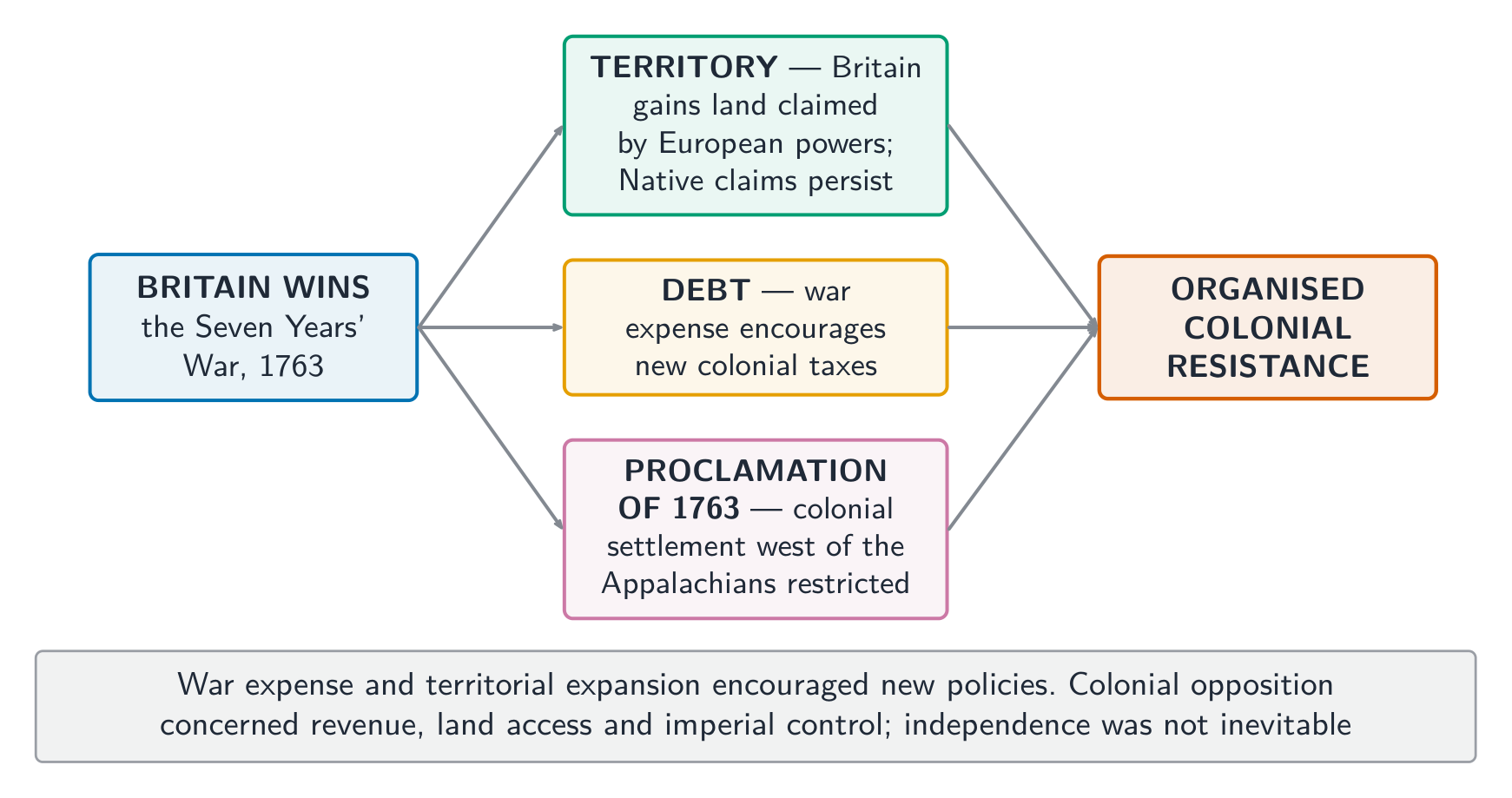
Try it — cause and consequence. Before 1763, British colonial expansion threatened trade networks and Native control of land. After 1763, Britain held more territory but faced great war expense. Explain one cause of the war and one problem victory created. Name whose interests were threatened.
Worked reasoning. Inland expansion increased rivalry with France and threatened Native lands and trading relationships. Victory brought Britain a major expansion of territory 领土大扩张 and an enormous war debt 巨额战争债务. Officials sought revenue from the colonies and tighter imperial control. These policies challenged colonial economic interests and traditions of self-government.
Try it — one policy, different interests. The Proclamation of 1763 1763年公告线 restricted colonial settlement west of the Appalachian Mountains. British officials wanted to limit costly frontier conflict and control settlement. Colonists seeking land wanted access to western territory after helping win the war. Native groups sought to defend their lands while continuing European trade. Why could an attempt to reduce conflict produce colonial opposition? Why did imperial claims not mean Native peoples had surrendered their lands?
Worked reasoning. Settlement restrictions frustrated colonists seeking western land. Their opposition concerned land access as well as taxation. Native groups continued trade and resisted colonial encroachment: a European territorial claim did not remove Native communities or their resistance. Victory created problems of revenue and control, but independence was not an inevitable result.
The exam treats the Revolution as an effect. Britain's victory produced territory, debt and a proclamation line, and all three converge.
| English |
|---|
| Seven Years' War/ˈsevən jɪəz wɔː/ |
| French and Indian War/frentʃ ænd ˈɪndɪən wɔː/ |
| major expansion of territory/ˈmeɪdʒə ekˈspænʃn ɒv ˈterɪtəri/ |
| enormous war debt/ɪˈnɔːməs wɔː det/ |
| Proclamation of 1763/ˌprɒkləˈmeɪʃn ɒv wɒn ˈθaʊznd ˈsevənhʌndrɪdn ˈsɪksti θriː/ |
| Thematic Focus | Learning Objective | Historical Developments |
|---|---|---|
WOR | Unit 3.C |
|
Source: College Board AP Course and Exam Description
New British efforts to collect taxes 征税 without the consent of colonial assemblies, and to assert imperial authority, provoked organised resistance.
Colonial leaders based their arguments on the rights of British subjects, on the ideals of the Enlightenment 启蒙思想, and on their own long experience of self-government - the assemblies built up during Period 2.
Resistance was not only argument. Facing shortages and, in some regions, British military occupation 军事占领, men and women both took part: boycotts of British goods, home manufacture, crowd action, and committees of correspondence. Leaders such as Benjamin Franklin 富兰克林 energised the movement, and the slogan of the period is "no taxation without representation" 无代表不纳税.
| English |
|---|
| collect taxes/kəˈlekt ˈtæksɪz/ |
| ideals of the Enlightenment/aɪˈdɪəlz ɒvðɪ enˈlaɪtənmənt/ |
| military occupation/ˈmɪlɪtəri ˌɒkjʊˈpeɪʃn/ |
| Benjamin Franklin/ˈbendʒəmɪn ˈfræŋklɪn/ |
| "no taxation without representation" |
| Thematic Focus | Learning Objective | Historical Developments |
|---|---|---|
NAT | Unit 3.D |
|
Source: College Board AP Course and Exam Description
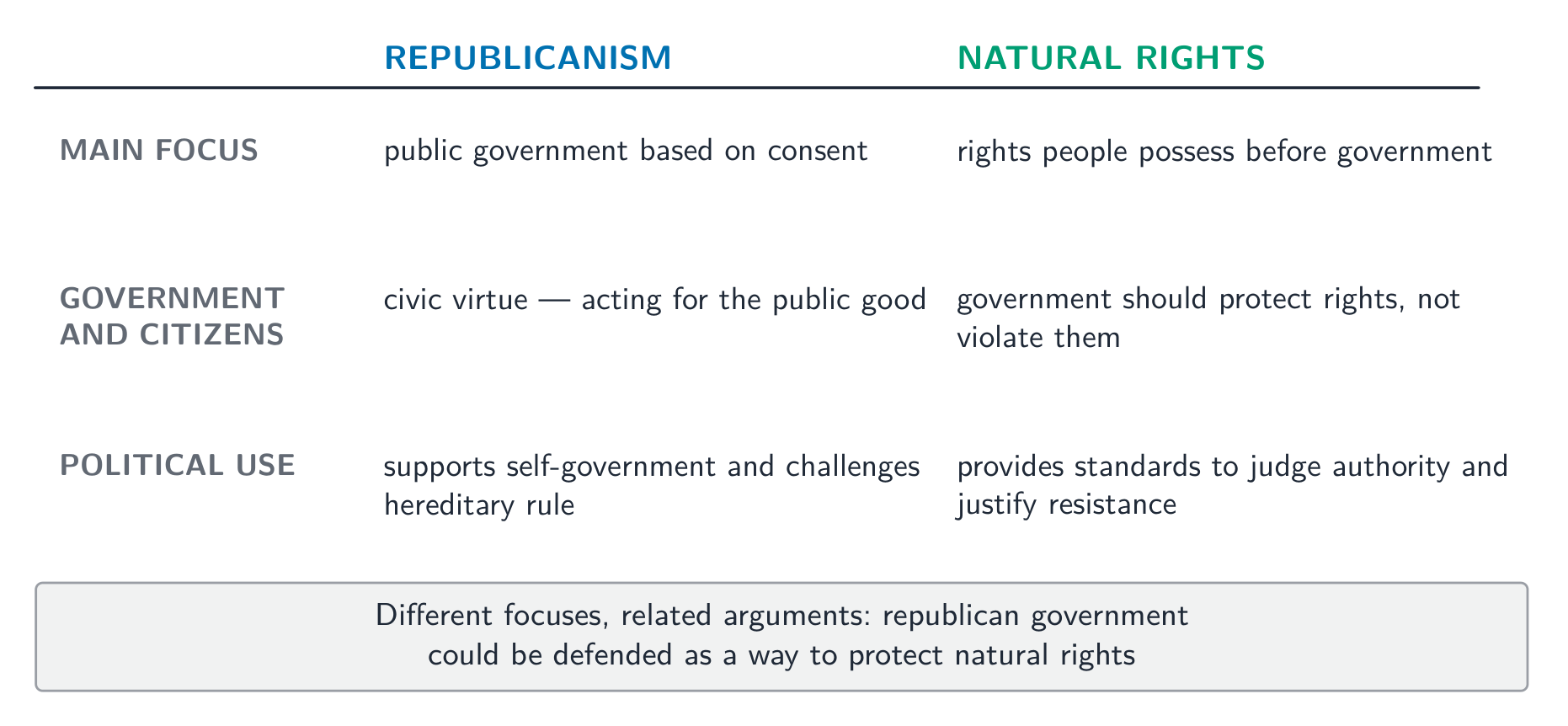
Enlightenment ideas led American political thinkers to emphasise individual talent over hereditary privilege, and to assert the natural rights 天赋权利 of the people and the sovereignty of the people 人民主权.
Try it — distinguish two claims. These are teacher-written claims, not historical quotations. A: People possess rights before government exists; violations can justify resistance. B: Public authority should rest on the people's consent, and citizens should place the public good above private gain. Match each to natural rights or republicanism and explain the difference in focus.
Worked distinction. A describes natural rights: government should protect rights that it did not create. B describes republicanism 共和主义: consent-based government and civic virtue, rather than hereditary rule and only private gain. Supporters could link the ideas by arguing that republican government would protect natural rights.
Try it — revise a claim. A student says natural rights mattered only during the break with Britain, and republicanism only afterwards. The CED explains that support for republican government based on natural rights appeared in Common Sense and the Declaration of Independence. Use that evidence to revise the student's claim.
Worked revision. Both ideas helped colonists criticise British rule and imagine a different government during the independence movement. Natural rights supplied standards for judging authority, while republicanism offered government based on the people's consent. The terms have different meanings but do not belong to separate, fixed stages. Naming them without explaining their role is not an argument.
| English |
|---|
| natural rights/ˈnætʃərəl raɪts/ |
| sovereignty of the people/ˈsɒvərɪnti ɒvðə ˈpiːpl/ |
| Republicanism/rɪˈpʌblɪkənɪzəm/ |
| Thematic Focus | Learning Objective | Historical Developments |
|---|---|---|
WOR | Unit 3.E |
|
| Thematic Focus | Learning Objective | Historical Developments |
|---|---|---|
WOR | Unit 3.F |
|
Unit 3.G |
|
Source: College Board AP Course and Exam Description
Try it — explain victory. Britain had military and financial advantages, and the Patriot cause faced Loyalist opposition. Patriots had colonial militias, the Continental Army, Washington's leadership, commitment and resilience, and foreign assistance 外国援助 from European allies, including France. Why is “Britain was too weak to win” a poor explanation? Use an obstacle and two Patriot resources to revise it.
Worked explanation. British advantages did not guarantee victory. Militias and the Continental Army fought the war, while Washington's leadership helped sustain the Patriot effort. Commitment and European assistance helped the movement continue despite opposition and hardship. Neither British weakness nor one isolated Patriot advantage explains the whole outcome.
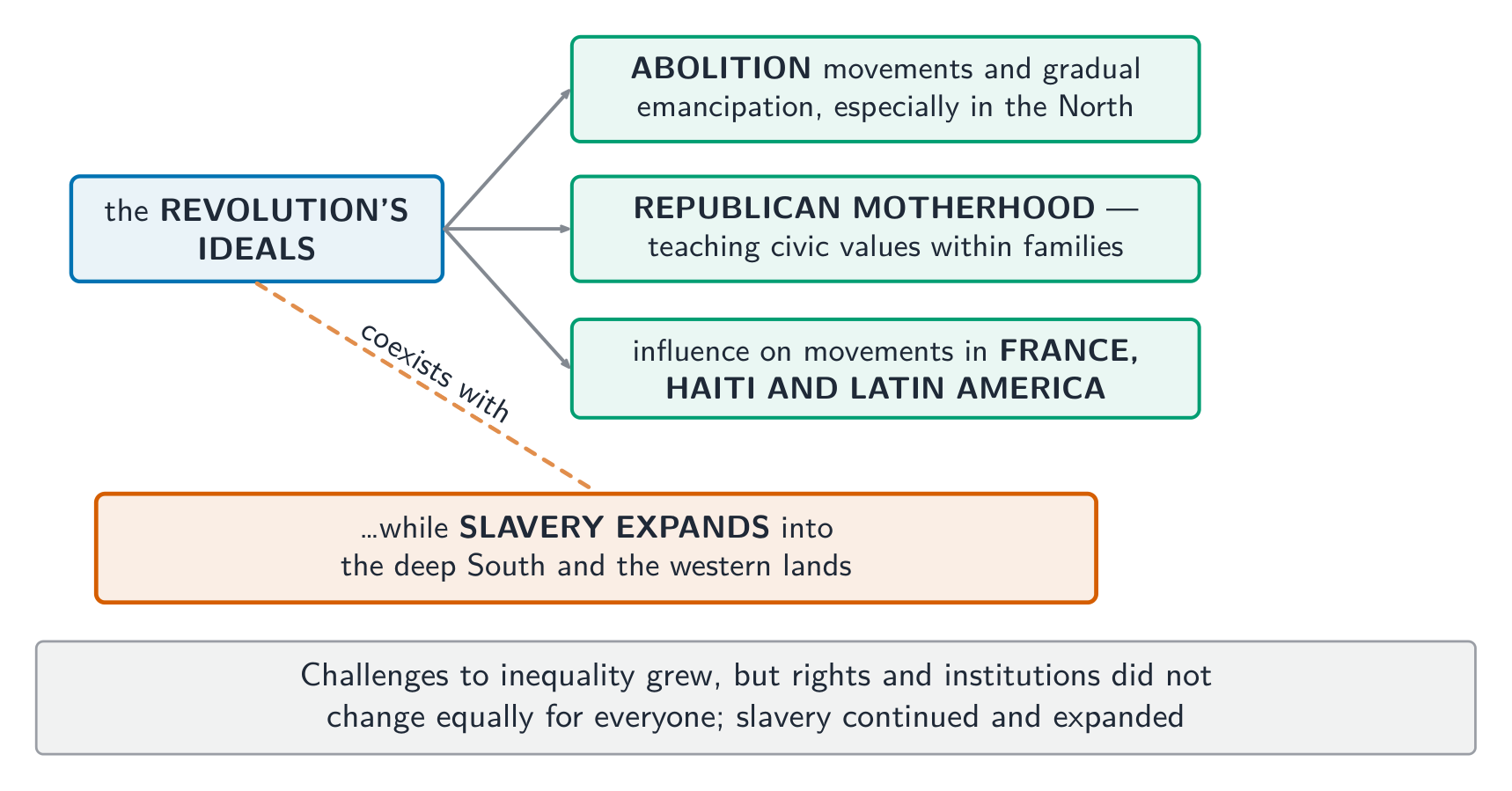
Try it — assess social change. The following evidence is paraphrased from the CED, not quoted from the original documents. In a 1777 freedom petition, Prince Hall and other free Black men used natural-rights and Christian ideas to argue for enslaved people's freedom. Pennsylvania passed an act for gradual abolition in 1780. The ideal of republican motherhood 共和母亲身份 valued women's role teaching republican values within families. Explain one change. Why does the evidence not prove immediate freedom and equal political rights for everyone?
Worked judgment. Rights language supported movements to abolish slavery 废奴运动; Pennsylvania's act shows a change in law, not immediate freedom throughout the country. Slavery continued and expanded into the deep South and adjacent western lands while antislavery 反奴隶制 sentiment grew. Republican motherhood changed ideas about the status of women 妇女地位 by valuing their political education within families, but did not itself establish equal political rights. A petition shows a demand, an act shows a legal change, and an ideal shows a valued role. These are different kinds of evidence with different limits.
Transfer — global influence. The American Revolution and the Declaration's ideals influenced movements in France, Haiti and Latin America. Does that mean these movements had identical aims or only one cause? Write a qualified claim that distinguishes “inspired” from “fully explains”.
Worked transfer. The Revolution and its rights language offered inspiration to movements in France, Haiti and Latin America. That evidence establishes influence, not identical aims or a single cause for each movement. Explaining a particular revolution requires evidence about its own circumstances and participants. Similarly, ideals encouraged challenges to inequality at home without automatically abolishing slavery or creating equal rights.
Exam transfer — 2025 AP US History, Set 1, Question 3(C), paraphrased. Briefly explain how one group responded to debates about British colonists' rights during 1765–1783. Try it: identify a group, its response and the reasoning linking that response to the rights debate. Naming “natural rights” or “the Revolution” alone does not explain a response.
Teacher-written model. Some Patriot colonists argued that British government had violated their natural rights. They therefore supported declaring independence in 1776 as a justified response to a government that failed to protect those rights.
Why this fits. It identifies a group and explains why a rights argument supported a particular response within the dates. The official scheme accepts colonists using natural-rights arguments to justify independence; it also accepts Loyalist defence of the Crown and other relevant responses. This is our model, not an official sample or the response of every colonist.
| English |
|---|
| foreign assistance/ˈfɒrən əˈsɪstəns/ |
| movements to abolish slavery/ˈmuːvmənts tʊ əˈbɒlɪʃ ˈsleɪvəri/ |
| status of women/ˈsteɪtəs ɒv ˈwɪmɪn/ |
| republican motherhood/rɪˈpʌblɪkən ˈmʌðəhʊd/ |
| antislavery/ˌæntɪˈsleɪvəri/ |
| Thematic Focus | Learning Objective | Historical Developments |
|---|---|---|
PCE | Unit 3.H |
|
| Thematic Focus | Learning Objective | Historical Developments |
|---|---|---|
PCE | Unit 3.I |
|
| Thematic Focus | Learning Objective | Historical Developments |
|---|---|---|
PCE | Unit 3.J |
|
Source: College Board AP Course and Exam Description
After declaring independence, leaders wrote new constitutions and declarations of rights that reflected republican ideals, generally limiting executive power.
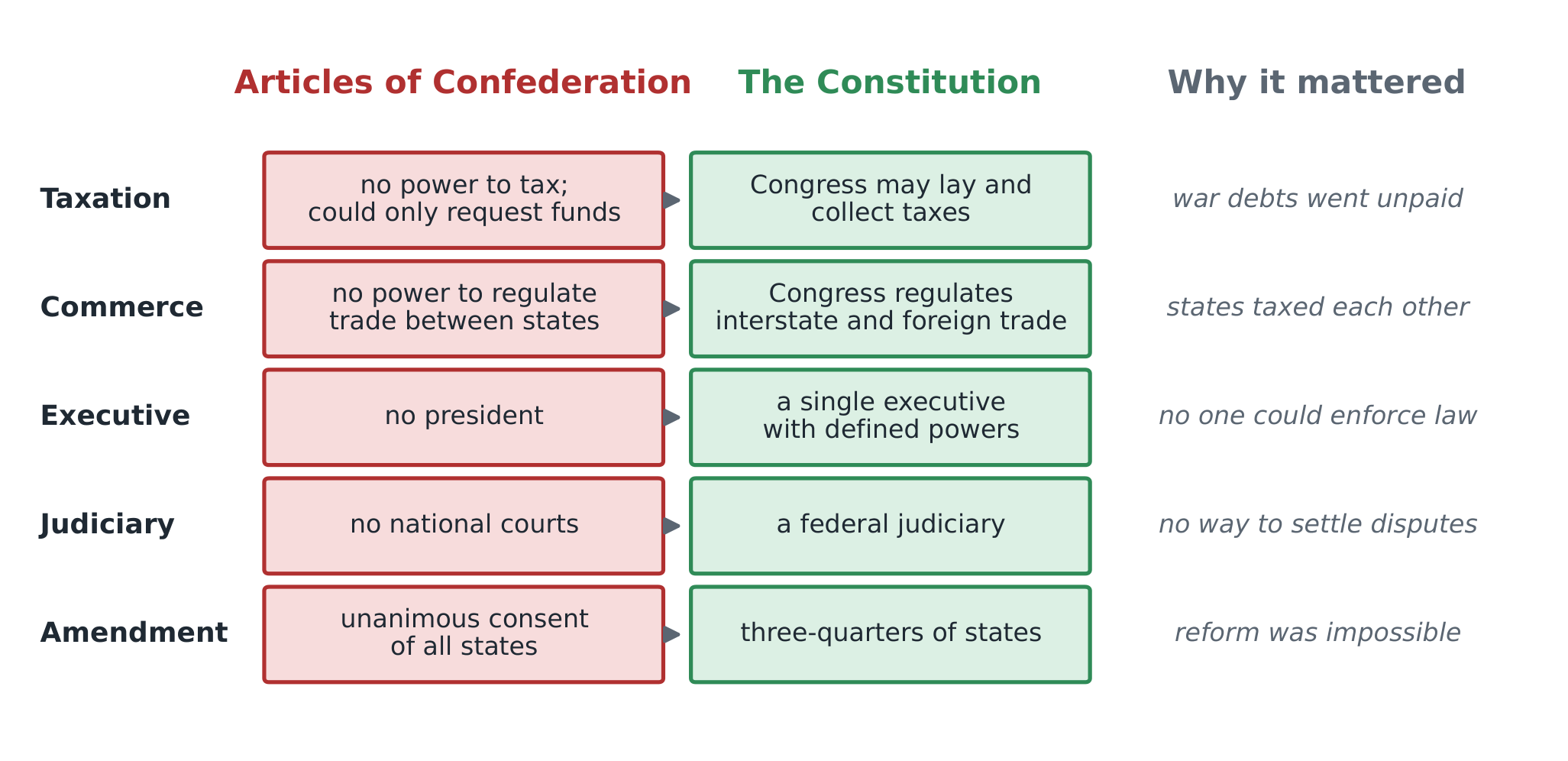
The Articles of Confederation 邦联条例 created a deliberately weak central government: no power to tax, no power to regulate commerce, no executive, and no national judiciary. It succeeded in organising western settlement through the Northwest Ordinance 西北法令, but could not manage debt, trade disputes, or unrest.
The Constitutional Convention 制宪会议 of 1787 produced a stronger national government built on compromise 妥协, including the Great Compromise 大妥协 over representation and compromises over slavery and commerce.
Ratification 批准 was contested. Federalists 联邦党人 argued the new government was strong enough to govern yet checked enough to be safe; Anti-Federalists 反联邦党人 feared centralised power and demanded protection for individual liberties, which produced the Bill of Rights 权利法案.
The Constitution is best learned as a list of powers that moved — and the ones that did not.
| English |
|---|
| Articles of Confederation/ˈɑːtɪklz ɒv kənˌfedəˈreɪʃn/ |
| Northwest Ordinance/nɔːˈθwest ˈɔːdɪnəns/ |
| Constitutional Convention/ˌkɒnstɪˈtjuːʃənl kənˈvenʃn/ |
| compromise/ˈkɒmprəmaɪz/ |
| Great Compromise/ɡreɪt ˈkɒmprəmaɪz/ |
| Ratification/ˌrætɪfɪˈkeɪʃn/ |
| Federalists/ˈfedərəlɪsts/ |
| Anti-Federalists/ˈænti ˈfedərəlɪsts/ |
| Bill of Rights/bɪl ɒv raɪts/ |
| Thematic Focus | Learning Objective | Historical Developments |
|---|---|---|
PCE | Unit 3.K |
|
Unit 3.L |
|
| Thematic Focus | Learning Objective | Historical Developments |
|---|---|---|
ARC | Unit 3.M |
|
Source: College Board AP Course and Exam Description
Under George Washington 华盛顿 and John Adams 亚当斯, political leaders disagreed sharply over the relationship between the national and state governments, economic policy, and foreign policy. Those disagreements hardened into the first party system 第一政党体系.
War between France and Britain after the French Revolution 法国大革命 forced hard choices, and the government pursued diplomatic initiatives to deal with the continued British and Spanish presence in North America. Washington's Farewell Address 华盛顿告别演说 urged national unity and warned against political factions and permanent foreign alliances.
Meanwhile a distinctive national culture 民族文化 developed - in art, literature, and architecture - alongside continued regional variation.
| English |
|---|
| George Washington/dʒɔːdʒ ˈwɒʃɪŋtn/ |
| John Adams/dʒɒn ˈædəmz/ |
| first party system/fɜːst ˈpɑːti ˈsɪstəm/ |
| French Revolution/frentʃ ˌrevəˈluːʃn/ |
| Washington's Farewell Address/ˈwɒʃɪŋtnz feəˈwel əˈdres/ |
| national culture/ˈnæʃənl ˈkʌltʃə/ |
| Thematic Focus | Learning Objective | Historical Developments |
|---|---|---|
SOC | Unit 3.N |
|
Unit 3.O |
|
Source: College Board AP Course and Exam Description
American Indian groups repeatedly evaluated and adjusted their alliances with European powers and the new United States as circumstances changed.
Growing numbers of migrants moved west, intensifying competition over resources, boundaries, and trade 资源、边界与贸易. The relationship between the federal government and American Indian tribes remained ambiguous 含混不清, contributing to recurring conflict. In the Southwest, the Spanish expanded their mission system 传教团体系, supported by the bonded labour of local American Indians.
| English |
|---|
| resources, boundaries, and trade/rɪˈzɔːsɪz ˈbaʊndəriz ænd treɪd/ |
| ambiguous/æmˈbɪɡjuːəs/ |
| mission system/ˈmɪʃn ˈsɪstəm/ |
| Learning Objective | Review: Unit 3 Key Concepts |
|---|---|
Unit 3.P |
|
Source: College Board AP Course and Exam Description
The period's reasoning skill is continuity and change 延续与变化. The strongest answers hold both: political institutions changed radically, while slavery, westward expansion, and conflict with American Indians continued and intensified.
Exam transfer — 2025 AP US History, Set 1, Question 3(B). The prompt asks students to briefly describe one effect of the Seven Years' War from 1754 to 1765. Try it before reading the model: describe an effect within those dates, with relevant details. Would the Declaration of Independence in 1776 fit?
Teacher-written model. Britain's costly victory encouraged Parliament to raise revenue from its North American colonies. The Stamp Act of 1765 imposed a tax on printed materials in the colonies.
Why this fits. The response describes a postwar tax policy within 1754–1765. The official scheme accepts further British taxation to pay for the war, the end of French colonies, or heightened tensions among colonists, British officials and Native groups. “Describe” requires relevant characteristics beyond an isolated term; it does not require a fixed two-part formula. The Declaration of Independence falls outside the dates of this prompt. This model is our teaching response, not an official sample answer or a guarantee of credit.
| English |
|---|
| continuity and change/kɒntɪˈnjuːɪti ænd tʃeɪndʒ/ |
Work through it step by step, with instant-check exercises.
Loading subjects…