Skip to content

Period 8: 1945–1980

AP United States History · Topic 8

Train
8.1 8.2

The Cold War, 1945 to 1980

Syllabus

8.1 Contextualizing Period 8

Learning ObjectivePreview: Unit 8 Key Concepts

Unit 8.A
Explain the context for societal change from 1945 to 1980.

  • KC-8.1 The United States responded to an uncertain and unstable postwar world by asserting and working to maintain a position of global leadership, with far-reaching domestic and international consequences.
    • KC-8.1.I United States policymakers engaged in a cold war with the authoritarian Soviet Union, seeking to limit the growth of Communist military power and ideological influence, create a free-market global economy, and build an international security system.
    • KC-8.1.II Cold War policies led to public debates over the power of the federal government and acceptable means for pursuing international and domestic goals while protecting civil liberties.
  • KC-8.2 New movements for civil rights and liberal efforts to expand the role of government generated a range of political and cultural responses.
    • KC-8.2.I Seeking to fulfill Reconstruction-era promises, civil rights activists and political leaders achieved some legal and political successes in ending segregation, although progress toward racial equality was slow.
    • KC-8.2.II Responding to social conditions and the African American civil rights movement, a variety of movements emerged that focused on issues of identity, social justice, and the environment.
    • KC-8.2.III Liberalism influenced postwar politics and court decisions, but it came under increasing attack from the left as well as from a resurgent conservative movement.
  • KC-8.3 Postwar economic and demographic changes had far-reaching consequences for American society, politics, and culture.
    • KC-8.3.I Rapid economic and social changes in American society fostered a sense of optimism in the postwar years.
    • KC-8.3.II New demographic and social developments, along with anxieties over the Cold War, changed U.S. culture and led to significant political and moral debates that sharply divided the nation.

8.2 The Cold War from 1945 to 1980

Thematic FocusLearning ObjectiveHistorical Developments

WOR
America in the World — Diplomatic, economic, cultural, and military interactions between empires, nations, and peoples shape the development of America and America’s increasingly important role in the world.

Unit 8.B
Explain the continuities and changes in Cold War policies from 1945 to 1980.

  • KC-8.1.I United States policymakers engaged in a cold war with the authoritarian Soviet Union, seeking to limit the growth of Communist military power and ideological influence, create a free-market global economy, and build an international security system.
  • KC-8.1.I.A As postwar tensions dissolved the wartime alliance between Western democracies and the Soviet Union, the United States developed a foreign policy based on collective security, international aid, and economic institutions that bolstered non-Communist nations.
  • KC-8.1.I.B.i Concerned by expansionist Communist ideology and Soviet repression, the United States sought to contain communism through a variety of measures, including major military engagements in Korea.
  • KC-8.1.I.C The Cold War fluctuated between periods of direct and indirect military confrontation and periods of mutual coexistence (or détente).

Source: College Board AP Course and Exam Description

Period 8 runs from 1945 to 1980. Two arguments dominate it: how far the United States should go to contain communism abroad, and how far the federal government should go to guarantee rights and welfare at home. They are connected, because both are arguments about the reach of national power.

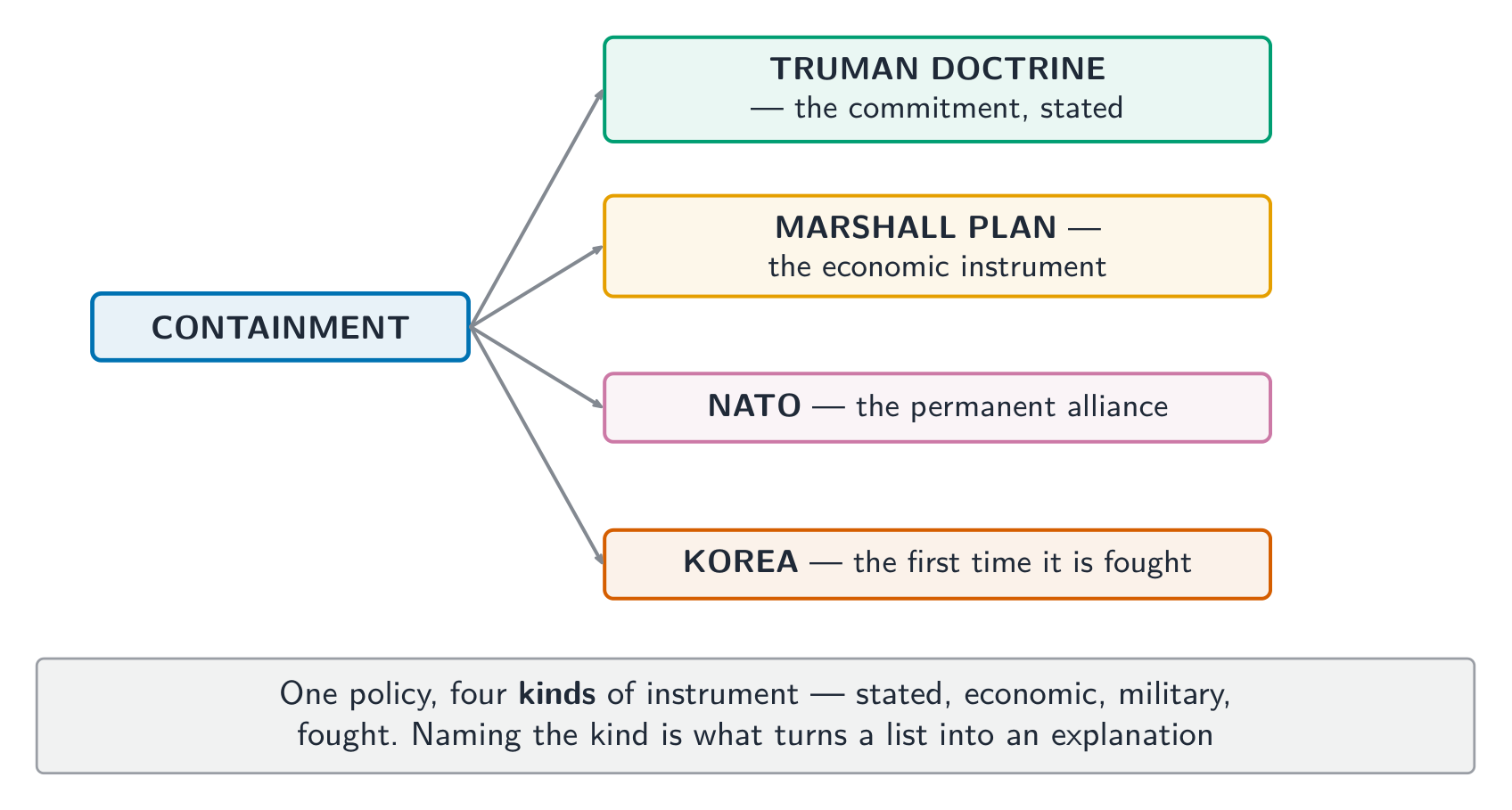
The Cold War 冷战 began as wartime cooperation collapsed into rivalry with the Soviet Union. American policy settled on containment 遏制 - preventing the spread of communism rather than attempting to remove it - expressed through the Truman Doctrine 杜鲁门主义, the Marshall Plan 马歇尔计划, and NATO 北约.

Containment then produced commitments the country had not anticipated: the Korean War 朝鲜战争, a permanent peacetime military establishment, an arms race 军备竞赛, and the space race 太空竞赛.

Vocabulary Train
English Chinese Pinyin
Cold War 冷战 lěng zhàn
containment 遏制 è zhì
Truman Doctrine 杜鲁门主义 dù lǔ mén zhǔ yì
Marshall Plan 马歇尔计划 mǎ xiē ěr jì huà
NATO 北约 běi yuē
Korean War 朝鲜战争 cháo xiān zhàn zhēng
arms race 军备竞赛 jūn bèi jìng sài
space race 太空竞赛 tài kōng jìng sài
8.3

The Red Scare at Home

Syllabus

8.3 The Red Scare

Thematic FocusLearning ObjectiveHistorical Developments

NAT
American and National Identity — The development of and debates about democracy, freedom, citizenship, diversity, and individualism shape American national identity, cultural values, and beliefs about American exceptionalism, and in turn, these ideas shape political institutions and society. Throughout American history, notions of national identity and culture have coexisted with varying degrees of regional and group identities.

Unit 8.C
Explain the causes and effects of the Red Scare after World War II.

  • KC-8.1.II.A Americans debated policies and methods designed to expose suspected communists within the United States even as both parties supported the broader strategy of containing communism.

Source: College Board AP Course and Exam Description

Fear of communism reshaped domestic politics. Loyalty programmes 忠诚审查, congressional investigations, and McCarthyism 麦卡锡主义 targeted suspected communists in government, universities, unions, and the entertainment industry.

The examinable point is the cost to civil liberties 公民自由的代价: accusation often functioned as proof, and the fear narrowed the range of acceptable political debate for a decade.

Vocabulary Train
English Chinese Pinyin
Loyalty programmes 忠诚审查 zhōng chéng shěn chá
McCarthyism 麦卡锡主义 mài kǎ xī zhǔ yì
cost to civil liberties 公民自由的代价 gōng mín zì yóu de dài jià
8.4 8.5

Prosperity and Its Discontents

Syllabus

8.4 Economy After 1945

Thematic FocusLearning ObjectiveHistorical Developments

WXT
Work, Exchange, and Technology — The interplay between markets, private enterprise, labor, technology, and government policy shape the American economy. In turn, economic activity shapes society and government policy and drives technological innovation.

Unit 8.D
Explain the causes of economic growth in the years after World War II. THEMATIC FOCUS Migration and Settlement MIG Push and pull factors shape immigration to and migration within America, and the demographic change as a result of these moves shapes the migrants, society, and the environment. LEARNING OBJECTIVE

  • KC-8.3.I.A A burgeoning private sector, federal spending, the baby boom, and technological developments helped spur economic growth. HISTORICAL DEVELOPMENTS

Unit 8.E
Explain the causes and effects of the migration of various groups of Americans after 1945.

  • KC-8.3.I.B As higher education opportunities and new technologies rapidly expanded, increasing social mobility encouraged the migration of the middle class to the suburbs and of many Americans to the South and West. The Sun Belt region emerged as a significant political and economic force.

8.5 Culture after 1945

Thematic FocusLearning ObjectiveHistorical Developments

ARC
American and Regional Culture — Creative expression, demographic change, philosophy, religious beliefs, scientific ideas, social mores, and technology shape national, regional, and group cultures in America, and these varying cultures often play a role in shaping government policy and developing economic systems.

Unit 8.F
Explain how mass culture has been maintained or challenged over time.

  • KC-8.3.II.A Mass culture became increasingly homogeneous in the postwar years, inspiring challenges to conformity by artists, intellectuals, and rebellious youth.

Source: College Board AP Course and Exam Description

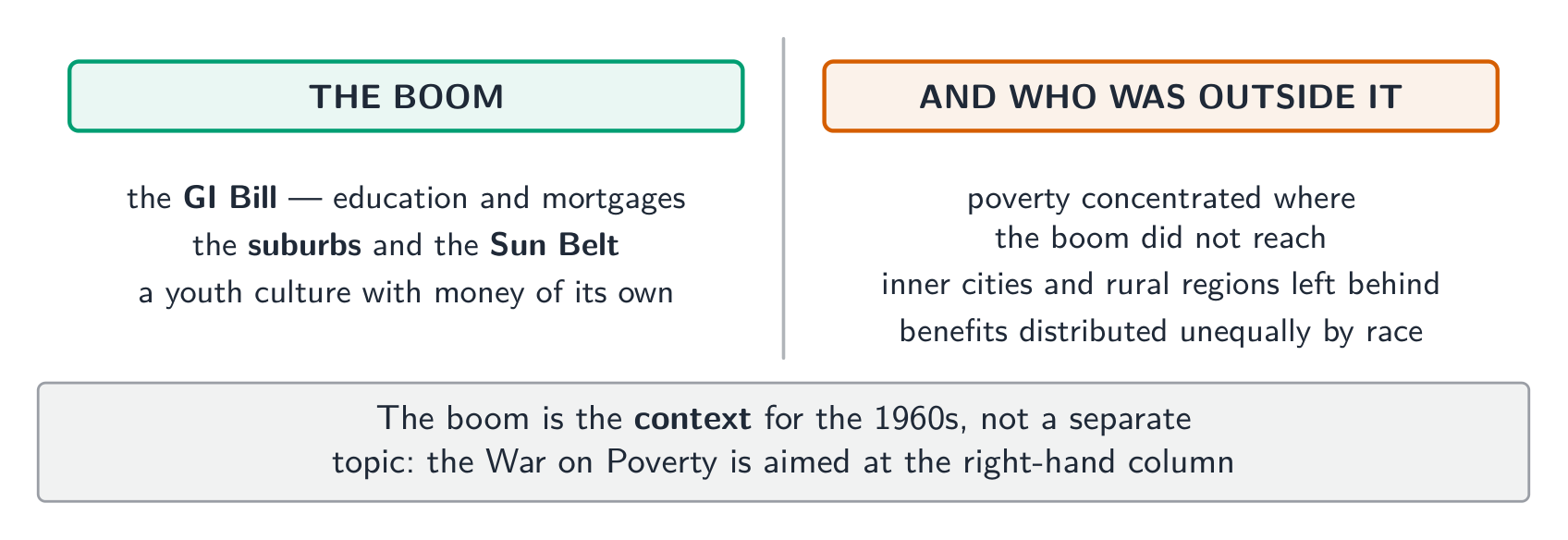
The postwar economy grew strongly. Federal spending on defence, highways, and the GI Bill 退伍军人权利法 supported home ownership and higher education, and the population moved to the suburbs 郊区 and to the Sun Belt 阳光地带.

Culture changed with it: mass consumption, television, and a distinct youth culture 青年文化 with its own music and markets.

Prosperity was uneven. Suburban growth was frequently closed to African Americans by law and practice, cities lost tax base and jobs, and poverty 贫困 persisted in ways the decade's self-image obscured - which is what later reform movements responded to.

Vocabulary Train
English Chinese Pinyin
GI Bill 退伍军人权利法 tuì wǔ jūn rén quán lì fǎ
suburbs 郊区 jiāo qū
Sun Belt 阳光地带 yáng guāng dì dài
youth culture 青年文化 qīng nián wén huà
poverty 贫困 pín kùn
8.6 8.10 8.11

The Civil Rights Movement

Syllabus

8.6 Early Steps in the Civil Rights Movement (1940s and 1950s)

Thematic FocusLearning ObjectiveHistorical Developments

SOC
Social Structures — Social categories, roles, and practices are created, maintained, challenged, and transformed throughout American history, shaping government policy, economic systems, culture, and the lives of citizens.

Unit 8.G
Explain how and why the civil rights movements developed and expanded from 1945 to 1960.

  • KC-8.2.I Seeking to fulfill Reconstruction-era promises, civil rights activists and political leaders achieved some legal and political successes in ending segregation, although progress toward racial equality was slow.
  • KC-8.2.I.B.i The three branches of the federal government used measures including desegregation of the armed services and Brown v. Board of Education (1954) to promote greater racial equality.

8.10 The African American Civil Rights Movement (1960s)

Thematic FocusLearning ObjectiveHistorical Developments

PCE
Politics and Power — Debates fostered by social and political groups about the role of government in American social, political, and economic life shape government policy, institutions, political parties, and the rights of citizens.

Unit 8.L
Explain how and why various groups responded to calls for the expansion of civil rights from 1960 to 1980.

  • KC-8.2.I.A During and after World War II, civil rights activists and leaders, most notably Martin Luther King Jr., combated racial discrimination utilizing a variety of strategies, including legal challenges, direct action, and nonviolent protest tactics.
  • KC-8.2.I.C Continuing resistance slowed efforts at desegregation, sparking social and political unrest across the nation. Debates among civil rights activists over the efficacy of nonviolence increased after 1965.

Unit 8.M
Explain the various ways in which the federal government responded to the calls for the expansion of civil rights.

  • KC-8.2.I.B.ii The three branches of the federal government used measures including the Civil Rights Act of 1964 to promote greater racial equality.
  • KC-8.2.III.B.ii A series of Supreme Court decisions expanded civil rights and individual liberties.

8.11 The Civil Rights Movement Expands

Thematic FocusLearning ObjectiveHistorical Developments

SOC
Social Structures — Social categories, roles, and practices are created, maintained, challenged, and transformed throughout American history, shaping government policy, economic systems, culture, and the lives of citizens.

Unit 8.L
Explain how and why various groups responded to calls for the expansion of civil rights from 1960 to 1980.

  • KC-8.2.II.B Latino, American Indian, and Asian American movements continued to demand social and economic equality and a redress of past injustices.
  • KC-8.2.II.A Feminist and LGBTQ+ activists mobilized behind claims for legal, economic, and social equality.
  • KC-8.3.II.B.i Feminists who participated in the counterculture of the 1960s rejected many of the social, economic, and political values of their parents’ generation and advocated changes in sexual norms.

Source: College Board AP Course and Exam Description

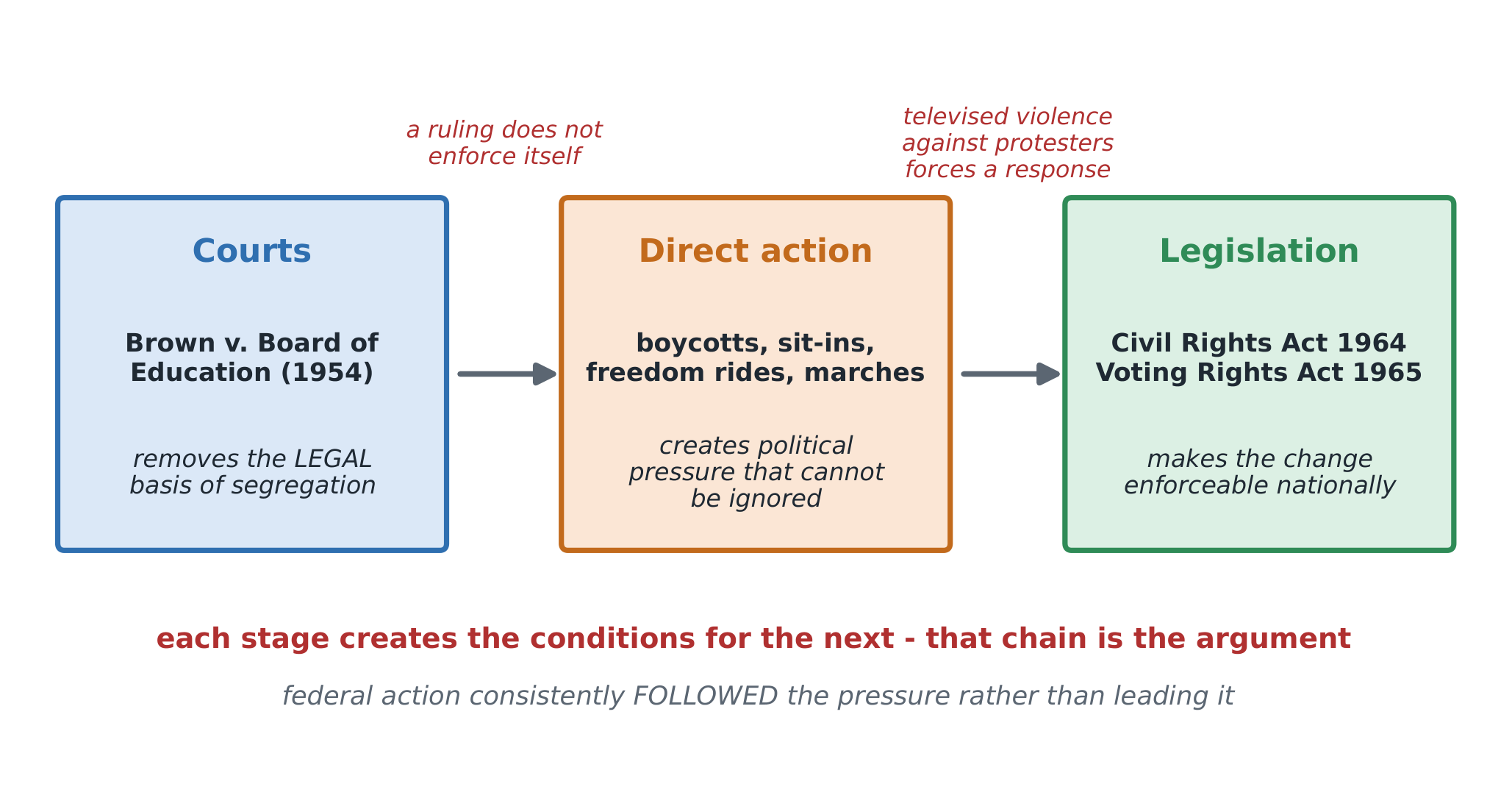
The civil rights movement as three arenas - courts, direct action, legislation - each converting pressure into the next
Litigation, direct action and legislation were not alternatives: each one created the conditions for the next

Early steps in the 1940s and 1950s worked mainly through the courts 法院. Legal strategy produced Brown v. Board of Education 布朗诉教育委员会案, which held segregated schooling unconstitutional and stripped away the legal basis of segregation.

Court victories did not enforce themselves, so the movement turned to direct action 直接行动: the Montgomery bus boycott, sit-ins, freedom rides, and mass marches, organised through churches and student groups and grounded in nonviolent protest 非暴力抗议.

Sustained pressure and televised violence against protesters produced legislation 立法: the Civil Rights Act of 1964 1964年民权法 and the Voting Rights Act of 1965 1965年选举权法.

The movement then expanded 扩展: later activists raised questions of economic inequality, housing, and policing, and some rejected nonviolence and integration in favour of Black Power 黑人权力. Its example also shaped movements by women, Latinos, American Indians, and others.

Vocabulary Train
English Chinese Pinyin
courts 法院 fǎ yuàn
Brown v. Board of Education 布朗诉教育委员会案 bù lǎng sù jiào yù wěi yuán huì àn
direct action 直接行动 zhí jiē xíng dòng
nonviolent protest 非暴力抗议 fēi bào lì kàng yì
legislation 立法 lì fǎ
Civil Rights Act of 1964 1964年民权法 1964 nián mín quán fǎ
Voting Rights Act of 1965 1965年选举权法 1965 nián xuǎn jǔ quán fǎ
expanded 扩展 kuò zhǎn
Black Power 黑人权力 hēi rén quán lì
8.7 8.8 8.9

The Great Society and the Vietnam War

Syllabus

8.7 America as a World Power

Thematic FocusLearning ObjectiveHistorical Developments

WOR
America in the World — Diplomatic, economic, cultural, and military interactions between empires, nations, and peoples shape the development of America and America’s increasingly important role in the world.

Unit 8.H
Explain the various military and diplomatic responses to international developments over time.

  • KC-8.1.I.E Cold War competition extended to Latin America, where the United States supported non-Communist regimes that had varying levels of commitment to democracy.
  • KC-8.1.II.C.i Americans debated the merits of a large nuclear arsenal and the military–industrial complex.
  • KC-8.1.I.D.i Postwar decolonization and the emergence of powerful nationalist movements in Africa and the Middle East led both sides in the Cold War to seek allies among new nations, many of which remained nonaligned.

8.8 The Vietnam War

Thematic FocusLearning ObjectiveHistorical Developments

WOR
America in the World — Diplomatic, economic, cultural, and military interactions between empires, nations, and peoples shape the development of America and America’s increasingly important role in the world.

Unit 8.I
Explain the causes and effects of the Vietnam War.

  • KC-8.1.I.B.ii Concerned by expansionist Communist ideology and Soviet repression, the United States sought to contain communism through a variety of measures, including major military engagements in Vietnam.
  • KC-8.1.I.D.ii Postwar decolonization and the emergence of powerful nationalist movements in Asia led both sides in the Cold War to seek allies among new nations, many of which remained nonaligned.
  • KC-8.1.II.C.ii Americans debated the appropriate power of the executive branch in conducting foreign and military policy.

8.9 The Great Society

Thematic FocusLearning ObjectiveHistorical Developments

MIG
Migration and Settlement — Push and pull factors shape immigration to and migration within America, and the demographic change as a result of these moves shapes the migrants, society, and the environment.

Unit 8.J
Explain the causes and effects of continuing policy debates about the role of the federal government over time.

  • KC-8.2.II.C Despite an overall affluence in postwar America, advocates raised concerns about the prevalence and persistence of poverty as a national problem.
  • KC-8.2.III.A Liberalism, based on anti-communism abroad and a firm belief in the efficacy of government power to achieve social goals at home, reached a high point of political influence by the mid-1960s.
  • KC-8.2.III.B.i Liberal ideas found expression in Lyndon Johnson’s Great Society, which attempted to use federal legislation and programs to end racial discrimination, eliminate poverty, and address other social issues.

Unit 8.K
Explain the continuities and changes in immigration patterns over time.

  • KC-8.3.I.C Immigrants from around the world sought access to the political, social, and economic opportunities in the United States, especially after the passage of new immigration laws in 1965.

Source: College Board AP Course and Exam Description

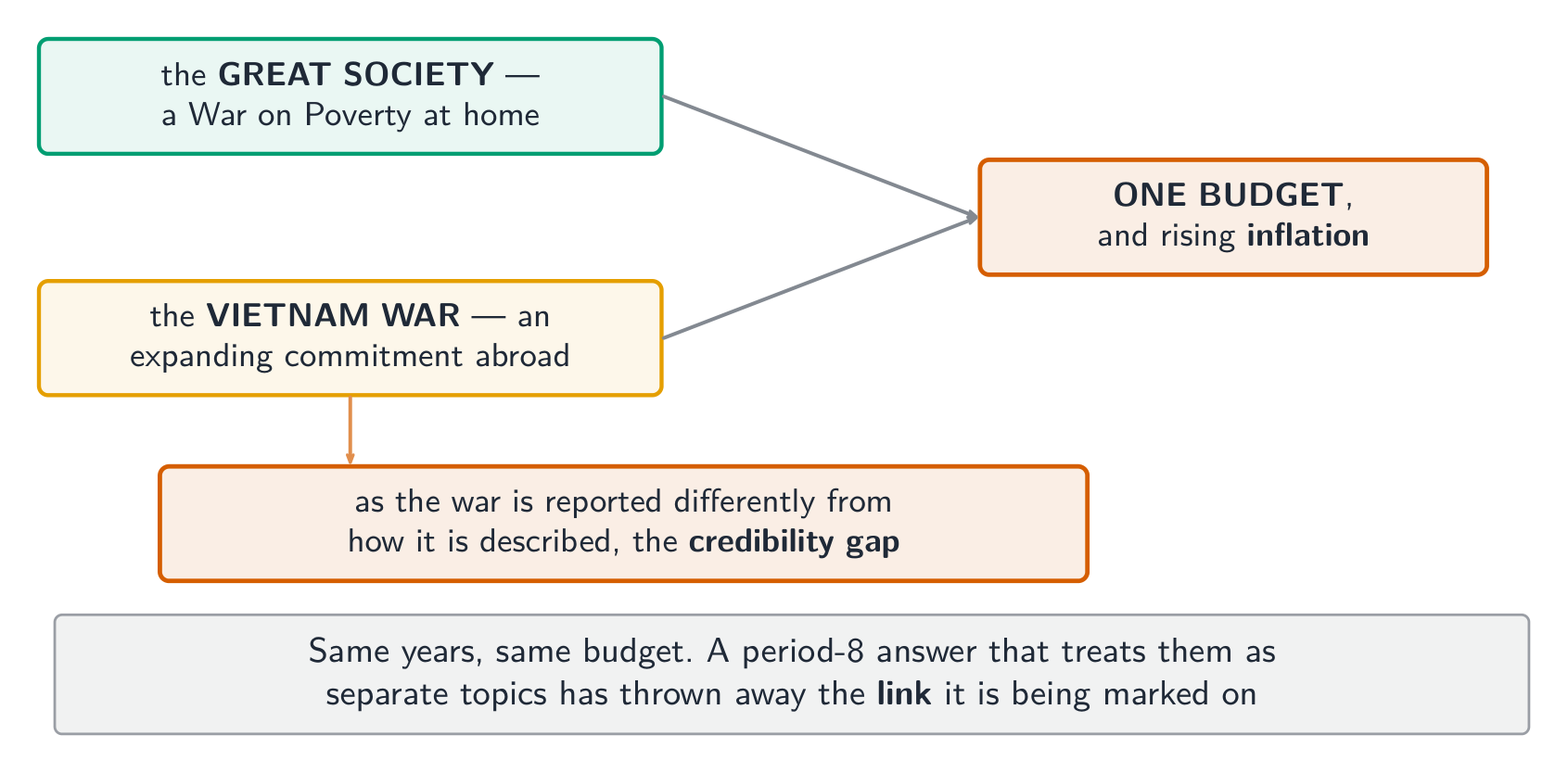
The Great Society 伟大社会 extended federal responsibility furthest since the New Deal: Medicare and Medicaid, federal aid to education, and the War on Poverty 向贫困宣战.

The Vietnam War 越南战争 grew out of containment and consumed the same presidency. Escalation without decisive results produced a large antiwar movement 反战运动, deep political division, and a credibility gap 信任鸿沟 between government statements and reported reality. Defeat abroad and disillusion at home weakened confidence in federal power just as its domestic role peaked.

Vocabulary Train
English Chinese Pinyin
Great Society 伟大社会 wěi dà shè huì
War on Poverty 向贫困宣战 xiàng pín kùn xuān zhàn
Vietnam War 越南战争 yuè nán zhàn zhēng
antiwar movement 反战运动 fǎn zhàn yùn dòng
credibility gap 信任鸿沟 xìn rèn hóng gōu
8.12 8.13 8.14

Society in Transition

Syllabus

8.12 Youth Culture of the 1960s

Thematic FocusLearning ObjectiveHistorical Developments

ARC
American and Regional Culture — Creative expression, demographic change, philosophy, religious beliefs, scientific ideas, social mores, and technology shape national, regional, and group cultures in America, and these varying cultures often play a role in shaping government policy and developing economic systems.

Unit 8.N
Explain how and why opposition to existing policies and values developed and changed over the course of the 20th century.

  • KC-8.1.II.B Although anti-communist foreign policy faced little domestic opposition in previous years, the Vietnam War inspired sizable and passionate anti-war protests that became more numerous as the war escalated and sometimes led to violence.
  • KC-8.2.III.D Some groups on the left also rejected liberal policies, arguing that political leaders did too little to transform the racial and economic status quo at home and pursued immoral policies abroad.
  • KC-8.3.II.B.ii Young people who participated in the counterculture of the 1960s rejected many of the social, economic, and political values of their parents’ generation, introduced greater informality into U.S. culture, and advocated changes in sexual norms.

8.13 The Environment and Natural Resources from 1968 to 1980

Thematic FocusLearning ObjectiveHistorical Developments

GEO
Geography and the Environment — Geographic and environmental factors, including competition over and debates about natural resources, shape the development of America and foster regional diversity. The development of America impacts the environment and reshapes geography, which leads to debates about environmental and geographic issues.

Unit 8.O
Explain how and why policies related to the environment developed and changed from 1968 to 1980.

  • KC-8.1.II.D Ideological, military, and economic concerns shaped U.S. involvement in the Middle East, with several oil crises in the region eventually sparking attempts at creating a national energy policy.
  • KC-8.2.II.D Environmental problems and accidents led to a growing environmental movement that aimed to use legislative and public efforts to combat pollution and protect natural resources. The federal government established new environmental programs and regulations.

8.14 Society in Transition

Thematic FocusLearning ObjectiveHistorical Developments

ARC
American and Regional Culture — Creative expression, demographic change, philosophy, religious beliefs, scientific ideas, social mores, and technology shape national, regional, and group cultures in America, and these varying cultures often play a role in shaping government policy and developing economic systems.

Unit 8.J
Explain the causes and effects of continuing policy debates about the role of the federal government over time.

  • KC-8.2.III.C In the 1960s, conservatives challenged liberal laws and court decisions and perceived moral and cultural decline, seeking to limit the role of the federal government and enact more assertive foreign policies.
  • KC-8.2.III.E Public confidence and trust in government’s ability to solve social and economic problems declined in the 1970s in the wake of economic challenges, political scandals, and foreign policy crises.
  • KC-8.2.III.F The 1970s saw growing clashes between conservatives and liberals over social and cultural issues, the power of the federal government, race, and movements for greater individual rights.

Unit 8.P
Explain the effects of the growth of religious movements over the course of the 20th century.

  • KC-8.3.II.C The rapid and substantial growth of evangelical Christian churches and organizations was accompanied by greater political and social activism on the part of religious conservatives.

Source: College Board AP Course and Exam Description

The later part of the period is defined by movements and by limits.

  • The women's movement 妇女运动 pressed for legal equality and workplace access; the Equal Rights Amendment 平等权利修正案 failed ratification.
  • Environmental 环境保护 concern grew into federal action on air, water, and endangered species between 1968 and 1980.
  • Immigration law was reformed in 1965, changing the origins of new arrivals.
  • Conservatism 保守主义 organised in response to all of it, on taxes, social change, and the size of government - the movement Period 9 opens with.

Economic trouble sharpened everything: inflation 通货膨胀, oil shocks, and industrial decline ended the postwar boom.

Vocabulary Train
English Chinese Pinyin
women's movement 妇女运动 fù nǚ yùn dòng
Equal Rights Amendment 平等权利修正案 píng děng quán lì xiū zhèng àn
Environmental 环境保护 huán jìng bǎo hù
Conservatism 保守主义 bǎo shǒu zhǔ yì
inflation 通货膨胀 tōng huò péng zhàng
8.15

Continuity and Change in Period 8

Syllabus

8.15 Continuity and Change in Period 8

Learning ObjectiveReview: Unit 8 Key Concepts

Unit 8.Q
Explain the extent to which the events of the period from 1945 to1980 reshaped national identity.

  • KC-8.1 The United States responded to an uncertain and unstable postwar world by asserting and working to maintain a position of global leadership, with far-reaching domestic and international consequences.
    • KC-8.1.I United States policymakers engaged in a cold war with the authoritarian Soviet Union, seeking to limit the growth of Communist military power and ideological influence, create a free-market global economy, and build an international security system.
    • KC-8.1.II Cold War policies led to public debates over the power of the federal government and acceptable means for pursuing international and domestic goals while protecting civil liberties.
  • KC-8.2 New movements for civil rights and liberal efforts to expand the role of government generated a range of political and cultural responses.
    • KC-8.2.I Seeking to fulfill Reconstruction-era promises, civil rights activists and political leaders achieved some legal and political successes in ending segregation, although progress toward racial equality was slow.
    • KC-8.2.II Responding to social conditions and the African American civil rights movement, a variety of movements emerged that focused on issues of identity, social justice, and the environment.
    • KC-8.2.III Liberalism influenced postwar politics and court decisions, but it came under increasing attack from the left as well as from a resurgent conservative movement.
  • KC-8.3 Postwar economic and demographic changes had far-reaching consequences for American society, politics, and culture.
    • KC-8.3.I Rapid economic and social changes in American society fostered a sense of optimism in the postwar years.
    • KC-8.3.II New demographic and social developments, along with anxieties over the Cold War, changed U.S. culture and led to significant political and moral debates that sharply divided the nation.

Source: College Board AP Course and Exam Description

The period's reasoning skill is continuity and change. Rights expanded enormously in law; economic inequality and residential segregation persisted, and both statements belong in a strong answer.

Worked example (a real AP exam question). The 2023 exam set the long essay "Evaluate the extent to which the growth of civil rights activism contributed to changes in government action" in the twentieth century. A strong thesis makes activism the cause and names the government changes: "Civil rights activism contributed to a great extent to changes in government action, as litigation produced Brown v. Board of Education and sustained direct action created the political pressure behind the Civil Rights Act of 1964 and the Voting Rights Act of 1965, although federal action consistently followed rather than led that pressure." Notice the shape: the prompt asks about a contribution, so the essay must trace the link from activism to policy, not describe the movement on its own.

8.15

Exam tips

  • Define containment precisely - preventing spread, not rollback - and use it to explain Korea and Vietnam as consequences.
  • For the Red Scare, the mark is in the cost to civil liberties, not in a narrative of accusations.
  • Present civil rights as courts → direct action → legislation, each stage creating the next.
  • Say what the Great Society actually did (Medicare, Medicaid, education aid) rather than calling it "reforms".
  • Vietnam's domestic effect - division and the credibility gap - matters as much as the military outcome.
  • On continuity-and-change prompts, pair legal gains with persistent economic and residential inequality.

More topics in AP United States History

Log in or create account

IGCSE, A-Level & AP