1.1 Contextualizing Period 1
| Learning Objective | Preview: Unit 1 Key Concepts |
|---|---|
Unit 1.A |
|
1.2 Native American Societies Before European Contact
| Thematic Focus | Learning Objective | Historical Developments |
|---|---|---|
GEO | Unit 1.B |
|
AP United States History · Topic 1
 7:47
7:47
Period 1: 1491 to 1607
In 1491 North America was not empty and it was not one place. It held hundreds of societies, farming, hunting, fishing and trading, and they differed from each…
English narration · English + 中文 subtitles burned in
| Learning Objective | Preview: Unit 1 Key Concepts |
|---|---|
Unit 1.A |
|
| Thematic Focus | Learning Objective | Historical Developments |
|---|---|---|
GEO | Unit 1.B |
|
Source: College Board AP Course and Exam Description
Period 1 runs from 1491 to 1607 - from the eve of European contact to the founding of Jamestown. It exists to explain what the Americas were like before Europeans arrived, and what happened when three worlds met.
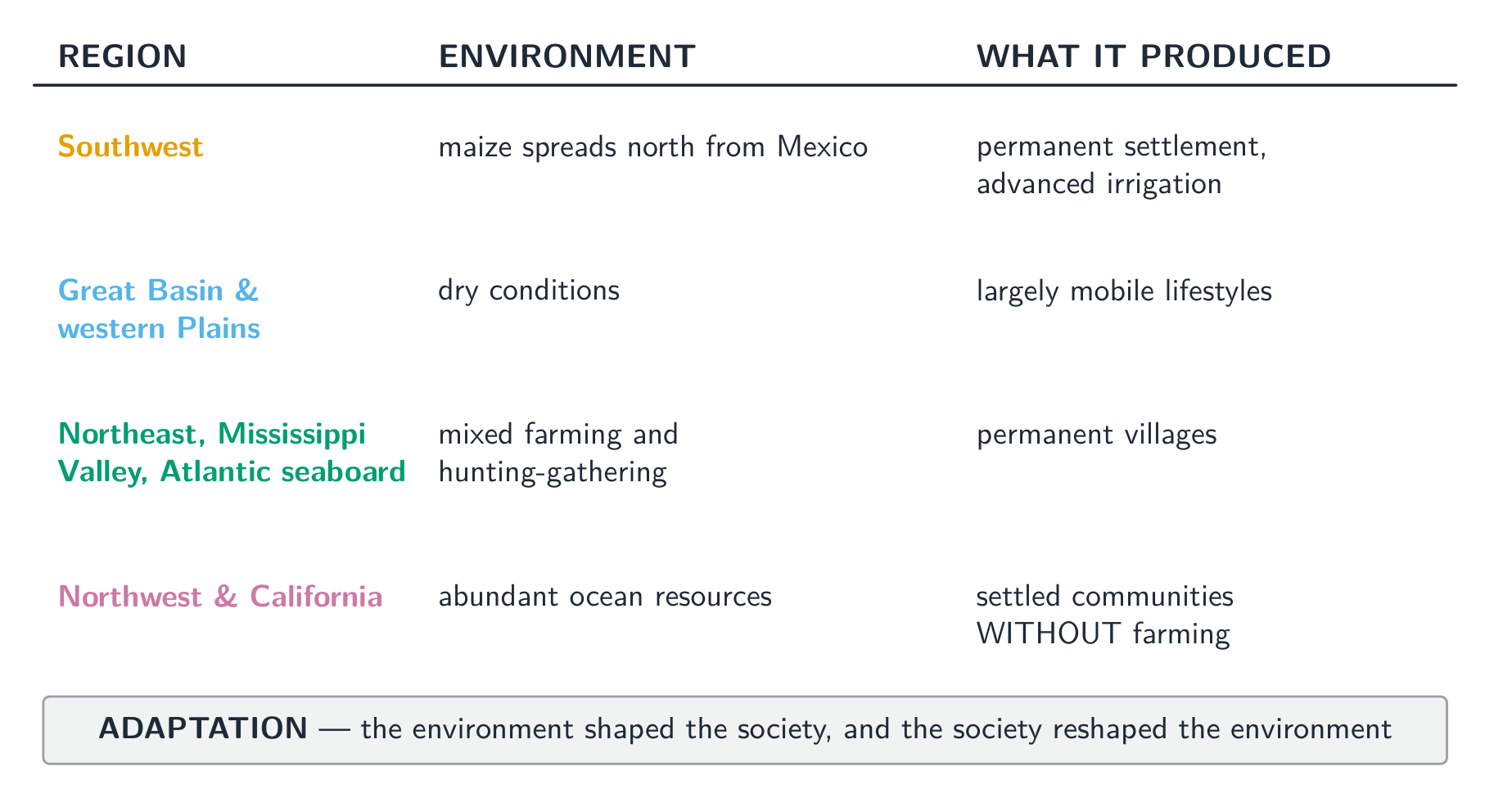
North America in 1491 held hundreds of distinct societies. They differed because they adapted to different environments, and the CED groups them by region:
The pattern to hold on to is adaptation 适应: the environment shaped the society, and the society reshaped the environment.
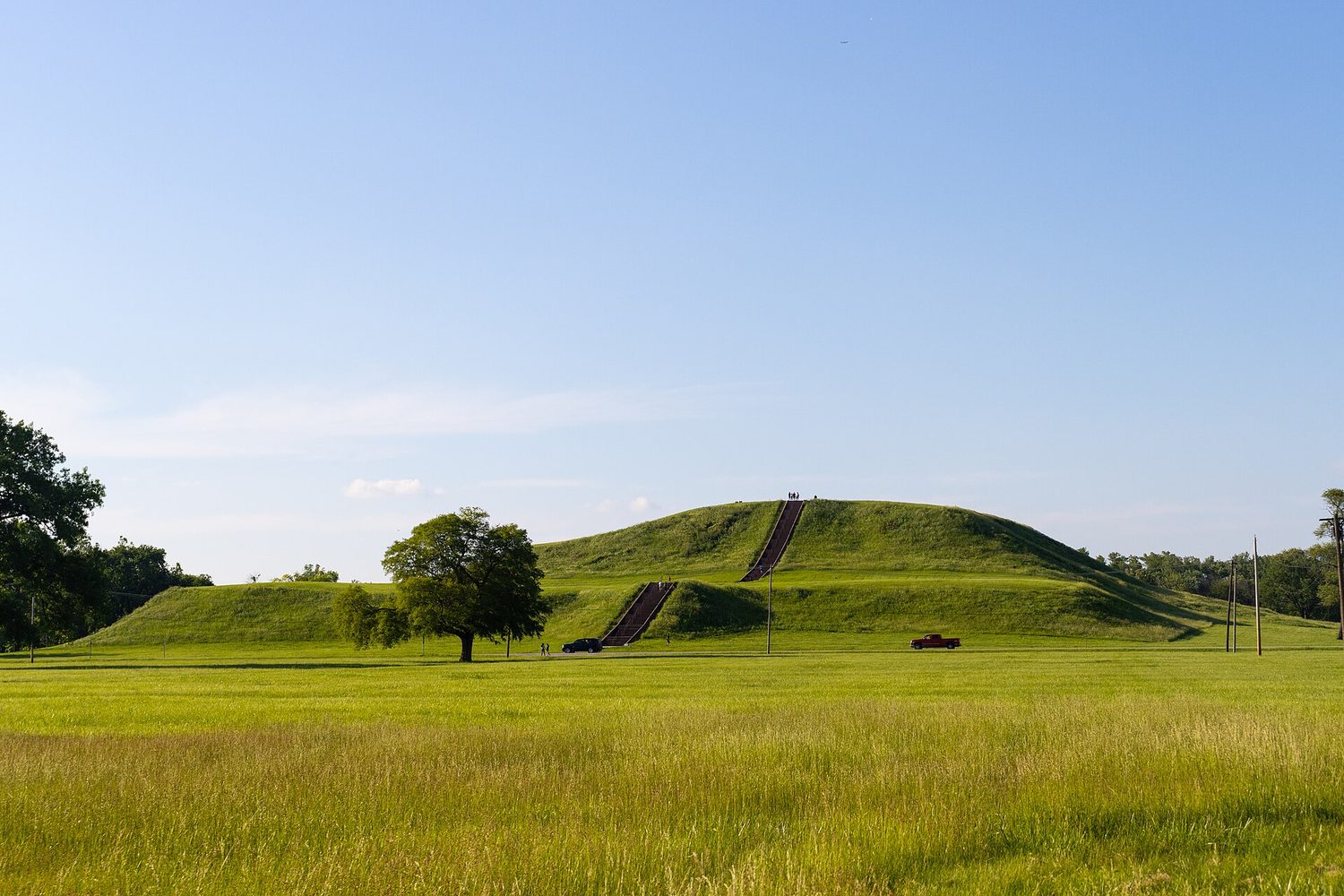
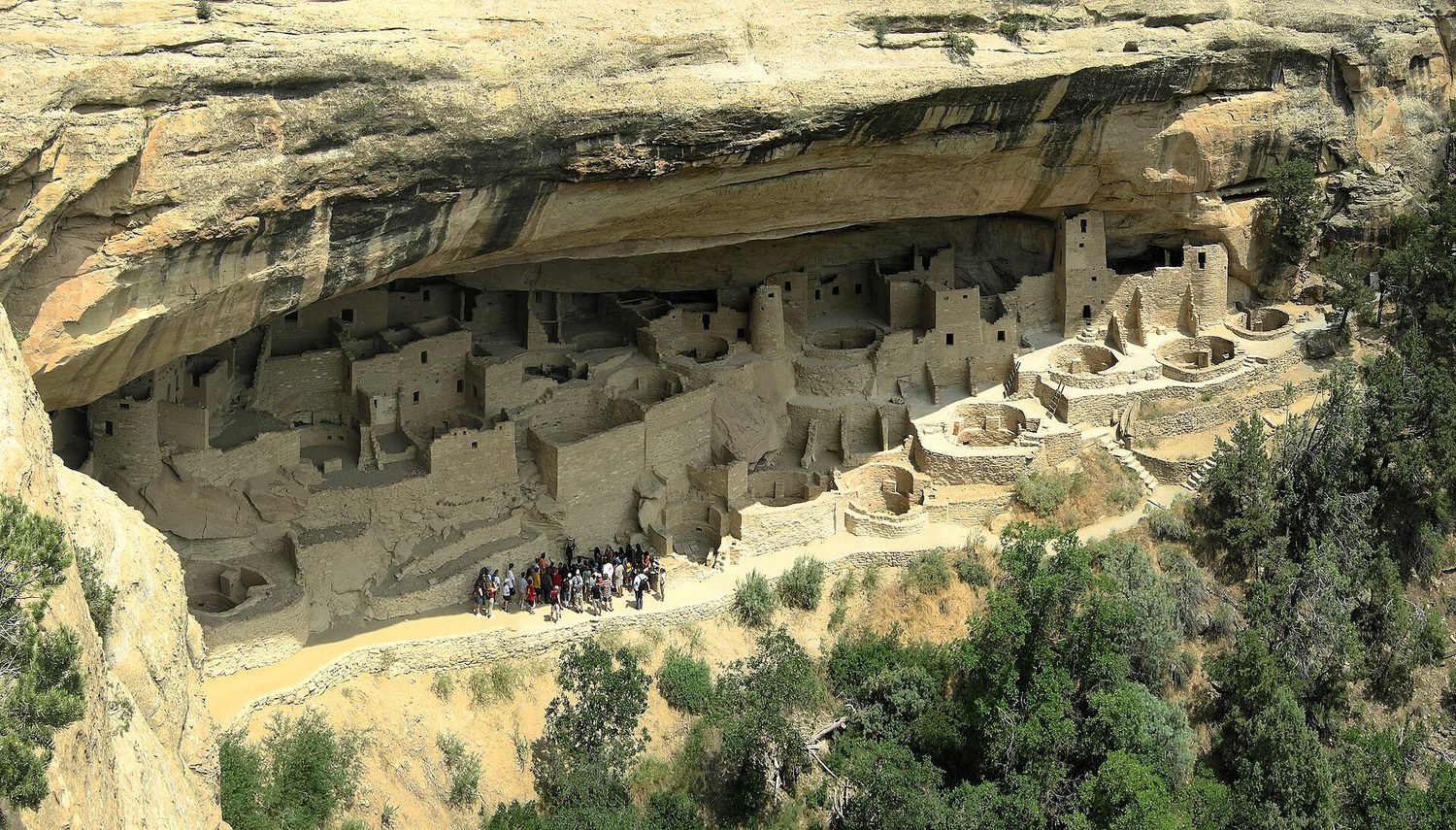
The four CED regional groupings are one mechanism with different inputs: the environment shapes the economy, and the economy shapes settlement.
| English |
|---|
| maize/meɪz/ |
| advanced irrigation/ədˈvænst ˌɪrɪˈɡeɪʃn/ |
| mobile lifestyles/ˈməʊbaɪl ˈlaɪfstaɪlz/ |
| adaptation/ˌædæpˈteɪʃn/ |
| Thematic Focus | Learning Objective | Historical Developments |
|---|---|---|
WOR | Unit 1.C |
|
Source: College Board AP Course and Exam Description
European exploration was driven by a search for new sources of wealth 新的财富来源, expanded trade routes, and the spread of Christianity 基督教. Spain and Portugal moved first, and Spain's American empire followed.
Two changes made the voyages possible: improvements in maritime technology 航海技术, and more organised methods of financing trade, especially the joint-stock company 股份公司, which spread the risk of a voyage across many investors.
| English |
|---|
| new sources of wealth/njuː ˈsɔːsɪz ɒv welθ/ |
| Christianity/ˌkrɪstɪˈænɪti/ |
| maritime technology/ˈmærɪtaɪm tekˈnɒlədʒi/ |
| joint-stock company/dʒɔɪnt stɒk ˈkʌmpəni/ |
| Thematic Focus | Learning Objective | Historical Developments |
|---|---|---|
GEO | Unit 1.D |
|
Source: College Board AP Course and Exam Description
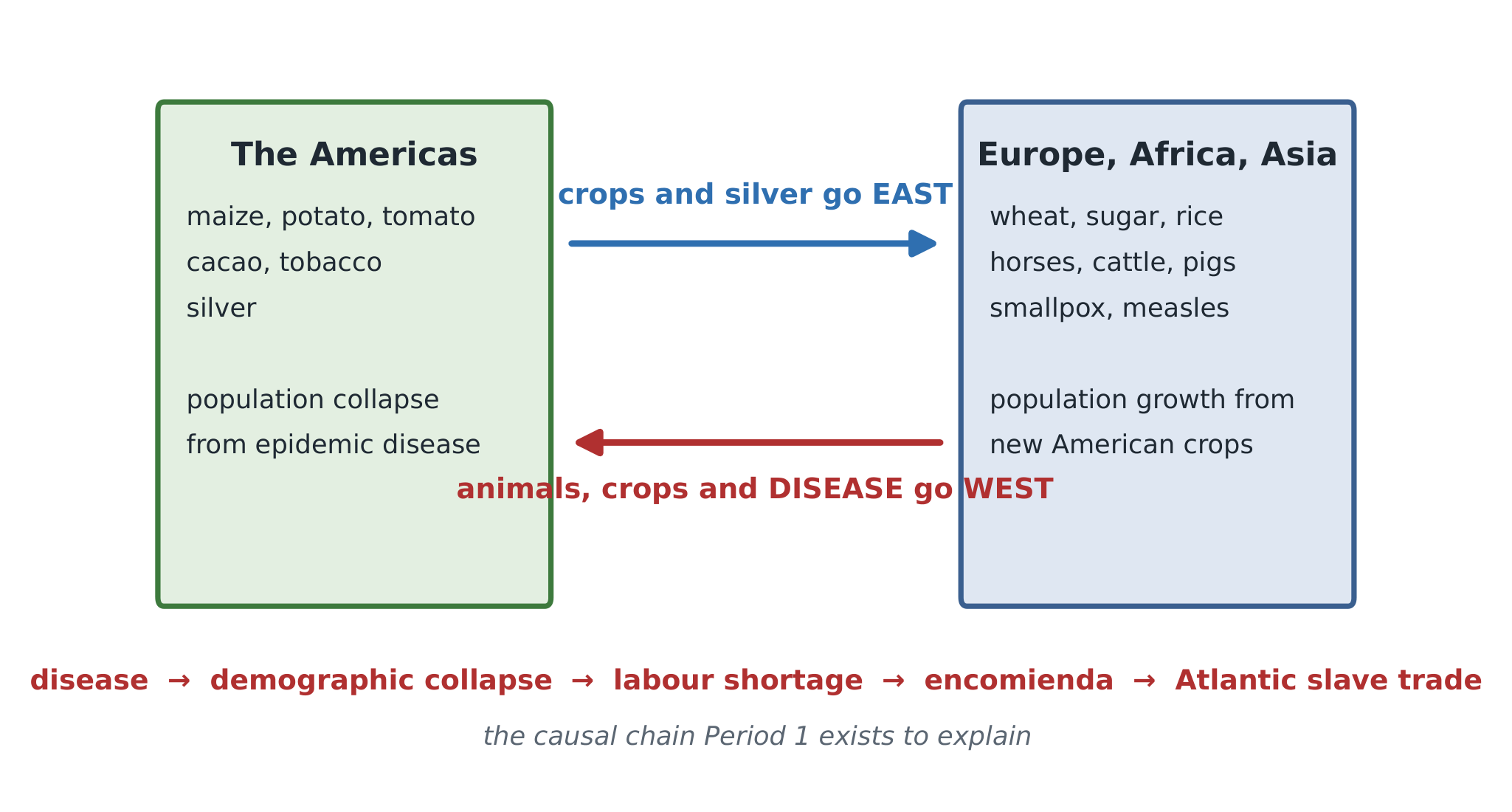
The Columbian Exchange 哥伦布大交换 is the transfer of plants, animals, people, and diseases between the Americas and the rest of the world. It connected environments and societies across the Atlantic and changed food supplies, populations and colonial economies.
Moving east to Europe: American crops such as maize and the potato 马铃薯 raised nutrition and helped drive European population growth 欧洲人口增长. American silver 白银 reshaped global trade.
Moving west to the Americas: European animals, crops, and - decisively - epidemic disease 流行病. Populations with no prior exposure suffered catastrophic mortality, and this demographic collapse 人口锐减 accompanied and enabled Spanish conquest.
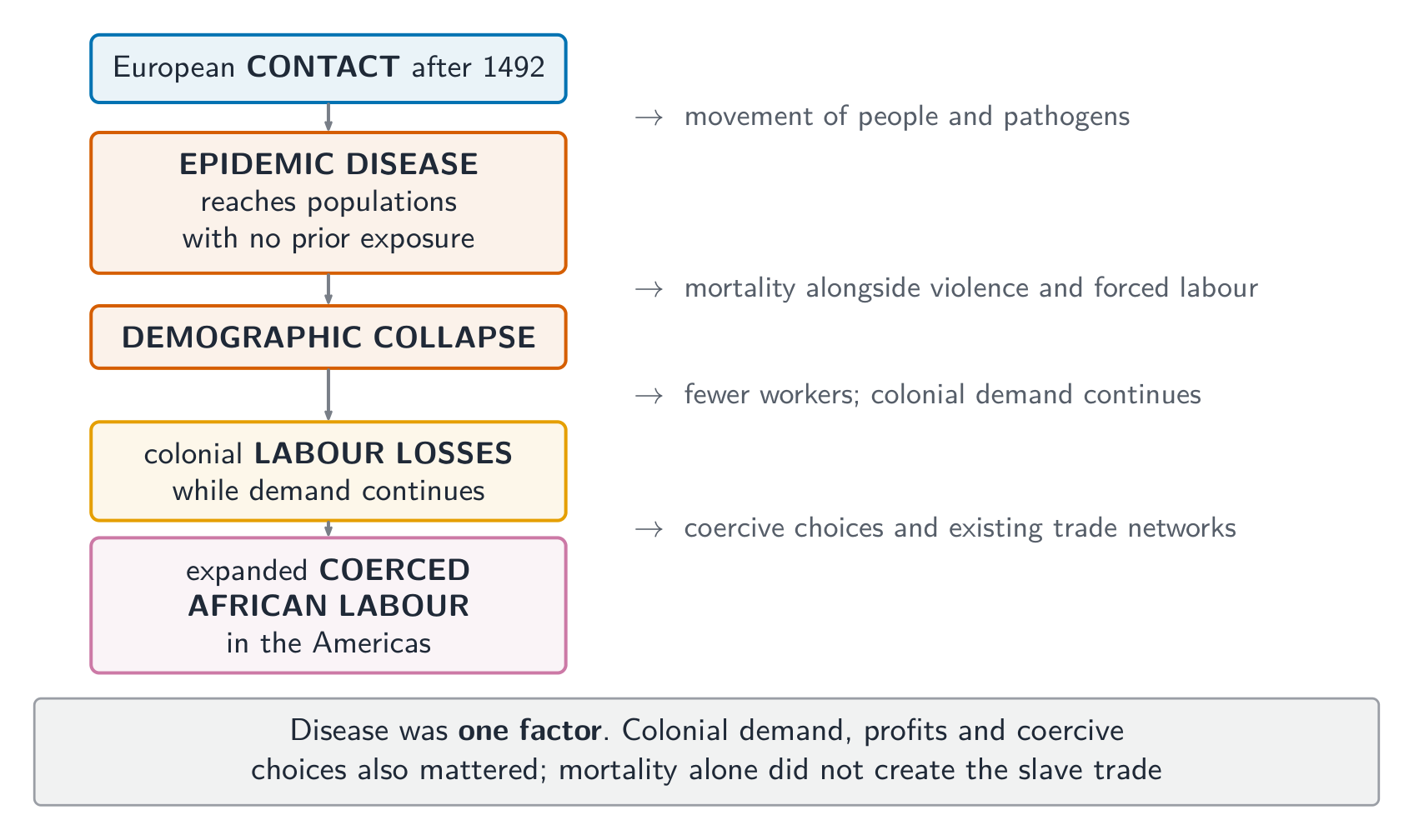
The marks are for the links, not the endpoints: contact carries disease, disease collapses populations, the collapse destroys the encomienda labour supply, and Europeans look elsewhere.
| English |
|---|
| Columbian Exchange/kəˈlʌmbɪən eksˈtʃeɪndʒ/ |
| potato/pəˈteɪtəʊ/ |
| European population growth/ˌjʊərəˈpɪən ˌpɒpjʊˈleɪʃn ɡrəʊθ/ |
| silver/ˈsɪlvə/ |
| epidemic disease/ˌepɪˈdemɪk dɪˈziːz/ |
| demographic collapse/ˌdeməˈɡræfɪk kəˈlæps/ |
| Thematic Focus | Learning Objective | Historical Developments |
|---|---|---|
SOC | Unit 1.E |
|
Source: College Board AP Course and Exam Description
Spanish colonists sought labour for profitable agriculture and mining.
The encomienda system 委托监护制 granted Spanish colonists the right to extract labour from Native American communities to support plantation-based agriculture and mining 采矿. Disease, violence and forced labour reduced Native populations, while colonial demand for workers continued. European traders partnered with some West African groups who practised slavery to forcibly extract enslaved people for the Americas through the Atlantic slave trade 大西洋奴隶贸易. Spanish colonists used enslaved Africans in plantation agriculture and mining. Population loss was one factor; profitable colonial production, coercive decisions and existing trafficking networks also mattered. Do not describe a shortage as making enslavement inevitable, or encomienda as a stage that simply ended before African slavery began.
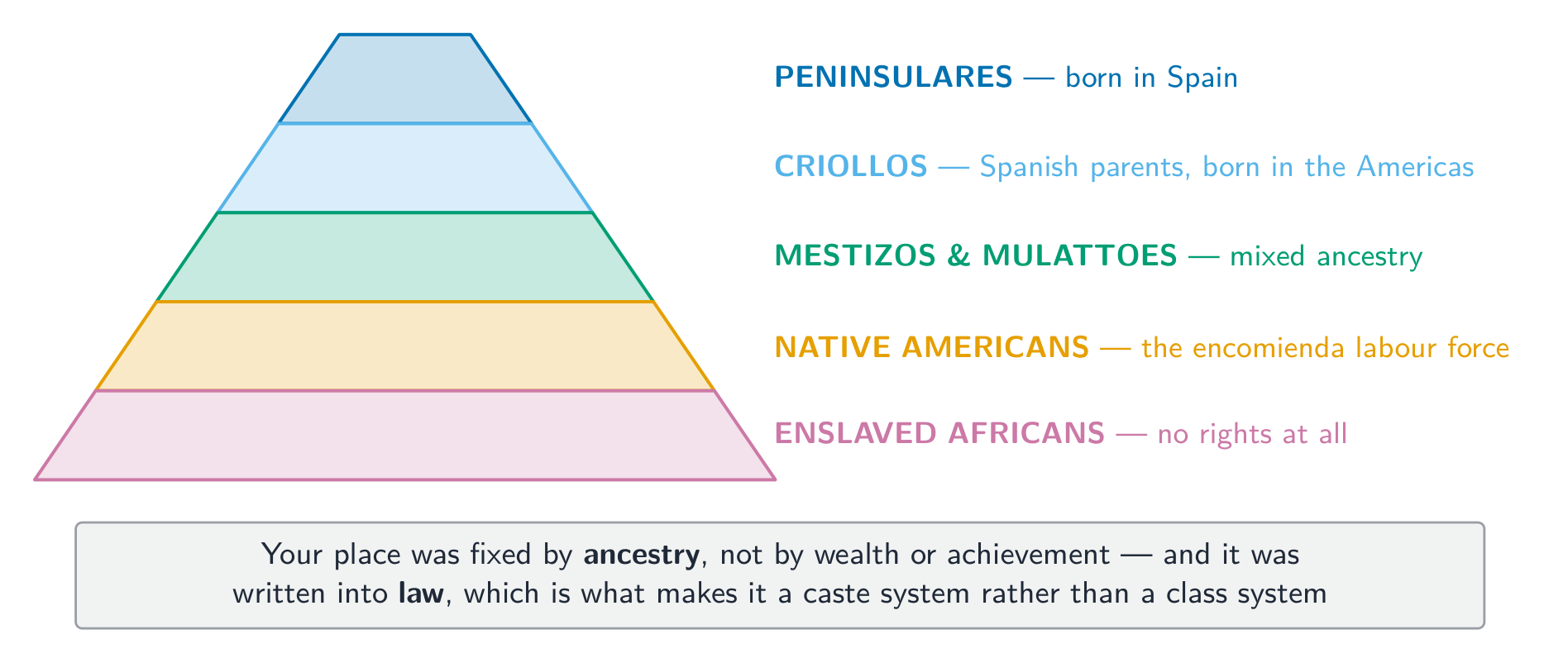
Spain then organised the resulting society formally. The caste system 种姓等级制度 defined the status of every group - Europeans, Native Americans, Africans, and people of mixed ancestry - and fixed rights and obligations by category.
| English |
|---|
| encomienda system/enˌkəʊmɪˈendə ˈsɪstəm/ |
| mining/ˈmaɪnɪŋ/ |
| Atlantic slave trade/ətˈlæntɪk sleɪv treɪd/ |
| caste system/kæst ˈsɪstəm/ |
| Thematic Focus | Learning Objective | Historical Developments |
|---|---|---|
WOR | Unit 1.F |
|
Source: College Board AP Course and Exam Description
Europeans and Native Americans held divergent worldviews 不同的世界观 on religion, gender roles, family, land use, and power. Two ideas about land were especially incompatible: European private property 私有财产 against Native American systems of shared use.
The early years were shaped by mutual misunderstanding 相互误解. As European demands on land and labour grew, Native peoples resisted 抵抗 - through accommodation, alliance, trade, and armed conflict.
Contact also started an argument inside Europe. Extended contact with Native Americans and Africans fostered a debate among European religious and political leaders about how non-Europeans should be treated and what rights they held - a debate that produced justifications for conquest as well as criticisms of it.
| English |
|---|
| divergent worldviews/daɪˈvɜːdʒənt ˈwɜːldvjuːz/ |
| private property/ˈpraɪvət ˈprɒpəti/ |
| mutual misunderstanding/ˈmjuːtʃuːəl mɪˌsʌndəˈstændɪŋ/ |
| resisted/rɪˈzɪstɪd/ |
| Learning Objective | Review: Unit 1 Key Concepts |
|---|---|
Unit 1.G |
|
Source: College Board AP Course and Exam Description
Historical questions can ask you to analyse sources, compare societies, explain causes, describe context 时代背景 or develop an argument. Read the task rather than assuming every question tests the same skill.
Contextualization 情境化 places a development in relevant wider circumstances. Causation 因果关系 explains how and why a development happened. Both require specific knowledge and an explained connection.
Try it — classify and improve the reasoning. Consider these student statements about colonial labour in Spanish America:
| Statement | Student reasoning |
|---|---|
| A | Colonists sought wealth from agriculture and mining. |
| B | Disease killed many Native people; labour demands continued. |
| C | Disease alone created African slavery in the Americas. |
Which statement describes a motive or wider setting? Which begins a causal explanation? Which overclaims? Improve B and C by explaining colonial demand, coercive choices and trade networks.
Worked reasoning. A gives an economic setting and motive. B begins to connect population loss with pressure on the labour supply, but needs a further link: colonists still demanded workers for agriculture and mining. C removes human choices and other causes. European traders and colonists forcibly obtained and exploited enslaved Africans through existing networks to serve colonial production. Disease was one factor, alongside violence and forced labour; it did not alone create the trade. Explaining these choices does not justify them.
Transfer — more than one reasoning process. Compare the Southwest and the Great Basin before contact. Give one difference in livelihood, connect it to an environmental condition, and avoid saying that all Native societies were the same.
Worked answer. In the Southwest, maize agriculture and irrigation supported permanent settlements. In the Great Basin, arid conditions encouraged mobile hunting and gathering. This compares different adaptations and explains a connection to environment; it is not simply a list of dates. Local societies varied within each regional grouping.
Exam-linked practice — contextualization. The 2023 Set 1 long essay, Question 2, asks students to evaluate change from transatlantic trade in British North American colonial society during 1607–1776 (paraphrased). We practise only its context requirement here, not a complete essay.
A student opens with: "Europeans travelled across the ocean. Many things happened before 1607." Explain why this lacks useful context. Then write a short opening that connects earlier Spanish colonization, the search for wealth and later English colonial investment.
Teacher-written model. Before English settlement at Jamestown, Spanish colonization had brought American resources into European commerce. Profits from earlier colonies encouraged other European powers to pursue American settlements and trade. This competition helps explain the setting in which British colonial society became tied to Atlantic commerce.
Why the revision helps. It describes a wider development and explains its relevance. An earlier date or a passing name alone is insufficient. This is an illustrative response guided by the official rubric, not an official sample or a guaranteed point. A full essay must also make a defensible claim about the specified period and support it with relevant evidence; earlier Spanish context cannot replace that evidence.
Grounding. Course content follows CED Topics 1.3–1.5 and historical thinking skills 4–6. The exam connection is 2023 Set 1 LEQ2, official scoring guidelines, contextualization row. The distinction between earlier African trafficking and later American colonial demand is supported by the Smithsonian National Museum of African American History and Culture.
| English |
|---|
| causation/kɔːˈseɪʃn/ |
| context/ˈkɒntekst/ |
| Contextualization/kənˌtekstʃuːəlaɪˈzeɪʃn/ |
Work through it step by step, with instant-check exercises.
Loading subjects…