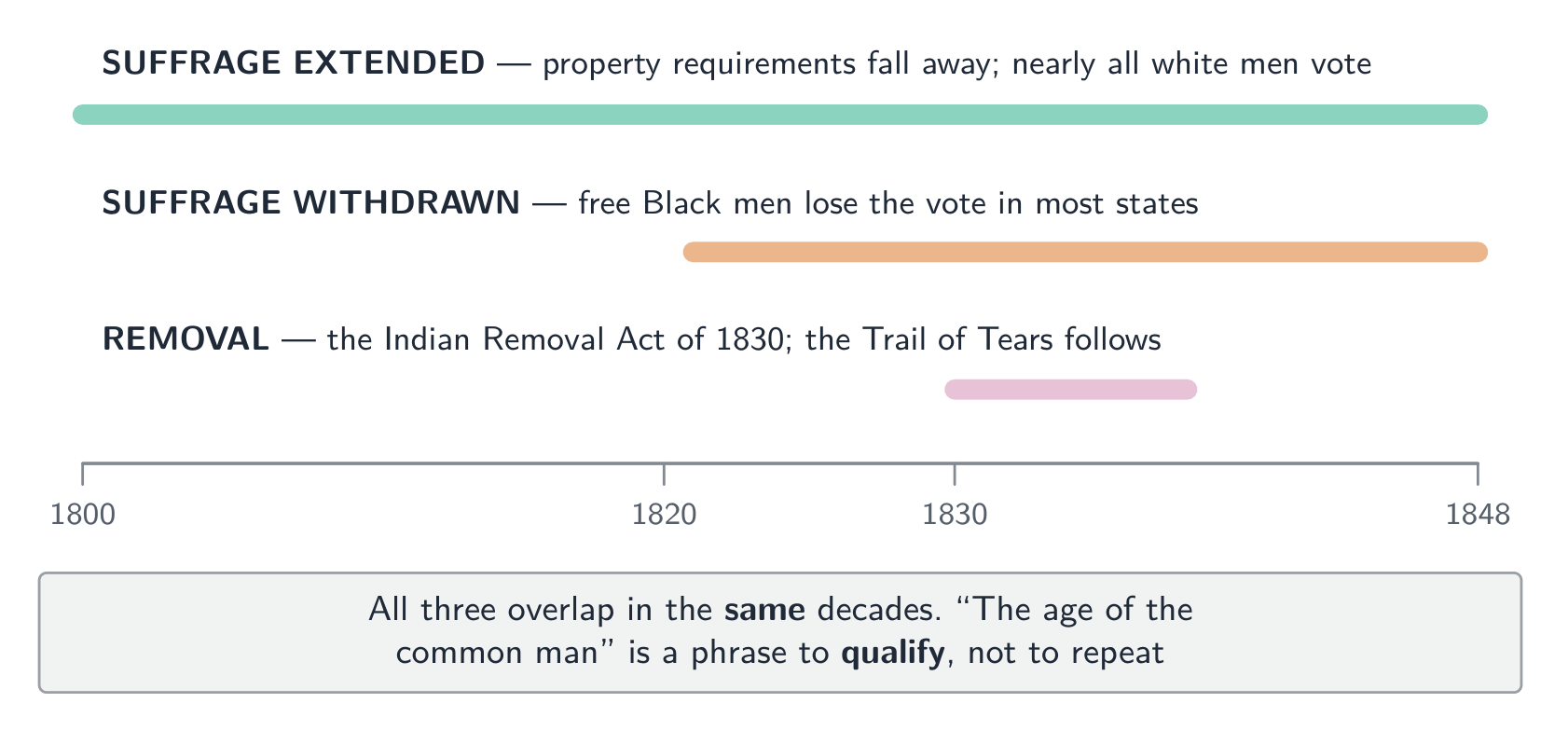
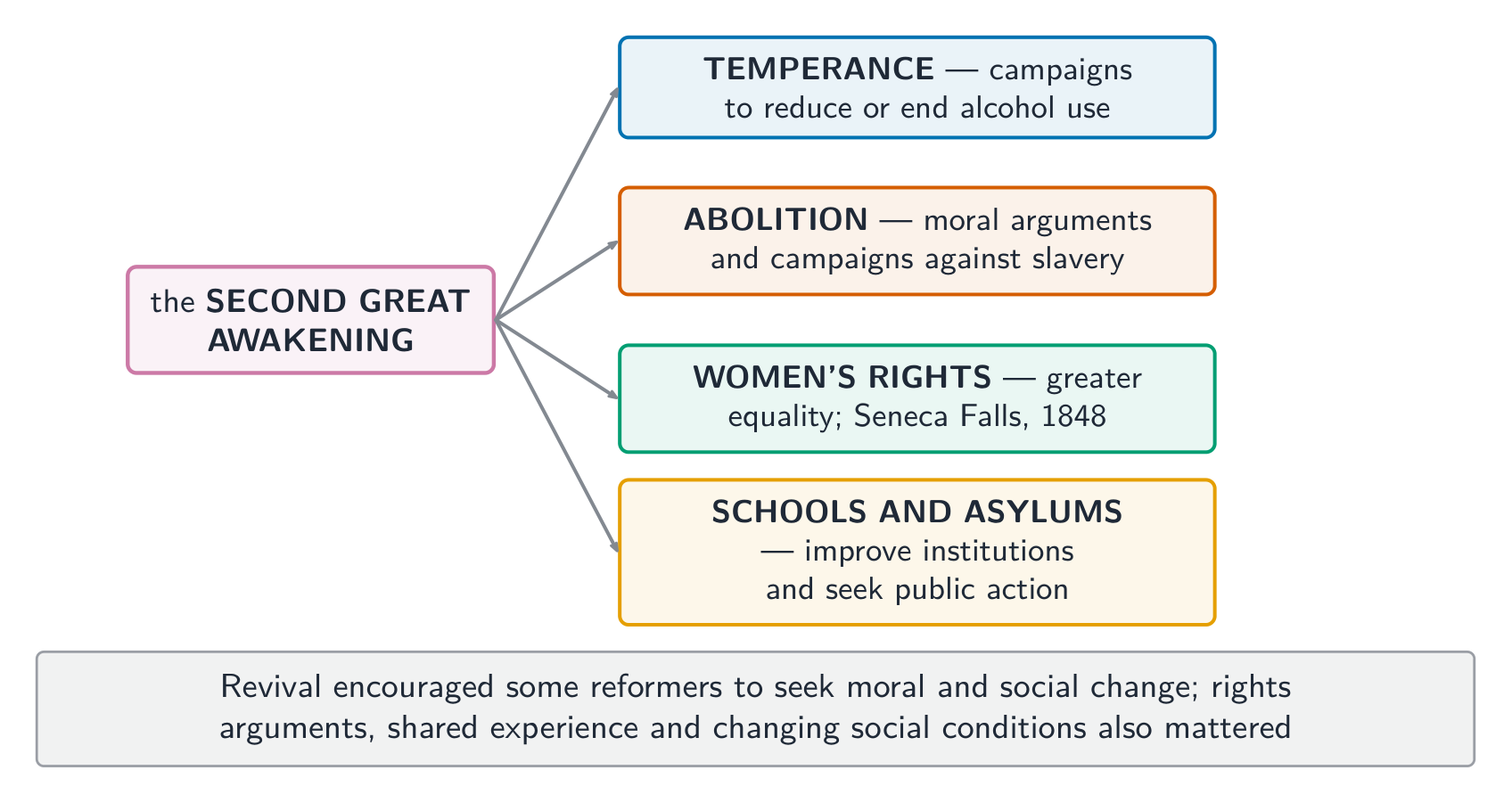
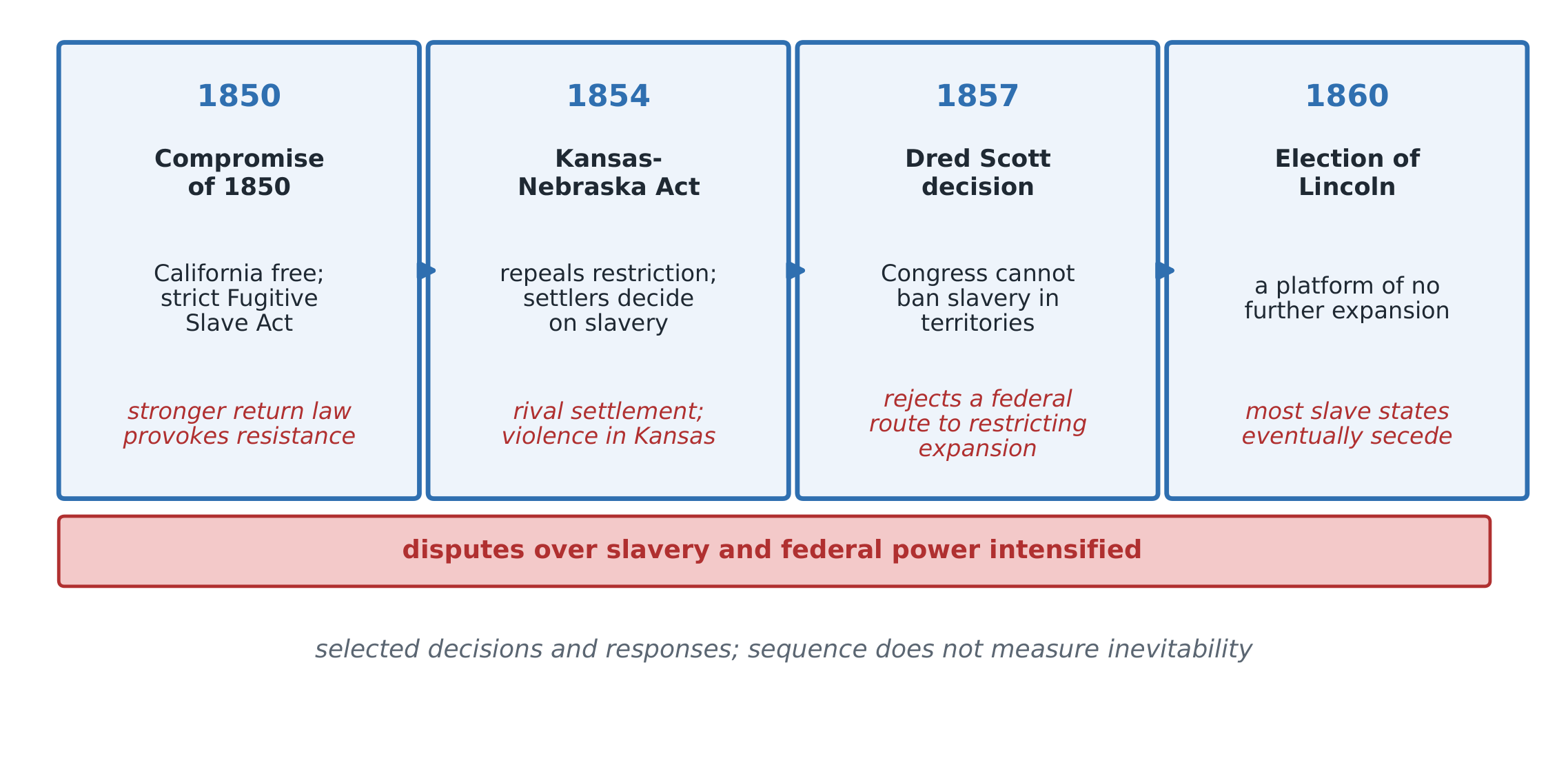
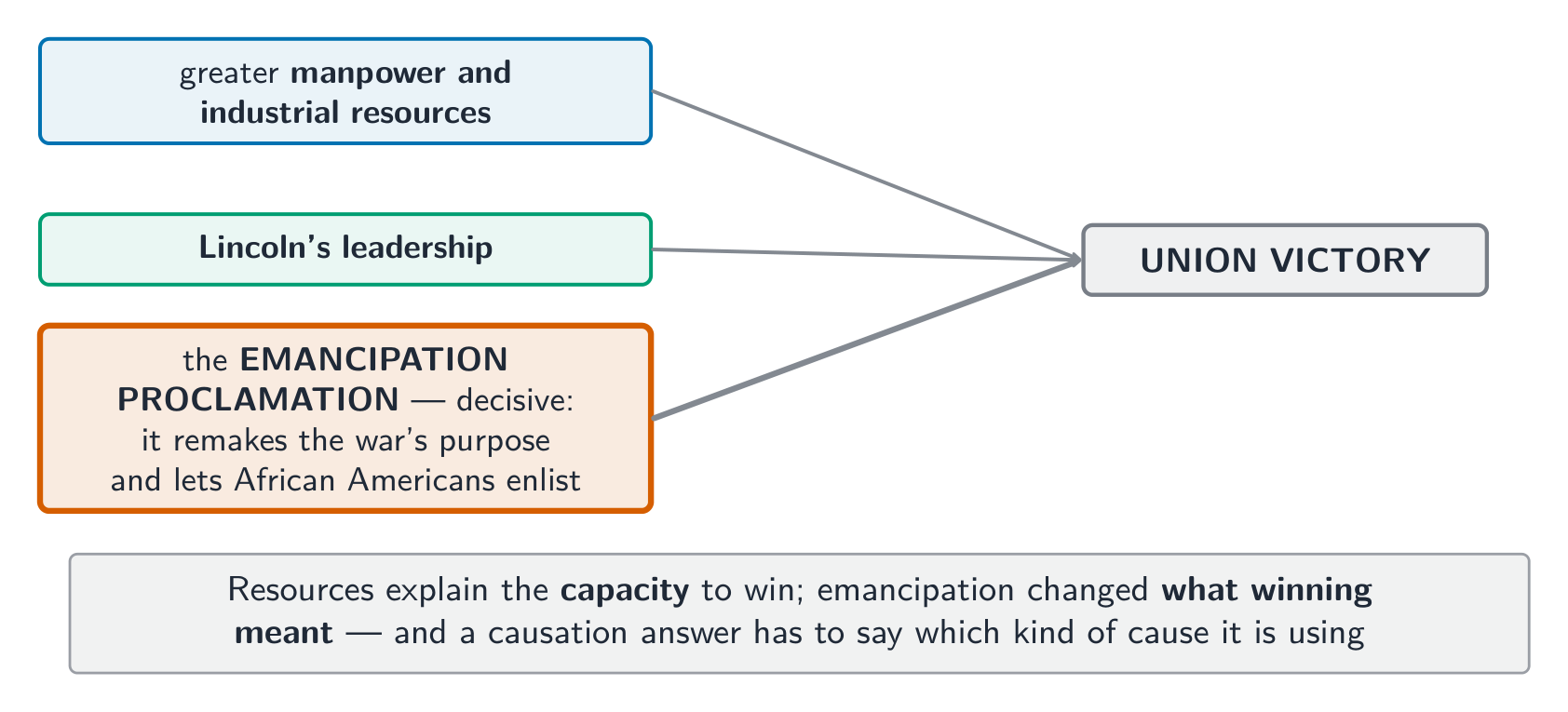
Skip to content
Subjects

AP United States History

Tips

AP United States History runs through nine chronological periods, from the societies of North America before 1491 to the present day. Each period is framed by the same thematic focus strands - geography and the environment, migration and settlement, politics and power, work and technology, American and national identity, America in the world, and social structures.

This is a course in argument, not memory. The knowledge you need is real, but questions ask you to *explain* - why a development happened, what changed and what stayed the same, how one thing caused another. A date recalled correctly earns nothing on its own.

Learn each period's story as a chain, not a list. The exam rewards students who can say what a development grew out of and what it led to. That is why every period ends with a topic on causation, comparison, or continuity and change.

Practise writing with evidence. Free-response answers are built from specific, named evidence and a clear line of reasoning, and the written sections carry the same skills a first-year college history course expects.

The notes below follow the College Board framework period by period, with the key concepts each topic is built on.
  • 1

    Period 1: 1491–1607

    1.1 1.2

    Native American Societies Before Contact

    Syllabus

    1.1 Contextualizing Period 1

    Learning ObjectivePreview: Unit 1 Key Concepts

    Unit 1.A
    Explain the context for European encounters in the Americas from 1491 to 1607.

    • KC-1.1 As native populations migrated and settled across the vast expanse of North America over time, they developed distinct and increasingly complex societies by adapting to and transforming their diverse environments.
      • KC-1.1.I Different native societies adapted to and transformed their environments through innovations in agriculture, resource use, and social structure.
    • KC-1.2 Contact among Europeans, Native Americans, and Africans resulted in the Columbian Exchange and significant social, cultural, and political changes on both sides of the Atlantic Ocean.
      • KC-1.2.I European expansion into the Western Hemisphere generated intense social, religious, political, and economic competition and changes within European societies.
      • KC-1.2.II The Columbian Exchange and development of the Spanish Empire in the Western Hemisphere resulted in extensive demographic, economic, and social changes.
      • KC-1.2.III In their interactions, Europeans and Native Americans asserted divergent worldviews regarding issues such as religion, gender roles, family, land use, and power.

    1.2 Native American Societies Before European Contact

    Thematic FocusLearning ObjectiveHistorical Developments

    GEO
    Geography and the Environment — Geographic and environmental factors, including competition over and debates about natural resources, shape the development of America and foster regional diversity. The development of America impacts the environment and reshapes geography, which leads to debates about environmental and geographic issues.

    Unit 1.B
    Explain how and why various native populations in the period before European contact interacted with the natural environment in North America.

    • KC-1.1.I.A The spread of maize cultivation from present-day Mexico northward into the present-day American Southwest and beyond supported economic development, settlement, advanced irrigation, and social diversification among societies.
    • KC-1.1.I.B Societies responded to the aridity of the Great Basin and the grasslands of the western Great Plains by developing largely mobile lifestyles.
    • KC-1.1.I.C In the Northeast, the Mississippi River Valley, and along the Atlantic seaboard, some societies developed mixed agricultural and hunter-gatherer economies that favored the development of permanent villages.
    • KC-1.1.I.D Societies in the Northwest and present-day California supported themselves by hunting and gathering, and in some areas developed settled communities supported by the vast resources of the ocean.

    Source: College Board AP Course and Exam Description

    Period 1 runs from 1491 to 1607 - from the eve of European contact to the founding of Jamestown. It exists to explain what the Americas were like before Europeans arrived, and what happened when three worlds met.

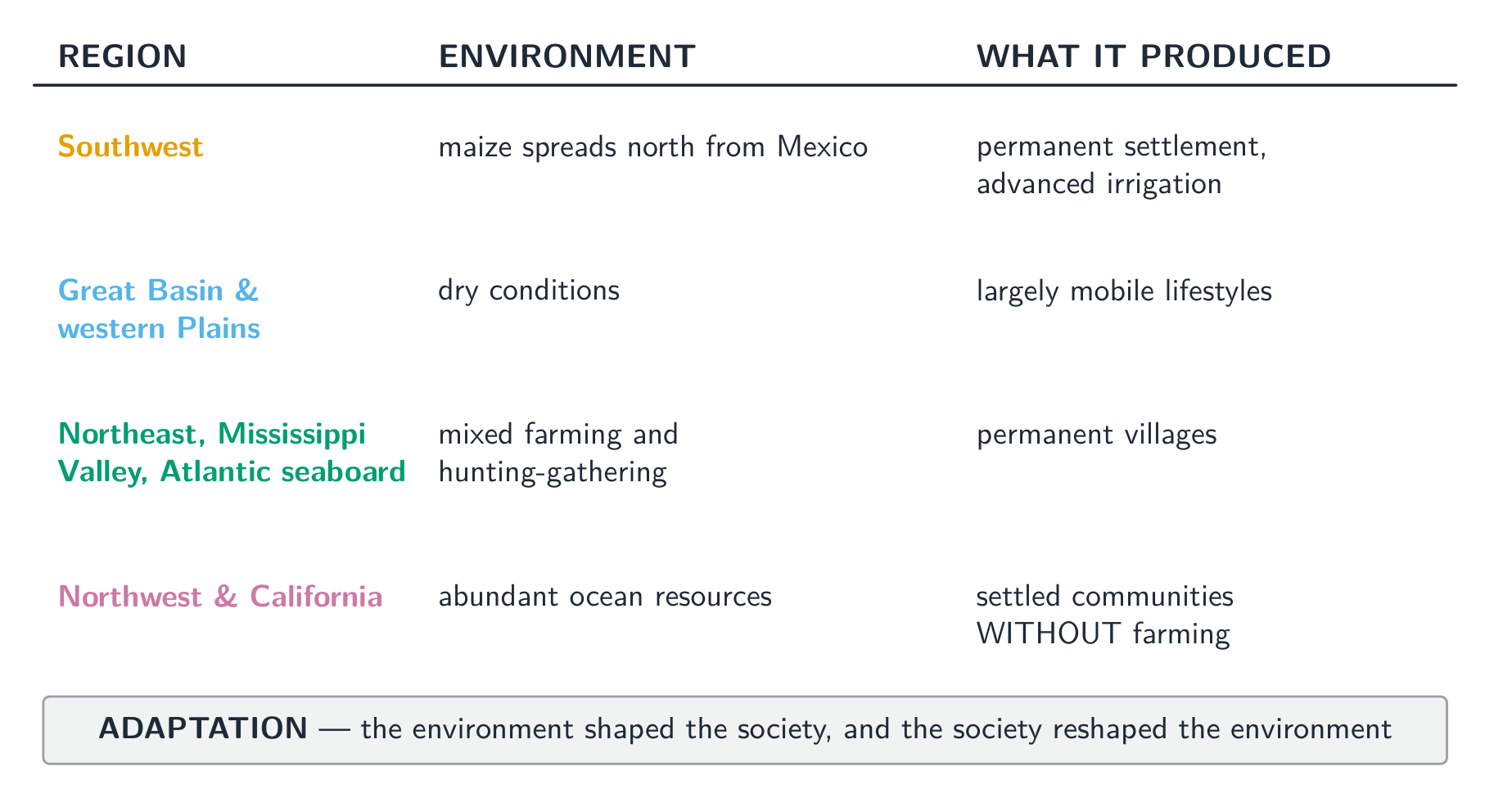
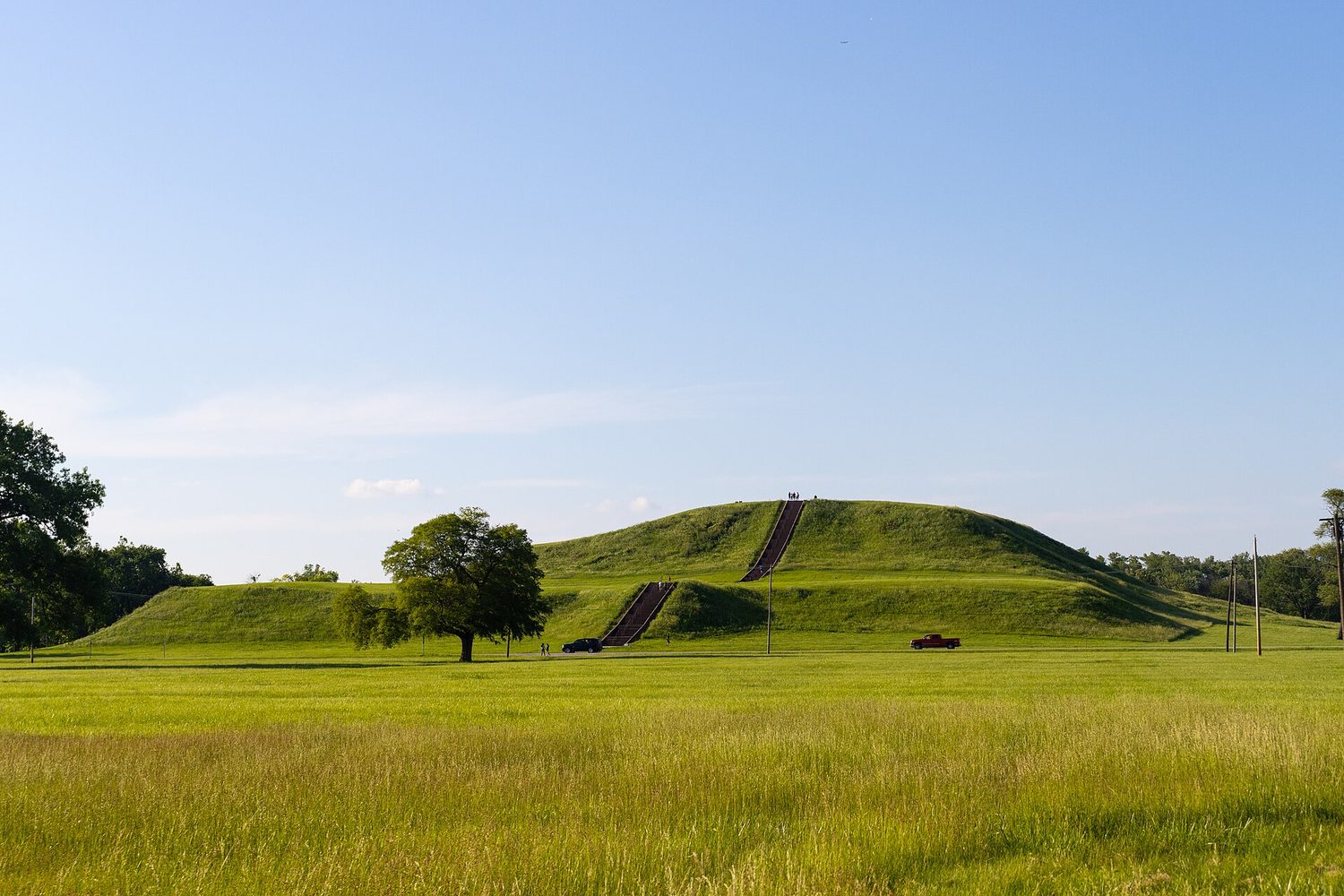
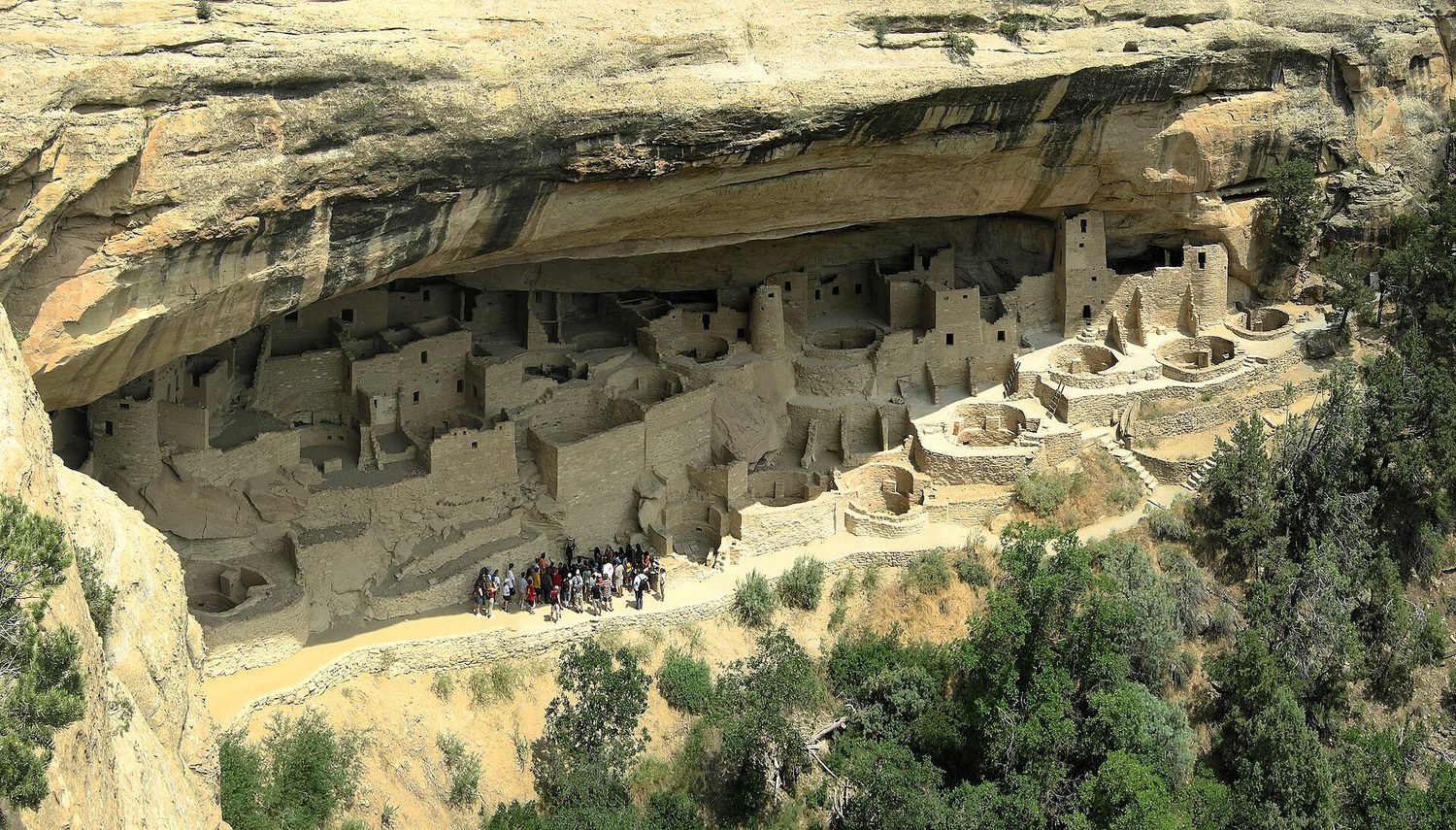
    North America in 1491 held hundreds of distinct societies. They differed because they adapted to different environments, and the CED groups them by region:

    • In the Southwest, the spread of maize 玉米 cultivation northward from present-day Mexico supported permanent settlement, advanced irrigation 先进灌溉, and greater social complexity.
    • In the Great Basin and the western Great Plains, dry conditions produced largely mobile lifestyles 流动性生活方式.
    • In the Northeast, the Mississippi River Valley, and along the Atlantic seaboard, societies developed mixed agricultural and hunter-gatherer economies 农业与狩猎采集混合经济, which favoured permanent villages.
    • In the Northwest and present-day California, abundant ocean resources allowed settled communities without farming.

    The pattern to hold on to is adaptation 适应: the environment shaped the society, and the society reshaped the environment.
    Vocabulary Train
    English Chinese Pinyin
    maize 玉米 yù mǐ
    advanced irrigation 先进灌溉 xiān jìn guàn gài
    mobile lifestyles 流动性生活方式 liú dòng xìng shēng huó fāng shì
    mixed agricultural and hunter-gatherer economies 农业与狩猎采集混合经济 nóng yè yǔ shòu liè cǎi jí hùn hé jīng jì
    adaptation 适应 shì yìng
    1.3

    Why Europeans Crossed the Atlantic

    Syllabus

    1.3 European Exploration in the Americas

    Thematic FocusLearning ObjectiveHistorical Developments

    WOR
    America in the World — Diplomatic, economic, cultural, and military interactions between empires, nations, and peoples shape the development of America and America’s increasingly important role in the world.

    Unit 1.C
    Explain the causes of exploration and conquest of the New World by various European nations.

    • KC-1.2.I.A European nations’ efforts to explore and conquer the New World stemmed from a search for new sources of wealth, economic and military competition, and a desire to spread Christianity.

    Source: College Board AP Course and Exam Description

    European exploration was driven by a search for new sources of wealth 新的财富来源, expanded trade routes, and the spread of Christianity 基督教. Spain and Portugal moved first, and Spain's American empire followed.

    Two changes made the voyages possible: improvements in maritime technology 航海技术, and more organised methods of financing trade, especially the joint-stock company 股份公司, which spread the risk of a voyage across many investors.

    Vocabulary Train
    English Chinese Pinyin
    new sources of wealth 新的财富来源 xīn de cái fù lái yuán
    Christianity 基督教 jī dū jiào
    maritime technology 航海技术 háng hǎi jì shù
    joint-stock company 股份公司 gǔ fèn gōng sī
    1.4

    The Columbian Exchange

    Syllabus

    1.4 Columbian Exchange, Spanish Exploration, and Conquest

    Thematic FocusLearning ObjectiveHistorical Developments

    GEO
    Geography and the Environment — Geographic and environmental factors, including competition over and debates about natural resources, shape the development of America and foster regional diversity. The development of America impacts the environment and reshapes geography, which leads to debates about environmental and geographic issues.

    Unit 1.D
    Explain causes of the Columbian Exchange and its effect on Europe and the Americas during the period after 1492.

    • KC-1.2.I.B The Columbian Exchange brought new crops to Europe from the Americas, stimulating European population growth, and new sources of mineral wealth, which facilitated the European shift from feudalism to capitalism.
    • KC-1.2.I.C Improvements in maritime technology and more organized methods for conducting international trade, such as joint-stock companies, helped drive changes to economies in Europe and the Americas.
    • KC-1.2.II.A Spanish exploration and conquest of the Americas were accompanied and furthered by widespread deadly epidemics that devastated native populations and by the introduction of crops and animals not found in the Americas.

    Source: College Board AP Course and Exam Description

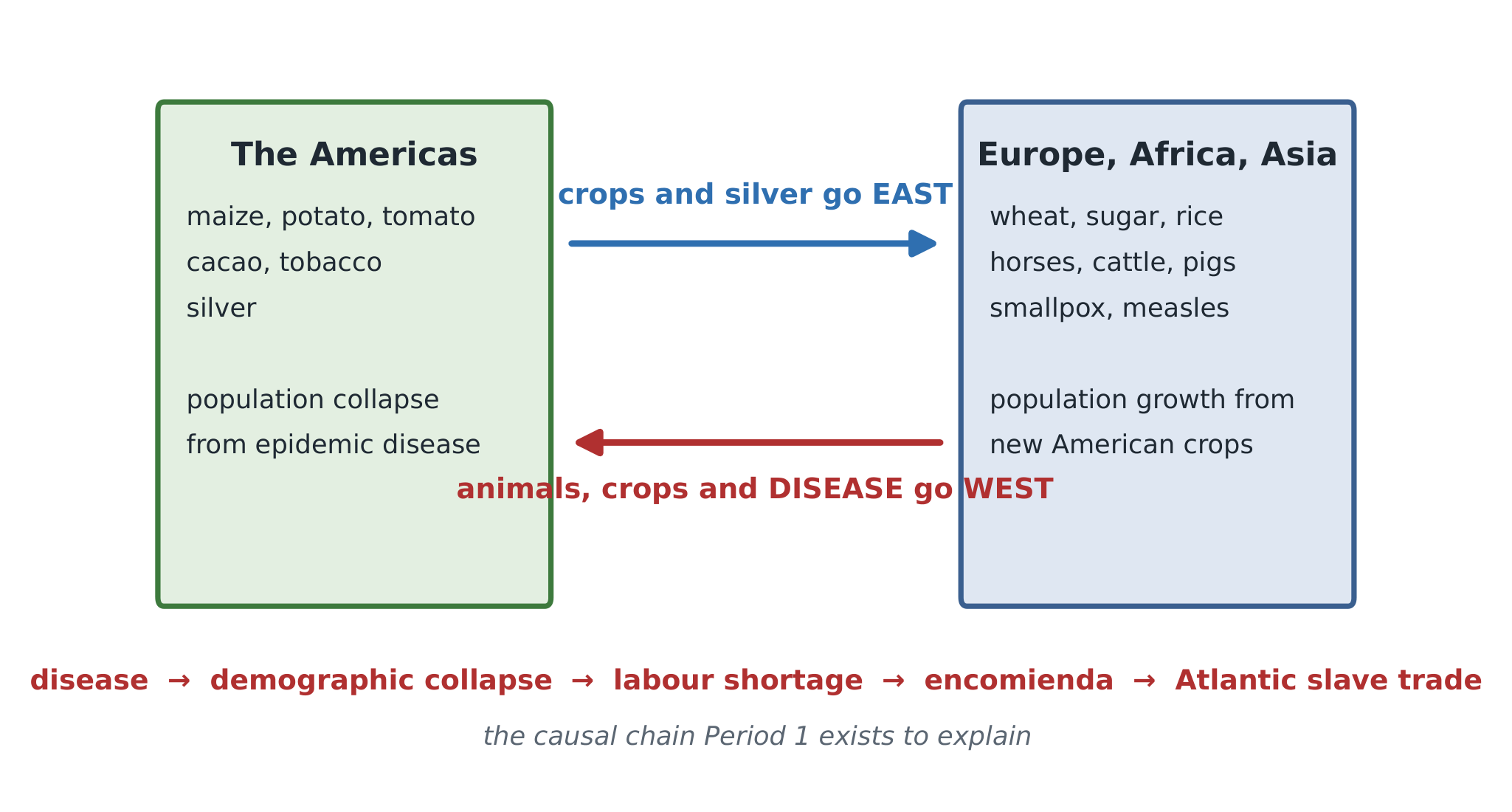
    The Columbian Exchange: crops and precious metals moving east, animals, crops and disease moving west
    The Columbian Exchange moved crops, animals, people and disease in both directions, with very different consequences on each side

    The Columbian Exchange 哥伦布大交换 is the transfer of plants, animals, people, and diseases between the Americas and the rest of the world. It is the single most important development of Period 1, because almost everything else follows from it.

    Moving east to Europe: American crops such as maize and the potato 马铃薯 raised nutrition and helped drive European population growth 欧洲人口增长. American silver 白银 reshaped global trade.

    Moving west to the Americas: European animals, crops, and - decisively - epidemic disease 流行病. Populations with no prior exposure suffered catastrophic mortality, and this demographic collapse 人口锐减 accompanied and enabled Spanish conquest.
    Vocabulary Train
    English Chinese Pinyin
    Columbian Exchange 哥伦布大交换 gē lún bù dà jiāo huàn
    potato 马铃薯 mǎ líng shǔ
    European population growth 欧洲人口增长 ōu zhōu rén kǒu zēng zhǎng
    silver 白银 bái yín
    epidemic disease 流行病 liú xíng bìng
    demographic collapse 人口锐减 rén kǒu ruì jiǎn
    1.5

    Labour, Slavery, and Caste in Spanish America

    Syllabus

    1.5 Labor, Slavery, and Caste in the Spanish Colonial System

    Thematic FocusLearning ObjectiveHistorical Developments

    SOC
    Social Structures — Social categories, roles, and practices are created, maintained, challenged, and transformed throughout American history, shaping government policy, economic systems, culture, and the lives of citizens.

    Unit 1.E
    Explain how the growth of the Spanish Empire in North America shaped the development of social and economic structures over time.

    • KC-1.2.II.B In the encomienda system, Spanish colonial economies marshaled Native American labor to support plantation-based agriculture and extract precious metals and other resources.
    • KC-1.2.II.C European traders partnered with some West African groups who practiced slavery to forcibly extract enslaved laborers for the Americas. The Spanish imported enslaved Africans to labor in plantation agriculture and mining.
    • KC-1.2.II.D The Spanish developed a caste system that incorporated, and carefully defined the status of, the diverse population of Europeans, Africans, and Native Americans in their empire.

    Source: College Board AP Course and Exam Description

    Spain built an economy that needed labour it did not have.

    The encomienda system 委托监护制 granted Spanish colonists the right to extract labour from Native American communities to support plantation-based agriculture and mining 采矿. When that labour collapsed with the population, Europeans turned elsewhere: traders partnered with some West African groups who already practised slavery to forcibly extract enslaved people, beginning the Atlantic slave trade 大西洋奴隶贸易.

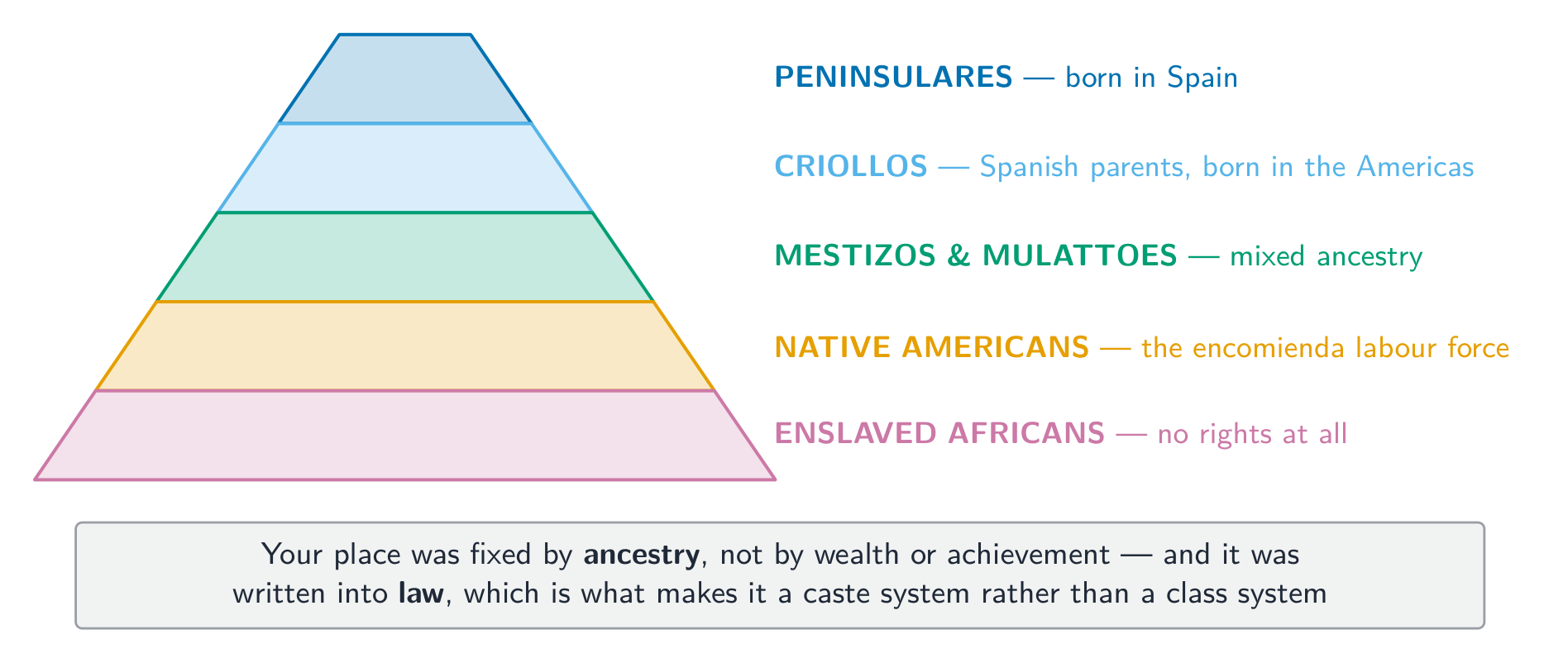
    Spain then organised the resulting society formally. The caste system 种姓等级制度 defined the status of every group - Europeans, Native Americans, Africans, and people of mixed ancestry - and fixed rights and obligations by category.

    Vocabulary Train
    English Chinese Pinyin
    encomienda system 委托监护制 wěi tuō jiān hù zhì
    mining 采矿 cǎi kuàng
    Atlantic slave trade 大西洋奴隶贸易 dà xī yáng nú lì mào yì
    caste system 种姓等级制度 zhǒng xìng děng jí zhì dù
    1.6

    Worldviews in Conflict

    Syllabus

    1.6 Cultural Interactions Between Europeans, Native Americans, and Africans

    Thematic FocusLearning ObjectiveHistorical Developments

    WOR
    America in the World — Diplomatic, economic, cultural, and military interactions between empires, nations, and peoples shape the development of America and America’s increasingly important role in the world.

    Unit 1.F
    Explain how and why European and Native American perspectives of others developed and changed in the period.

    • KC-1.2.III In their interactions, Europeans and Native Americans asserted divergent worldviews regarding issues such as religion, gender roles, family, land use, and power.
    • KC-1.2.III.A Mutual misunderstandings between Europeans and Native Americans often defined the early years of interaction and trade as each group sought to make sense of the other. Over time, Europeans and Native Americans adopted some useful aspects of each other’s culture.
    • KC-1.2.III.B As European encroachments on Native Americans’ lands and demands on their labor increased, native peoples sought to defend and maintain their political sovereignty, economic prosperity, religious beliefs, and concepts of gender relations through diplomatic negotiations and military resistance.
    • KC-1.2.III.C Extended contact with Native Americans and Africans fostered a debate among European religious and political leaders about how non-Europeans should be treated, as well as evolving religious, cultural, and racial justifications for the subjugation of Africans and Native Americans.

    Source: College Board AP Course and Exam Description

    Europeans and Native Americans held divergent worldviews 不同的世界观 on religion, gender roles, family, land use, and power. Two ideas about land were especially incompatible: European private property 私有财产 against Native American systems of shared use.

    The early years were shaped by mutual misunderstanding 相互误解. As European demands on land and labour grew, Native peoples resisted 抵抗 - through accommodation, alliance, trade, and armed conflict.

    Contact also started an argument inside Europe. Extended contact with Native Americans and Africans fostered a debate among European religious and political leaders about how non-Europeans should be treated and what rights they held - a debate that produced justifications for conquest as well as criticisms of it.

    Vocabulary Train
    English Chinese Pinyin
    divergent worldviews 不同的世界观 bù tóng de shì jiè guān
    private property 私有财产 sī yǒu cái chǎn
    mutual misunderstanding 相互误解 xiāng hù wù jiě
    resisted 抵抗 dǐ kàng
    1.7

    Thinking Like a Historian in Period 1

    Syllabus

    1.7 Causation in Period 1

    Learning ObjectiveReview: Unit 1 Key Concepts

    Unit 1.G
    Explain the effects of the development of transatlantic voyages from 1491 to 1607.

    • KC-1.1 As native populations migrated and settled across the vast expanse of North America over time, they developed distinct and increasingly complex societies by adapting to and transforming their diverse environments.
      • KC-1.1.I Different native societies adapted to and transformed their environments through innovations in agriculture, resource use, and social structure.
    • KC-1.2 Contact among Europeans, Native Americans, and Africans resulted in the Columbian Exchange and significant social, cultural, and political changes on both sides of the Atlantic Ocean.
      • KC-1.2.I European expansion into the Western Hemisphere generated intense social, religious, political, and economic competition and changes within European societies.
      • KC-1.2.II The Columbian Exchange and development of the Spanish Empire in the Western Hemisphere resulted in extensive demographic, economic, and social changes.
      • KC-1.2.III In their interactions, Europeans and Native Americans asserted divergent worldviews regarding issues such as religion, gender roles, family, land use, and power.

    Source: College Board AP Course and Exam Description

    Every AP question about Period 1 is really a question about causation 因果关系 or context 时代背景.

    • Contextualization 情境化 means placing a development in the broader circumstances that produced it. Period 1 supplies the context for almost every later question about colonisation.
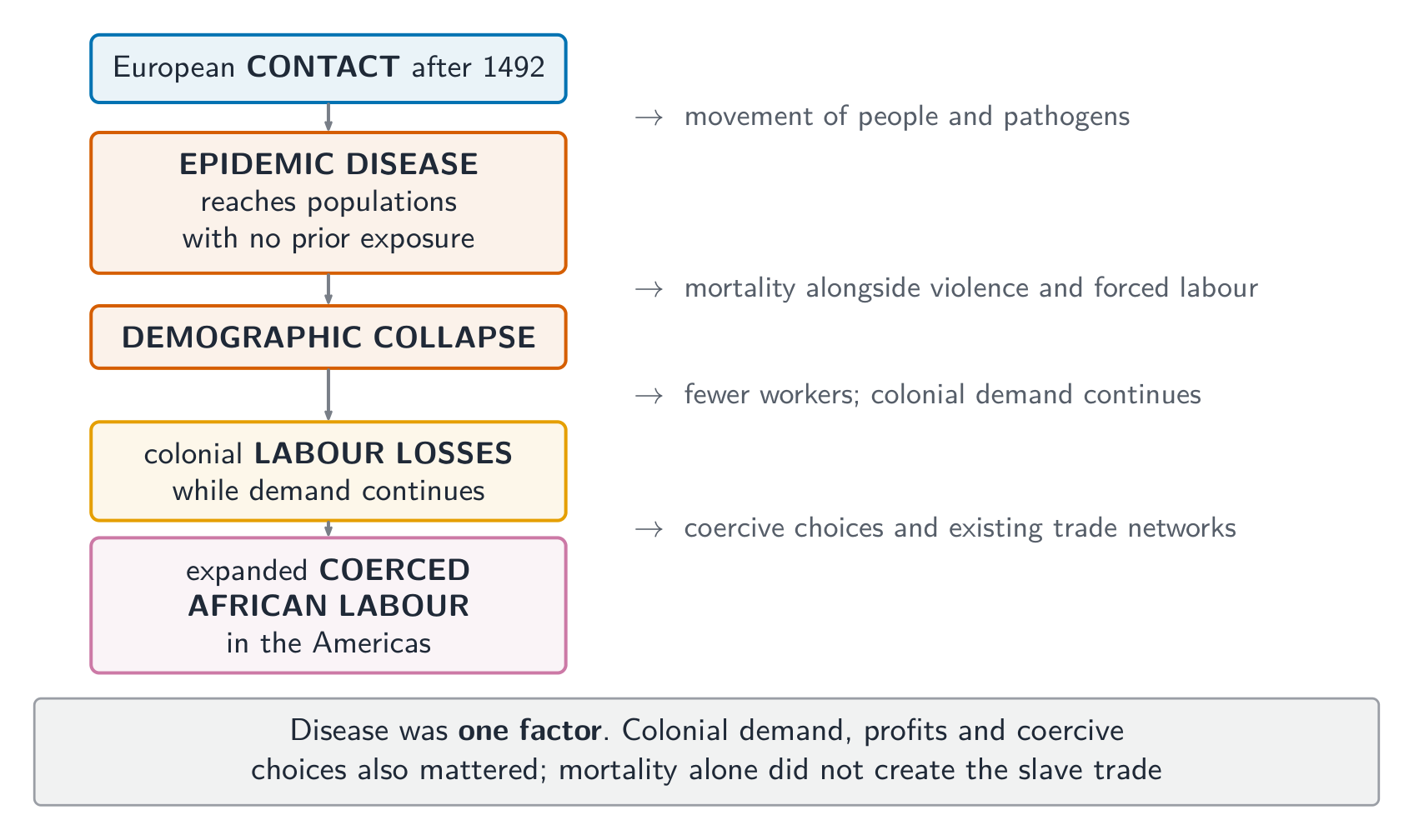
    • Causation asks what produced a change and what followed from it. The Columbian Exchange is the clearest chain in the whole course: disease caused demographic collapse, which caused a labour shortage, which drove the Atlantic slave trade.

    Worked example (a real AP exam question). The 2023 exam set the long essay "Evaluate the extent to which the growth of transatlantic trade changed British North American colonial society." Period 1 is not the answer to this question, but it earns the contextualization point that opens it: "Transatlantic trade grew out of the Columbian Exchange begun after 1492, which linked the Americas, Europe and West Africa in a single Atlantic system and established the plantation agriculture and coerced labour that later colonial trade depended on." Notice the shape: Evaluate the extent to which wants a thesis that takes a position on how much, and the context sentence must connect to the prompt rather than simply describe an earlier period. A paragraph of unconnected background earns nothing.

    Vocabulary Train
    English Chinese Pinyin
    causation 因果关系 yīn guǒ guān xì
    context 时代背景 shí dài bèi jǐng
    Contextualization 情境化 qíng jìng huà
    1.7

    Exam tips

    • Period 1 is short but supplies context for later questions. Learn it as the origin of the Atlantic system, not as a list of dates.
    • The strongest causal chain to memorise: disease → demographic collapse → labour shortage → encomienda → Atlantic slave trade.
    • Name specific regions when describing Native societies. "Native Americans farmed" is too general; the Southwest, Great Basin, Northeast, and Northwest each had a distinct adaptation.
    • Keep the Columbian Exchange two-directional. Answers that only describe what Europe gained miss half the concept.
    • Encomienda is a labour system, not a land grant, and the Spanish caste system is a social hierarchy defined by ancestry.
    • For any prompt, identify the task verb first: describe, explain, compare, or evaluate the extent. Each earns points differently.
  • 2

    Period 2: 1607–1754

    2.1 2.2

    Four Colonizers, Four Strategies

    Syllabus

    2.1 Contextualizing Period 2

    Learning ObjectivePreview: Unit 2 Key Concepts

    Unit 2.A
    Explain the context for the colonization of North America from 1607 to 1754.

    • KC-2.1 Europeans developed a variety of colonization and migration patterns, influenced by different imperial goals, cultures, and the varied North American environments where they settled. They competed with each other and American Indians for resources.
      • KC-2.1.I Spanish, French, Dutch, and British colonizers had different economic and imperial goals involving land and labor that shaped the social and political development of their colonies as well as their relationships with native populations.
      • KC-2.1.II In the 17th century, early British colonies developed along the Atlantic coast, with regional differences that reflected various environmental, economic, cultural, and demographic factors.
      • KC-2.1.III Competition over resources between European rivals and American Indians encouraged industry and trade and led to conflict in the Americas.
    • KC-2.2 The British colonies participated in political, social, cultural, and economic exchanges with Great Britain that encouraged both stronger bonds with Britain and resistance to Britain’s control.
      • KC-2.2.I Transatlantic commercial, religious, philosophical, and political exchanges led residents of the British colonies to evolve in their political and cultural attitudes as they became increasingly tied to Britain and one another.
      • KC-2.2.II Like other European empires in the Americas that participated in the Atlantic slave trade, the English colonies developed a system of slavery that reflected the specific economic, demographic, and geographic characteristics of those colonies.

    2.2 European Colonization

    Thematic FocusLearning ObjectiveHistorical Developments

    MIG
    Migration and Settlement — Push and pull factors shape immigration to and migration within America, and the demographic change as a result of these moves shapes the migrants, society, and the environment.

    Unit 2.B
    Explain how and why various European colonies developed and expanded from 1607 to 1754.

    • KC-2.1.I.A Spanish efforts to extract wealth from the land led them to develop institutions based on subjugating native populations, converting them to Christianity, and incorporating them, along with enslaved and free Africans, into Spanish colonial society.
    • KC-2.1.I.B French and Dutch colonial efforts involved relatively few Europeans and relied on trade alliances and intermarriage with American Indians to build economic and diplomatic relationships and acquire furs and other products for export to Europe.
    • KC-2.1.I.C English colonization efforts attracted a comparatively large number of male and female British migrants, as well as other European migrants, all of whom sought social mobility, economic prosperity, religious freedom, and improved living conditions. These colonists focused on agriculture and settled on land taken from Native Americans, from whom they lived separately.

    Source: College Board AP Course and Exam Description

    Period 2 runs from 1607 to 1754 - from Jamestown to the eve of the Seven Years' War. Its central question is why European colonies turned out so differently from one another.

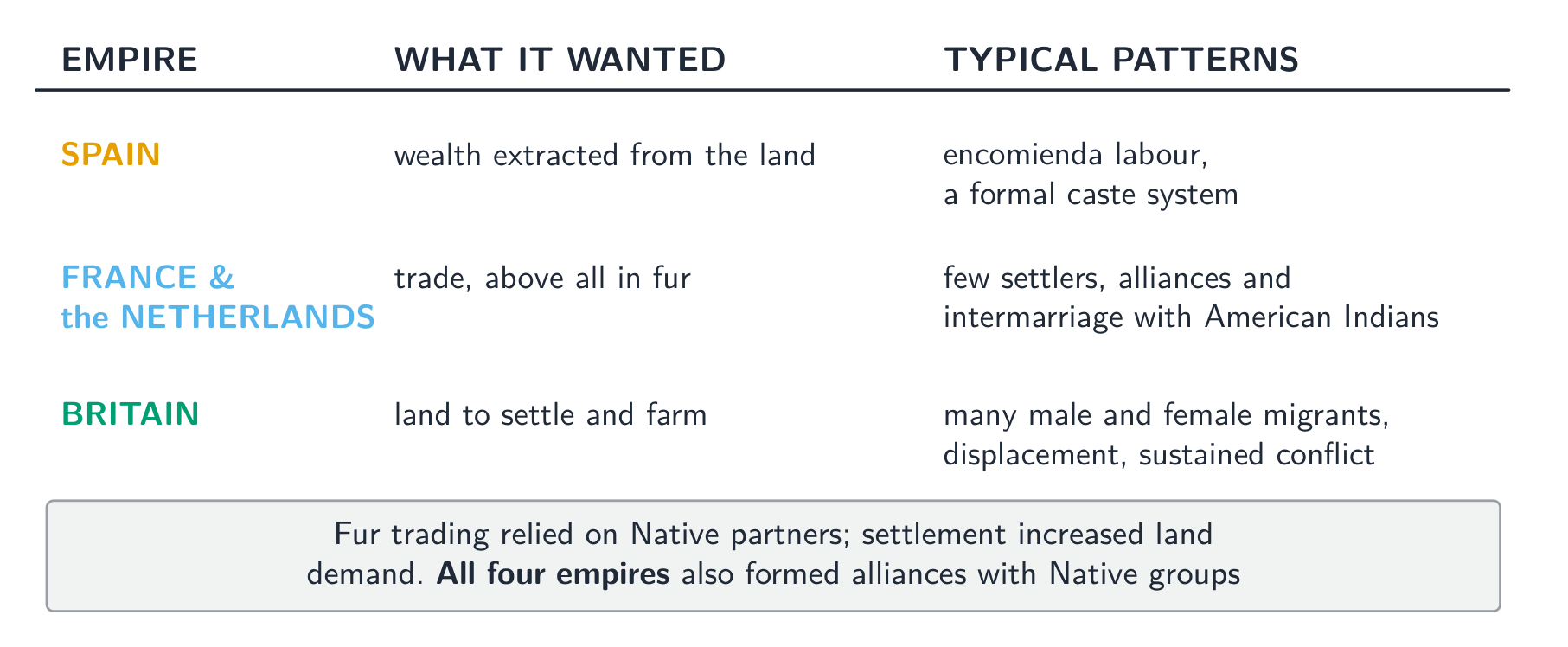
    Each empire wanted something different, and that goal shaped everything else:

    • Spain extracted wealth from the land, developing institutions built on subjugating 征服 native populations - the encomienda system carried over from Period 1.
    • France and the Netherlands sent relatively few Europeans and relied on trade alliances 贸易同盟 with American Indians, especially in fur 毛皮.
    • Britain attracted a comparatively large number of male and female migrants 男女移民, who came to settle and farm rather than only to extract.

    That last difference matters most. Because British colonists arrived as families and wanted land, they displaced native peoples rather than trading with them - which made British-Indian relations more violent than French ones.

    Vocabulary Train
    English Chinese Pinyin
    subjugating 征服 zhēng fú
    trade alliances 贸易同盟 mào yì tóng méng
    fur 毛皮 máo pí
    male and female migrants 男女移民 nán nǚ yí mín
    2.3

    The Regions of British Colonies

    Syllabus

    2.3 The Regions of British Colonies

    Thematic FocusLearning ObjectiveHistorical Developments

    GEO
    Geography and the Environment — Geographic and environmental factors, including competition over and debates about natural resources, shape the development of America and foster regional diversity. The development of America impacts the environment and reshapes geography, which leads to debates about environmental and geographic issues.

    Unit 2.C
    Explain how and why environmental and other factors shaped the development and expansion of various British colonies that developed and expanded from 1607 to 1754.

    • KC-2.1.II.A The Chesapeake and North Carolina colonies grew prosperous exporting tobacco—a labor-intensive product initially cultivated by white, mostly male indentured servants and later by enslaved Africans.
    • KC-2.1.II.B The New England colonies, initially settled by Puritans, developed around small towns with family farms and achieved a thriving mixed economy of agriculture and commerce.
    • KC-2.1.II.C The middle colonies supported a flourishing export economy based on cereal crops and attracted a broad range of European migrants, leading to societies with greater cultural, ethnic, and religious diversity and tolerance.
    • KC-2.1.II.D The colonies of the southern Atlantic coast and the British West Indies used long growing seasons to develop plantation economies based on exporting cash crops. They depended on the labor of enslaved Africans, who often constituted the majority of the population in these areas and developed their own forms of cultural and religious autonomy.
    • KC-2.1.II.E Distance and Britain’s initially lax attention led to the colonies creating self-governing institutions that were unusually democratic for the era. The New England colonies based power in participatory town meetings, which in turn elected members to their colonial legislatures; in the southern colonies, elite planters exercised local authority and also dominated the elected assemblies.

    Source: College Board AP Course and Exam Description

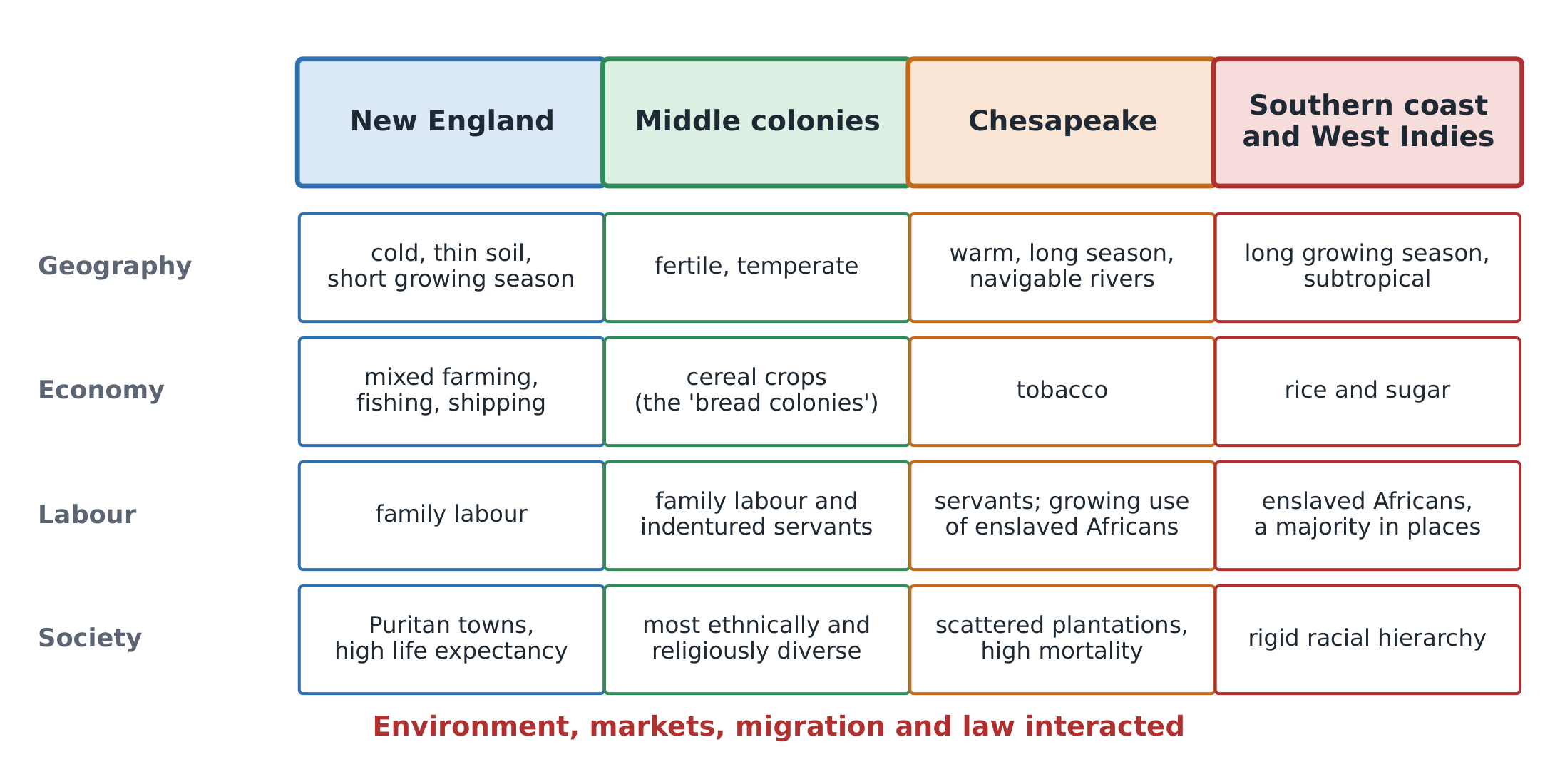
    The four British colonial regions compared by geography, economy, labour system and society
    Four regions, four economies: geography set the crop, the crop set the labour system, and the labour system set the society

    British North America was not one place. Four regions developed distinct societies.

    • The Chesapeake 切萨皮克 and North Carolina grew prosperous exporting tobacco 烟草, a labour-intensive crop. Labour came first from indentured servants 契约仆役 and increasingly from enslaved Africans.
    • The New England colonies, initially settled by Puritans 清教徒, developed around small towns with family farms 家庭农场, a mixed economy, and unusually high life expectancy.
    • The middle colonies supported a flourishing export economy based on cereal crops 谷物, and attracted the broadest range of European migrants, producing the most ethnically and religiously diverse 族群与宗教多元 region.
    • The colonies of the southern Atlantic coast and the British West Indies used long growing seasons for rice 稻米 and sugar 蔗糖, cash crops so labour-hungry that enslaved Africans became a majority of the population in places.

    One political feature was shared. Distance from London, and Britain's initially lax attention 松散管理, let the colonies create self-governing institutions 自治机构 - colonial assemblies that later shaped resistance to imperial control.

    Vocabulary Train
    English Chinese Pinyin
    Chesapeake 切萨皮克 qiè sà pí kè
    tobacco 烟草 yān cǎo
    indentured servants 契约仆役 qì yuē pú yì
    Puritans 清教徒 qīng jiào tú
    family farms 家庭农场 jiā tíng nóng chǎng
    cereal crops 谷物 gǔ wù
    ethnically and religiously diverse 族群与宗教多元 zú qún yǔ zōng jiào duō yuán
    rice 稻米 dào mǐ
    sugar 蔗糖 zhè táng
    lax attention 松散管理 sōng sǎn guǎn lǐ
    self-governing institutions 自治机构 zì zhì jī gòu
    2.4

    Transatlantic Trade

    Syllabus

    2.4 Transatlantic Trade

    Thematic FocusLearning ObjectiveHistorical Developments

    WXT
    Work, Exchange, and Technology — The interplay between markets, private enterprise, labor, technology, and government policy shape the American economy. In turn, economic activity shapes society and government policy and drives technological innovation.

    Unit 2.D
    Explain causes and effects of transatlantic trade over time.

    • KC-2.1.III.A An Atlantic economy developed in which goods, as well as enslaved Africans and American Indians, were exchanged between Europe, Africa, and the Americas through extensive trade networks. European colonial economies focused on acquiring, producing, and exporting commodities that were valued in Europe and gaining new sources of labor.
    • KC-2.1.III.B Continuing trade with Europeans increased the flow of goods in and out of American Indian communities, stimulating cultural and economic changes and spreading epidemic diseases that caused radical demographic shifts.
    • KC-2.2.I.C The British government increasingly attempted to incorporate its North American colonies into a coherent, hierarchical, and imperial structure in order to pursue mercantilist economic aims, but conflicts with colonists and American Indians led to erratic enforcement of imperial policies.

    Source: College Board AP Course and Exam Description

    An Atlantic economy 大西洋经济 developed in which goods - and enslaved Africans and American Indians - were exchanged around the ocean rim. Continuing trade increased the flow of goods in and out of American Indian communities, changing them too.

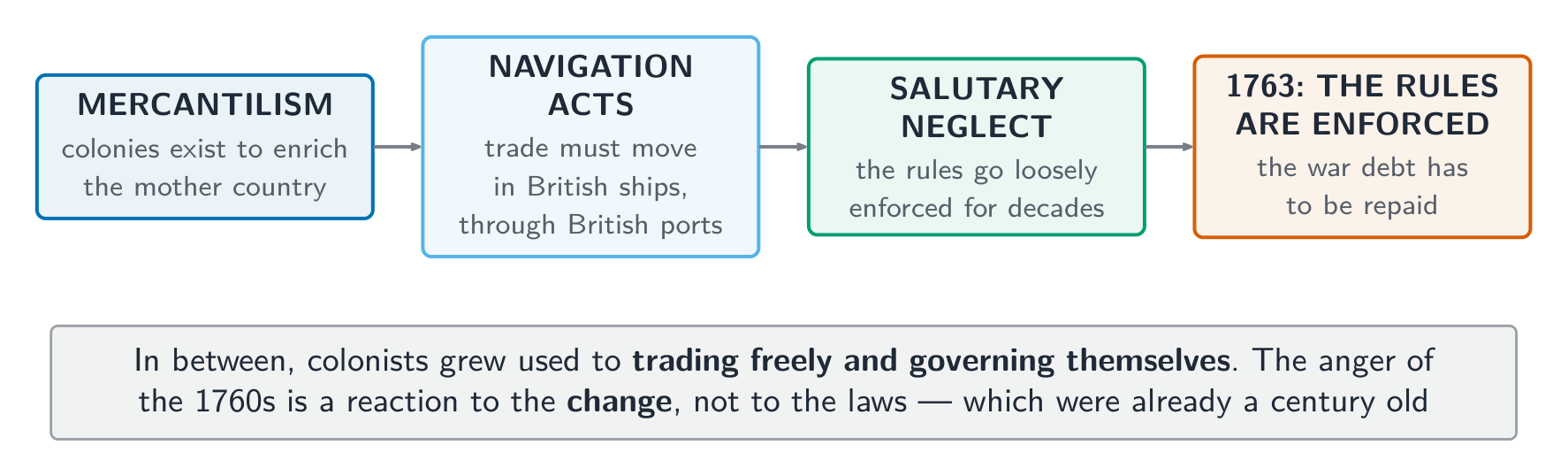
    From the mid-seventeenth century, the British government tried to bring its colonies into a coherent imperial system, driven by mercantilism 重商主义 - the belief that colonies exist to enrich the mother country. The Navigation Acts 航海条例 required colonial trade to move in British ships through British ports.

    Enforcement was loose for decades, a practice later called salutary neglect 有益的忽视. Colonists grew used to trading freely and governing themselves, which is exactly why tightening the rules after 1763 provoked such anger.

    Vocabulary Train
    English Chinese Pinyin
    Atlantic economy 大西洋经济 dà xī yáng jīng jì
    mercantilism 重商主义 zhòng shāng zhǔ yì
    Navigation Acts 航海条例 háng hǎi tiáo lì
    salutary neglect 有益的忽视 yǒu yì de hū shì
    2.5

    Interactions with American Indians

    Syllabus

    2.5 Interactions Between American Indians and Europeans

    Thematic FocusLearning ObjectiveHistorical Developments

    WOR
    America in the World — Diplomatic, economic, cultural, and military interactions between empires, nations, and peoples shape the development of America and America’s increasingly important role in the world.

    Unit 2.E
    Explain how and why interactions between various European nations and American Indians changed over time.

    • KC-2.1.III.C Interactions between European rivals and American Indian populations fostered both accommodation and conflict. French, Dutch, British, and Spanish colonies allied with and armed American Indian groups, who frequently sought alliances with Europeans against other American Indian groups.
    • KC-2.1.III.E British conflicts with American Indians over land, resources, and political boundaries led to military confrontations, such as Metacom’s War (King Philip’s War) in New England.
    • KC-2.1.III.F American Indian resistance to Spanish colonizing efforts in North America, particularly after the Pueblo Revolt, led to Spanish accommodation of some aspects of American Indian culture in the Southwest.

    Source: College Board AP Course and Exam Description

    Contact produced both accommodation 调适 and conflict 冲突, and the balance differed by empire and region.

    Where trade mattered most - New France, the Dutch fur trade - alliances and intermarriage were common. Where land mattered most, conflict followed. British expansion led to sustained military conflict 军事冲突 with American Indians over land, resources, and boundaries.

    Resistance took organised forms. The Pueblo Revolt 普韦布洛起义 of 1680 drove the Spanish out of New Mexico for over a decade and forced lasting changes in Spanish policy - the clearest example in the course of native resistance succeeding.

    Vocabulary Train
    English Chinese Pinyin
    accommodation 调适 tiáo shì
    conflict 冲突 chōng tū
    military conflict 军事冲突 jūn shì chōng tū
    Pueblo Revolt 普韦布洛起义 pǔ wéi bù luò qǐ yì
    2.6

    Slavery in the British Colonies

    Syllabus

    2.6 Slavery in the British Colonies

    Thematic FocusLearning ObjectiveHistorical Developments

    SOC
    Social Structures — Social categories, roles, and practices are created, maintained, challenged, and transformed throughout American history, shaping government policy, economic systems, culture, and the lives of citizens.

    Unit 2.F
    Explain the causes and effects of slavery in the various British colonial regions.

    • KC-2.2.II.A All the British colonies participated to varying degrees in the Atlantic slave trade due to the abundance of land and a growing European demand for colonial goods, as well as a shortage of indentured servants. Small New England farms used relatively few enslaved laborers, all port cities held significant minorities of enslaved people, and the emerging plantation systems of the Chesapeake and the southern Atlantic coast had large numbers of enslaved workers, while the great majority of enslaved Africans were sent to the West Indies.
    • KC-2.2.II.B As chattel slavery became the dominant labor system in many southern colonies, new laws created a strict racial system that prohibited interracial relationships and defined the descendants of African American mothers as black and enslaved in perpetuity.

    Unit 2.G
    Explain how enslaved people responded to slavery.

    • KC-2.2.II.C Africans developed both overt and covert means to resist the dehumanizing nature of slavery and maintain their family and gender systems, culture, and religion.

    Source: College Board AP Course and Exam Description

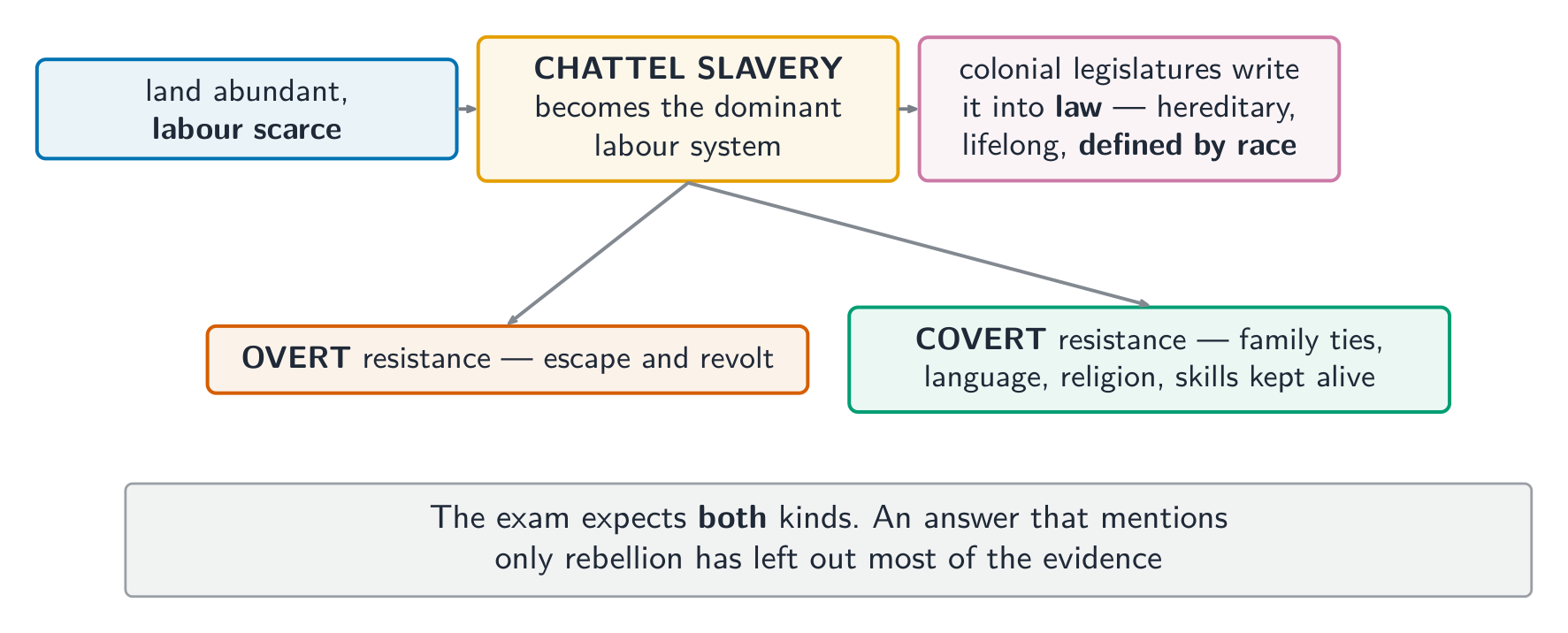
    All the British colonies participated in the Atlantic slave trade to varying degrees, because land was abundant and labour scarce.

    As chattel slavery 动产奴隶制 became the dominant labour system in many southern colonies, colonial legislatures wrote new laws creating a strict racial system 严格的种族制度. Slavery became hereditary, lifelong, and defined by race - a legal structure, not merely a practice.

    Enslaved Africans developed overt and covert means of resistance 公开与隐蔽的反抗: escape and revolt, and also the maintenance of family ties, languages, religious practices, and skills. The exam expects both kinds; an answer that mentions only rebellion misses most of the evidence.

    Vocabulary Train
    English Chinese Pinyin
    chattel slavery 动产奴隶制 dòng chǎn nú lì zhì
    strict racial system 严格的种族制度 yán gé de zhǒng zú zhì dù
    overt and covert means of resistance 公开与隐蔽的反抗 gōng kāi yǔ yǐn bì de fǎn kàng
    2.7

    Colonial Society and Culture

    Syllabus

    2.7 Colonial Society and Culture

    Thematic FocusLearning ObjectiveHistorical Developments

    NAT
    American and National Identity — The development of and debates about democracy, freedom, citizenship, diversity, and individualism shape American national identity, cultural values, and beliefs about American exceptionalism, and in turn, these ideas shape political institutions and society. Throughout American history, notions of national identity and culture have coexisted with varying degrees of regional and group identities.

    Unit 2.H
    Explain how and why the movement of a variety of people and ideas across the Atlantic contributed to the development of American culture over time.

    • KC-2.2.I.A The presence of different European religious and ethnic groups contributed to a significant degree of pluralism and intellectual exchange, which were later enhanced by the first Great Awakening and the spread of European Enlightenment ideas.
    • KC-2.2.I.B The British colonies experienced a gradual Anglicization over time, developing autonomous political communities based on English models with influence from intercolonial commercial ties, the emergence of a transatlantic print culture, and the spread of Protestant evangelicalism.

    Unit 2.I
    Explain how and why the different goals and interests of European leaders and colonists affected how they viewed themselves and their relationship with Britain.

    • KC-2.1.III.D The goals and interests of European leaders and colonists at times diverged, leading to a growing mistrust on both sides of the Atlantic. Colonists, especially in British North America, expressed dissatisfaction over issues including territorial settlements, frontier defense, self-rule, and trade.
    • KC-2.2.I.D Colonists’ resistance to imperial control drew on local experiences of self-government, evolving ideas of liberty, the political thought of the Enlightenment, greater religious independence and diversity, and an ideology critical of perceived corruption in the imperial system.

    Source: College Board AP Course and Exam Description

    Two opposite processes ran at once.

    Toward diversity: the presence of different European religious and ethnic groups produced a significant degree of pluralism 多元并存, most visibly in the middle colonies.

    Toward similarity: the colonies experienced a gradual Anglicization 英国化, adopting British goods, print culture, legal norms, and political ideas even as they developed autonomous political communities.

    Transatlantic exchange also brought the Enlightenment 启蒙运动 and, in the 1730s and 1740s, the religious revivals of the First Great Awakening 第一次大觉醒, which encouraged colonists to question established authority - religious first, political later.

    The goals of European leaders and colonists increasingly diverged 分歧, and colonists' resistance to imperial control drew on local experience of self-government and evolving ideas about rights.

    Vocabulary Train
    English Chinese Pinyin
    pluralism 多元并存 duō yuán bìng cún
    Anglicization 英国化 yīng guó huà
    Enlightenment 启蒙运动 qǐ méng yùn dòng
    First Great Awakening 第一次大觉醒 dì yī cì dà jué xǐng
    diverged 分歧 fēn qí
    2.8

    Comparison in Period 2

    Syllabus

    2.8 Comparison in Period 2

    Learning ObjectiveReview: Unit 2 Key Concepts

    Unit 2.J
    Compare the effects of the development of colonial society in the various regions of North America.

    • KC-2.1 Europeans developed a variety of colonization and migration patterns, influenced by different imperial goals, cultures, and the varied North American environments where they settled. They competed with each other and American Indians for resources.
      • KC-2.1.I Spanish, French, Dutch, and British colonizers had different economic and imperial goals involving land and labor that shaped the social and political development of their colonies as well as their relationships with native populations.
      • KC-2.1.II In the 17th century, early British colonies developed along the Atlantic coast, with regional differences that reflected various environmental, economic, cultural, and demographic factors.
      • KC-2.1.III Competition over resources between European rivals and American Indians encouraged industry and trade and led to conflict in the Americas.
    • KC-2.2 The British colonies participated in political, social, cultural, and economic exchanges with Great Britain that encouraged both stronger bonds with Britain and resistance to Britain’s control.
      • KC-2.2.I Transatlantic commercial, religious, philosophical, and political exchanges led residents of the British colonies to evolve in their political and cultural attitudes as they became increasingly tied to Britain and one another.
      • KC-2.2.II Like other European empires in the Americas that participated in the Atlantic slave trade, the English colonies developed a system of slavery that reflected the specific economic, demographic, and geographic characteristics of those colonies.

    Source: College Board AP Course and Exam Description

    The unit ends with comparison 比较, the reasoning skill this period is built to teach: the regions differ enough that almost any claim about "the colonies" needs qualifying.

    Worked example (a real AP exam question). The 2025 exam asked, as part A of a short-answer question, "Briefly describe one political development in British North America from 1607 to 1753." A full-mark answer is one specific development, named and located in time: "Colonial assemblies such as the Virginia House of Burgesses developed powers over taxation and spending, which gave colonists practical experience of representative self-government before 1754." Notice the shape: Briefly describe wants a specific development stated accurately - not a list, not an evaluation, and not an essay. Marks are lost here by writing too much about the wrong thing, or by staying vague ("colonies became more independent").

    Vocabulary Train
    English Chinese Pinyin
    comparison 比较 bǐ jiào
    2.8

    Exam tips

    • Answer the why behind regional difference: geography set the crop, the crop set the labour system, and the labour system set the society.
    • Never treat "the colonies" as one place. A comparison question wants New England against the Chesapeake, with evidence from each.
    • Mercantilism is the theory, the Navigation Acts are the policy, and salutary neglect is the lax enforcement that made later enforcement feel like tyranny.
    • For slavery, give both overt and covert resistance; and note that slave codes made slavery racial and hereditary, which is the change being tested.
    • The Pueblo Revolt is the go-to example of successful native resistance; British-Indian conflict is the go-to contrast with French trade alliances.
    • Match your answer to the task verb. Briefly describe takes one or two accurate sentences, while Evaluate the extent needs a thesis that takes a position.
  • 3

    Period 3: 1754–1800

    3.1 3.2

    The Seven Years' War and Its Consequences

    Syllabus

    3.1 Contextualizing Period 3

    Learning ObjectivePreview: Unit 3 Key Concepts

    Unit 3.A
    Explain the context in which America gained independence and developed a sense of national identity.

    • KC-3.1 British attempts to assert tighter control over its North American colonies and the colonial resolve to pursue self-government led to a colonial independence movement and the Revolutionary War.
      • KC-3.1.I The competition among the British, French, and American Indians for economic and political advantage in North America culminated in the Seven Years’ War (the French and Indian War), in which Britain defeated France and allied American Indians.
      • KC-3.1.II The desire of many colonists to assert ideals of self-government in the face of renewed British imperial efforts led to a colonial independence movement and war with Britain.
    • KC-3.2 The American Revolution’s democratic and republican ideals inspired new experiments with different forms of government.
      • KC-3.2.I The ideals that inspired the revolutionary cause reflected new beliefs about politics, religion, and society that had been developing over the course of the 18th century.
      • KC-3.2.II After declaring independence, American political leaders created new constitutions and declarations of rights that articulated the role of the state and federal governments while protecting individual liberties and limiting both centralized power and excessive popular influence.
      • KC-3.2.III.i New forms of national culture and political institutions developed in the United States alongside continued regional variations and differences over economic, political, social, and foreign policy issues.
    • KC-3.3 Migration within North America and competition over resources, boundaries, and trade intensified conflicts among peoples and nations.
      • KC-3.3.I In the decades after American independence, interactions among different groups resulted in competition for resources, shifting alliances, and cultural blending.
      • KC-3.3.II The continued presence of European powers in North America challenged the United States to find ways to safeguard its borders, maintain neutral trading rights, and promote its economic interests.

    3.2 The Seven Years’ War (The French and Indian War)

    Thematic FocusLearning ObjectiveHistorical Developments

    WOR
    America in the World — Diplomatic, economic, cultural, and military interactions between empires, nations, and peoples shape the development of America and America’s increasingly important role in the world.

    Unit 3.B
    Explain the causes and effects of the Seven Years’ War (the French and Indian War).

    • KC-3.1.I.A Colonial rivalry intensified between Britain and France in the mid-18th century, as the growing population of the British colonies expanded into the interior of North America, threatening French–Indian trade networks and American Indian autonomy.
    • KC-3.1.I.B Britain achieved a major expansion of its territorial holdings by defeating the French, but at tremendous expense, setting the stage for imperial efforts to raise revenue and consolidate control over the colonies.
    • KC-3.1.I.C After the British victory, imperial officials’ attempts to prevent colonists from moving westward generated colonial opposition, while native groups sought to both continue trading with Europeans and resist the encroachments of colonists on tribal lands.

    Source: College Board AP Course and Exam Description

    Period 3 runs from 1754 to 1800 - from the outbreak of the Seven Years' War to the end of John Adams's presidency. It contains the Revolution, but the exam treats the Revolution as an effect, so start with its cause.

    Colonial rivalry between Britain and France intensified in the mid-eighteenth century as a growing colonial population pressed westward. The Seven Years' War 七年战争, known in North America as the French and Indian War 法印战争, settled that rivalry.

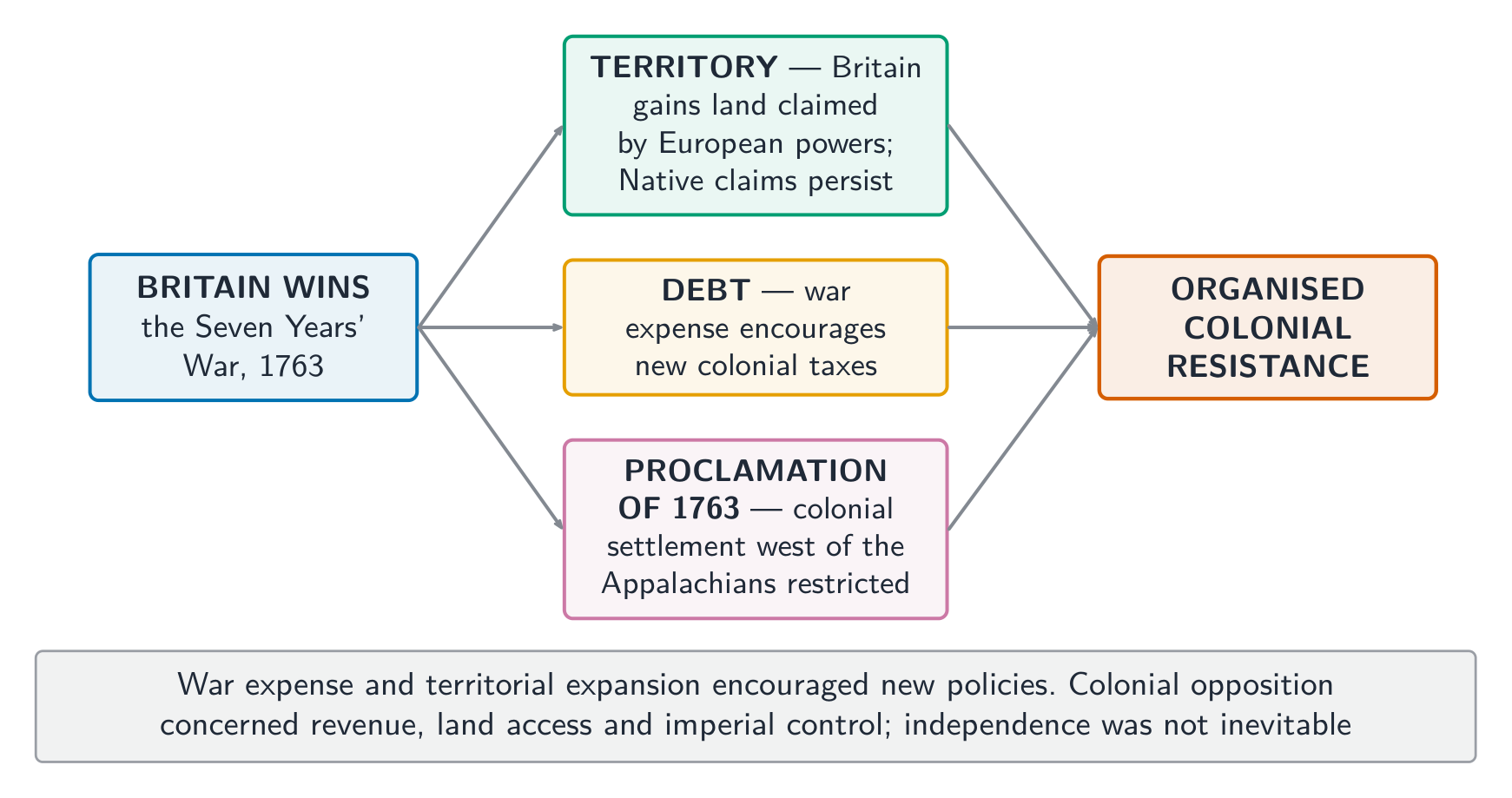
    Britain won, and three consequences follow directly:

    • A major expansion of territory 领土大扩张 - France was removed from mainland North America.
    • An enormous war debt 巨额战争债务, which Britain decided the colonies should help repay.
    • Restrictions on westward movement, notably the Proclamation of 1763 1763年公告线, intended to prevent costly conflict with American Indians but resented by colonists who wanted the land they had just helped win.

    That is the chain the exam wants: victory produced debt and new territory, and managing both required tighter control of the colonies.

    Vocabulary Train
    English Chinese Pinyin
    Seven Years' War 七年战争 qī nián zhàn zhēng
    French and Indian War 法印战争 fǎ yìn zhàn zhēng
    major expansion of territory 领土大扩张 lǐng tǔ dà kuò zhāng
    enormous war debt 巨额战争债务 jù é zhàn zhēng zhài wù
    Proclamation of 1763 1763年公告线 1763 nián gōng gào xiàn
    3.3

    Taxation Without Representation

    Syllabus

    3.3 Taxation Without Representation

    Thematic FocusLearning ObjectiveHistorical Developments

    WOR
    America in the World — Diplomatic, economic, cultural, and military interactions between empires, nations, and peoples shape the development of America and America’s increasingly important role in the world.

    Unit 3.C
    Explain how British colonial policies regarding North America led to the Revolutionary War.

    • KC-3.1.II.A The imperial struggles of the mid-18th century, as well as new British efforts to collect taxes without direct colonial representation or consent and to assert imperial authority in the colonies, began to unite the colonists against perceived and real constraints on their economic activities and political rights.
    • KC-3.1.II.B Colonial leaders based their calls for resistance to Britain on arguments about the rights of British subjects, the rights of the individual, local traditions of self-rule, and the ideas of the Enlightenment.
    • KC-3.1.II.C The effort for American independence was energized by colonial leaders such as Benjamin Franklin, as well as by popular movements that included the political activism of laborers, artisans, and women.
    • KC-3.1.II.D In the face of economic shortages and the British military occupation of some regions, men and women mobilized in large numbers to provide financial and material support to the Patriot movement.

    Source: College Board AP Course and Exam Description

    New British efforts to collect taxes 征税 without the consent of colonial assemblies, and to assert imperial authority, provoked organised resistance.

    Colonial leaders based their arguments on the rights of British subjects 英国臣民的权利, on the ideals of the Enlightenment 启蒙思想, and on their own long experience of self-government - the assemblies built up during Period 2.

    Resistance was not only argument. Facing shortages and, in some regions, British military occupation 军事占领, men and women both took part: boycotts of British goods, home manufacture, crowd action, and committees of correspondence. Leaders such as Benjamin Franklin 富兰克林 energised the movement, and the slogan of the period is "no taxation without representation" 无代表不纳税.

    Vocabulary Train
    English Chinese Pinyin
    collect taxes 征税 zhēng shuì
    the rights of British subjects 英国臣民的权利 yīng guó chén mín de quán lì
    ideals of the Enlightenment 启蒙思想 qǐ méng sī xiǎng
    military occupation 军事占领 jūn shì zhàn lǐng
    Benjamin Franklin 富兰克林 fù lán kè lín
    "no taxation without representation" 无代表不纳税 wú dài biǎo bù nà shuì
    3.4

    The Ideas Behind the Revolution

    Syllabus

    3.4 Philosophical Foundations of the American Revolution

    Thematic FocusLearning ObjectiveHistorical Developments

    NAT
    American and National Identity — The development of and debates about democracy, freedom, citizenship, diversity, and individualism shape American national identity, cultural values, and beliefs about American exceptionalism, and in turn, these ideas shape political institutions and society. Throughout American history, notions of national identity and culture have coexisted with varying degrees of regional and group identities.

    Unit 3.D
    Explain how and why colonial attitudes about government and the individual changed in the years leading up to the American Revolution.

    • KC-3.2.I.A Enlightenment ideas and philosophy inspired many American political thinkers to emphasize individual talent over hereditary privilege, while religion strengthened Americans’ view of themselves as a people blessed with liberty.
    • KC-3.2.I.B The colonists’ belief in the superiority of republican forms of government based on the natural rights of the people found expression in Thomas Paine’s Common Sense and the Declaration of Independence. The ideas in these documents resonated throughout American history, shaping Americans’ understanding of the ideals on which the nation was based.

    Source: College Board AP Course and Exam Description

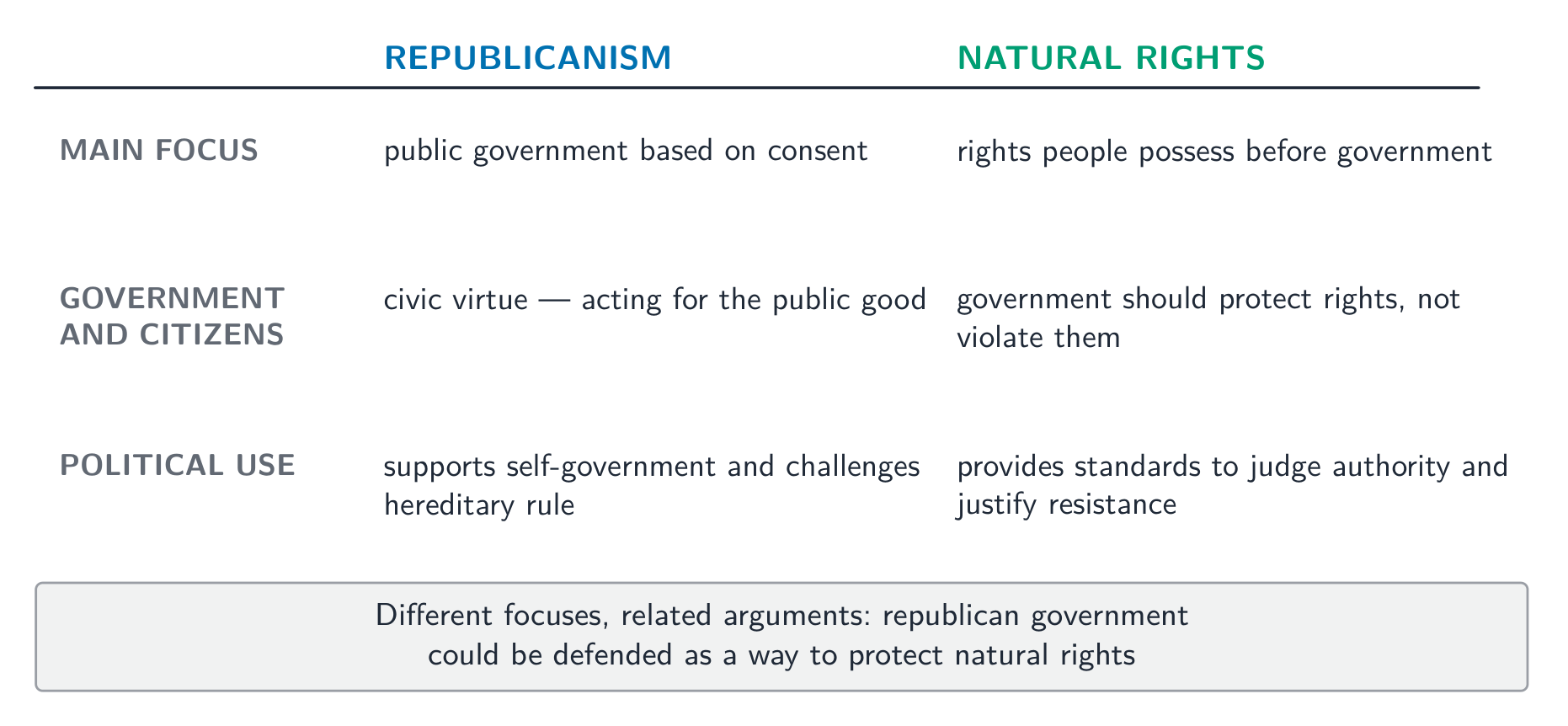
    Enlightenment ideas led American political thinkers to emphasise individual talent over hereditary privilege 才能重于世袭特权, and to assert the natural rights 天赋权利 of the people and the sovereignty of the people 人民主权.

    Two ideas do most of the work in essays:

    • Republicanism 共和主义 - government rests on the consent of the governed, and citizens must show virtue by placing the public good above private interest.
    • Natural rights - rights that exist before government, which government is created to protect, and whose violation justifies resistance.
    Vocabulary Train
    English Chinese Pinyin
    individual talent over hereditary privilege 才能重于世袭特权 cái néng zhòng yú shì xí tè quán
    natural rights 天赋权利 tiān fù quán lì
    sovereignty of the people 人民主权 rén mín zhǔ quán
    Republicanism 共和主义 gòng hé zhǔ yì
    3.5 3.6

    The War and Its Wider Effects

    Syllabus

    3.5 The American Revolution

    Thematic FocusLearning ObjectiveHistorical Developments

    WOR
    America in the World — Diplomatic, economic, cultural, and military interactions between empires, nations, and peoples shape the development of America and America’s increasingly important role in the world.

    Unit 3.E
    Explain how various factors contributed to the American victory in the Revolution.

    • KC-3.1.II.E Despite considerable loyalist opposition, as well as Great Britain’s apparently overwhelming military and financial advantages, the Patriot cause succeeded because of the actions of colonial militias and the Continental Army, George Washington’s military leadership, the colonists’ ideological commitment and resilience, and assistance sent by European allies.

    3.6 The Influence of Revolutionary Ideals

    Thematic FocusLearning ObjectiveHistorical Developments

    WOR
    America in the World — Diplomatic, economic, cultural, and military interactions between empires, nations, and peoples shape the development of America and America’s increasingly important role in the world.

    Unit 3.F
    Explain the various ways the American Revolution affected society.

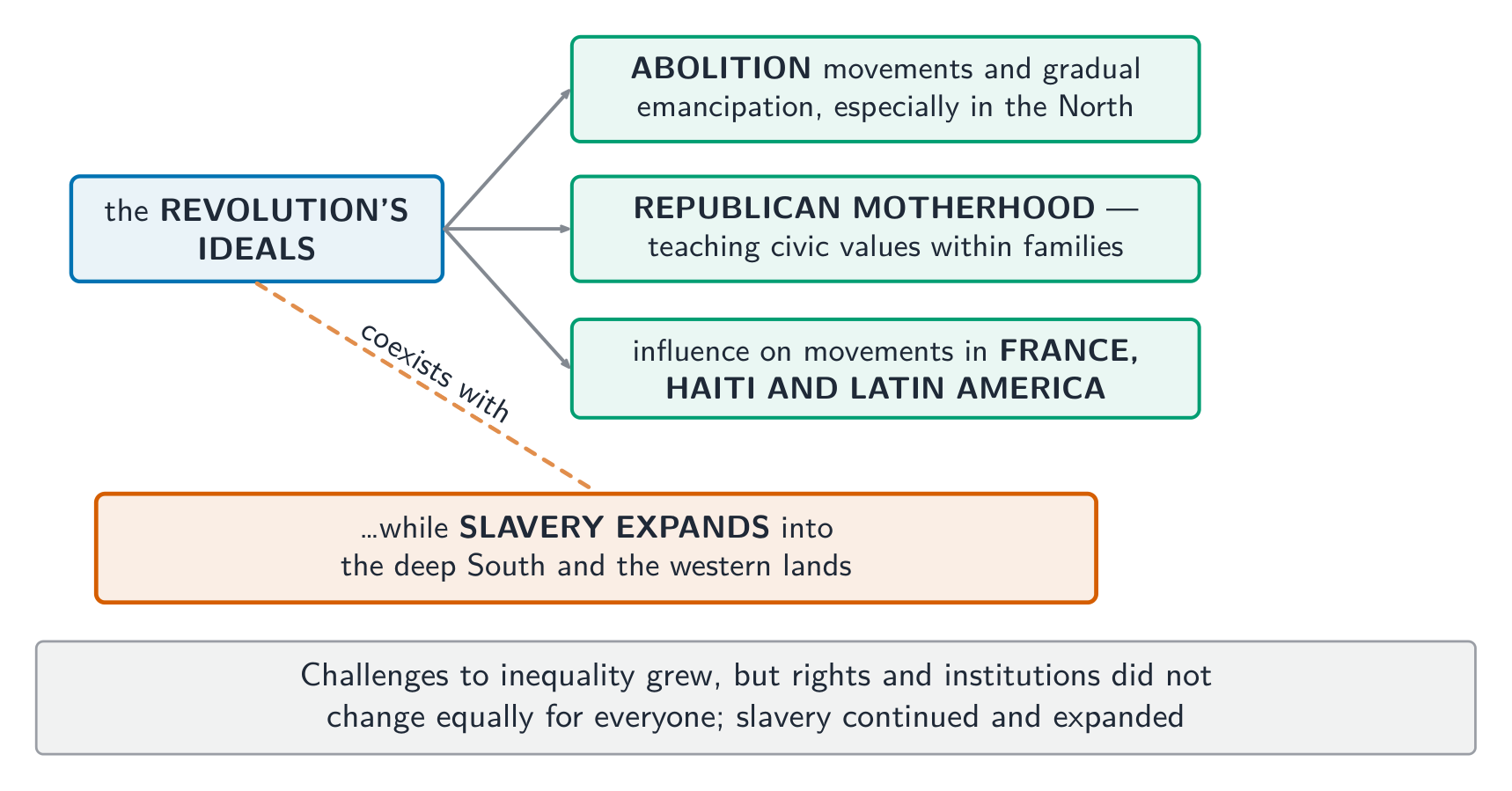
    • KC-3.2.I.C During and after the American Revolution, an increased awareness of inequalities in society motivated some individuals and groups to call for the abolition of slavery and greater political democracy in the new state and national governments.
    • KC-3.2.I.D In response to women’s participation in the American Revolution, Enlightenment ideas, and women’s appeals for expanded roles, an ideal of “republican motherhood” gained popularity. It called on women to teach republican values within the family and granted women a new importance in American political culture.

    Unit 3.G
    Describe the global impact of the American Revolution.

    • KC-3.2.I.E The American Revolution and the ideals set forth in the Declaration of Independence reverberated in France, Haiti, and Latin America, inspiring future independence movements.

    Source: College Board AP Course and Exam Description

    The war for independence succeeded through a combination of colonial resolve, difficult terrain, and crucially foreign assistance 外国援助, above all from France.

    The Revolution's ideals then spread further than its leaders intended:

    • They inspired movements to abolish slavery 废奴运动, especially in the North, and gradual emancipation laws.
    • They raised questions about the status of women 妇女地位, expressed in the idea of republican motherhood 共和母亲身份 - that women shaped the republic by raising virtuous citizens.
    • They influenced later revolutions elsewhere in the Atlantic world.

    At the same time the expansion of slavery into the deep South and adjacent western lands continued, alongside rising antislavery 反奴隶制 sentiment - a contradiction the course returns to repeatedly.

    Vocabulary Train
    English Chinese Pinyin
    foreign assistance 外国援助 wài guó yuán zhù
    movements to abolish slavery 废奴运动 fèi nú yùn dòng
    status of women 妇女地位 fù nǚ dì wèi
    republican motherhood 共和母亲身份 gòng hé mǔ qīn shēn fèn
    antislavery 反奴隶制 fǎn nú lì zhì
    3.7 3.8 3.9

    From Confederation to Constitution

    Syllabus

    3.7 The Articles of Confederation

    Thematic FocusLearning ObjectiveHistorical Developments

    PCE
    Politics and Power — Debates fostered by social and political groups about the role of government in American social, political, and economic life shape government policy, institutions, political parties, and the rights of citizens.

    Unit 3.H
    Explain how different forms of government developed and changed as a result of the Revolutionary Period.

    • KC-3.2.II.A Many new state constitutions placed power in the hands of the legislative branch and maintained property qualifications for voting and citizenship.
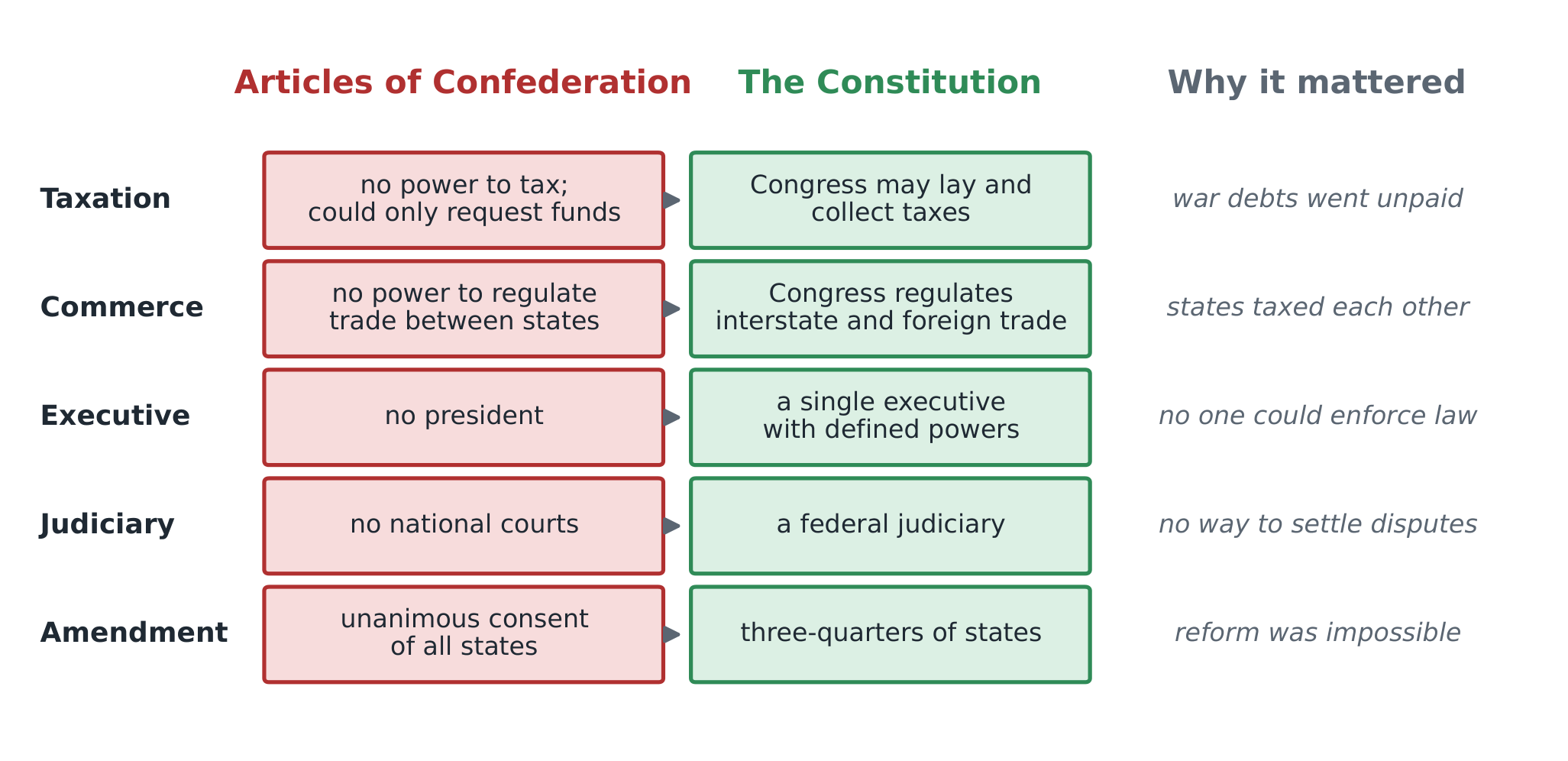
    • KC-3.2.II.B The Articles of Confederation unified the newly independent states, creating a central government with limited power. After the Revolution, difficulties over international trade, finances, interstate commerce, foreign relations, and internal unrest led to calls for a stronger central government.
    • KC-3.3.I.C As settlers moved westward during the 1780s, Congress enacted the Northwest Ordinance for admitting new states; the ordinance promoted public education, the protection of private property, and a ban on slavery in the Northwest Territory.

    3.8 The Constitutional Convention and Debates over Ratification

    Thematic FocusLearning ObjectiveHistorical Developments

    PCE
    Politics and Power — Debates fostered by social and political groups about the role of government in American social, political, and economic life shape government policy, institutions, political parties, and the rights of citizens.

    Unit 3.I
    Explain the differing ideological positions on the structure and function of the federal government.

    • KC-3.2.II.C.i Delegates from the states participated in the Constitutional Convention and through negotiation, collaboration, and compromise proposed a constitution.
    • KC-3.2.II.D The Constitutional Convention compromised over the representation of slave states in Congress and the role of the federal government in regulating both slavery and the slave trade, allowing the prohibition of the international slave trade after 1808.
    • KC-3.2.II.E In the debate over ratifying the Constitution, Anti-Federalists opposing ratification battled with Federalists, whose principles were articulated in the Federalist Papers (primarily written by Alexander Hamilton and James Madison). Federalists ensured the ratification of the Constitution by promising the addition of a Bill of Rights that enumerated individual rights and explicitly restricted the powers of the federal government.

    3.9 The Constitution

    Thematic FocusLearning ObjectiveHistorical Developments

    PCE
    Politics and Power — Debates fostered by social and political groups about the role of government in American social, political, and economic life shape government policy, institutions, political parties, and the rights of citizens.

    Unit 3.J
    Explain the continuities and changes in the structure and functions of the government with the ratification of the Constitution.

    • KC-3.2.II.C.ii Delegates from the states participated in the Constitutional Convention that created a limited but dynamic central government embodying federalism and providing for a separation of powers between its three branches.

    Source: College Board AP Course and Exam Description

    The Articles of Confederation and the Constitution compared on the powers each gave the national government
    The Constitution was written to fix specific, named weaknesses - each row is one of them

    After declaring independence, leaders wrote new constitutions and declarations of rights 宪法与权利宣言 that reflected republican ideals, generally limiting executive power.

    The Articles of Confederation 邦联条例 created a deliberately weak central government: no power to tax, no power to regulate commerce, no executive, and no national judiciary. It succeeded in organising western settlement through the Northwest Ordinance 西北法令, but could not manage debt, trade disputes, or unrest.

    The Constitutional Convention 制宪会议 of 1787 produced a stronger national government built on compromise 妥协, including the Great Compromise 大妥协 over representation and compromises over slavery and commerce.

    Ratification 批准 was contested. Federalists 联邦党人 argued the new government was strong enough to govern yet checked enough to be safe; Anti-Federalists 反联邦党人 feared centralised power and demanded protection for individual liberties, which produced the Bill of Rights 权利法案.

    Vocabulary Train
    English Chinese Pinyin
    constitutions and declarations of rights 宪法与权利宣言 xiàn fǎ yǔ quán lì xuān yán
    Articles of Confederation 邦联条例 bāng lián tiáo lì
    Northwest Ordinance 西北法令 xī běi fǎ lìng
    Constitutional Convention 制宪会议 zhì xiàn huì yì
    compromise 妥协 tuǒ xié
    Great Compromise 大妥协 dà tuǒ xié
    Ratification 批准 pī zhǔn
    Federalists 联邦党人 lián bāng dǎng rén
    Anti-Federalists 反联邦党人 fǎn lián bāng dǎng rén
    Bill of Rights 权利法案 quán lì fǎ àn
    3.10 3.11

    The New Republic

    Syllabus

    3.10 Shaping a New Republic

    Thematic FocusLearning ObjectiveHistorical Developments

    PCE
    Politics and Power — Debates fostered by social and political groups about the role of government in American social, political, and economic life shape government policy, institutions, political parties, and the rights of citizens.

    Unit 3.K
    Explain how and why competition intensified conflicts among peoples and nations from 1754 to 1800.

    • KC-3.3.II.A The U.S. government forged diplomatic initiatives aimed at dealing with the continued British and Spanish presence in North America, as U.S. settlers migrated beyond the Appalachians and sought free navigation of the Mississippi River.
    • KC-3.3.II.B War between France and Britain resulting from the French Revolution presented challenges to the United States over issues of free trade and foreign policy and fostered political disagreement.
    • KC-3.3.I.E The Spanish, supported by the bonded labor of the local American Indians, expanded their mission settlements into California; these provided opportunities for social mobility among soldiers and led to new cultural blending.
    • KC-3.3.I.D An ambiguous relationship between the federal government and American Indian tribes contributed to problems regarding treaties and American Indian legal claims relating to the seizure of their lands.

    Unit 3.L
    Explain how and why political ideas, institutions, and party systems developed and changed in the new republic.

    • KC-3.2.III.A During the presidential administrations of George Washington and John Adams, political leaders created institutions and precedents that put the principles of the Constitution into practice.
    • KC-3.2.III.B Political leaders in the 1790s took a variety of positions on issues such as the relationship between the national government and the states, economic policy, foreign policy, and the balance between liberty and order. This led to the formation of political parties— most significantly the Federalists, led by Alexander Hamilton, and the Democratic-Republican Party, led by Thomas Jefferson and James Madison.
    • KC-3.3.II.C George Washington’s Farewell Address encouraged national unity, as he cautioned against political factions and warned about the danger of permanent foreign alliances.

    3.11 Developing an American Identity

    Thematic FocusLearning ObjectiveHistorical Developments

    ARC
    American and Regional Culture — Creative expression, demographic change, philosophy, religious beliefs, scientific ideas, social mores, and technology shape national, regional, and group cultures in America, and these varying cultures often play a role in shaping government policy and developing economic systems.

    Unit 3.M
    Explain the continuities and changes in American culture from 1754 to 1800.

    • KC-3.2.III.ii New forms of national culture developed in the United States alongside continued regional variations.
    • KC-3.2.III.D Ideas about national identity increasingly found expression in works of art, literature, and architecture.

    Source: College Board AP Course and Exam Description

    Under George Washington 华盛顿 and John Adams 亚当斯, political leaders disagreed sharply over the relationship between the national and state governments 联邦与各州的关系, economic policy, and foreign policy. Those disagreements hardened into the first party system 第一政党体系.

    War between France and Britain after the French Revolution 法国大革命 forced hard choices, and the government pursued diplomatic initiatives to deal with the continued British and Spanish presence in North America. Washington's Farewell Address 华盛顿告别演说 urged national unity and warned against political factions and permanent foreign alliances.

    Meanwhile a distinctive national culture 民族文化 developed - in art, literature, and architecture - alongside continued regional variation.

    Vocabulary Train
    English Chinese Pinyin
    George Washington 华盛顿 huá shèng dùn
    John Adams 亚当斯 yà dāng sī
    relationship between the national and state governments 联邦与各州的关系 lián bāng yǔ gè zhōu de guān xì
    first party system 第一政党体系 dì yī zhèng dǎng tǐ xì
    French Revolution 法国大革命 fǎ guó dà gé mìng
    Washington's Farewell Address 华盛顿告别演说 huá shèng dùn gào bié yǎn shuō
    national culture 民族文化 mín zú wén huà
    3.12

    Movement and Conflict in the Early Republic

    Syllabus

    3.12 Movement in the Early Republic

    Thematic FocusLearning ObjectiveHistorical Developments

    SOC
    Social Structures — Social categories, roles, and practices are created, maintained, challenged, and transformed throughout American history, shaping government policy, economic systems, culture, and the lives of citizens.

    Unit 3.N
    Explain how and why migration and immigration to and within North America caused competition and conflict over time.

    • KC-3.3.I.A Various American Indian groups repeatedly evaluated and adjusted their alliances with Europeans, other tribes, and the United States, seeking to limit migration of white settlers and maintain control of tribal lands and natural resources. British alliances with American Indians contributed to tensions between the United States and Britain.
    • KC-3.3.I.B As increasing numbers of migrants from North America and other parts of the world continued to move westward, frontier cultures that had emerged in the colonial period continued to grow, fueling social, political, and ethnic tensions.

    Unit 3.O
    Explain the continuities and changes in regional attitudes about slavery as it expanded from 1754 to 1800.

    • KC-3.2.III.C The expansion of slavery in the deep South and adjacent western lands and rising antislavery sentiment began to create distinctive regional attitudes toward slavery.

    Source: College Board AP Course and Exam Description

    American Indian groups repeatedly evaluated and adjusted their alliances 重新评估并调整结盟 with European powers and the new United States as circumstances changed.

    Growing numbers of migrants moved west, intensifying competition over resources, boundaries, and trade 资源边界与贸易. The relationship between the federal government and American Indian tribes remained ambiguous 含混不清, contributing to recurring conflict. In the Southwest, the Spanish expanded their mission system 传教团体系, supported by the bonded labour of local American Indians.

    Vocabulary Train
    English Chinese Pinyin
    evaluated and adjusted their alliances 重新评估并调整结盟 chóng xīn píng gū bìng tiáo zhěng jié méng
    resources, boundaries, and trade 资源、边界与贸易 zī yuán 、 biān jiè yǔ mào yì
    ambiguous 含混不清 hán hùn bù qīng
    mission system 传教团体系 chuán jiào tuán tǐ xì
    3.13

    Continuity and Change in Period 3

    Syllabus

    3.13 Continuity and Change in Period 3

    Learning ObjectiveReview: Unit 3 Key Concepts

    Unit 3.P
    Explain how the American independence movement affected society from 1754 to 1800.

    • KC-3.1 British attempts to assert tighter control over its North American colonies and the colonial resolve to pursue self-government led to a colonial independence movement and the Revolutionary War.
      • KC-3.1.I The competition among the British, French, and American Indians for economic and political advantage in North America culminated in the Seven Years’ War (the French and Indian War), in which Britain defeated France and allied American Indians.
      • KC-3.1.II The desire of many colonists to assert ideals of self-government in the face of renewed British imperial efforts led to a colonial independence movement and war with Britain.
    • KC-3.2 The American Revolution’s democratic and republican ideals inspired new experiments with different forms of government.
      • KC-3.2.I The ideals that inspired the revolutionary cause reflected new beliefs about politics, religion, and society that had been developing over the course of the 18th century.
      • KC-3.2.II After declaring independence, American political leaders created new constitutions and declarations of rights that articulated the role of the state and federal governments while protecting individual liberties and limiting both centralized power and excessive popular influence.
      • KC-3.2.III.i New forms of national culture and political institutions developed in the United States alongside continued regional variations and differences over economic, political, social, and foreign policy issues.
    • KC-3.3 Migration within North America and competition over resources, boundaries, and trade intensified conflicts among peoples and nations.
      • KC-3.3.I In the decades after American independence, interactions among different groups resulted in competition for resources, shifting alliances, and cultural blending.
      • KC-3.3.II The continued presence of European powers in North America challenged the United States to find ways to safeguard its borders, maintain neutral trading rights, and promote its economic interests.

    Source: College Board AP Course and Exam Description

    The period's reasoning skill is continuity and change 延续与变化. The strongest answers hold both: political institutions changed radically, while slavery, westward expansion, and conflict with American Indians continued and intensified.

    Worked example (a real AP exam question). The 2025 exam asked, as part B of a short-answer question, "Briefly describe one effect of the Seven Years' War from 1754 to 1765." A full-mark answer names one effect and shows it is an effect: "Britain emerged from the war with a large debt, which led Parliament to impose new taxes such as the Stamp Act on the colonies to help pay for imperial defence." Notice the shape: describe one effect needs the causal link stated, not just a fact from the period. "Britain won the war" is a result, not an effect on what followed; "the colonies were angry" is too vague to credit.

    Vocabulary Train
    English Chinese Pinyin
    continuity and change 延续与变化 yán xù yǔ biàn huà
    3.13

    Exam tips

    • Learn the causal chain: war → debt and new territory → taxes and the Proclamation of 1763 → colonial resistance → independence.
    • Republicanism and natural rights are the two ideas to name; do not just write "Enlightenment ideas".
    • For the Constitution, argue from the specific weakness it fixed - no power to tax, no power to regulate commerce, no executive.
    • Keep Federalist and Anti-Federalist positions straight, and remember the Bill of Rights was the price of ratification.
    • The Revolution's effects on slavery and women are examinable, and both are partial: ideals spread further than rights did.
    • On continuity-and-change prompts, give one of each. An answer that only lists changes has answered half the question.
  • 4

    Period 4: 1800–1848

    4.1 4.2

    Jefferson's Era and the Courts

    Syllabus

    4.1 Contextualizing Period 4

    Learning ObjectivePreview: Unit 4 Key Concepts

    Unit 4.A
    Explain the context in which the republic developed from 1800 to 1848.

    • KC-4.1 The United States began to develop a modern democracy and celebrated a new national culture, while Americans sought to define the nation’s democratic ideals and change their society and institutions to match them.
      • KC-4.1.I The nation’s transition to a more participatory democracy was achieved by expanding suffrage from a system based on property ownership to one based on voting by all adult white men, and it was accompanied by the growth of political parties.
      • KC-4.1.II While Americans embraced a new national culture, various groups developed distinctive cultures of their own.
      • KC-4.1.III Increasing numbers of Americans, many inspired by new religious and intellectual movements, worked primarily outside of government institutions to advance their ideals.
    • KC-4.2 Innovations in technology, agriculture, and commerce powerfully accelerated the American economy, precipitating profound changes to U.S. society and to national and regional identities.
      • KC-4.2.I New transportation systems and technologies dramatically expanded manufacturing and agricultural production.
      • KC-4.2.II The changes caused by the market revolution had significant effects on U.S. society, workers’ lives, and gender and family relations.
      • KC-4.2.III Economic development shaped settlement and trade patterns, helping to unify the nation while also encouraging the growth of different regions.
    • KC-4.3 The U.S. interest in increasing foreign trade and expanding its national borders shaped the nation’s foreign policy and spurred government and private initiatives.
      • KC-4.3.I Struggling to create an independent global presence, the United States sought to claim territory throughout the North American continent and promote foreign trade.
      • KC-4.3.II The United States’ acquisition of lands in the West gave rise to contests over the extension of slavery into new territories.

    4.2 The Rise of Political Parties and the Era of Jefferson

    Thematic FocusLearning ObjectiveHistorical Developments

    PCE
    Politics and Power — Debates fostered by social and political groups about the role of government in American social, political, and economic life shape government policy, institutions, political parties, and the rights of citizens.

    Unit 4.B
    Explain the causes and effects of policy debates in the early republic.

    • KC-4.1.I.A In the early 1800s, national political parties continued to debate issues such as the tariff, powers of the federal government, and relations with European powers.
    • KC-4.1.I.B Supreme Court decisions established the primacy of the judiciary in determining the meaning of the Constitution and asserted that federal laws took precedence over state laws.
    • KC-4.3.I.A.i Following the Louisiana Purchase, the U.S. government sought influence and control over North America through a variety of means, including exploration and diplomatic efforts.

    Source: College Board AP Course and Exam Description

    Period 4 runs from 1800 to 1848. Three things happen at once: democracy widens, the economy transforms, and the country expands - and each one deepens the argument over slavery.

    National parties continued to debate the tariff 关税, the national bank 银行, and internal improvements 内部改良 (federally funded roads and canals). These were arguments about how much power the national government should have.

    The Supreme Court settled part of that argument. Its decisions established the primacy of the judiciary 司法至上 in determining the meaning of the Constitution - the principle of judicial review 司法审查 - and generally strengthened federal power over the states.

    Expansion began early: after the Louisiana Purchase 路易斯安那购地, the government sought influence and control over the West, sending expeditions and negotiating with American Indian nations.

    Vocabulary Train
    English Chinese Pinyin
    tariff 关税 guān shuì
    bank 银行 yín háng
    internal improvements 内部改良 nèi bù gǎi liáng
    primacy of the judiciary 司法至上 sī fǎ zhì shàng
    judicial review 司法审查 sī fǎ shěn chá
    Louisiana Purchase 路易斯安那购地 lù yì sī ān nà gòu dì
    4.3 4.4

    Politics, Regions, and the World Stage

    Syllabus

    4.3 Politics and Regional Interests

    Thematic FocusLearning ObjectiveHistorical Developments

    PCE
    Politics and Power — Debates fostered by social and political groups about the role of government in American social, political, and economic life shape government policy, institutions, political parties, and the rights of citizens.

    Unit 4.C
    Explain how different regional interests affected debates about the role of the federal government in the early republic.

    • KC-4.1.I.D Regional interests often trumped national concerns as the basis for many political leaders’ positions on slavery and economic policy.
    • KC-4.2.III.D Plans to further unify the U.S. economy, such as the American System, generated debates over whether such policies would benefit agriculture or industry, potentially favoring different sections of the country.
    • KC-4.3.II.C Congressional attempts at political compromise, such as the Missouri Compromise, only temporarily stemmed growing tensions between opponents and defenders of slavery.

    4.4 America on the World Stage

    Thematic FocusLearning ObjectiveHistorical Developments

    WOR
    America in the World — Diplomatic, economic, cultural, and military interactions between empires, nations, and peoples shape the development of America and America’s increasingly important role in the world.

    Unit 4.D
    Explain how and why American foreign policy developed and expanded over time.

    • KC-4.3.I Struggling to create an independent global presence, the United States sought to claim territory throughout the North American continent and promote foreign trade.
    • KC-4.3.I.A.ii The U.S. government sought influence and control over the Western Hemisphere through a variety of means, including military actions, American Indian removal, and diplomatic efforts such as the Monroe Doctrine.

    Source: College Board AP Course and Exam Description

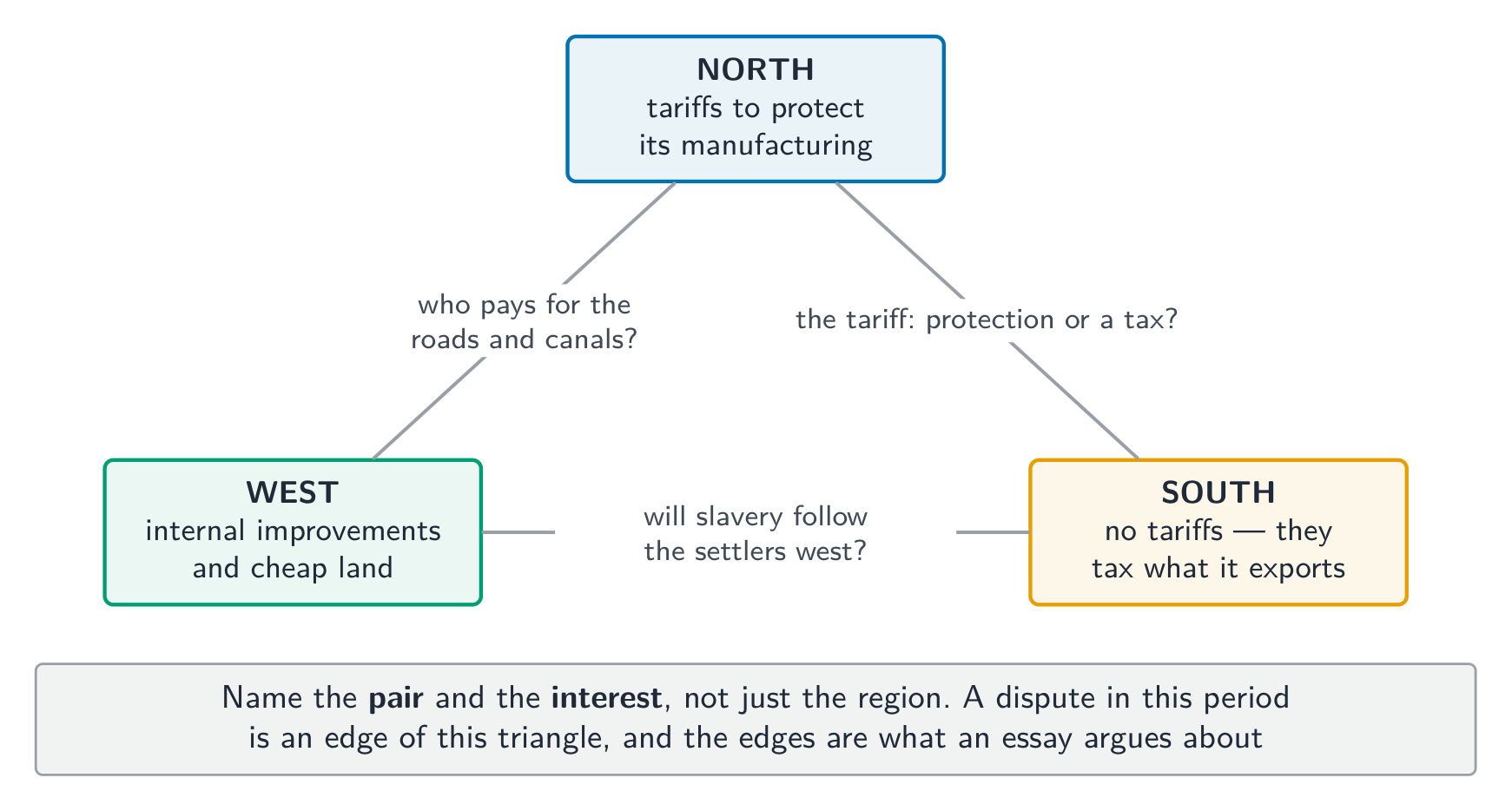
    As the country grew, regional interests 区域利益 diverged. The North favoured tariffs to protect manufacturing; the South opposed them as a tax on its exports; the West wanted internal improvements and cheap land. Nearly every political dispute of the period maps onto that triangle.

    Abroad, the United States struggled to create an independent global presence 独立的国际地位. It fought the War of 1812 1812年战争, expanded foreign trade, and in the Monroe Doctrine 门罗主义 declared the Western Hemisphere closed to further European colonisation - an assertion of influence well beyond the country's actual power at the time.

    Vocabulary Train
    English Chinese Pinyin
    regional interests 区域利益 qū yù lì yì
    independent global presence 独立的国际地位 dú lì de guó jì dì wèi
    War of 1812 1812年战争 1812 nián zhàn zhēng
    Monroe Doctrine 门罗主义 mén luó zhǔ yì
    4.5

    The Market Revolution

    Syllabus

    4.5 Market Revolution: Industrialization

    Thematic FocusLearning ObjectiveHistorical Developments

    WXT
    Work, Exchange, and Technology — The interplay between markets, private enterprise, labor, technology, and government policy shape the American economy. In turn, economic activity shapes society and government policy and drives technological innovation.

    Unit 4.E
    Explain the causes and effects of the innovations in technology, agriculture, and commerce over time.

    • KC-4.2.I.A Entrepreneurs helped to create a market revolution in production and commerce, in which market relationships between producers and consumers came to prevail as the manufacture of goods became more organized.
    • KC-4.2.I.B Innovations including textile machinery, steam engines, interchangeable parts, the telegraph, and agricultural inventions increased the efficiency of production methods.
    • KC-4.2.I.C Legislation and judicial systems supported the development of roads, canals, and railroads, which extended and enlarged markets and helped foster regional interdependence. Transportation networks linked the North and Midwest more closely than they linked regions in the South.
    • KC-4.2.III.B Increasing Southern cotton production and the related growth of Northern manufacturing, banking, and shipping industries promoted the development of national and international commercial ties.

    Source: College Board AP Course and Exam Description

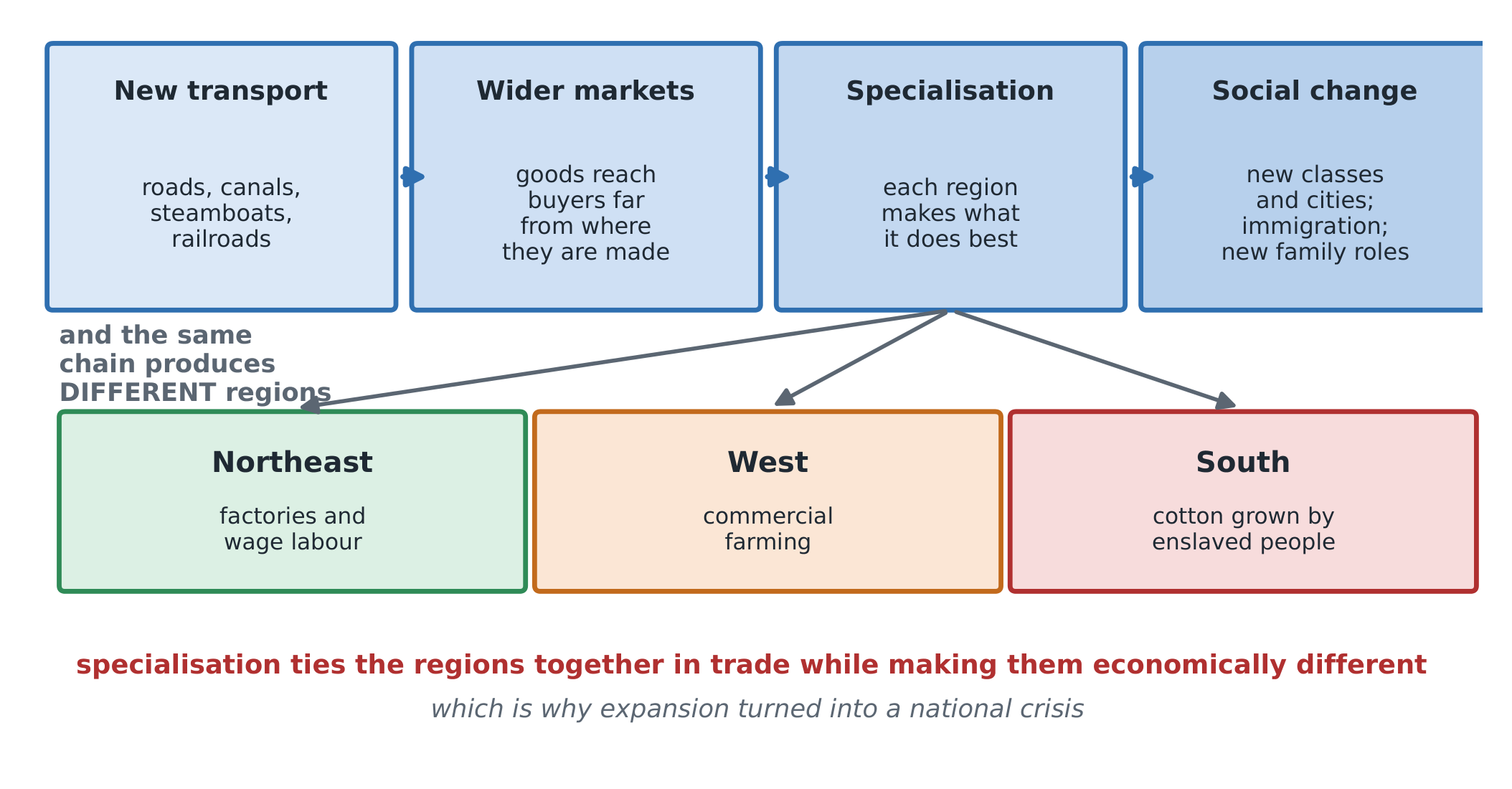
    The market revolution as a chain: new transport creates wider markets, which drive specialisation, which reshapes each region and its society
    The market revolution is a chain, not a list: each link is what turns the previous one into a change in how people lived

    New transportation systems 交通体系 - roads, canals 运河 such as the Erie, steamboats, and then railroads 铁路 - together with new technologies dramatically expanded manufacturing and agricultural output.

    The mechanism is what the exam wants. Cheaper transport widened markets 市场; wider markets let regions specialise 专业化 in what they did best; specialisation tied the regions together in trade while making them economically different from one another.

    The results by region: factory production 工厂生产 and wage labour in the Northeast, commercial farming 商业化农业 in the West, and in the South an intensified reliance on cotton 棉花 grown by enslaved people.

    Vocabulary Train
    English Chinese Pinyin
    transportation systems 交通体系 jiāo tōng tǐ xì
    canals 运河 yùn hé
    railroads 铁路 tiě lù
    markets 市场 shì chǎng
    specialise 专业化 zhuān yè huà
    factory production 工厂生产 gōng chǎng shēng chǎn
    commercial farming 商业化农业 shāng yè huà nóng yè
    cotton 棉花 mián huā
    4.6

    Society and Culture in the Market Revolution

    Syllabus

    4.6 Market Revolution: Society and Culture

    Thematic FocusLearning ObjectiveHistorical Developments

    SOC
    Social Structures — Social categories, roles, and practices are created, maintained, challenged, and transformed throughout American history, shaping government policy, economic systems, culture, and the lives of citizens.

    Unit 4.F
    Explain how and why innovation in technology, agriculture, and commerce affected various segments of American society over time.

    • KC-4.2.III.A Large numbers of international migrants moved to industrializing Northern cities, while many Americans moved west of the Appalachians, developing thriving new communities along the Ohio and Mississippi rivers.
    • KC-4.2.II.B The growth of manufacturing drove a significant increase in prosperity and standards of living for some; this led to the emergence of a larger middle class and a small but wealthy business elite, but also to a large and growing population of laboring poor.
    • KC-4.2.II.A Increasing numbers of Americans, especially women and men working in factories, no longer relied on semi-subsistence agriculture; instead they supported themselves producing goods for distant markets.
    • KC-4.2.II.C Gender and family roles changed in response to the market revolution, particularly with the growth of definitions of domestic ideals that emphasized the separation of public and private spheres.

    Source: College Board AP Course and Exam Description

    The market revolution changed how people lived, not just what they produced.

    • Work moved out of the household and into factories and offices, producing a growing middle class 中产阶级 and a new wage-earning working class 雇佣劳动者阶级.
    • A separation of home and workplace 家庭与工作场所分离 encouraged an ideology assigning women a domestic role, even as many women worked for wages in mills.
    • Immigration 移民 rose sharply, especially from Ireland and Germany, producing both a larger labour force and organised nativist 排外主义 hostility.
    • Urbanisation 城市化 accelerated, with the social problems that followed.
    Vocabulary Train
    English Chinese Pinyin
    middle class 中产阶级 zhōng chǎn jiē jí
    wage-earning working class 雇佣劳动者阶级 gù yōng láo dòng zhě jiē jí
    separation of home and workplace 家庭与工作场所分离 jiā tíng yǔ gōng zuò chǎng suǒ fēn lí
    Immigration 移民 yí mín
    nativist 排外主义 pái wài zhǔ yì
    Urbanisation 城市化 chéng shì huà
    4.7 4.8

    Expanding Democracy and Jackson

    Syllabus

    4.7 Expanding Democracy

    Thematic FocusLearning ObjectiveHistorical Developments

    PCE
    Politics and Power — Debates fostered by social and political groups about the role of government in American social, political, and economic life shape government policy, institutions, political parties, and the rights of citizens.

    Unit 4.G
    Explain the causes and effects of the expansion of participatory democracy from 1800 to 1848.

    • KC-4.1.I The nation’s transition to a more participatory democracy was achieved by expanding suffrage from a system based on property ownership to one based on voting by all adult white men, and it was accompanied by the growth of political parties.

    4.8 Jackson and Federal Power

    Thematic FocusLearning ObjectiveHistorical Developments

    PCE
    Politics and Power — Debates fostered by social and political groups about the role of government in American social, political, and economic life shape government policy, institutions, political parties, and the rights of citizens.

    Unit 4.H
    Explain the causes and effects of continuing policy debates about the role of the federal government from 1800 to 1848.

    • KC-4.1.I.C By the 1820s and 1830s, new political parties arose—the Democrats, led by Andrew Jackson, and the Whigs, led by Henry Clay— that disagreed about the role and powers of the federal government and issues such as the national bank, tariffs, and federally funded internal improvements.
    • KC-4.3.I.B Frontier settlers tended to champion expansion efforts, while American Indian resistance led to a sequence of wars and federal efforts to control and relocate American Indian populations.

    Source: College Board AP Course and Exam Description

    The transition to a more participatory democracy 更具参与性的民主 came through expanding suffrage 选举权 - the removal of property qualifications for white men - along with new campaign styles and mass political parties.

    The limits matter as much as the expansion: this widening applied to white men, while free African Americans in several states lost voting rights in the same decades, and women had none.

    Andrew Jackson 杰克逊 embodied and tested the new politics. His presidency featured a war on the national bank, the nullification crisis 废止危机 over the tariff, and the Indian Removal Act 印第安人迁移法 - the forced removal of southeastern nations along what became known as the Trail of Tears 血泪之路.

    Vocabulary Train
    English Chinese Pinyin
    more participatory democracy 更具参与性的民主 gèng jù cān yù xìng de mín zhǔ
    suffrage 选举权 xuǎn jǔ quán
    Andrew Jackson 杰克逊 jié kè xùn
    nullification crisis 废止危机 fèi zhǐ wēi jī
    Indian Removal Act 印第安人迁移法 yìn dì ān rén qiān yí fǎ
    Trail of Tears 血泪之路 xuè lèi zhī lù
    4.9 4.10 4.11

    Religion, Reform, and American Culture

    Syllabus

    4.9 The Development of an American Culture

    Thematic FocusLearning ObjectiveHistorical Developments

    ARC
    American and Regional Culture — Creative expression, demographic change, philosophy, religious beliefs, scientific ideas, social mores, and technology shape national, regional, and group cultures in America, and these varying cultures often play a role in shaping government policy and developing economic systems.

    Unit 4.I
    Explain how and why a new national culture developed from 1800 to 1848.

    • KC-4.1.II.B A new national culture emerged that combined American elements, European influences, and regional cultural sensibilities.
    • KC-4.1.II.C Liberal social ideas from abroad and Romantic beliefs in human perfectibility influenced literature, art, philosophy, and architecture.

    4.10 The Second Great Awakening

    Thematic FocusLearning ObjectiveHistorical Developments

    ARC
    American and Regional Culture — Creative expression, demographic change, philosophy, religious beliefs, scientific ideas, social mores, and technology shape national, regional, and group cultures in America, and these varying cultures often play a role in shaping government policy and developing economic systems.

    Unit 4.J
    Explain the causes of the Second Great Awakening.

    • KC-4.1.II.A.i The rise of democratic and individualistic beliefs, a response to rationalism, and changes to society caused by the market revolution, along with greater social and geographical mobility, contributed to a Second Great Awakening among Protestants.

    4.11 An Age of Reform

    Thematic FocusLearning ObjectiveHistorical Developments

    ARC
    American and Regional Culture — Creative expression, demographic change, philosophy, religious beliefs, scientific ideas, social mores, and technology shape national, regional, and group cultures in America, and these varying cultures often play a role in shaping government policy and developing economic systems.

    Unit 4.K
    Explain how and why various reform movements developed and expanded from 1800 to 1848.

    • KC-4.1.II.A.ii The rise of democratic and individualistic beliefs, a response to rationalism, and changes to society caused by the market revolution, along with greater social and geographical mobility, contributed to a Second Great Awakening among Protestants that influenced moral and social reforms and inspired utopian and other religious movements.
    • KC-4.1.III.A Americans formed new voluntary organizations that aimed to change individual behaviors and improve society through temperance and other reform efforts.
    • KC-4.1.III.B.i Abolitionist and antislavery movements gradually achieved emancipation in the North, contributing to the growth of the free African American population, even as many state governments restricted African Americans’ rights.
    • KC-4.3.II.B.i Antislavery movements increased in the North.
    • KC-4.1.III.C A women’s rights movement sought to create greater equality and opportunities for women, expressing its ideals at the Seneca Falls Convention. Over time, arguments emerged over whether to narrow the goals to white women.

    Source: College Board AP Course and Exam Description

    The rise of democratic and individualistic beliefs, a reaction against rationalism, and changes brought by the market revolution together produced the Second Great Awakening 第二次大觉醒, a wave of religious revival emphasising personal salvation and human perfectibility.

    That conviction fed reform. Americans formed voluntary organizations 自愿团体 aimed at changing individual behaviour and institutions:

    • Temperance 禁酒运动 and prison, asylum, and school reform.
    • Abolitionist and antislavery movements 废奴与反奴隶制运动, which gradually achieved emancipation in the North and grew louder nationally.
    • A women's rights movement 妇女权利运动, which sought greater equality and opportunity and expressed its ideals at the Seneca Falls Convention 塞内卡福尔斯会议.

    Ideas about national identity increasingly found expression in art, literature, and architecture 艺术文学与建筑, while various groups maintained distinctive cultures of their own.

    Vocabulary Train
    English Chinese Pinyin
    Second Great Awakening 第二次大觉醒 dì èr cì dà jué xǐng
    voluntary organizations 自愿团体 zì yuàn tuán tǐ
    Temperance 禁酒运动 jìn jiǔ yùn dòng
    Abolitionist and antislavery movements 废奴与反奴隶制运动 fèi nú yǔ fǎn nú lì zhì yùn dòng
    women's rights movement 妇女权利运动 fù nǚ quán lì yùn dòng
    Seneca Falls Convention 塞内卡福尔斯会议 sāi nèi kǎ fú ěr sī huì yì
    art, literature, and architecture 艺术、文学与建筑 yì shù 、 wén xué yǔ jiàn zhù
    4.12 4.13

    African Americans and the Society of the South

    Syllabus

    4.12 African Americans in the Early Republic

    Thematic FocusLearning ObjectiveHistorical Developments

    SOC
    Social Structures — Social categories, roles, and practices are created, maintained, challenged, and transformed throughout American history, shaping government policy, economic systems, culture, and the lives of citizens.

    Unit 4.L
    Explain the continuities and changes in the experience of African Americans from 1800 to 1848.

    • KC-4.1.III.B.ii Antislavery efforts in the South were largely limited to unsuccessful rebellions by enslaved people.
    • KC-4.1.II.D Enslaved blacks and free African Americans created communities and strategies to protect their dignity and family structures, and they joined political efforts aimed at changing their status.

    4.13 The Society of the South in the Early Republic

    Thematic FocusLearning ObjectiveHistorical Developments

    GEO
    Geography and the Environment — Geographic and environmental factors, including competition over and debates about natural resources, shape the development of America and foster regional diversity. The development of America impacts the environment and reshapes geography, which leads to debates about environmental and geographic issues.

    Unit 4.M
    Explain how geographic and environmental factors shaped the development of the South from 1800 to 1848.

    • KC-4.3.II.B.ii In the South, although the majority of Southerners owned no enslaved persons, most leaders argued that slavery was part of the Southern way of life.
    • KC-4.2.III.C Southern business leaders continued to rely on the production and export of traditional agricultural staples, contributing to the growth of a distinctive Southern regional identity.
    • KC-4.3.II.A As overcultivation depleted arable land in the Southeast, slaveholders began relocating their plantations to more fertile lands west of the Appalachians, where the institution of slavery continued to grow.

    Source: College Board AP Course and Exam Description

    Antislavery effort in the South was largely limited to unsuccessful rebellions 未能成功的起义 by enslaved people, which were met with harsher laws and tighter control.

    Enslaved and free African Americans created communities and strategies 社群与策略 to protect themselves: family and kinship networks, religious practice, music, and covert resistance - a continuation of the pattern from Period 2.

    In the South, although the majority of southerners owned no enslaved persons, most supported the system. As overcultivation depleted arable land in the Southeast, slaveholders relocated westward 向西迁移, carrying slavery into new territory - which is precisely what made westward expansion a national crisis rather than a regional one.

    Vocabulary Train
    English Chinese Pinyin
    unsuccessful rebellions 未能成功的起义 wèi néng chéng gōng de qǐ yì
    communities and strategies 社群与策略 shè qún yǔ cè lüè
    relocated westward 向西迁移 xiàng xī qiān yí
    4.14

    Causation in Period 4

    Syllabus

    4.14 Causation in Period 4

    Learning ObjectiveReview: Unit 4 Key Concepts

    Unit 4.N
    Explain the extent to which politics, economics, and foreign policy promoted the development of American identity from 1800 to 1848.

    • KC-4.1 The United States began to develop a modern democracy and celebrated a new national culture, while Americans sought to define the nation’s democratic ideals and change their society and institutions to match them.
      • KC-4.1.I The nation’s transition to a more participatory democracy was achieved by expanding suffrage from a system based on property ownership to one based on voting by all adult white men, and it was accompanied by the growth of political parties.
      • KC-4.1.II While Americans embraced a new national culture, various groups developed distinctive cultures of their own.
      • KC-4.1.III Increasing numbers of Americans, many inspired by new religious and intellectual movements, worked primarily outside of government institutions to advance their ideals.
    • KC-4.2 Innovations in technology, agriculture, and commerce powerfully accelerated the American economy, precipitating profound changes to U.S. society and to national and regional identities.
      • KC-4.2.I New transportation systems and technologies dramatically expanded manufacturing and agricultural production.
      • KC-4.2.II The changes caused by the market revolution had significant effects on U.S. society, workers’ lives, and gender and family relations.
      • KC-4.2.III Economic development shaped settlement and trade patterns, helping to unify the nation while also encouraging the growth of different regions.
    • KC-4.3 The U.S. interest in increasing foreign trade and expanding its national borders shaped the nation’s foreign policy and spurred government and private initiatives.
      • KC-4.3.I Struggling to create an independent global presence, the United States sought to claim territory throughout the North American continent and promote foreign trade.
      • KC-4.3.II The United States’ acquisition of lands in the West gave rise to contests over the extension of slavery into new territories.

    Source: College Board AP Course and Exam Description

    The period's reasoning skill is causation. The strongest chain to hold: the market revolution and westward expansion were engines of growth, and both drove the sectional conflict that Period 5 resolves by war.

    Worked example (a real AP exam question). The 2023 exam set the long essay "Evaluate the extent to which commercial development changed United States society from 1800 to 1855." A high-scoring thesis takes a position on how much, and names the areas of change: "Commercial development transformed United States society to a great extent between 1800 and 1855, creating a wage-earning working class and a distinct middle class in the North and drawing the West into national markets, though in the South it deepened rather than displaced an existing slave-based agricultural order." Notice the shape: Evaluate the extent rewards a qualified position - "to a great extent, though…" - because that structure lets the essay use evidence on both sides. A thesis that merely says commercial development "changed society a lot" cannot be argued.

    4.14

    Exam tips

    • Learn the market revolution as a chain: transport → wider markets → specialisation → different regional economies → social change.
    • Give the regional triangle (North, South, West) when explaining a political dispute; tariff, bank, and internal improvements all fit it.
    • Democracy expanded for white men while free Black men lost rights in several states. Saying so is what turns a description into an evaluation.
    • Connect the Second Great Awakening to reform: revival supplied the belief that people and society could be perfected.
    • Southern westward migration matters because it carried slavery west, turning expansion into the central national conflict.
    • On Evaluate the extent prompts, qualify your position. "To a great extent, although…" is the structure the rubric rewards.
  • 5

    Period 5: 1844–1877

    5.1 5.2 5.3

    Manifest Destiny and Expansion

    Syllabus

    5.1 Contextualizing Period 5

    Learning ObjectivePreview: Unit 5 Key Concepts

    Unit 5.A
    Explain the context in which sectional conflict emerged from 1844 to 1877.

    • KC-5.1 The United States became more connected with the world, pursued an expansionist foreign policy in the Western Hemisphere, and emerged as the destination for many migrants from other countries.
      • KC-5.1.I Popular enthusiasm for U.S. expansion, bolstered by economic and security interests, resulted in the acquisition of new territories, substantial migration westward, and new overseas initiatives.
      • KC-5.1.II In the 1840s and 1850s, Americans continued to debate questions about rights and citizenship for various groups of U.S. inhabitants.
    • KC-5.2 Intensified by expansion and deepening regional divisions, debates over slavery and other economic, cultural, and political issues led the nation into civil war.
      • KC-5.2.I Ideological and economic differences over slavery produced an array of diverging responses from Americans in the North and the South.
      • KC-5.2.II Debates over slavery came to dominate political discussion in the 1850s, culminating in the bitter election of 1860 and the secession of Southern states.
    • KC-5.3 The Union victory in the Civil War and the contested reconstruction of the South settled the issues of slavery and secession, but left unresolved many questions about the power of the federal government and citizenship rights.
      • KC-5.3.I The North’s greater manpower and industrial resources, the leadership of Abraham Lincoln and others, and the decision to emancipate enslaved people eventually led to the Union military victory over the Confederacy in the devastating Civil War.
      • KC-5.3.II.i Reconstruction and the Civil War ended slavery, altered relationships between the states and the federal government, and led to debates over new definitions of citizenship, particularly regarding the rights of African Americans, women, and other minorities.

    5.2 Manifest Destiny

    Thematic FocusLearning ObjectiveHistorical Developments

    GEO
    Geography and the Environment — Geographic and environmental factors, including competition over and debates about natural resources, shape the development of America and foster regional diversity. The development of America impacts the environment and reshapes geography, which leads to debates about environmental and geographic issues.

    Unit 5.B
    Explain the causes and effects of westward expansion from 1844 to 1877.

    • KC-5.1.I.A The desire for access to natural and mineral resources and the hope of many settlers for economic opportunities or religious refuge led to an increased migration to and settlement in the West.
    • KC-5.1.I.B Advocates of annexing western lands argued that Manifest Destiny and the superiority of American institutions compelled the United States to expand its borders westward to the Pacific Ocean; however, this frequently provoked competition and violent conflict.
    • KC-5.1.I.D Westward migration was boosted during and after the Civil War by the passage of new legislation promoting western transportation and economic development.
    • KC-5.1.I.E U.S. interest in expanding trade led to economic, diplomatic, and cultural initiatives to create more ties with Asia.

    5.3 The Mexican–American War

    Thematic FocusLearning ObjectiveHistorical Developments

    WOR
    America in the World — Diplomatic, economic, cultural, and military interactions between empires, nations, and peoples shape the development of America and America’s increasingly important role in the world.

    Unit 5.C
    Explain the causes and effects of the Mexican– American War.

    • KC-5.1.I.C The United States added large territories in the West through victory in the Mexican– American War and diplomatic negotiations, raising questions about the status of slavery, American Indians, and Mexicans in the newly acquired lands.
    • KC-5.1.II.C U.S. government interaction and conflict with Mexican Americans and American Indians increased in regions newly taken from American Indians and Mexico, altering these groups’ economic self-sufficiency and cultures.

    Source: College Board AP Course and Exam Description

    Period 5 runs from 1844 to 1877. It is the period in which the argument over slavery stops being political and becomes military.

    Expansion is the trigger. The desire for access to natural and mineral resources 自然与矿产资源, and the hope of settlers for land, pushed Americans west. Advocates justified annexation through Manifest Destiny 天定命运论 - the claim that the United States was destined, and superior enough, to spread across the continent.

    The Mexican-American War 美墨战争 added enormous territory in the West. Later, wartime legislation such as the Homestead Act 宅地法 boosted migration further, and interest in expanding trade produced economic and diplomatic initiatives abroad.

    Expansion also meant conflict. The government's interaction with Mexican Americans 墨西哥裔美国人 and American Indians produced dispossession, resistance, and new legal disputes over land and citizenship.

    Vocabulary Train
    English Chinese Pinyin
    natural and mineral resources 自然与矿产资源 zì rán yǔ kuàng chǎn zī yuán
    Manifest Destiny 天定命运论 tiān dìng mìng yùn lùn
    Mexican-American War 美墨战争 měi mò zhàn zhēng
    Homestead Act 宅地法 zhái dì fǎ
    Mexican Americans 墨西哥裔美国人 mò xī gē yì měi guó rén
    5.4 5.5 5.6

    Why Expansion Broke the Political System

    Syllabus

    5.4 The Compromise of 1850

    Thematic FocusLearning ObjectiveHistorical Developments

    NAT
    American and National Identity — The development of and debates about democracy, freedom, citizenship, diversity, and individualism shape American national identity, cultural values, and beliefs about American exceptionalism, and in turn, these ideas shape political institutions and society. Throughout American history, notions of national identity and culture have coexisted with varying degrees of regional and group identities.

    Unit 5.D
    Explain the similarities and differences in how regional attitudes affected federal policy in the period after the Mexican–American War.

    • KC-5.2.II.A The Mexican Cession led to heated controversies over whether to allow slavery in the newly acquired territories.
    • KC-5.2.II.B.i The courts and national leaders made a variety of attempts to resolve the issue of slavery in the territories, including the Compromise of 1850.

    5.5 Sectional Conflict: Regional Differences

    Thematic FocusLearning ObjectiveHistorical Developments

    SOC
    Social Structures — Social categories, roles, and practices are created, maintained, challenged, and transformed throughout American history, shaping government policy, economic systems, culture, and the lives of citizens.

    Unit 5.E
    Explain the effects of immigration from various parts of the world on American culture from 1844 to 1877.

    • KC-5.1.II.A Substantial numbers of international migrants continued to arrive in the United States from Europe and Asia, mainly from Ireland and Germany, often settling in ethnic communities where they could preserve elements of their languages and customs.
    • KC-5.1.II.B A strongly anti-Catholic nativist movement arose that was aimed at limiting new immigrants’ political power and cultural influence.

    Unit 5.F
    Explain how regional differences related to slavery caused tension in the years leading up to the Civil War.

    • KC-5.2.I.A The North’s expanding manufacturing economy relied on free labor in contrast to the Southern economy’s dependence on enslaved labor. Some Northerners did not object to slavery on principle but claimed that slavery would undermine the free labor market. As a result, a free-soil movement arose that portrayed the expansion of slavery as incompatible with free labor.
    • KC-5.2.I.B African American and white abolitionists, although a minority in the North, mounted a highly visible campaign against slavery, presenting moral arguments against the institution, assisting escapes, and sometimes expressing a willingness to use violence to achieve their goals.
    • KC-5.2.I.C Defenders of slavery based their arguments on racial doctrines, the view that slavery was a positive social good, and the belief that slavery and states’ rights were protected by the Constitution.

    5.6 Failure of Compromise

    Thematic FocusLearning ObjectiveHistorical Developments

    PCE
    Politics and Power — Debates fostered by social and political groups about the role of government in American social, political, and economic life shape government policy, institutions, political parties, and the rights of citizens.

    Unit 5.G
    Explain the political causes of the Civil War.

    • KC-5.2.II.B.ii The courts and national leaders made a variety of attempts to resolve the issue of slavery in the territories, including the Kansas–Nebraska Act, and the Dred Scott decision, but these ultimately failed to reduce conflict.
    • KC-5.2.II.C The Second Party System ended when the issues of slavery and anti-immigrant nativism weakened loyalties to the two major parties and fostered the emergence of sectional parties, most notably the Republican Party in the North.

    Source: College Board AP Course and Exam Description

    Each attempted compromise settles slavery in new territory, then breaks - and each failure narrows the room for the next
    Each compromise dealt with slavery in the territories, and each collapse left less room for the next one

    Acquiring land forced a question that could not be avoided: would slavery expand into the new territories? Every attempt to answer it produced a temporary settlement that then failed.

    • The Compromise of 1850 1850年妥协案 admitted California as free and included a strict Fugitive Slave Act 逃奴法, which enraged the North by requiring its citizens to participate in enforcement.
    • Popular sovereignty 人民主权原则 - letting territorial settlers decide - produced violence in Kansas rather than a settlement.
    • The Dred Scott decision 德雷德·斯科特案 held that Congress could not ban slavery in the territories, removing compromise as a legal option.

    Ideological and economic differences produced diverging responses 分歧的回应 to slavery, from abolitionism to proslavery arguments defending it as a positive good. By the 1850s slavery dominated political discussion, destroying the existing party system and producing the new Republican Party 共和党.

    Vocabulary Train
    English Chinese Pinyin
    Compromise of 1850 1850年妥协案 1850 nián tuǒ xié àn
    Fugitive Slave Act 逃奴法 táo nú fǎ
    Popular sovereignty 人民主权原则 rén mín zhǔ quán yuán zé
    Dred Scott decision 德雷德·斯科特案 dé léi dé · sī kē tè àn
    diverging responses 分歧的回应 fēn qí de huí yìng
    Republican Party 共和党 gòng hé dǎng
    5.7 5.8 5.9

    Secession and the Civil War

    Syllabus

    5.7 Election of 1860 and Secession

    Thematic FocusLearning ObjectiveHistorical Developments

    PCE
    Politics and Power — Debates fostered by social and political groups about the role of government in American social, political, and economic life shape government policy, institutions, political parties, and the rights of citizens.

    Unit 5.H
    Describe the effects of Lincoln’s election.

    • KC-5.2.II.D Abraham Lincoln’s victory on the Republicans’ free-soil platform in the presidential election of 1860 was accomplished without any Southern electoral votes. After a series of contested debates about secession, most slave states voted to secede from the Union, precipitating the Civil War.

    5.8 Military Conflict in the Civil War

    Thematic FocusLearning ObjectiveHistorical Developments

    WOR
    America in the World — Diplomatic, economic, cultural, and military interactions between empires, nations, and peoples shape the development of America and America’s increasingly important role in the world.

    Unit 5.I
    Explain the various factors that contributed to the Union victory in the Civil War.

    • KC-5.3.I.A Both the Union and the Confederacy mobilized their economies and societies to wage the war even while facing considerable home front opposition.
    • KC-5.3.I.D Although the Confederacy showed military initiative and daring early in the war, the Union ultimately succeeded due to improvements in leadership and strategy, key victories, greater resources, and the wartime destruction of the South’s infrastructure.

    5.9 Government Policies During the Civil War

    Thematic FocusLearning ObjectiveHistorical Developments

    NAT
    American and National Identity — The development of and debates about democracy, freedom, citizenship, diversity, and individualism shape American national identity, cultural values, and beliefs about American exceptionalism, and in turn, these ideas shape political institutions and society. Throughout American history, notions of national identity and culture have coexisted with varying degrees of regional and group identities.

    Unit 5.J
    Explain how Lincoln’s leadership during the Civil War impacted American ideals over the course of the war.

    • KC-5.3.I.B Lincoln and most Union supporters began the Civil War to preserve the Union, but Lincoln’s decision to issue the Emancipation Proclamation reframed the purpose of the war and helped prevent the Confederacy from gaining full diplomatic support from European powers. Many African Americans fled southern plantations and enlisted in the Union Army, helping to undermine the Confederacy.
    • KC-5.3.I.C Lincoln sought to reunify the country and used speeches such as the Gettysburg Address to portray the struggle against slavery as the fulfillment of America’s founding democratic ideals.

    Source: College Board AP Course and Exam Description

    The election of 1860 1860年大选 brought Abraham Lincoln 林肯 to power on a platform of preventing slavery's expansion. Southern states responded by seceding 脱离联邦, and the war followed.

    The Union won because of greater manpower and industrial resources 更多的人力与工业资源, Lincoln's leadership, and, decisively, the Emancipation Proclamation 解放黑奴宣言, which turned the war into a war against slavery and enabled the enlistment of African American soldiers.

    Government policy changed on both sides during the war: conscription, taxation, and an expanded federal role in the economy. African Americans' service and the actions of enslaved people who freed themselves by reaching Union lines shaped the outcome as well.

    Vocabulary Train
    English Chinese Pinyin
    election of 1860 1860年大选 1860 nián dà xuǎn
    Abraham Lincoln 林肯 lín kěn
    seceding 脱离联邦 tuō lí lián bāng
    greater manpower and industrial resources 更多的人力与工业资源 gèng duō de rén lì yǔ gōng yè zī yuán
    Emancipation Proclamation 解放黑奴宣言 jiě fàng hēi nú xuān yán
    5.10

    Reconstruction

    Syllabus

    5.10 Reconstruction

    Thematic FocusLearning ObjectiveHistorical Developments

    PCE
    Politics and Power — Debates fostered by social and political groups about the role of government in American social, political, and economic life shape government policy, institutions, political parties, and the rights of citizens.

    Unit 5.K
    Explain the effects of government policy during Reconstruction on society from 1865 to 1877.

    • KC-5.3.II.ii Reconstruction altered relationships between the states and the federal government and led to debates over new definitions of citizenship, particularly regarding the rights of African Americans, women, and other minorities.
    • KC-5.3.II.A The 13th Amendment abolished slavery, while the 14th and 15th amendments granted African Americans citizenship, equal protection under the laws, and voting rights.
    • KC-5.3.II.B The women’s rights movement was both emboldened and divided over the 14th and 15th amendments to the Constitution.
    • KC-5.3.II.C Efforts by radical and moderate Republicans to change the balance of power between Congress and the presidency and to reorder race relations in the defeated South yielded some short-term successes. Reconstruction opened up political opportunities and other leadership roles to formerly enslaved persons but it ultimately failed, due both to determined Southern resistance and the North’s waning resolve.

    Source: College Board AP Course and Exam Description

    Reconstruction 重建时期 attempted to settle three questions: the status of the freedpeople, the terms of readmission for the southern states, and the balance of power between the states and the federal government.

    The constitutional achievement is the Reconstruction Amendments 重建修正案:

    • The 13th Amendment 第十三修正案 abolished slavery.
    • The 14th Amendment 第十四修正案 granted citizenship and equal protection.
    • The 15th Amendment 第十五修正案 prohibited denial of the vote on grounds of race.

    The women's rights movement was both emboldened and divided 既受鼓舞又出现分裂 by the 14th and 15th Amendments, because they extended rights on the basis of race while introducing the word "male" into the Constitution.

    Radical and moderate Republicans 激进派与温和派共和党人 worked to change the balance of power between Congress and the presidency and to reshape southern society, through the Freedmen's Bureau, military occupation, and new state constitutions.

    Vocabulary Train
    English Chinese Pinyin
    Reconstruction 重建时期 chóng jiàn shí qī
    Reconstruction Amendments 重建修正案 chóng jiàn xiū zhèng àn
    13th Amendment 第十三修正案 dì shí sān xiū zhèng àn
    14th Amendment 第十四修正案 dì shí sì xiū zhèng àn
    15th Amendment 第十五修正案 dì shí wǔ xiū zhèng àn
    emboldened and divided 既受鼓舞又出现分裂 jì shòu gǔ wǔ yòu chū xiàn fēn liè
    Radical and moderate Republicans 激进派与温和派共和党人 jī jìn pài yǔ wēn hé pài gòng hé dǎng rén
    5.11

    The Failure of Reconstruction

    Syllabus

    5.11 Failure of Reconstruction

    Thematic FocusLearning ObjectiveHistorical Developments

    NAT
    American and National Identity — The development of and debates about democracy, freedom, citizenship, diversity, and individualism shape American national identity, cultural values, and beliefs about American exceptionalism, and in turn, these ideas shape political institutions and society. Throughout American history, notions of national identity and culture have coexisted with varying degrees of regional and group identities.

    Unit 5.L
    Explain how and why Reconstruction resulted in continuity and change in regional and national understandings of what it meant to be American.

    • KC-5.3.II.D Southern plantation owners continued to own the majority of the region’s land even after Reconstruction. Formerly enslaved persons sought land ownership but generally fell short of self-sufficiency, as an exploitative and soil-intensive sharecropping system limited blacks’ and poor whites’ access to land in the South.
    • KC-5.3.II.E Segregation, violence, Supreme Court decisions, and local political tactics progressively stripped away African American rights, but the 14th and 15th amendments eventually became the basis for court decisions upholding civil rights in the 20th century.

    Source: College Board AP Course and Exam Description

    Reconstruction's gains were reversed, and the exam expects the mechanisms, not just the outcome.

    Southern plantation owners continued to own most of the region's land 仍拥有该地区大部分土地 even after emancipation, so formerly enslaved people entered arrangements such as sharecropping 分成租佃 that produced dependence and debt rather than economic independence.

    Then segregation 种族隔离, violence 暴力, unfavourable Supreme Court decisions 最高法院判决, and local political tactics progressively stripped away 逐步剥夺 the rights African Americans had gained. The result was a legal and social system that persisted into the twentieth century.

    Vocabulary Train
    English Chinese Pinyin
    continued to own most of the region's land 仍拥有该地区大部分土地 réng yōng yǒu gāi dì qū dà bù fèn tǔ dì
    sharecropping 分成租佃 fēn chéng zū diàn
    segregation 种族隔离 zhǒng zú gé lí
    violence 暴力 bào lì
    Supreme Court decisions 最高法院判决 zuì gāo fǎ yuàn pàn jué
    stripped away 逐步剥夺 zhú bù bō duó
    5.12

    Comparison in Period 5

    Syllabus

    5.12 Comparison in Period 5

    Learning ObjectiveReview: Unit 5 Key Concepts

    Unit 5.M
    Compare the relative significance of the effects of the Civil War on American values.

    • KC-5.1 The United States became more connected with the world, pursued an expansionist foreign policy in the Western Hemisphere, and emerged as the destination for many migrants from other countries.
      • KC-5.1.I Popular enthusiasm for U.S. expansion, bolstered by economic and security interests, resulted in the acquisition of new territories, substantial migration westward, and new overseas initiatives.
      • KC-5.1.II In the 1840s and 1850s, Americans continued to debate questions about rights and citizenship for various groups of U.S. inhabitants.
    • KC-5.2 Intensified by expansion and deepening regional divisions, debates over slavery and other economic, cultural, and political issues led the nation into civil war.
      • KC-5.2.I Ideological and economic differences over slavery produced an array of diverging responses from Americans in the North and the South.
      • KC-5.2.II Debates over slavery came to dominate political discussion in the 1850s, culminating in the bitter election of 1860 and the secession of Southern states.
    • KC-5.3 The Union victory in the Civil War and the contested reconstruction of the South settled the issues of slavery and secession, but left unresolved many questions about the power of the federal government and citizenship rights.
      • KC-5.3.I The North’s greater manpower and industrial resources, the leadership of Abraham Lincoln and others, and the decision to emancipate enslaved people eventually led to the Union military victory over the Confederacy in the devastating Civil War.
      • KC-5.3.II.i Reconstruction and the Civil War ended slavery, altered relationships between the states and the federal government, and led to debates over new definitions of citizenship, particularly regarding the rights of African Americans, women, and other minorities.

    Source: College Board AP Course and Exam Description

    The period's reasoning skill is comparison. Useful comparisons: the North and South before the war; the aims of Reconstruction against its outcomes; and the status of African Americans in 1865 against 1877.

    Worked example (a real AP exam question). The 2023 exam set the long essay "Evaluate the extent to which the definitions of United States citizenship changed from 1865 to 1920." A strong thesis takes a position and acknowledges the reversal: "Definitions of citizenship changed substantially between 1865 and 1920, as the 14th and 15th Amendments established birthright citizenship and prohibited racial barriers to voting; however, segregation, violence and Supreme Court decisions made those definitions far less meaningful in practice for African Americans by 1900." Notice the shape: for a period that both expanded and reversed rights, a thesis must hold the legal change and the practical reversal together. Writing only about the amendments describes half the period.

    5.12

    Exam tips

    • Expansion is the cause of the sectional crisis. Every compromise from 1850 onwards is an attempt to answer whether slavery could expand.
    • Name the mechanism, not the mood. "Tensions rose" earns nothing; the Fugitive Slave Act, Dred Scott, and Bleeding Kansas do.
    • Give the Emancipation Proclamation its strategic role: it redefined the war's purpose and enabled Black enlistment.
    • Learn the three Reconstruction Amendments by what each one does; questions often turn on the difference between them.
    • For Reconstruction's failure, name sharecropping, segregation, violence, and Court decisions - the four mechanisms.
    • On comparison prompts, develop both sides. An answer that treats one side in a clause has answered half the question.
  • 6

    Period 6: 1865–1898

    6.1 6.2 6.3

    Westward Expansion after the Civil War

    Syllabus

    6.1 Contextualizing Period 6

    Learning ObjectivePreview: Unit 6 Key Concepts

    Unit 6.A
    Explain the historical context for the rise of industrial capitalism in the United States.

    • KC-6.1 Technological advances, large-scale production methods, and the opening of new markets encouraged the rise of industrial capitalism in the United States.
      • KC-6.1.I Large-scale industrial production— accompanied by massive technological change, expanding international communication networks, and pro-growth government policies—generated rapid economic development and business consolidation.
      • KC-6.1.II A variety of perspectives on the economy and labor developed during a time of financial panics and downturns.
      • KC-6.1.III New systems of production and transportation enabled consolidation within agriculture, which, along with periods of instability, spurred a variety of responses from farmers.
    • KC-6.2 The migrations that accompanied industrialization transformed both urban and rural areas of the United States and caused dramatic social and cultural change.
      • KC-6.2.I International and internal migration increased urban populations and fostered the growth of a new urban culture.
      • KC-6.2.II Larger numbers of migrants moved to the West in search of land and economic opportunity, frequently provoking competition and violent conflict.
    • KC-6.3 The Gilded Age produced new cultural and intellectual movements, public reform efforts, and political debates over economic and social policies.
      • KC-6.3.I New cultural and intellectual movements both buttressed and challenged the social order of the Gilded Age.
      • KC-6.3.II Dramatic social changes in the period inspired political debates over citizenship, corruption, and the proper relationship between business and government.

    6.2 Westward Expansion: Economic Development

    Thematic FocusLearning ObjectiveHistorical Developments

    MIG
    Migration and Settlement — Push and pull factors shape immigration to and migration within America, and the demographic change as a result of these moves shapes the migrants, society, and the environment.

    Unit 6.B
    Explain the causes and effects of the settlement of the West from 1877 to 1898.

    • KC-6.1.III.A Improvements in mechanization helped agricultural production increase substantially and contributed to declines in food prices.
    • KC-6.1.III.B Many farmers responded to the increasing consolidation in agricultural markets and their dependence on the evolving railroad system by creating local and regional cooperative organizations.
    • KC-6.1.I.A Following the Civil War, government subsidies for transportation and communication systems helped open new markets in North America.
    • KC-6.2.II.A The building of transcontinental railroads, the discovery of mineral resources, and government policies promoted economic growth and created new communities and centers of commercial activity.

    6.3 Westward Expansion: Social and Cultural Development

    Thematic FocusLearning ObjectiveHistorical Developments

    MIG
    Migration and Settlement — Push and pull factors shape immigration to and migration within America, and the demographic change as a result of these moves shapes the migrants, society, and the environment.

    Unit 6.B
    Explain the causes and effects of the settlement of the West from 1877 to 1898.

    • KC-6.2.II.B In hopes of achieving ideals of self-sufficiency and independence, migrants moved to both rural and boomtown areas of the West for opportunities, such as building the railroads, mining, farming, and ranching.
    • KC-6.2.II.C As migrant populations increased in number and the American bison population was decimated, competition for land and resources in the West among white settlers, American Indians, and Mexican Americans led to an increase in violent conflict.
    • KC-6.2.II.D The U.S. government violated treaties with American Indians and responded to resistance with military force, eventually confining American Indians to reservations and denying tribal sovereignty.
    • KC-6.2.II.E Many American Indians preserved their cultures and tribal identities despite government policies promoting assimilation, and they attempted to develop self-sustaining economic practices.

    Source: College Board AP Course and Exam Description

    Period 6 runs from 1865 to 1898 - the Gilded Age 镀金时代. Industry, migration, and the West transform the country, and every transformation produces a political argument about who benefits.

    Improvements in mechanization 机械化 raised agricultural production substantially, while railroads carried crops to national and world markets. But the same forces squeezed farmers: consolidation in agricultural markets 农产品市场集中化 left them facing high freight rates, expensive credit, and falling crop prices.

    Westward settlement also meant the final dispossession of American Indians. Federal policy moved from treaties to reservations 保留地 and then to assimilation 同化 through the Dawes Act 道斯法, which divided communal land into individual plots and transferred the surplus to settlers.

    Vocabulary Train
    English Chinese Pinyin
    Gilded Age 镀金时代 dù jīn shí dài
    mechanization 机械化 jī xiè huà
    consolidation in agricultural markets 农产品市场集中化 nóng chǎn pǐn shì chǎng jí zhōng huà
    reservations 保留地 bǎo liú dì
    assimilation 同化 tóng huà
    Dawes Act 道斯法 dào sī fǎ
    6.4 6.5 6.6

    The Rise of Industrial Capitalism

    Syllabus

    6.4 The “New South”

    Thematic FocusLearning ObjectiveHistorical Developments

    NAT
    American and National Identity — The development of and debates about democracy, freedom, citizenship, diversity, and individualism shape American national identity, cultural values, and beliefs about American exceptionalism, and in turn, these ideas shape political institutions and society. Throughout American history, notions of national identity and culture have coexisted with varying degrees of regional and group identities.

    Unit 6.C
    Explain how various factors contributed to continuity and change in the “New South” from 1877 to 1898.

    • KC-6.1.II.D Despite the industrialization of some segments of the Southern economy—a change promoted by Southern leaders who called for a “New South”—agriculture based on sharecropping and tenant farming continued to be the primary economic activity in the South.
    • KC-6.3.II.C The Supreme Court decision in Plessy v. Ferguson that upheld racial segregation (known as Jim Crow) helped to mark the end of most of the political gains African Americans made during Reconstruction. Facing increased violence, discrimination, and scientific theories of race, African American reformers continued to fight for political and social equality.

    6.5 Technological Innovation

    Thematic FocusLearning ObjectiveHistorical Developments

    WXT
    Work, Exchange, and Technology — The interplay between markets, private enterprise, labor, technology, and government policy shape the American economy. In turn, economic activity shapes society and government policy and drives technological innovation.

    Unit 6.D
    Explain the effects of technological advances in the development of the United States over time.

    • KC-6.1.I.B.i Businesses made use of technological innovations and greater access to natural resources to dramatically increase the production of goods.

    6.6 The Rise of Industrial Capitalism

    Thematic FocusLearning ObjectiveHistorical Developments

    WXT
    Work, Exchange, and Technology — The interplay between markets, private enterprise, labor, technology, and government policy shape the American economy. In turn, economic activity shapes society and government policy and drives technological innovation.

    Unit 6.E
    Explain the socioeconomic continuities and changes associated with the growth of industrial capitalism from 1865 to 1898.

    • KC-6.1.I Large-scale industrial production— accompanied by massive technological change, expanding international communication networks, pro-growth government policies—generated rapid economic development and business consolidation.
    • KC-6.1.I.B.ii Businesses made use of redesigned financial and management structures, advances in marketing, and a growing labor force to dramatically increase the production of goods.
    • KC-6.1.I.D Many business leaders sought increased profits by consolidating corporations into large trusts and holding companies, which further concentrated wealth.
    • KC-6.1.I.E.i Businesses increasingly looked outside U.S. borders in an effort to gain greater influence and control over markets and natural resources in the Pacific Rim, Asia, and Latin America.

    Source: College Board AP Course and Exam Description

    Large-scale industrial production, accompanied by massive technological change, produced enormous output and enormous firms.

    • New corporate structures 公司组织形式 - trusts and holding companies - allowed consolidation 合并 and, in some industries, near-monopoly.
    • New transportation and communication networks, above all the railroad, created a genuinely national market.
    • Business leaders defended their position with laissez-faire 自由放任 arguments: competition promoted growth, and government should stay out.

    The same period produced rising inequality 不平等加剧 and recurring financial panics, which is why the economy itself became the central political question.

    Vocabulary Train
    English Chinese Pinyin
    corporate structures 公司组织形式 gōng sī zǔ zhī xíng shì
    consolidation 合并 hé bìng
    laissez-faire 自由放任 zì yóu fàng rèn
    rising inequality 不平等加剧 bù píng děng jiā jù
    6.7

    Labour in the Gilded Age

    Syllabus

    6.7 Labor in the Gilded Age

    Thematic FocusLearning ObjectiveHistorical Developments

    WXT
    Work, Exchange, and Technology — The interplay between markets, private enterprise, labor, technology, and government policy shape the American economy. In turn, economic activity shapes society and government policy and drives technological innovation.

    Unit 6.E
    Explain the socioeconomic continuities and changes associated with the growth of industrial capitalism from 1865 to 1898.

    • KC-6.1.I.C As the price of many goods decreased, workers’ real wages increased, providing new access to a variety of goods and services; many Americans’ standards of living improved, while the gap between rich and poor grew.
    • KC-6.1.II.C Labor and management battled over wages and working conditions, with workers organizing local and national unions and/or directly confronting business leaders.
    • KC-6.1.II.B.i The industrial workforce expanded and child labor increased.

    Source: College Board AP Course and Exam Description

    The Gilded Age argument: the same industrial economy read four different ways, each with its own remedy
    One economy, four responses: each group diagnosed a different problem and proposed a different remedy

    A variety of perspectives 各种不同的立场 on the economy and labour developed. Workers faced long hours, dangerous conditions, and wages that fell during downturns.

    They organised. Unions such as the Knights of Labor 劳工骑士团 and the American Federation of Labor 美国劳工联合会 differed over who to admit and what to demand - the AFL concentrating on skilled workers and practical gains in wages and hours. Strikes 罢工 were frequent, often large, and frequently broken by state or federal force, which itself became an argument about the role of government.
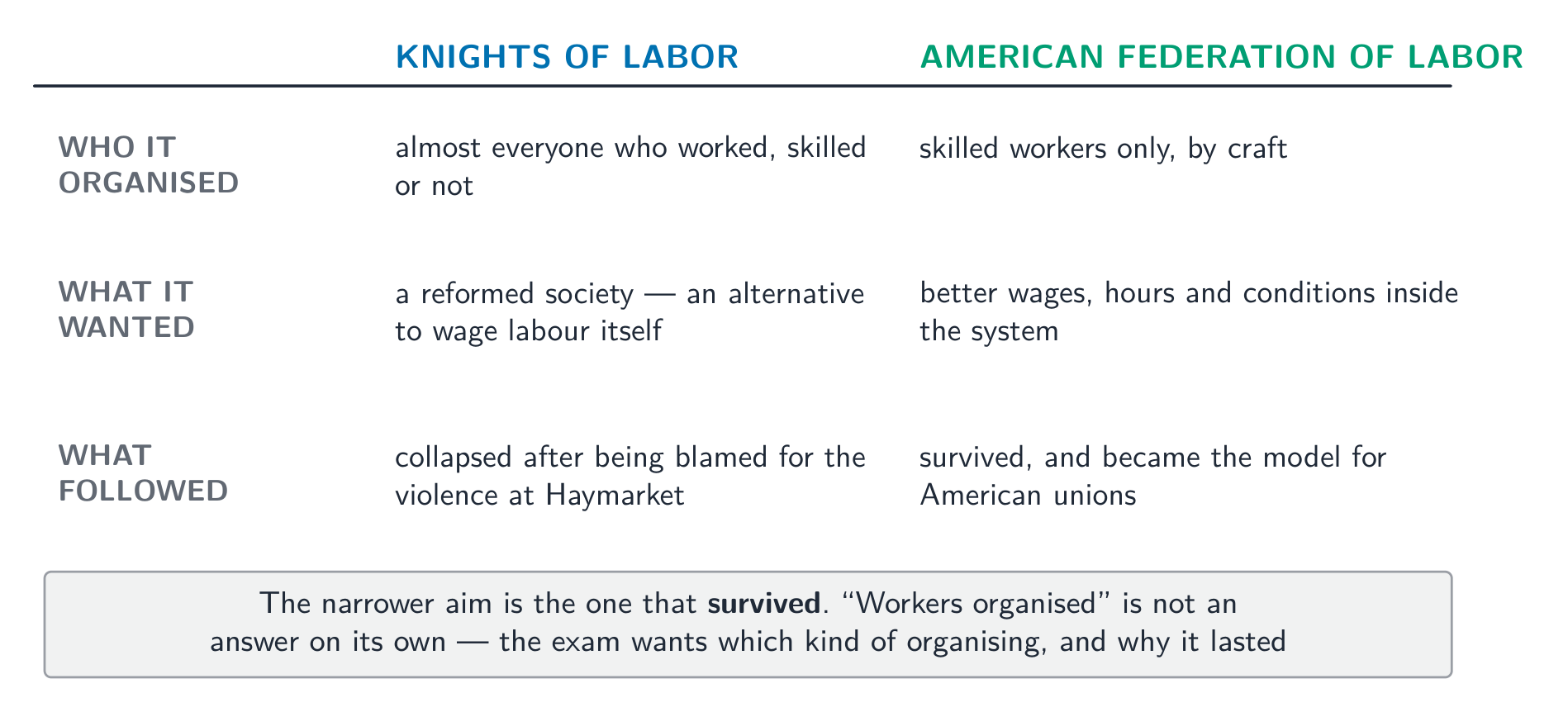
    Vocabulary Train
    English Chinese Pinyin
    variety of perspectives 各种不同的立场 gè zhǒng bù tóng de lì chǎng
    Knights of Labor 劳工骑士团 láo gōng qí shì tuán
    American Federation of Labor 美国劳工联合会 měi guó láo gōng lián hé huì
    Strikes 罢工 bà gōng
    6.8 6.9

    Migration and the Cities

    Syllabus

    6.8 Immigration and Migration in the Gilded Age

    Thematic FocusLearning ObjectiveHistorical Developments

    MIG
    Migration and Settlement — Push and pull factors shape immigration to and migration within America, and the demographic change as a result of these moves shapes the migrants, society, and the environment.

    Unit 6.F
    Explain how cultural and economic factors affected migration patterns over time.

    • KC-6.1.II.B.ii The industrial workforce expanded and became more diverse through internal and international migration.
    • KC-6.2.I.A As cities became areas of economic growth featuring new factories and businesses, they attracted immigrants from Asia and southern and eastern Europe, as well as African American migrants within and out of the South. Many migrants moved to escape poverty, religious persecution, and limited opportunities for social mobility in their home countries or regions.
    • KC-6.2.I.B Urban neighborhoods based on particular ethnicities, races, and classes provided new cultural opportunities for city dwellers.

    6.9 Responses to Immigration in the Gilded Age

    Thematic FocusLearning ObjectiveHistorical Developments

    MIG
    Migration and Settlement — Push and pull factors shape immigration to and migration within America, and the demographic change as a result of these moves shapes the migrants, society, and the environment.

    Unit 6.G
    Explain the various responses to immigration in the period over time.

    • KC-6.2.I.C Increasing public debates over assimilation and Americanization accompanied the growth of international migration. Many immigrants negotiated compromises between the cultures they brought and the culture they found in the United States.
    • KC-6.3.I.A Social commentators advocated theories later described as Social Darwinism to justify the success of those at the top of the socioeconomic structure as both appropriate and inevitable.
    • KC-6.3.II.B.i Many women, like Jane Addams, worked in settlement houses to help immigrants adapt to U.S. language and customs.

    Source: College Board AP Course and Exam Description

    International and internal migration increased urban populations and fostered the growth of cities 城市.

    New arrivals came increasingly from southern and eastern Europe 南欧与东欧, alongside Chinese migration to the West - which met the Chinese Exclusion Act 排华法案, the first significant federal restriction on immigration by nationality.

    In cities where access to power was unequally distributed, political machines 政治机器 provided jobs, housing help, and services in exchange for votes - corrupt by later standards, and for many migrants the only functioning source of support.

    Migration also produced organised hostility. Nativist movements argued that new arrivals threatened wages, culture, or self-government.

    Vocabulary Train
    English Chinese Pinyin
    cities 城市 chéng shì
    southern and eastern Europe 南欧与东欧 nán ōu yǔ dōng ōu
    Chinese Exclusion Act 排华法案 pái huá fǎ àn
    political machines 政治机器 zhèng zhì jī qì
    6.10 6.11

    The New Middle Class and Reform

    Syllabus

    6.10 Development of the Middle Class

    Thematic FocusLearning ObjectiveHistorical Developments

    SOC
    Social Structures — Social categories, roles, and practices are created, maintained, challenged, and transformed throughout American history, shaping government policy, economic systems, culture, and the lives of citizens.

    Unit 6.H
    Explain the causes of increased economic opportunity and its effects on society.

    • KC-6.2.I.E Corporations’ need for managers and for male and female clerical workers, as well as increased access to educational institutions, fostered the growth of a distinctive middle class. A growing amount of leisure time also helped expand consumer culture.
    • KC-6.3.I.B Some business leaders argued that the wealthy had a moral obligation to help the less fortunate and improve society, as articulated in the idea known as the Gospel of Wealth, and they made philanthropic contributions that enhanced educational opportunities and urban environments.

    6.11 Reform in the Gilded Age

    Thematic FocusLearning ObjectiveHistorical Developments

    SOC
    Social Structures — Social categories, roles, and practices are created, maintained, challenged, and transformed throughout American history, shaping government policy, economic systems, culture, and the lives of citizens.

    Unit 6.I
    Explain how different reform movements responded to the rise of industrial capitalism in the Gilded Age.

    • KC-6.3.I.C A number of artists and critics, including agrarians, utopians, socialists, and advocates of the Social Gospel, championed alternative visions for the economy and U.S. society.
    • KC-6.3.II.B.ii Many women sought greater equality with men, often joining voluntary organizations, going to college, and promoting social and political reform.

    Source: College Board AP Course and Exam Description

    Corporations' need for managers 管理人员 and for male and female clerical workers 文职人员 expanded a new middle class 中产阶级, with new patterns of consumption and leisure.

    Cultural and intellectual movements both buttressed and challenged 既支持又挑战 the social order:

    • Social Darwinism 社会达尔文主义 used evolutionary language to justify inequality as natural.
    • The Gospel of Wealth 财富福音 argued that the wealthy had a moral obligation 道德义务 to use their fortunes for the public good.
    • Agrarians, utopians, socialists, and artists criticised industrial society from the other direction.
    • Many women sought greater equality, often through voluntary organizations 自愿团体 - temperance, settlement houses, and suffrage work.
    Vocabulary Train
    English Chinese Pinyin
    managers 管理人员 guǎn lǐ rén yuán
    clerical workers 文职人员 wén zhí rén yuán
    middle class 中产阶级 zhōng chǎn jiē jí
    buttressed and challenged 既支持又挑战 jì zhī chí yòu tiǎo zhàn
    Social Darwinism 社会达尔文主义 shè huì dá ěr wén zhǔ yì
    Gospel of Wealth 财富福音 cái fù fú yīn
    moral obligation 道德义务 dào dé yì wù
    voluntary organizations 自愿团体 zì yuàn tuán tǐ
    6.12 6.13

    Politics and the Populist Challenge

    Syllabus

    6.12 Controversies over the Role of Government in the Gilded Age

    Thematic FocusLearning ObjectiveHistorical Developments

    PCE
    Politics and Power — Debates fostered by social and political groups about the role of government in American social, political, and economic life shape government policy, institutions, political parties, and the rights of citizens.

    Unit 6.J
    Explain continuities and changes in the role of the government in the U.S. economy.

    • KC-6.1.II.A Some argued that laissez-faire policies and competition promoted economic growth in the long run, and they opposed government intervention during economic downturns.
    • KC-6.1.I.E.ii Foreign policymakers increasingly looked outside U.S. borders in an effort to gain greater influence and control over markets and natural resources in the Pacific Rim, Asia, and Latin America.

    6.13 Politics in the Gilded Age

    Thematic FocusLearning ObjectiveHistorical Developments

    PCE
    Politics and Power — Debates fostered by social and political groups about the role of government in American social, political, and economic life shape government policy, institutions, political parties, and the rights of citizens.

    Unit 6.K
    Explain the similarities and differences between the political parties during the Gilded Age.

    • KC-6.1.III.C Economic instability inspired agrarian activists to create the People’s (Populist) Party, which called for a stronger governmental role in regulating the American economic system.
    • KC-6.3.II.A The major political parties appealed to lingering divisions from the Civil War and contended over tariffs and currency issues, even as reformers argued that economic greed and self-interest had corrupted all levels of government.
    • KC-6.2.I.D In an urban atmosphere where the access to power was unequally distributed, political machines thrived, in part by providing immigrants and the poor with social services.

    Source: College Board AP Course and Exam Description

    The major parties appealed to lingering divisions from the Civil War and competed over patronage 政治分肥 more than policy, producing close elections and limited legislation.

    Economic instability drove agrarian activists to build the People's (Populist) Party 人民党, demanding government action: regulation of railroads, currency reform, and a graduated income tax. Populism failed as a party but placed on the agenda the idea that government should intervene in the economy - the argument Period 7 takes up.

    Debates over citizenship 公民身份, race, and the role of government ran through all of this, as the rights promised during Reconstruction continued to be narrowed.

    Vocabulary Train
    English Chinese Pinyin
    patronage 政治分肥 zhèng zhì fēn féi
    People's (Populist) Party 人民党 rén mín dǎng
    citizenship 公民身份 gōng mín shēn fèn
    6.14

    Continuity and Change in Period 6

    Syllabus

    6.14 Continuity and Change Period 6

    Learning ObjectiveReview: Unit 6 Key Concepts

    Unit 6.L
    Explain the extent to which industrialization brought change from 1865 to 1898.

    • KC-6.1 Technological advances, large-scale production methods, and the opening of new markets encouraged the rise of industrial capitalism in the United States.
      • KC-6.1.I Large-scale industrial production— accompanied by massive technological change, expanding international communication networks, and pro-growth government policies—generated rapid economic development and business consolidation.
      • KC-6.1.II A variety of perspectives on the economy and labor developed during a time of financial panics and downturns.
      • KC-6.1.III New systems of production and transportation enabled consolidation within agriculture, which, along with periods of instability, spurred a variety of responses from farmers.
    • KC-6.2 The migrations that accompanied industrialization transformed both urban and rural areas of the United States and caused dramatic social and cultural change.
      • KC-6.2.I International and internal migration increased urban populations and fostered the growth of a new urban culture.
      • KC-6.2.II Larger numbers of migrants moved to the West in search of land and economic opportunity, frequently provoking competition and violent conflict.
    • KC-6.3 The Gilded Age produced new cultural and intellectual movements, public reform efforts, and political debates over economic and social policies.
      • KC-6.3.I New cultural and intellectual movements both buttressed and challenged the social order of the Gilded Age.
      • KC-6.3.II Dramatic social changes in the period inspired political debates over citizenship, corruption, and the proper relationship between business and government.

    Source: College Board AP Course and Exam Description

    The period's reasoning skill is continuity and change. Industrialisation changed where people lived and what they did, while inequality, sectional political loyalties, and racial exclusion persisted.

    Worked example (a real AP exam question). The 2025 exam set the long essay "Evaluate the extent to which economic changes influenced United States society between 1865" and the end of the century. A strong thesis names the changes and the groups they affected differently: "Economic change reshaped American society to a great extent after 1865, creating an urban industrial working class and a salaried middle class, but its benefits were distributed so unevenly that farmers and industrial workers organised politically against it." Notice the shape: naming who was affected differently is what allows an essay to argue about extent rather than just describe growth.

    6.14

    Exam tips

    • Explain farmers' anger with mechanisms: freight rates, credit, and falling crop prices - not "farmers struggled".
    • Keep the four Gilded Age responses distinct: laissez-faire, Social Darwinism, the Gospel of Wealth, and organised labour and Populism.
    • For immigration, name the shift to southern and eastern Europe and the Chinese Exclusion Act as the first nationality-based federal restriction.
    • Political machines are examinable as both corruption and social provision. Saying both is what earns the complexity.
    • Populism matters less for winning than for putting government intervention on the agenda.
    • On continuity-and-change prompts, name a specific continuity. Racial exclusion and unequal wealth are the safest here.
  • 7

    Period 7: 1890–1945

    7.1 7.2 7.3

    Imperialism and the Spanish-American War

    Syllabus

    7.1 Contextualizing Period 7

    Learning ObjectivePreview: Unit 7 Key Concepts

    Unit 7.A
    Explain the context in which America grew into its role as a world power.

    • KC-7.1 Growth expanded opportunity, while economic instability led to new efforts to reform U.S. society and its economic system.
      • KC-7.1.I The United States continued its transition from a rural, agricultural economy to an urban, industrial economy led by large companies.
      • KC-7.1.II In the Progressive Era of the early 20th century, Progressives responded to political corruption, economic instability, and social concerns by calling for greater government action and other political and social measures.
      • KC-7.1.III During the 1930s, policymakers responded to the mass unemployment and social upheavals of the Great Depression by transforming the U.S. into a limited welfare state, redefining the goals and ideas of modern American liberalism.
    • KC-7.2 Innovations in communications and technology contributed to the growth of mass culture, while significant changes occurred in internal and international migration patterns.
      • KC-7.2.I Popular culture grew in influence in U.S. society, even as debates increased over the effects of culture on public values, morals, and American national identity.
      • KC-7.2.II Economic pressures, global events, and political developments caused sharp variations in the numbers, sources, and experiences of both international and internal migrants.
    • KC-7.3 Participation in a series of global conflicts propelled the United States into a position of international power while renewing domestic debates over the nation’s proper role in the world.
      • KC-7.3.I In the late 19th century and early 20th century, new U.S. territorial ambitions and acquisitions in the Western Hemisphere and the Pacific accompanied heightened public debates over America’s role in the world.
      • KC-7.3.II World War I and its aftermath intensified ongoing debates about the nation’s role in the world and how best to achieve national security and pursue American interests.
      • KC-7.3.III U.S. participation in World War II transformed American society, while the victory of the United States and its allies over the Axis powers vaulted the U.S. into a position of global, political, and military leadership.

    7.2 Imperialism: Debates

    Thematic FocusLearning ObjectiveHistorical Developments

    WOR
    America in the World — Diplomatic, economic, cultural, and military interactions between empires, nations, and peoples shape the development of America and America’s increasingly important role in the world.

    Unit 7.B
    Explain the similarities and differences in attitudes about the nation’s proper role in the world.

    • KC-7.3.I.A Imperialists cited economic opportunities, racial theories, competition with European empires, and the perception in the 1890s that the western frontier was “closed” to argue that Americans were destined to expand their culture and institutions to peoples around the globe.
    • KC-7.3.I.B Anti-imperialists cited principles of self-determination and invoked both racial theories and the U.S. foreign policy tradition of isolationism to argue that the United States should not extend its territory overseas.

    7.3 The Spanish–American War

    Thematic FocusLearning ObjectiveHistorical Developments

    WOR
    America in the World — Diplomatic, economic, cultural, and military interactions between empires, nations, and peoples shape the development of America and America’s increasingly important role in the world.

    Unit 7.C
    Explain the effects of the Spanish–American War.

    • KC-7.3.I.C The American victory in the Spanish–American War led to the U.S. acquisition of island territories in the Caribbean and the Pacific, an increase in involvement in Asia, and the suppression of a nationalist movement in the Philippines.

    Source: College Board AP Course and Exam Description

    Period 7 runs from 1890 to 1945 - the longest and densest period. Three storylines run through it: the growth of federal power in the economy, the rise of mass culture and the arguments it provoked, and the country's move to global power.

    New territorial ambitions 领土野心 grew from a search for markets, naval strategy, and beliefs about national mission. Victory in the Spanish-American War 美西战争 gave the United States overseas possessions and forced a genuine argument.

    The imperialism debate 帝国主义之争 is the examinable point: supporters argued for markets, strategic bases, and a civilising mission; opponents argued that ruling people without their consent contradicted the country's founding principles, and some argued on racial or economic grounds. Both positions must appear in a strong answer.

    Vocabulary Train
    English Chinese Pinyin
    territorial ambitions 领土野心 lǐng tǔ yě xīn
    Spanish-American War 美西战争 měi xī zhàn zhēng
    imperialism debate 帝国主义之争 dì guó zhǔ yì zhī zhēng
    7.4

    The Progressive Era

    Syllabus

    7.4 The Progressives

    Thematic FocusLearning ObjectiveHistorical Developments

    GEO
    Geography and the Environment — Geographic and environmental factors, including competition over and debates about natural resources, shape the development of America and foster regional diversity. The development of America impacts the environment and reshapes geography, which leads to debates about environmental and geographic issues.

    Unit 7.D
    Compare the goals and effects of the Progressive reform movement.

    • KC-7.1.II.A Some Progressive Era journalists attacked what they saw as political corruption, social injustice, and economic inequality, while reformers, often from the middle and upper classes and including many women, worked to effect social changes in cities and among immigrant populations.
    • KC-7.1.II.D The Progressives were divided over many issues. Some Progressives supported Southern segregation, while others ignored its presence. Some Progressives advocated expanding popular participation in government, while others called for greater reliance on professional and technical experts to make government more efficient. Progressives also disagreed about immigration restriction.
    • KC-7.1.II.B On the national level, Progressives sought federal legislation that they believed would effectively regulate the economy, expand democracy, and generate moral reform. Progressive amendments to the Constitution dealt with issues such as prohibition and women’s suffrage.

    Unit 7.E
    Compare attitudes toward the use of natural resources from 1890 to 1945.

    • KC-7.1.II.C Preservationists and conservationists both supported the establishment of national parks while advocating different government responses to the overuse of natural resources.

    Source: College Board AP Course and Exam Description

    The United States continued its transition from a rural, agricultural economy to an urban, industrial 城市工业化 one, and Progressives 进步主义者 responded to the problems that came with it.

    Progressivism was a broad reform impulse, not a single programme, but its methods are consistent:

    • Use expertise and evidence 专业知识与证据 to diagnose social problems - the work of muckraking journalists and social surveys.
    • Use government to fix them: regulation of food, drugs, working conditions, and monopolies.
    • Reform politics itself 政治改革 through the direct primary, the initiative and referendum, and direct election of senators.

    Its limits are examinable too. Progressive reform largely excluded African Americans, and some Progressives supported segregation and immigration restriction.

    Vocabulary Train
    English Chinese Pinyin
    urban, industrial 城市工业化 chéng shì gōng yè huà
    Progressives 进步主义者 jìn bù zhǔ yì zhě
    expertise and evidence 专业知识与证据 zhuān yè zhī shí yǔ zhèng jù
    politics itself 政治改革 zhèng zhì gǎi gé
    7.5 7.6

    World War I and Its Aftermath

    Syllabus

    7.5 World War I: Military and Diplomacy

    Thematic FocusLearning ObjectiveHistorical Developments

    WOR
    America in the World — Diplomatic, economic, cultural, and military interactions between empires, nations, and peoples shape the development of America and America’s increasingly important role in the world.

    Unit 7.F
    Explain the causes and consequences of U.S. involvement in World War I.

    • KC-7.3.II.A After initial neutrality in World War I, the nation entered the conflict, departing from the U.S. foreign policy tradition of noninvolvement in European affairs, in response to Woodrow Wilson’s call for the defense of humanitarian and democratic principles.
    • KC-7.3.II.B Although the American Expeditionary Forces played a relatively limited role in combat, the United States’ entry helped to tip the balance of the conflict in favor of the Allies.
    • KC-7.3.II.C Despite Wilson’s deep involvement in postwar negotiations, the U.S. Senate refused to ratify the Treaty of Versailles or join the League of Nations.

    7.6 World War I: Home Front

    Thematic FocusLearning ObjectiveHistorical Developments

    MIG
    Migration and Settlement — Push and pull factors shape immigration to and migration within America, and the demographic change as a result of these moves shapes the migrants, society, and the environment.

    Unit 7.G
    Explain the causes and effects of international and internal migration patterns over time.

    • KC-7.2.I.C Official restrictions on freedom of speech grew during World War I, as increased anxiety about radicalism led to a Red Scare and attacks on labor activism and immigrant culture.
    • KC-7.2.II.A.i Immigration from Europe reached its peak in the years before World War I. During World War I, nativist campaigns against some ethnic groups led to the passage of quotas that restricted immigration, particularly from southern and eastern Europe, and increased barriers to Asian immigration.
    • KC-7.2.II.B.i The increased demand for war production and labor during World War I led many Americans to migrate to urban centers in search of economic opportunities.
    • KC-7.2.II.C In the Great Migration during and after World War I, African Americans escaping segregation, racial violence, and limited economic opportunity in the South moved to the North and West, where they found new opportunities but still encountered discrimination.

    Source: College Board AP Course and Exam Description

    Entry into the First World War 第一次世界大战 mobilised the economy and expanded federal power, but it also intensified debates about the nation's role in the world and about civil liberties at home, where dissent was prosecuted.

    The war triggered the Great Migration 大迁徙, as African Americans moved north for wartime industrial jobs, reshaping northern cities and politics.

    Afterwards the United States pursued a unilateral foreign policy 单边外交政策 - rejecting the League of Nations while remaining economically engaged abroad.

    Vocabulary Train
    English Chinese Pinyin
    First World War 第一次世界大战 dì yí cì shì jiè dà zhàn
    Great Migration 大迁徙 dà qiān xǐ
    unilateral foreign policy 单边外交政策 dān biān wài jiāo zhèng cè
    7.7 7.8

    The 1920s: Mass Culture and Backlash

    Syllabus

    7.7 1920s: Innovations in Communication and Technology

    Thematic FocusLearning ObjectiveHistorical Developments

    WXT
    Work, Exchange, and Technology — The interplay between markets, private enterprise, labor, technology, and government policy shape the American economy. In turn, economic activity shapes society and government policy and drives technological innovation.

    Unit 7.H
    Explain the causes and effects of the innovations in communication and technology in the United States over time.

    • KC-7.1.I.A New technologies and manufacturing techniques helped focus the U.S. economy on the production of consumer goods, contributing to improved standards of living, greater personal mobility, and better communications systems.
    • KC-7.2.I.A New forms of mass media, such as radio and cinema, contributed to the spread of national culture as well as greater awareness of regional cultures.

    7.8 1920s: Cultural and Political Controversies

    Thematic FocusLearning ObjectiveHistorical Developments

    ARC
    American and Regional Culture — Creative expression, demographic change, philosophy, religious beliefs, scientific ideas, social mores, and technology shape national, regional, and group cultures in America, and these varying cultures often play a role in shaping government policy and developing economic systems.

    Unit 7.G
    Explain the causes and effects of international and internal migration patterns over time.

    • KC-7.1.I.B By 1920, a majority of the U.S. population lived in urban centers, which offered new economic opportunities for women, international migrants, and internal migrants.
    • KC-7.2.II.A.ii After World War I, nativist campaigns against some ethnic groups led to the passage of quotas that restricted immigration, particularly from southern and eastern Europe, and increased barriers to Asian immigration.

    Unit 7.I
    Explain the causes and effects of developments in popular culture in the United States over time.

    • KC-7.2.I.B Migration gave rise to new forms of art and literature that expressed ethnic and regional identities, such as the Harlem Renaissance movement.
    • KC-7.2.I.D In the 1920s, cultural and political controversies emerged as Americans debated gender roles, modernism, science, religion, and issues related to race and immigration.

    Source: College Board AP Course and Exam Description

    Innovations in communication and technology - radio, film, mass-circulation magazines, and the automobile - contributed to the growth of mass culture 大众文化, which increasingly set national tastes.

    The same decade produced sharp divisions 尖锐分歧 over what the country should be:
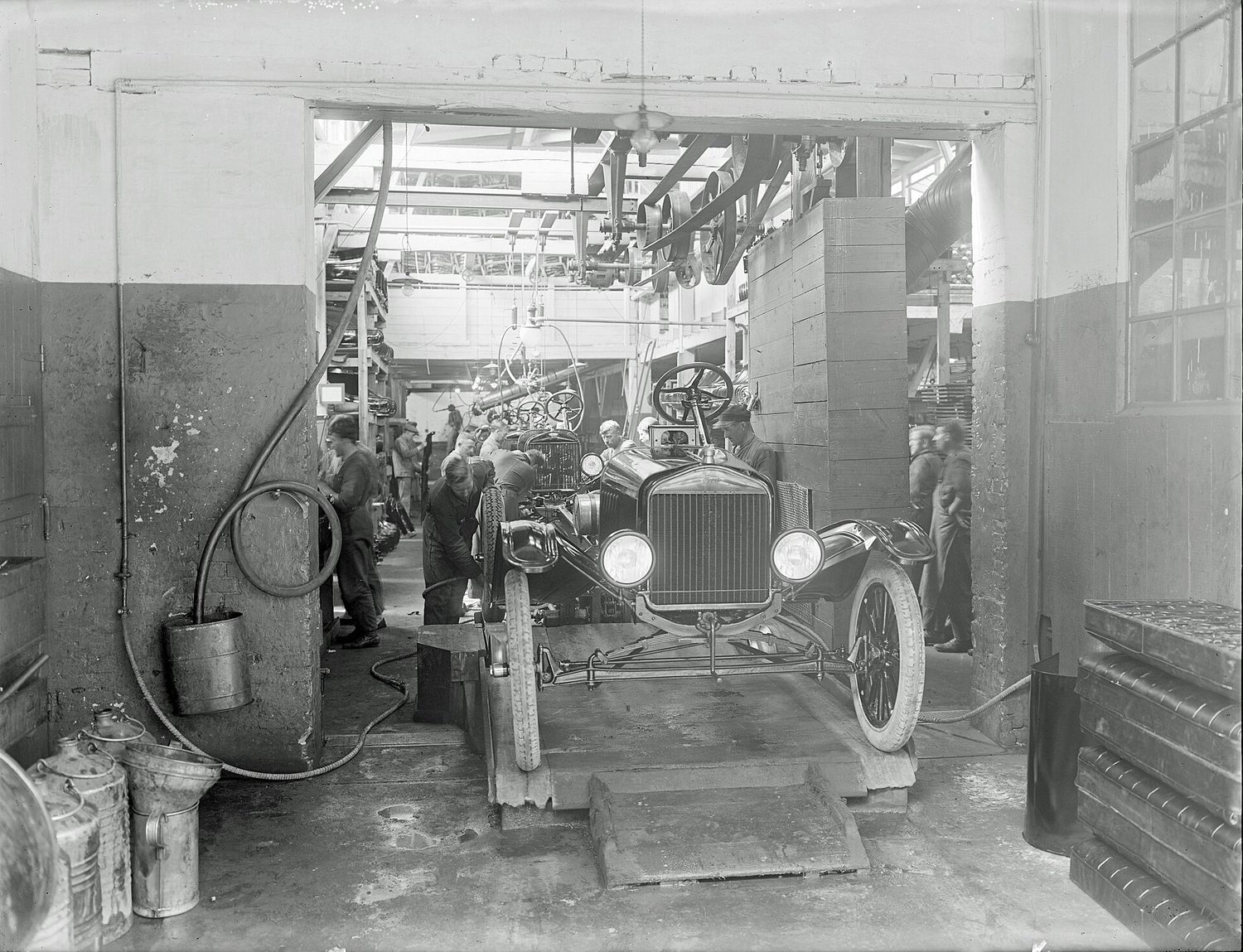
    • Immigration restriction 移民限制 through national-origins quotas.
    • Conflict over religion and science, and over prohibition 禁酒令.
    • A revived Ku Klux KlanK and organised nativism.
    • The Harlem Renaissance 哈莱姆文艺复兴 and the "New Woman" as assertions of new cultural identities.
    Vocabulary Train
    English Chinese Pinyin
    mass culture 大众文化 dà zhòng wén huà
    sharp divisions 尖锐分歧 jiān ruì fēn qí
    Immigration restriction 移民限制 yí mín xiàn zhì
    prohibition 禁酒令 jìn jiǔ lìng
    Ku Klux Klan 三K党 sān K dǎng
    Harlem Renaissance 哈莱姆文艺复兴 hā lái mǔ wén yì fù xīng
    7.9 7.10

    Depression and the New Deal

    Syllabus

    7.9 The Great Depression

    Thematic FocusLearning ObjectiveHistorical Developments

    WXT
    Work, Exchange, and Technology — The interplay between markets, private enterprise, labor, technology, and government policy shape the American economy. In turn, economic activity shapes society and government policy and drives technological innovation.

    Unit 7.J
    Explain the causes of the Great Depression and its effects on the economy.

    • KC-7.1.I The United States continued its transition from a rural, agricultural economy to an urban, industrial economy led by large companies.
    • KC-7.1.I.C Episodes of credit and market instability in the early 20th century, in particular the Great Depression, led to calls for a stronger financial regulatory system.
    • KC-7.1.III During the 1930s, policymakers responded to the mass unemployment and social upheavals of the Great Depression by transforming the U.S. into a limited welfare state, redefining the goals and ideas of modern American liberalism.

    7.10 The New Deal

    Thematic FocusLearning ObjectiveHistorical Developments

    PCE
    Politics and Power — Debates fostered by social and political groups about the role of government in American social, political, and economic life shape government policy, institutions, political parties, and the rights of citizens.

    Unit 7.K
    Explain how the Great Depression and the New Deal impacted American political, social, and economic life over time.

    • KC-7.1.III.A Franklin Roosevelt’s New Deal attempted to end the Great Depression by using government power to provide relief to the poor, stimulate recovery, and reform the American economy.
    • KC-7.1.III.B Radical, union, and populist movements pushed Roosevelt toward more extensive efforts to change the American economic system, while conservatives in Congress and the Supreme Court sought to limit the New Deal’s scope.
    • KC-7.1.III.C Although the New Deal did not end the Depression, it left a legacy of reforms and regulatory agencies and fostered a long-term political realignment in which many ethnic groups, African Americans, and working-class communities identified with the Democratic Party.
    • KC-7.2.II.B.ii The increased demand for war production and labor during World War II and the economic difficulties of the 1930s led many Americans to migrate to urban centers in search of economic opportunities.

    Source: College Board AP Course and Exam Description

    The New Deal grouped by purpose: relief now, recovery for the economy, reform so it cannot happen again
    Sorting New Deal programmes by purpose - relief, recovery, reform - is what turns a list into an argument

    The Great Depression 大萧条 brought mass unemployment and social dislocation, and policymakers responded by expanding the federal role in the economy.

    Franklin Roosevelt's New Deal 罗斯福新政 attempted to end the Depression through relief 救济, recovery 复苏, and reform 改革. Radical, union, and populist movements 激进派工会与民粹运动 pushed Roosevelt toward more extensive measures - which is why the "Second New Deal" is more ambitious than the first.

    The verdict the CED states plainly: the New Deal did not end the Depression, but it left a lasting legacy of reform - Social Security, federal deposit insurance, labour rights, and the expectation that government is responsible for economic security.

    Vocabulary Train
    English Chinese Pinyin
    Great Depression 大萧条 dà xiāo tiáo
    Franklin Roosevelt's New Deal 罗斯福新政 luó sī fú xīn zhèng
    relief 救济 jiù jì
    recovery 复苏 fù sū
    reform 改革 gǎi gé
    Radical, union, and populist movements 激进派、工会与民粹运动 jī jìn pài 、 gōng huì yǔ mín cuì yùn dòng
    7.11 7.12 7.13

    The Second World War

    Syllabus

    7.11 Interwar Foreign Policy

    Thematic FocusLearning ObjectiveHistorical Developments

    WOR
    America in the World — Diplomatic, economic, cultural, and military interactions between empires, nations, and peoples shape the development of America and America’s increasingly important role in the world.

    Unit 7.B
    Explain the similarities and differences in attitudes about the nation’s proper role in the world.

    • KC-7.3.II.D In the years following World War I, the United States pursued a unilateral foreign policy that used international investment, peace treaties, and select military intervention to promote a vision of international order, even while maintaining U.S. isolationism.
    • KC-7.3.II.E In the 1930s, while many Americans were concerned about the rise of fascism and totalitarianism, most opposed taking military action against the aggression of Nazi Germany and Japan until the Japanese attack on Pearl Harbor drew the United States into World War II.

    7.12 World War II: Mobilization

    Thematic FocusLearning ObjectiveHistorical Developments

    SOC
    Social Structures — Social categories, roles, and practices are created, maintained, challenged, and transformed throughout American history, shaping government policy, economic systems, culture, and the lives of citizens.

    Unit 7.L
    Explain how and why U.S. participation in World War II transformed American society.

    • KC-7.3.III.B The mass mobilization of American society helped end the Great Depression, and the country’s strong industrial base played a pivotal role in winning the war by equipping and provisioning allies and millions of U.S. troops.
    • KC-7.3.III.C.i Mobilization provided opportunities for women and minorities to improve their socioeconomic positions for the war’s duration, while also leading to debates over racial segregation. Wartime experiences also generated challenges to civil liberties, such as the internment of Japanese Americans.
    • KC-7.2.II.D Migration to the United States from Mexico and elsewhere in the Western Hemisphere increased, in spite of contradictory government policies toward Mexican immigration.

    7.13 World War II: Military

    Thematic FocusLearning ObjectiveHistorical Developments

    WOR
    America in the World — Diplomatic, economic, cultural, and military interactions between empires, nations, and peoples shape the development of America and America’s increasingly important role in the world.

    Unit 7.M
    Explain the causes and effects of the victory of the United States and its allies over the Axis powers.

    • KC-7.3.III.A Americans viewed the war as a fight for the survival of freedom and democracy against fascist and militarist ideologies. This perspective was later reinforced by revelations about Japanese wartime atrocities, Nazi concentration camps, and the Holocaust.
    • KC-7.3.III.C.ii Military service provided opportunities for women and minorities to improve their socioeconomic positions for the war’s duration, while also leading to debates over racial segregation.
    • KC-7.3.III.D The United States and its allies achieved military victory through Allied cooperation, technological and scientific advances, the contributions of servicemen and women, and campaigns such as Pacific “island-hopping” and the D-Day invasion. The use of atomic bombs hastened the end of the war and sparked debates about the morality of using atomic weapons.

    Source: College Board AP Course and Exam Description

    Americans viewed the war as a fight for the survival of freedom and democracy 自由与民主的存续 against fascist aggression.

    Mass mobilization 全面动员 helped end the Great Depression, and it changed society:

    • Mobilisation and military service provided opportunities for women and minorities 妇女与少数族裔 to improve their status, though within continued segregation and discrimination.
    • Migration from Mexico and elsewhere in the Western Hemisphere increased to meet labour demand.
    • Japanese Americans were forcibly interned 拘禁, the period's clearest case of wartime rights denied.

    Victory came through Allied cooperation 盟国合作, industrial capacity, and technological advantage, ending with the use of atomic weapons against Japan.

    Vocabulary Train
    English Chinese Pinyin
    survival of freedom and democracy 自由与民主的存续 zì yóu yǔ mín zhǔ de cún xù
    Mass mobilization 全面动员 quán miàn dòng yuán
    women and minorities 妇女与少数族裔 fù nǚ yǔ shǎo shù zú yì
    interned 拘禁 jū jìn
    Allied cooperation 盟国合作 méng guó hé zuò
    7.14

    Postwar Diplomacy

    Syllabus

    7.14 Postwar Diplomacy

    Thematic FocusLearning ObjectiveHistorical Developments

    WOR
    America in the World — Diplomatic, economic, cultural, and military interactions between empires, nations, and peoples shape the development of America and America’s increasingly important role in the world.

    Unit 7.N
    Explain the consequences of U.S. involvement in World War II.

    • KC-7.3.III.E The war-ravaged condition of Asia and Europe, and the dominant U.S. role in the Allied victory and postwar peace settlements, allowed the United States to emerge from the war as the most powerful nation on Earth.

    Source: College Board AP Course and Exam Description

    The war-ravaged condition of Asia and Europe, and the dominant U.S. role in the Allied victory and in the occupations that followed, left the United States as the strongest power in the world - and set up the confrontation with the Soviet Union that Period 8 begins with.

    7.15

    Comparison in Period 7

    Syllabus

    7.15 Comparison in Period 7

    Learning ObjectiveReview: Unit 7 Key Concepts

    Unit 7.O
    Compare the relative significance of the major events of the first half of the 20th century in shaping American identity.

    • KC-7.1 Growth expanded opportunity, while economic instability led to new efforts to reform U.S. society and its economic system.
      • KC-7.1.I The United States continued its transition from a rural, agricultural economy to an urban, industrial economy led by large companies.
      • KC-7.1.II In the Progressive Era of the early 20th century, Progressives responded to political corruption, economic instability, and social concerns by calling for greater government action and other political and social measures.
      • KC-7.1.III During the 1930s, policymakers responded to the mass unemployment and social upheavals of the Great Depression by transforming the U.S. into a limited welfare state, redefining the goals and ideas of modern American liberalism.
    • KC-7.2 Innovations in communications and technology contributed to the growth of mass culture, while significant changes occurred in internal and international migration patterns.
      • KC-7.2.I Popular culture grew in influence in U.S. society, even as debates increased over the effects of culture on public values, morals, and American national identity.
      • KC-7.2.II Economic pressures, global events, and political developments caused sharp variations in the numbers, sources, and experiences of both international and internal migrants.
    • KC-7.3 Participation in a series of global conflicts propelled the United States into a position of international power while renewing domestic debates over the nation’s proper role in the world.
      • KC-7.3.I In the late 19th century and early 20th century, new U.S. territorial ambitions and acquisitions in the Western Hemisphere and the Pacific accompanied heightened public debates over America’s role in the world.
      • KC-7.3.II World War I and its aftermath intensified ongoing debates about the nation’s role in the world and how best to achieve national security and pursue American interests.
      • KC-7.3.III U.S. participation in World War II transformed American society, while the victory of the United States and its allies over the Axis powers vaulted the U.S. into a position of global, political, and military leadership.

    Source: College Board AP Course and Exam Description

    The period's reasoning skill is comparison. The most useful pairing is Progressive-era reform against the New Deal: both expanded federal power, but the New Deal did so on a far larger scale and in response to collapse rather than to growth.

    Worked example (a real AP exam question). The 2024 exam set the long essay "Evaluate the extent to which beliefs about threats to the United States shaped society from 1917 to 1945." A strong thesis names the beliefs and what they produced: "Beliefs about internal and external threats shaped American society to a great extent between 1917 and 1945, producing wartime restrictions on dissent, immigration quotas in the 1920s, and the internment of Japanese Americans, even as the same fears mobilised broad support for federal power." Notice the shape: the prompt is about beliefs, so the evidence must be things beliefs caused - policies and social changes - not simply a narrative of the wars.

    7.15

    Exam tips

    • Give both sides of the imperialism debate; a one-sided answer misses the point of the question.
    • Progressivism is a method - expertise, then government action, then political reform. Its exclusion of African Americans is examinable.
    • Sort New Deal programmes by relief, recovery, reform. That structure converts a list into an argument.
    • State the CED's verdict directly: the New Deal did not end the Depression but left a permanent legacy.
    • Wartime opportunity for women and minorities was real and limited. Saying both is what earns complexity.
    • For 1917-1945 prompts about fear or threat, use civil liberties, immigration quotas, and internment as your evidence.
  • 8

    Period 8: 1945–1980

    8.1 8.2

    The Cold War, 1945 to 1980

    Syllabus

    8.1 Contextualizing Period 8

    Learning ObjectivePreview: Unit 8 Key Concepts

    Unit 8.A
    Explain the context for societal change from 1945 to 1980.

    • KC-8.1 The United States responded to an uncertain and unstable postwar world by asserting and working to maintain a position of global leadership, with far-reaching domestic and international consequences.
      • KC-8.1.I United States policymakers engaged in a cold war with the authoritarian Soviet Union, seeking to limit the growth of Communist military power and ideological influence, create a free-market global economy, and build an international security system.
      • KC-8.1.II Cold War policies led to public debates over the power of the federal government and acceptable means for pursuing international and domestic goals while protecting civil liberties.
    • KC-8.2 New movements for civil rights and liberal efforts to expand the role of government generated a range of political and cultural responses.
      • KC-8.2.I Seeking to fulfill Reconstruction-era promises, civil rights activists and political leaders achieved some legal and political successes in ending segregation, although progress toward racial equality was slow.
      • KC-8.2.II Responding to social conditions and the African American civil rights movement, a variety of movements emerged that focused on issues of identity, social justice, and the environment.
      • KC-8.2.III Liberalism influenced postwar politics and court decisions, but it came under increasing attack from the left as well as from a resurgent conservative movement.
    • KC-8.3 Postwar economic and demographic changes had far-reaching consequences for American society, politics, and culture.
      • KC-8.3.I Rapid economic and social changes in American society fostered a sense of optimism in the postwar years.
      • KC-8.3.II New demographic and social developments, along with anxieties over the Cold War, changed U.S. culture and led to significant political and moral debates that sharply divided the nation.

    8.2 The Cold War from 1945 to 1980

    Thematic FocusLearning ObjectiveHistorical Developments

    WOR
    America in the World — Diplomatic, economic, cultural, and military interactions between empires, nations, and peoples shape the development of America and America’s increasingly important role in the world.

    Unit 8.B
    Explain the continuities and changes in Cold War policies from 1945 to 1980.

    • KC-8.1.I United States policymakers engaged in a cold war with the authoritarian Soviet Union, seeking to limit the growth of Communist military power and ideological influence, create a free-market global economy, and build an international security system.
    • KC-8.1.I.A As postwar tensions dissolved the wartime alliance between Western democracies and the Soviet Union, the United States developed a foreign policy based on collective security, international aid, and economic institutions that bolstered non-Communist nations.
    • KC-8.1.I.B.i Concerned by expansionist Communist ideology and Soviet repression, the United States sought to contain communism through a variety of measures, including major military engagements in Korea.
    • KC-8.1.I.C The Cold War fluctuated between periods of direct and indirect military confrontation and periods of mutual coexistence (or détente).

    Source: College Board AP Course and Exam Description

    Period 8 runs from 1945 to 1980. Two arguments dominate it: how far the United States should go to contain communism abroad, and how far the federal government should go to guarantee rights and welfare at home. They are connected, because both are arguments about the reach of national power.

    The Cold War 冷战 began as wartime cooperation collapsed into rivalry with the Soviet Union. American policy settled on containment 遏制 - preventing the spread of communism rather than attempting to remove it - expressed through the Truman Doctrine 杜鲁门主义, the Marshall Plan 马歇尔计划, and NATO 北约.

    Containment then produced commitments the country had not anticipated: the Korean War 朝鲜战争, a permanent peacetime military establishment, an arms race 军备竞赛, and the space race 太空竞赛.

    Vocabulary Train
    English Chinese Pinyin
    Cold War 冷战 lěng zhàn
    containment 遏制 è zhì
    Truman Doctrine 杜鲁门主义 dù lǔ mén zhǔ yì
    Marshall Plan 马歇尔计划 mǎ xiē ěr jì huà
    NATO 北约 běi yuē
    Korean War 朝鲜战争 cháo xiān zhàn zhēng
    arms race 军备竞赛 jūn bèi jìng sài
    space race 太空竞赛 tài kōng jìng sài
    8.3

    The Red Scare at Home

    Syllabus

    8.3 The Red Scare

    Thematic FocusLearning ObjectiveHistorical Developments

    NAT
    American and National Identity — The development of and debates about democracy, freedom, citizenship, diversity, and individualism shape American national identity, cultural values, and beliefs about American exceptionalism, and in turn, these ideas shape political institutions and society. Throughout American history, notions of national identity and culture have coexisted with varying degrees of regional and group identities.

    Unit 8.C
    Explain the causes and effects of the Red Scare after World War II.

    • KC-8.1.II.A Americans debated policies and methods designed to expose suspected communists within the United States even as both parties supported the broader strategy of containing communism.

    Source: College Board AP Course and Exam Description

    Fear of communism reshaped domestic politics. Loyalty programmes 忠诚审查, congressional investigations, and McCarthyism 麦卡锡主义 targeted suspected communists in government, universities, unions, and the entertainment industry.

    The examinable point is the cost to civil liberties 公民自由的代价: accusation often functioned as proof, and the fear narrowed the range of acceptable political debate for a decade.

    Vocabulary Train
    English Chinese Pinyin
    Loyalty programmes 忠诚审查 zhōng chéng shěn chá
    McCarthyism 麦卡锡主义 mài kǎ xī zhǔ yì
    cost to civil liberties 公民自由的代价 gōng mín zì yóu de dài jià
    8.4 8.5

    Prosperity and Its Discontents

    Syllabus

    8.4 Economy After 1945

    Thematic FocusLearning ObjectiveHistorical Developments

    WXT
    Work, Exchange, and Technology — The interplay between markets, private enterprise, labor, technology, and government policy shape the American economy. In turn, economic activity shapes society and government policy and drives technological innovation.

    Unit 8.D
    Explain the causes of economic growth in the years after World War II. THEMATIC FOCUS Migration and Settlement MIG Push and pull factors shape immigration to and migration within America, and the demographic change as a result of these moves shapes the migrants, society, and the environment. LEARNING OBJECTIVE

    • KC-8.3.I.A A burgeoning private sector, federal spending, the baby boom, and technological developments helped spur economic growth. HISTORICAL DEVELOPMENTS

    Unit 8.E
    Explain the causes and effects of the migration of various groups of Americans after 1945.

    • KC-8.3.I.B As higher education opportunities and new technologies rapidly expanded, increasing social mobility encouraged the migration of the middle class to the suburbs and of many Americans to the South and West. The Sun Belt region emerged as a significant political and economic force.

    8.5 Culture after 1945

    Thematic FocusLearning ObjectiveHistorical Developments

    ARC
    American and Regional Culture — Creative expression, demographic change, philosophy, religious beliefs, scientific ideas, social mores, and technology shape national, regional, and group cultures in America, and these varying cultures often play a role in shaping government policy and developing economic systems.

    Unit 8.F
    Explain how mass culture has been maintained or challenged over time.

    • KC-8.3.II.A Mass culture became increasingly homogeneous in the postwar years, inspiring challenges to conformity by artists, intellectuals, and rebellious youth.

    Source: College Board AP Course and Exam Description

    The postwar economy grew strongly. Federal spending on defence, highways, and the GI Bill 退伍军人权利法 supported home ownership and higher education, and the population moved to the suburbs 郊区 and to the Sun Belt 阳光地带.

    Culture changed with it: mass consumption, television, and a distinct youth culture 青年文化 with its own music and markets.

    Prosperity was uneven. Suburban growth was frequently closed to African Americans by law and practice, cities lost tax base and jobs, and poverty 贫困 persisted in ways the decade's self-image obscured - which is what later reform movements responded to.

    Vocabulary Train
    English Chinese Pinyin
    GI Bill 退伍军人权利法 tuì wǔ jūn rén quán lì fǎ
    suburbs 郊区 jiāo qū
    Sun Belt 阳光地带 yáng guāng dì dài
    youth culture 青年文化 qīng nián wén huà
    poverty 贫困 pín kùn
    8.6 8.10 8.11

    The Civil Rights Movement

    Syllabus

    8.6 Early Steps in the Civil Rights Movement (1940s and 1950s)

    Thematic FocusLearning ObjectiveHistorical Developments

    SOC
    Social Structures — Social categories, roles, and practices are created, maintained, challenged, and transformed throughout American history, shaping government policy, economic systems, culture, and the lives of citizens.

    Unit 8.G
    Explain how and why the civil rights movements developed and expanded from 1945 to 1960.

    • KC-8.2.I Seeking to fulfill Reconstruction-era promises, civil rights activists and political leaders achieved some legal and political successes in ending segregation, although progress toward racial equality was slow.
    • KC-8.2.I.B.i The three branches of the federal government used measures including desegregation of the armed services and Brown v. Board of Education (1954) to promote greater racial equality.

    8.10 The African American Civil Rights Movement (1960s)

    Thematic FocusLearning ObjectiveHistorical Developments

    PCE
    Politics and Power — Debates fostered by social and political groups about the role of government in American social, political, and economic life shape government policy, institutions, political parties, and the rights of citizens.

    Unit 8.L
    Explain how and why various groups responded to calls for the expansion of civil rights from 1960 to 1980.

    • KC-8.2.I.A During and after World War II, civil rights activists and leaders, most notably Martin Luther King Jr., combated racial discrimination utilizing a variety of strategies, including legal challenges, direct action, and nonviolent protest tactics.
    • KC-8.2.I.C Continuing resistance slowed efforts at desegregation, sparking social and political unrest across the nation. Debates among civil rights activists over the efficacy of nonviolence increased after 1965.

    Unit 8.M
    Explain the various ways in which the federal government responded to the calls for the expansion of civil rights.

    • KC-8.2.I.B.ii The three branches of the federal government used measures including the Civil Rights Act of 1964 to promote greater racial equality.
    • KC-8.2.III.B.ii A series of Supreme Court decisions expanded civil rights and individual liberties.

    8.11 The Civil Rights Movement Expands

    Thematic FocusLearning ObjectiveHistorical Developments

    SOC
    Social Structures — Social categories, roles, and practices are created, maintained, challenged, and transformed throughout American history, shaping government policy, economic systems, culture, and the lives of citizens.

    Unit 8.L
    Explain how and why various groups responded to calls for the expansion of civil rights from 1960 to 1980.

    • KC-8.2.II.B Latino, American Indian, and Asian American movements continued to demand social and economic equality and a redress of past injustices.
    • KC-8.2.II.A Feminist and LGBTQ+ activists mobilized behind claims for legal, economic, and social equality.
    • KC-8.3.II.B.i Feminists who participated in the counterculture of the 1960s rejected many of the social, economic, and political values of their parents’ generation and advocated changes in sexual norms.

    Source: College Board AP Course and Exam Description

    The civil rights movement as three arenas - courts, direct action, legislation - each converting pressure into the next
    Litigation, direct action and legislation were not alternatives: each one created the conditions for the next

    Early steps in the 1940s and 1950s worked mainly through the courts 法院. Legal strategy produced Brown v. Board of Education 布朗诉教育委员会案, which held segregated schooling unconstitutional and stripped away the legal basis of segregation.

    Court victories did not enforce themselves, so the movement turned to direct action 直接行动: the Montgomery bus boycott, sit-ins, freedom rides, and mass marches, organised through churches and student groups and grounded in nonviolent protest 非暴力抗议.

    Sustained pressure and televised violence against protesters produced legislation 立法: the Civil Rights Act of 1964 1964年民权法 and the Voting Rights Act of 1965 1965年选举权法.

    The movement then expanded 扩展: later activists raised questions of economic inequality, housing, and policing, and some rejected nonviolence and integration in favour of Black Power 黑人权力. Its example also shaped movements by women, Latinos, American Indians, and others.

    Vocabulary Train
    English Chinese Pinyin
    courts 法院 fǎ yuàn
    Brown v. Board of Education 布朗诉教育委员会案 bù lǎng sù jiào yù wěi yuán huì àn
    direct action 直接行动 zhí jiē xíng dòng
    nonviolent protest 非暴力抗议 fēi bào lì kàng yì
    legislation 立法 lì fǎ
    Civil Rights Act of 1964 1964年民权法 1964 nián mín quán fǎ
    Voting Rights Act of 1965 1965年选举权法 1965 nián xuǎn jǔ quán fǎ
    expanded 扩展 kuò zhǎn
    Black Power 黑人权力 hēi rén quán lì
    8.7 8.8 8.9

    The Great Society and the Vietnam War

    Syllabus

    8.7 America as a World Power

    Thematic FocusLearning ObjectiveHistorical Developments

    WOR
    America in the World — Diplomatic, economic, cultural, and military interactions between empires, nations, and peoples shape the development of America and America’s increasingly important role in the world.

    Unit 8.H
    Explain the various military and diplomatic responses to international developments over time.

    • KC-8.1.I.E Cold War competition extended to Latin America, where the United States supported non-Communist regimes that had varying levels of commitment to democracy.
    • KC-8.1.II.C.i Americans debated the merits of a large nuclear arsenal and the military–industrial complex.
    • KC-8.1.I.D.i Postwar decolonization and the emergence of powerful nationalist movements in Africa and the Middle East led both sides in the Cold War to seek allies among new nations, many of which remained nonaligned.

    8.8 The Vietnam War

    Thematic FocusLearning ObjectiveHistorical Developments

    WOR
    America in the World — Diplomatic, economic, cultural, and military interactions between empires, nations, and peoples shape the development of America and America’s increasingly important role in the world.

    Unit 8.I
    Explain the causes and effects of the Vietnam War.

    • KC-8.1.I.B.ii Concerned by expansionist Communist ideology and Soviet repression, the United States sought to contain communism through a variety of measures, including major military engagements in Vietnam.
    • KC-8.1.I.D.ii Postwar decolonization and the emergence of powerful nationalist movements in Asia led both sides in the Cold War to seek allies among new nations, many of which remained nonaligned.
    • KC-8.1.II.C.ii Americans debated the appropriate power of the executive branch in conducting foreign and military policy.

    8.9 The Great Society

    Thematic FocusLearning ObjectiveHistorical Developments

    MIG
    Migration and Settlement — Push and pull factors shape immigration to and migration within America, and the demographic change as a result of these moves shapes the migrants, society, and the environment.

    Unit 8.J
    Explain the causes and effects of continuing policy debates about the role of the federal government over time.

    • KC-8.2.II.C Despite an overall affluence in postwar America, advocates raised concerns about the prevalence and persistence of poverty as a national problem.
    • KC-8.2.III.A Liberalism, based on anti-communism abroad and a firm belief in the efficacy of government power to achieve social goals at home, reached a high point of political influence by the mid-1960s.
    • KC-8.2.III.B.i Liberal ideas found expression in Lyndon Johnson’s Great Society, which attempted to use federal legislation and programs to end racial discrimination, eliminate poverty, and address other social issues.

    Unit 8.K
    Explain the continuities and changes in immigration patterns over time.

    • KC-8.3.I.C Immigrants from around the world sought access to the political, social, and economic opportunities in the United States, especially after the passage of new immigration laws in 1965.

    Source: College Board AP Course and Exam Description

    The Great Society 伟大社会 extended federal responsibility furthest since the New Deal: Medicare and Medicaid, federal aid to education, and the War on Poverty 向贫困宣战.

    The Vietnam War 越南战争 grew out of containment and consumed the same presidency. Escalation without decisive results produced a large antiwar movement 反战运动, deep political division, and a credibility gap 信任鸿沟 between government statements and reported reality. Defeat abroad and disillusion at home weakened confidence in federal power just as its domestic role peaked.

    Vocabulary Train
    English Chinese Pinyin
    Great Society 伟大社会 wěi dà shè huì
    War on Poverty 向贫困宣战 xiàng pín kùn xuān zhàn
    Vietnam War 越南战争 yuè nán zhàn zhēng
    antiwar movement 反战运动 fǎn zhàn yùn dòng
    credibility gap 信任鸿沟 xìn rèn hóng gōu
    8.12 8.13 8.14

    Society in Transition

    Syllabus

    8.12 Youth Culture of the 1960s

    Thematic FocusLearning ObjectiveHistorical Developments

    ARC
    American and Regional Culture — Creative expression, demographic change, philosophy, religious beliefs, scientific ideas, social mores, and technology shape national, regional, and group cultures in America, and these varying cultures often play a role in shaping government policy and developing economic systems.

    Unit 8.N
    Explain how and why opposition to existing policies and values developed and changed over the course of the 20th century.

    • KC-8.1.II.B Although anti-communist foreign policy faced little domestic opposition in previous years, the Vietnam War inspired sizable and passionate anti-war protests that became more numerous as the war escalated and sometimes led to violence.
    • KC-8.2.III.D Some groups on the left also rejected liberal policies, arguing that political leaders did too little to transform the racial and economic status quo at home and pursued immoral policies abroad.
    • KC-8.3.II.B.ii Young people who participated in the counterculture of the 1960s rejected many of the social, economic, and political values of their parents’ generation, introduced greater informality into U.S. culture, and advocated changes in sexual norms.

    8.13 The Environment and Natural Resources from 1968 to 1980

    Thematic FocusLearning ObjectiveHistorical Developments

    GEO
    Geography and the Environment — Geographic and environmental factors, including competition over and debates about natural resources, shape the development of America and foster regional diversity. The development of America impacts the environment and reshapes geography, which leads to debates about environmental and geographic issues.

    Unit 8.O
    Explain how and why policies related to the environment developed and changed from 1968 to 1980.

    • KC-8.1.II.D Ideological, military, and economic concerns shaped U.S. involvement in the Middle East, with several oil crises in the region eventually sparking attempts at creating a national energy policy.
    • KC-8.2.II.D Environmental problems and accidents led to a growing environmental movement that aimed to use legislative and public efforts to combat pollution and protect natural resources. The federal government established new environmental programs and regulations.

    8.14 Society in Transition

    Thematic FocusLearning ObjectiveHistorical Developments

    ARC
    American and Regional Culture — Creative expression, demographic change, philosophy, religious beliefs, scientific ideas, social mores, and technology shape national, regional, and group cultures in America, and these varying cultures often play a role in shaping government policy and developing economic systems.

    Unit 8.J
    Explain the causes and effects of continuing policy debates about the role of the federal government over time.

    • KC-8.2.III.C In the 1960s, conservatives challenged liberal laws and court decisions and perceived moral and cultural decline, seeking to limit the role of the federal government and enact more assertive foreign policies.
    • KC-8.2.III.E Public confidence and trust in government’s ability to solve social and economic problems declined in the 1970s in the wake of economic challenges, political scandals, and foreign policy crises.
    • KC-8.2.III.F The 1970s saw growing clashes between conservatives and liberals over social and cultural issues, the power of the federal government, race, and movements for greater individual rights.

    Unit 8.P
    Explain the effects of the growth of religious movements over the course of the 20th century.

    • KC-8.3.II.C The rapid and substantial growth of evangelical Christian churches and organizations was accompanied by greater political and social activism on the part of religious conservatives.

    Source: College Board AP Course and Exam Description

    The later part of the period is defined by movements and by limits.

    • The women's movement 妇女运动 pressed for legal equality and workplace access; the Equal Rights Amendment 平等权利修正案 failed ratification.
    • Environmental 环境保护 concern grew into federal action on air, water, and endangered species between 1968 and 1980.
    • Immigration law was reformed in 1965, changing the origins of new arrivals.
    • Conservatism 保守主义 organised in response to all of it, on taxes, social change, and the size of government - the movement Period 9 opens with.

    Economic trouble sharpened everything: inflation 通货膨胀, oil shocks, and industrial decline ended the postwar boom.

    Vocabulary Train
    English Chinese Pinyin
    women's movement 妇女运动 fù nǚ yùn dòng
    Equal Rights Amendment 平等权利修正案 píng děng quán lì xiū zhèng àn
    Environmental 环境保护 huán jìng bǎo hù
    Conservatism 保守主义 bǎo shǒu zhǔ yì
    inflation 通货膨胀 tōng huò péng zhàng
    8.15

    Continuity and Change in Period 8

    Syllabus

    8.15 Continuity and Change in Period 8

    Learning ObjectiveReview: Unit 8 Key Concepts

    Unit 8.Q
    Explain the extent to which the events of the period from 1945 to1980 reshaped national identity.

    • KC-8.1 The United States responded to an uncertain and unstable postwar world by asserting and working to maintain a position of global leadership, with far-reaching domestic and international consequences.
      • KC-8.1.I United States policymakers engaged in a cold war with the authoritarian Soviet Union, seeking to limit the growth of Communist military power and ideological influence, create a free-market global economy, and build an international security system.
      • KC-8.1.II Cold War policies led to public debates over the power of the federal government and acceptable means for pursuing international and domestic goals while protecting civil liberties.
    • KC-8.2 New movements for civil rights and liberal efforts to expand the role of government generated a range of political and cultural responses.
      • KC-8.2.I Seeking to fulfill Reconstruction-era promises, civil rights activists and political leaders achieved some legal and political successes in ending segregation, although progress toward racial equality was slow.
      • KC-8.2.II Responding to social conditions and the African American civil rights movement, a variety of movements emerged that focused on issues of identity, social justice, and the environment.
      • KC-8.2.III Liberalism influenced postwar politics and court decisions, but it came under increasing attack from the left as well as from a resurgent conservative movement.
    • KC-8.3 Postwar economic and demographic changes had far-reaching consequences for American society, politics, and culture.
      • KC-8.3.I Rapid economic and social changes in American society fostered a sense of optimism in the postwar years.
      • KC-8.3.II New demographic and social developments, along with anxieties over the Cold War, changed U.S. culture and led to significant political and moral debates that sharply divided the nation.

    Source: College Board AP Course and Exam Description

    The period's reasoning skill is continuity and change. Rights expanded enormously in law; economic inequality and residential segregation persisted, and both statements belong in a strong answer.

    Worked example (a real AP exam question). The 2023 exam set the long essay "Evaluate the extent to which the growth of civil rights activism contributed to changes in government action" in the twentieth century. A strong thesis makes activism the cause and names the government changes: "Civil rights activism contributed to a great extent to changes in government action, as litigation produced Brown v. Board of Education and sustained direct action created the political pressure behind the Civil Rights Act of 1964 and the Voting Rights Act of 1965, although federal action consistently followed rather than led that pressure." Notice the shape: the prompt asks about a contribution, so the essay must trace the link from activism to policy, not describe the movement on its own.

    8.15

    Exam tips

    • Define containment precisely - preventing spread, not rollback - and use it to explain Korea and Vietnam as consequences.
    • For the Red Scare, the mark is in the cost to civil liberties, not in a narrative of accusations.
    • Present civil rights as courts → direct action → legislation, each stage creating the next.
    • Say what the Great Society actually did (Medicare, Medicaid, education aid) rather than calling it "reforms".
    • Vietnam's domestic effect - division and the credibility gap - matters as much as the military outcome.
    • On continuity-and-change prompts, pair legal gains with persistent economic and residential inequality.
  • 9

    Period 9: 1980–Present

    9.1 9.2

    Reagan and the Conservative Turn

    Syllabus

    9.1 Contextualizing Period 9

    Learning ObjectivePreview: Unit 9 Key Concepts

    Unit 9.A
    Explain the context in which the United States faced international and domestic challenges after 1980.

    • KC-9.1 A newly ascendant conservative movement achieved several political and policy goals during the 1980s and continued to strongly influence public discourse in the following decades.
      • KC-9.1.I Conservative beliefs regarding the need for traditional social values and a reduced role for government advanced in U.S. politics after 1980.
    • KC-9.2 Moving into the 21st century, the nation experienced significant technological, economic, and demographic changes.
      • KC-9.2.I New developments in science and technology enhanced the economy and transformed society, while manufacturing decreased.
      • KC-9.2.II The U.S. population continued to undergo demographic shifts that had significant cultural and political consequences.
    • KC-9.3 The end of the Cold War and new challenges to U.S. leadership forced the nation to redefine its foreign policy and role in the world.
      • KC-9.3.I The Reagan administration promoted an interventionist foreign policy that continued in later administrations, even after the end of the Cold War.
      • KC-9.3.II Following the attacks of September 11, 2001, U.S. foreign policy efforts focused on fighting terrorism around the world.

    9.2 Reagan and Conservatism

    Thematic FocusLearning ObjectiveHistorical Developments

    PCE
    Politics and Power — Debates fostered by social and political groups about the role of government in American social, political, and economic life shape government policy, institutions, political parties, and the rights of citizens.

    Unit 9.B
    Explain the causes and effects of continuing policy debates about the role of the federal government over time.

    • KC-9.1.I.A Ronald Reagan’s victory in the presidential election of 1980 represented an important milestone, allowing conservatives to enact significant tax cuts and continue the deregulation of many industries.
    • KC-9.1.I.B Conservatives argued that liberal programs were counterproductive in fighting poverty and stimulating economic growth. Some of their efforts to reduce the size and scope of government met with inertia and liberal opposition, as many programs remained popular with voters.
    • KC-9.1.I.C Policy debates continued over free-trade agreements, the scope of the government social safety net, and calls to reform the U.S. financial system.
    • KC-9.1.I Conservative beliefs regarding the need for traditional social values and a reduced role for government advanced in U.S. politics after 1980.
    • KC-9.2.II.C Intense political and cultural debates continued over issues such as immigration policy, diversity, gender roles, and family structures.

    Source: College Board AP Course and Exam Description

    Period 9 runs from 1980 to the present. It is short in topics but wide in scope, and the exam treats it as the culmination of arguments running through the whole course: the size of government, the country's global role, and who counts as a full member of the nation.

    The conservative movement 保守主义运动 that organised in the 1960s and 1970s came to power with Ronald Reagan 里根. Its programme had three strands:

    • Tax cuts and deregulation 减税与放松管制, on the argument that reducing the burden on business would raise growth - often called supply-side economics 供给学派经济学.
    • Reduced federal spending on domestic programmes, though defence spending 国防开支 rose sharply and deficits grew.
    • Appeals to social conservatism 社会保守主义, on religion, family, and law and order.

    The result was a lasting shift in the terms of debate: after 1980 both parties argued within narrower limits about the federal government's economic role than at any time since the New Deal.

    Vocabulary Train
    English Chinese Pinyin
    conservative movement 保守主义运动 bǎo shǒu zhǔ yì yùn dòng
    Ronald Reagan 里根 lǐ gēn
    Tax cuts and deregulation 减税与放松管制 jiǎn shuì yǔ fàng sōng guǎn zhì
    supply-side economics 供给学派经济学 gōng jǐ xué pài jīng jì xué
    defence spending 国防开支 guó fáng kāi zhī
    social conservatism 社会保守主义 shè huì bǎo shǒu zhǔ yì
    9.3

    The End of the Cold War

    Syllabus

    9.3 The End of the Cold War

    Thematic FocusLearning ObjectiveHistorical Developments

    WOR
    America in the World — Diplomatic, economic, cultural, and military interactions between empires, nations, and peoples shape the development of America and America’s increasingly important role in the world.

    Unit 9.C
    Explain the causes and effects of the end of the Cold War and its legacy.

    • KC-9.3.I.A Reagan asserted U.S. opposition to communism through speeches, diplomatic efforts, limited military interventions, and a buildup of nuclear and conventional weapons.
    • KC-9.3.I.B Increased U.S. military spending, Reagan’s diplomatic initiatives, and political changes and economic problems in Eastern Europe and the Soviet Union were all important in ending the Cold War.
    • KC-9.3.I.C The end of the Cold War led to new diplomatic relationships but also new U.S. military and peacekeeping interventions, as well as continued debates over the appropriate use of American power in the world.

    Source: College Board AP Course and Exam Description

    Renewed military build-up, negotiation, and above all internal weakness in the Soviet Union brought the Cold War to an end. The Soviet system collapsed between 1989 and 1991.

    The consequences framed the decades that followed: the United States became the sole superpower, with unresolved questions about when and where to intervene 何时何地干预, and about what commitments made sense once containment no longer organised policy.
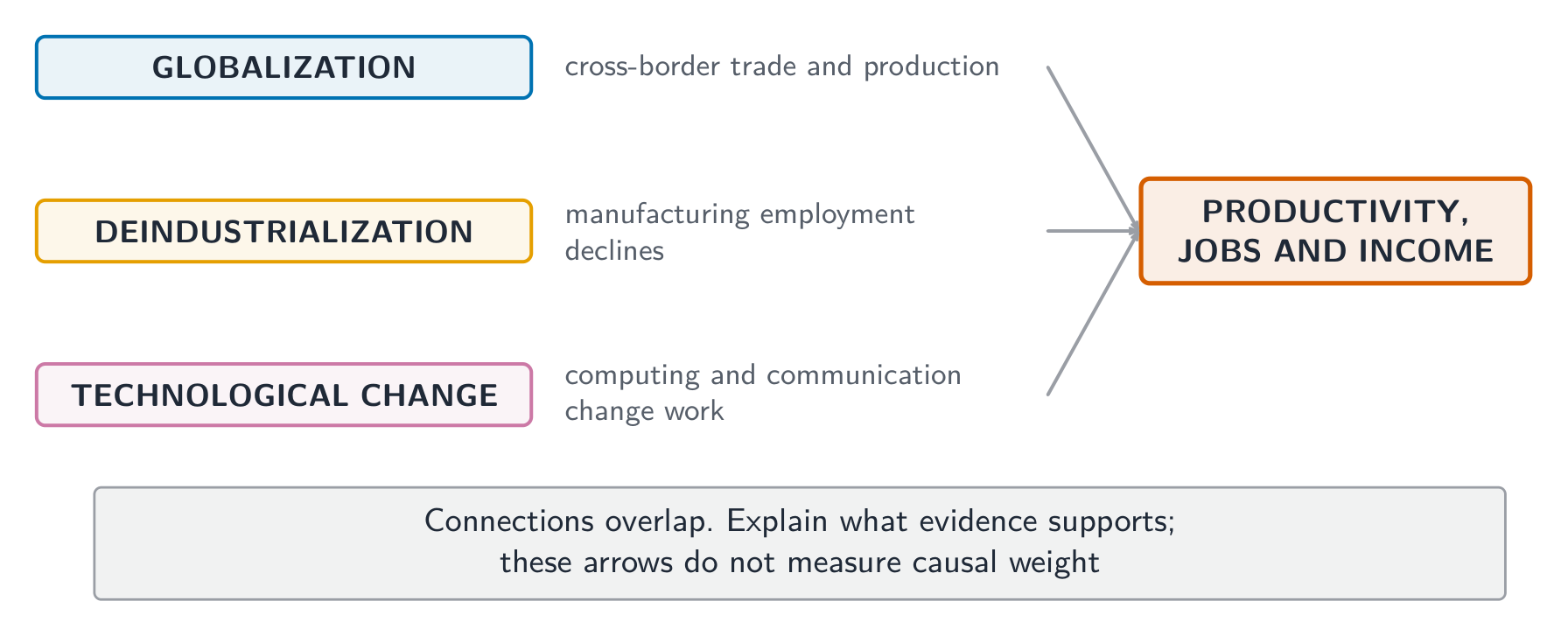
    Vocabulary Train
    English Chinese Pinyin
    when and where to intervene 何时何地干预 hé shí hé dì gān yù
    9.4

    A Changing Economy

    Syllabus

    9.4 A Changing Economy

    Thematic FocusLearning ObjectiveHistorical Developments

    WXT
    Work, Exchange, and Technology — The interplay between markets, private enterprise, labor, technology, and government policy shape the American economy. In turn, economic activity shapes society and government policy and drives technological innovation.

    Unit 9.D
    Explain the causes and effects of economic and technological change over time.

    • KC-9.2.I.A Economic productivity increased as improvements in digital communications enabled increased American participation in worldwide economic opportunities.
    • KC-9.2.I.B Technological innovations in computing, digital mobile technology, and the internet transformed daily life, increased access to information, and led to new social behaviors and networks.
    • KC-9.2.I.C Employment increased in service sectors and decreased in manufacturing, and union membership declined.
    • KC-9.2.I.D Real wages stagnated for the working and middle class amid growing economic inequality.

    Source: College Board AP Course and Exam Description

    The economy after 1980 was reshaped by three forces:

    • Globalization 全球化 - trade agreements, integrated supply chains, and competition that moved manufacturing abroad.
    • Deindustrialization 去工业化 - the loss of manufacturing employment in older industrial regions and the growth of service work.
    • Technological change 技术变革 - computing and then the internet, which transformed productivity, work, and communication.

    Together these raised aggregate wealth while widening income inequality 收入不平等 and reducing security for workers whose industries declined - the economic argument that has dominated politics since.

    Vocabulary Train
    English Chinese Pinyin
    Globalization 全球化 quán qiú huà
    Deindustrialization 去工业化 qù gōng yè huà
    Technological change 技术变革 jì shù biàn gé
    income inequality 收入不平等 shōu rù bù píng děng
    9.5

    Migration and a Changing Population

    Syllabus

    9.5 Migration and Immigration in the 1990s and 2000s

    Thematic FocusLearning ObjectiveHistorical Developments

    MIG
    Migration and Settlement — Push and pull factors shape immigration to and migration within America, and the demographic change as a result of these moves shapes the migrants, society, and the environment.

    Unit 9.E
    Explain the causes and effects of domestic and international migration over time.

    • KC-9.2.II.A After 1980, the political, economic, and cultural influence of the American South and West continued to increase as population shifted to those areas.
    • KC-9.2.II.B International migration from Latin America and Asia increased dramatically. The new immigrants affected U.S. culture in many ways and supplied the economy with an important labor force.

    Source: College Board AP Course and Exam Description

    Migration and immigration 人口迁移与移民 in the 1990s and 2000s continued to reshape the population, with growth in arrivals from Latin America and Asia 拉丁美洲与亚洲 following the 1965 reform of immigration law.

    The consequences are the examinable part: population growth in the South and West, the growth of multi-ethnic cities, ongoing debate over immigration policy 移民政策 and border enforcement, and continuing arguments about citizenship 公民身份 and national identity - the same argument the course has traced since Reconstruction.

    Vocabulary Train
    English Chinese Pinyin
    Migration and immigration 人口迁移与移民 rén kǒu qiān yí yǔ yí mín
    Latin America and Asia 拉丁美洲与亚洲 lā dīng měi zhōu yǔ yà zhōu
    immigration policy 移民政策 yí mín zhèng cè
    citizenship 公民身份 gōng mín shēn fèn
    9.6

    Challenges of the Twenty-First Century

    Syllabus

    9.6 Challenges of the 21st Century

    Thematic FocusLearning ObjectiveHistorical Developments

    WOR
    America in the World — Diplomatic, economic, cultural, and military interactions between empires, nations, and peoples shape the development of America and America’s increasingly important role in the world.

    Unit 9.F
    Explain the causes and effects of the domestic and international challenges the United States has faced in the 21st century.

    • KC-9.3.II.A In the wake of attacks on the World Trade Center and the Pentagon in 2001, the United States launched military efforts against terrorism and lengthy, controversial conflicts in Afghanistan and Iraq.
    • KC-9.3.II.B The war on terrorism sought to improve security within the United States but also raised questions about the protection of civil liberties and human rights.
    • KC-9.3.II.C Conflicts in the Middle East and concerns about climate change led to debates over U.S. dependence on fossil fuels and the impact of economic consumption on the environment.
    • KC-9.3.II.D Despite economic and foreign policy challenges, the United States continued as the world’s leading superpower in the 21st century.

    Source: College Board AP Course and Exam Description

    The period's later topics group around a small number of developments:

    • The September 11 attacks 九一一袭击 and the response - military intervention abroad, a new security apparatus, and renewed debate over the balance between security and civil liberties 安全与公民自由.
    • Economic crisis in 2008 and the argument over government's role in stabilising the economy.
    • Political polarisation 政治极化, amplified by changes in media and communication.
    • Debate over climate and energy 气候与能源 policy.
    Vocabulary Train
    English Chinese Pinyin
    September 11 attacks 九一一袭击 jiǔ yī yī xí jī
    security and civil liberties 安全与公民自由 ān quán yǔ gōng mín zì yóu
    Political polarisation 政治极化 zhèng zhì jí huà
    climate and energy 气候与能源 qì hòu yǔ néng yuán
    9.7

    Causation in Period 9

    Syllabus

    9.7 Causation in Period 9

    Learning ObjectiveReview: Unit 9 Key Concepts

    Unit 9.G
    Explain the relative significance of the effects of change in the period after 1980 on American national identity.

    • KC-9.1 A newly ascendant conservative movement achieved several political and policy goals during the 1980s and continued to strongly influence public discourse in the following decades.
      • KC-9.1.I Conservative beliefs regarding the need for traditional social values and a reduced role for government advanced in U.S. politics after 1980.
    • KC-9.2 Moving into the 21st century, the nation experienced significant technological, economic, and demographic changes.
      • KC-9.2.I New developments in science and technology enhanced the economy and transformed society, while manufacturing decreased.
      • KC-9.2.II The U.S. population continued to undergo demographic shifts that had significant cultural and political consequences.
    • KC-9.3 The end of the Cold War and new challenges to U.S. leadership forced the nation to redefine its foreign policy and role in the world.
      • KC-9.3.I The Reagan administration promoted an interventionist foreign policy that continued in later administrations, even after the end of the Cold War.
      • KC-9.3.II Following the attacks of September 11, 2001, U.S. foreign policy efforts focused on fighting terrorism around the world.

    Source: College Board AP Course and Exam Description

    The period's reasoning skill is causation, and the most useful move is to link a recent development back to an earlier one: deindustrialisation to the market revolution's regional specialisation, immigration debates to the nativism of the 1850s and 1920s, and arguments over federal power to the New Deal.

    Worked example (a real AP exam question). The 2026 exam set the long essay "Evaluate the extent to which women's participation in public life in the United States changed" over the twentieth century. A strong thesis distinguishes kinds of change and their timing: "Women's participation in public life changed substantially across the twentieth century, as suffrage, wartime employment and the women's movement opened political and professional roles, although occupational segregation and unequal pay meant participation expanded faster in law than in economic power." Notice the shape: for a long-span prompt, the thesis must say what kind of change and where it stalled, since that is what allows evidence from several periods to be used rather than narrated.

    9.7

    Exam tips

    • Define supply-side economics as an argument (cut taxes to raise growth), and note the deficits that followed - both belong in an evaluation.
    • The Cold War's end matters for what it opened: sole-superpower status and unresolved questions about intervention.
    • Keep globalization, deindustrialization, and technological change as three distinct causes, not one blur.
    • For immigration after 1965, name the shift in origins and the political argument it produced.
    • After 2001, the examinable tension is security against civil liberties - the same tension as the Red Scare and the First World War.
    • Long-span prompts reward connecting periods. Link a recent development to an earlier one and say what continued.

Log in or create account

IGCSE, A-Level & AP