9.1 Contextualizing Period 9
| Learning Objective | Preview: Unit 9 Key Concepts |
|---|---|
Unit 9.A |
|
9.2 Reagan and Conservatism
| Thematic Focus | Learning Objective | Historical Developments |
|---|---|---|
PCE | Unit 9.B |
|
AP United States History · Topic 9
 5:44
5:44
Period 9: 1980 to the present
This period is short in topics and wide in scope, and the exam treats it as the culmination of the whole course. Three arguments that have run since the…
English narration · English + 中文 subtitles burned in
| Learning Objective | Preview: Unit 9 Key Concepts |
|---|---|
Unit 9.A |
|
| Thematic Focus | Learning Objective | Historical Developments |
|---|---|---|
PCE | Unit 9.B |
|
Source: College Board AP Course and Exam Description
Period 9 runs from 1980 to the present. It examines continuing debates over government, economic and demographic change, and the United States' role in the world.
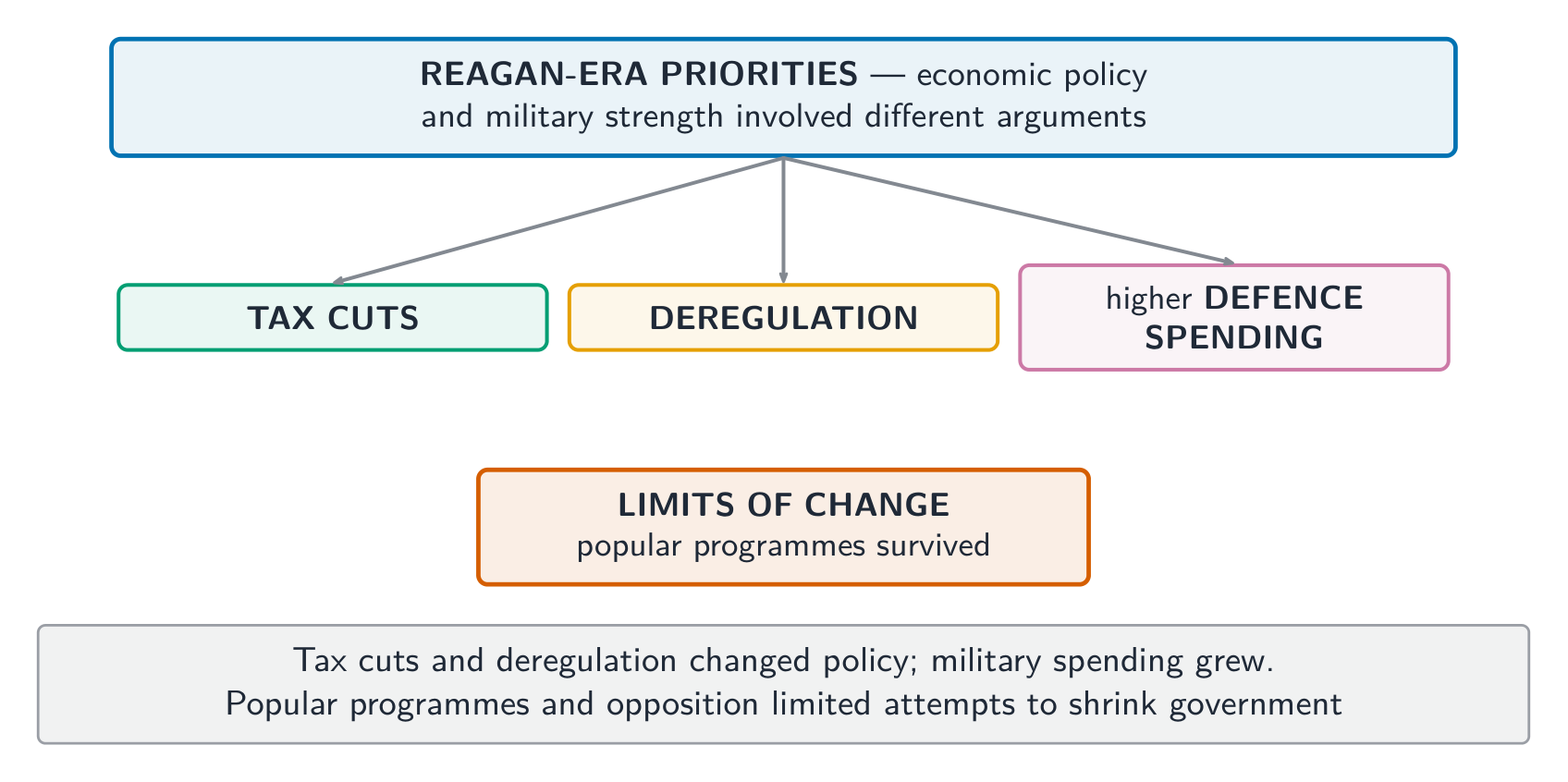
The conservative movement 保守主义运动 that organised in the 1960s and 1970s came to power with Ronald Reagan 里根. Its programme had three strands:
Tax cuts and deregulation changed policy, while opposition and the popularity of many programmes limited attempts to shrink government. Debates over free trade, the social safety net and financial regulation continued.
Try it — identify the goal. Teacher-written cases grounded in CED Topics 9.2 and 9.3: tax cuts and deregulation aimed to encourage private economic activity; the military buildup opposed communism; social conservatives promoted traditional values. Match these to economic, foreign-policy and social goals. Does the military case fit “less government in every field”?
Worked comparison. The coalition combined different goals. Supply-side reasoning stressed incentives for work, saving and investment; military policy used federal resources; social conservatism involved values beyond the economic argument. Reduced regulation did not mean federal power disappeared.
Source practice — Reagan's September 1981 economic-recovery address, paraphrased. Reagan expected tax cuts to stimulate growth and jobs, spending restraint to reduce deficits, and less regulation to ease business burdens. Identify a policy and its intended effect. What further evidence would establish whether the aim was achieved?
Worked reading. A speech establishes the administration's argument, not independent proof of success. Compare implementation, economic performance and budgets. The CED records tax cuts and deregulation alongside resistance to shrinking popular programmes. Do not treat expected growth as a universal rule that tax cuts pay for themselves.
Conservative economic policy changed while popular programmes limited attempts to shrink government.
| English |
|---|
| conservative movement/kənˈsɜːvətɪv ˈmuːvmənt/ |
| Ronald Reagan/ˈrɒnld ˈreɪɡən/ |
| Tax cuts and deregulation/tæks kʌts ænd diːˌreɡjʊˈleɪʃn/ |
| supply-side economics/səˈplaɪ saɪd ˌiːkəˈnɒmɪks/ |
| defence spending/dɪˈfens ˈspendɪŋ/ |
| social conservatism/ˈsəʊʃl kənˈsɜːvətɪzəm/ |
| Thematic Focus | Learning Objective | Historical Developments |
|---|---|---|
WOR | Unit 9.C |
|
Source: College Board AP Course and Exam Description
Renewed military build-up, negotiation, and above all internal weakness in the Soviet Union brought the Cold War to an end. The Soviet system collapsed between 1989 and 1991.
The consequences framed the decades that followed: the United States became the sole superpower, with unresolved questions about when and where to intervene, and about what commitments made sense once containment no longer organised policy.
| Thematic Focus | Learning Objective | Historical Developments |
|---|---|---|
WXT | Unit 9.D |
|
Source: College Board AP Course and Exam Description
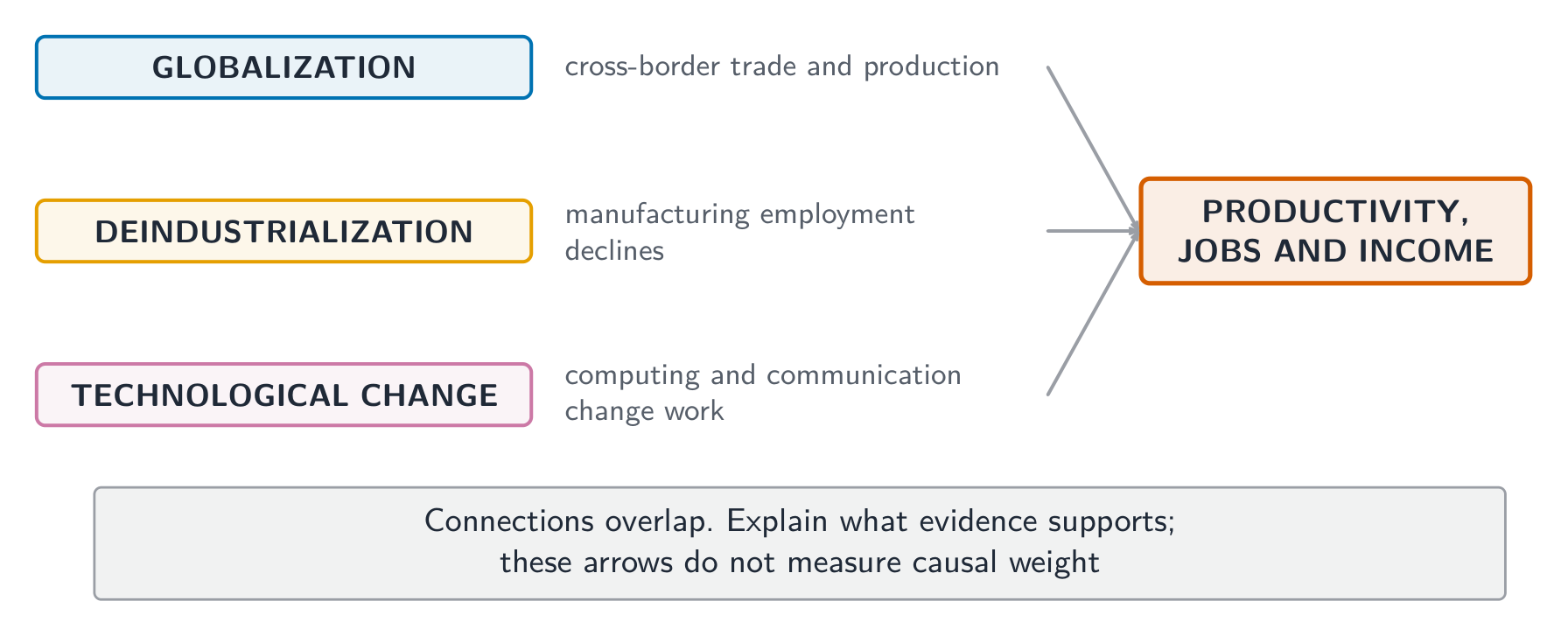
Three developments help describe the economy after 1980:
Digital communication increased productivity and worldwide economic opportunities. These gains coexisted with stagnant working- and middle-class real wages and growing income inequality 收入不平等.
Try it — identify developments and overlap. Teacher-written cases grounded in CED Topic 9.4: A, digital communication helps a business reach customers abroad; B, manufacturing employment falls while service employment rises; C, computing and the internet change work and access to information. Match the cases to globalization, deindustrialization and technological change. Can one case involve more than one development?
Worked classification. A involves global connections and technology. B describes a sectoral employment shift; it does not establish that every job moved abroad or that manufacturing vanished. C concerns technology's wider effects. Identify the pattern before explaining its cause.
Try it — assess distribution. The CED describes increased productivity alongside stagnant working- and middle-class real wages and rising inequality. Does higher productivity prove all workers gained equally?
Worked judgment. Productive capacity and income distribution are different. Growth can coexist with unequal gains. Employment shifts and declining union membership describe the setting, but listing trends does not measure their causal weights. An explanation needs evidence about the group, dates and mechanism.

Distinguish global connections, employment shifts and technology without assuming causal weights.
| English |
|---|
| Globalization/ˌɡləʊbəlaɪˈzeɪʃn/ |
| Deindustrialization/ˌdeɪndəˌstrɪəlaɪˈzeɪʃn/ |
| Technological change/ˌteknəˈlɒdʒɪkl tʃeɪndʒ/ |
| income inequality/ˈɪŋkʌm ɪniːˈkwɒlɪti/ |
| Thematic Focus | Learning Objective | Historical Developments |
|---|---|---|
MIG | Unit 9.E |
|
Source: College Board AP Course and Exam Description
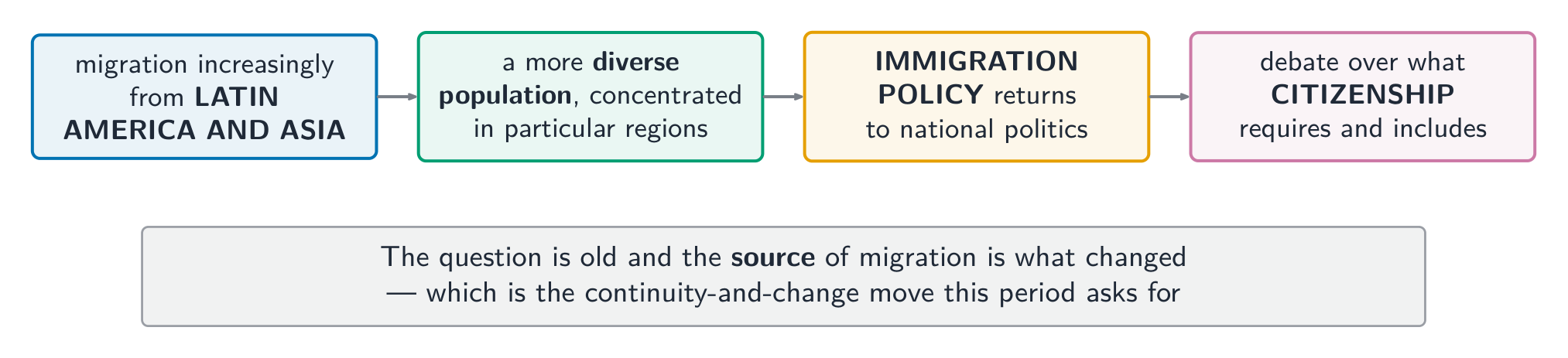
Migration and immigration 人口迁移与移民 in the 1990s and 2000s continued to reshape the population, with growth in arrivals from Latin America and Asia 拉丁美洲与亚洲 following the 1965 reform of immigration law.
The consequences are the examinable part: population growth in the South and West, the growth of multi-ethnic cities, ongoing debate over immigration policy 移民政策 and border enforcement, and continuing arguments about citizenship 公民身份 and national identity - the same argument the course has traced since Reconstruction.
| English |
|---|
| Migration and immigration/maɪˈɡreɪʃn ænd ˌɪmɪˈɡreɪʃn/ |
| Latin America and Asia/ˈlætɪn əˈmerɪkə ænd ˈeɪʃə/ |
| immigration policy/ˌɪmɪˈɡreɪʃn ˈpɒlɪsi/ |
| citizenship/ˈsɪtɪzənʃɪp/ |
| Thematic Focus | Learning Objective | Historical Developments |
|---|---|---|
WOR | Unit 9.F |
|
Source: College Board AP Course and Exam Description
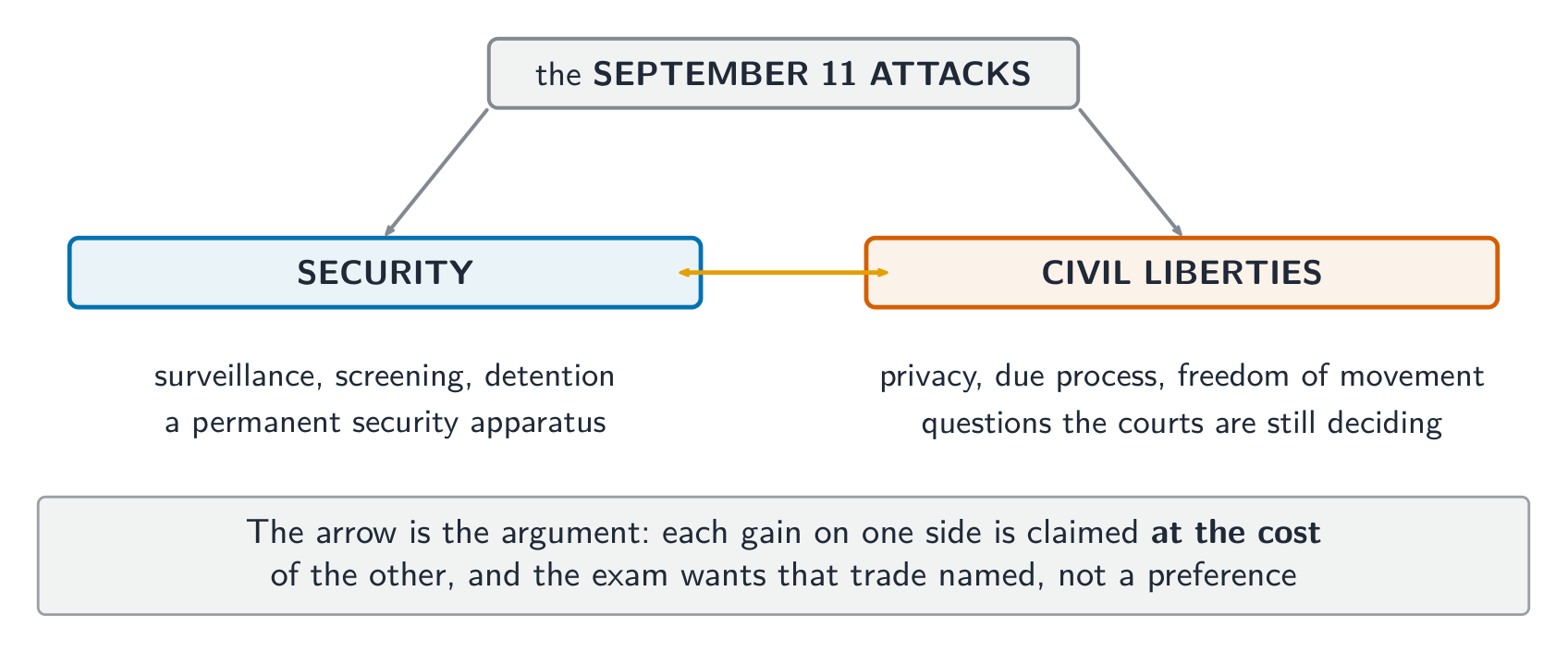
The period's later topics group around a small number of developments:
| English |
|---|
| September 11 attacks/sepˈtembə ɪˈlevən əˈtæks/ |
| security and civil liberties/sɪˈkjʊərɪti ænd ˈsɪvl ˈlɪbətiz/ |
| Political polarisation/pəˈlɪtɪkl ˌpəʊləraɪˈzeɪʃn/ |
| climate and energy/ˈklaɪmət ænd ˈenədʒi/ |
| Learning Objective | Review: Unit 9 Key Concepts |
|---|---|
Unit 9.G |
|
Source: College Board AP Course and Exam Description
Practise causation by explaining mechanisms with relevant evidence. Possible connections across periods include deindustrialisation to the market revolution's regional specialisation, immigration debates to the nativism of the 1850s and 1920s, and arguments over federal power to the New Deal.
Exam transfer — 2025 AP US History, Set 2, long essay Q4, paraphrased. Evaluate how United States society responded to economic changes from 1960 to 2000. Explain a response rather than only naming a change. Connect computers to changing employment, then develop another relevant example such as migration toward the Sun Belt or a policy debate. This unit supplies evidence for part of the question's dates.
Teacher-written model passage. As computing became more important to the late-twentieth-century economy, Americans increasingly worked in service and information-related jobs. Computer-based work supported white-collar opportunities, while access to these opportunities was uneven, especially for workers without college education.
Why it fits. The official scheme accepts computers and the service economy as evidence when used to explain jobs and class opportunities. This is one developed passage, not a complete long essay or official sample. A full response needs an argument and further developed examples; a limiting phrase alone does not guarantee complex understanding or credit.
Work through it step by step, with instant-check exercises.
Loading subjects…