2.1 Contextualizing Period 2
| Learning Objective | Preview: Unit 2 Key Concepts |
|---|---|
Unit 2.A |
|
2.2 European Colonization
| Thematic Focus | Learning Objective | Historical Developments |
|---|---|---|
MIG | Unit 2.B |
|
AP United States History · Topic 2
 8:26
8:26
Period 2: 1607 to 1754
Two English colonies, founded within twenty years of each other by people from the same country under the same crown. One grows tobacco with enslaved labour on…
English narration · English + 中文 subtitles burned in
| Learning Objective | Preview: Unit 2 Key Concepts |
|---|---|
Unit 2.A |
|
| Thematic Focus | Learning Objective | Historical Developments |
|---|---|---|
MIG | Unit 2.B |
|
Source: College Board AP Course and Exam Description
Period 2 runs from 1607 to 1754 - from Jamestown to the eve of the Seven Years' War. Its central question is why European colonies turned out so differently from one another.
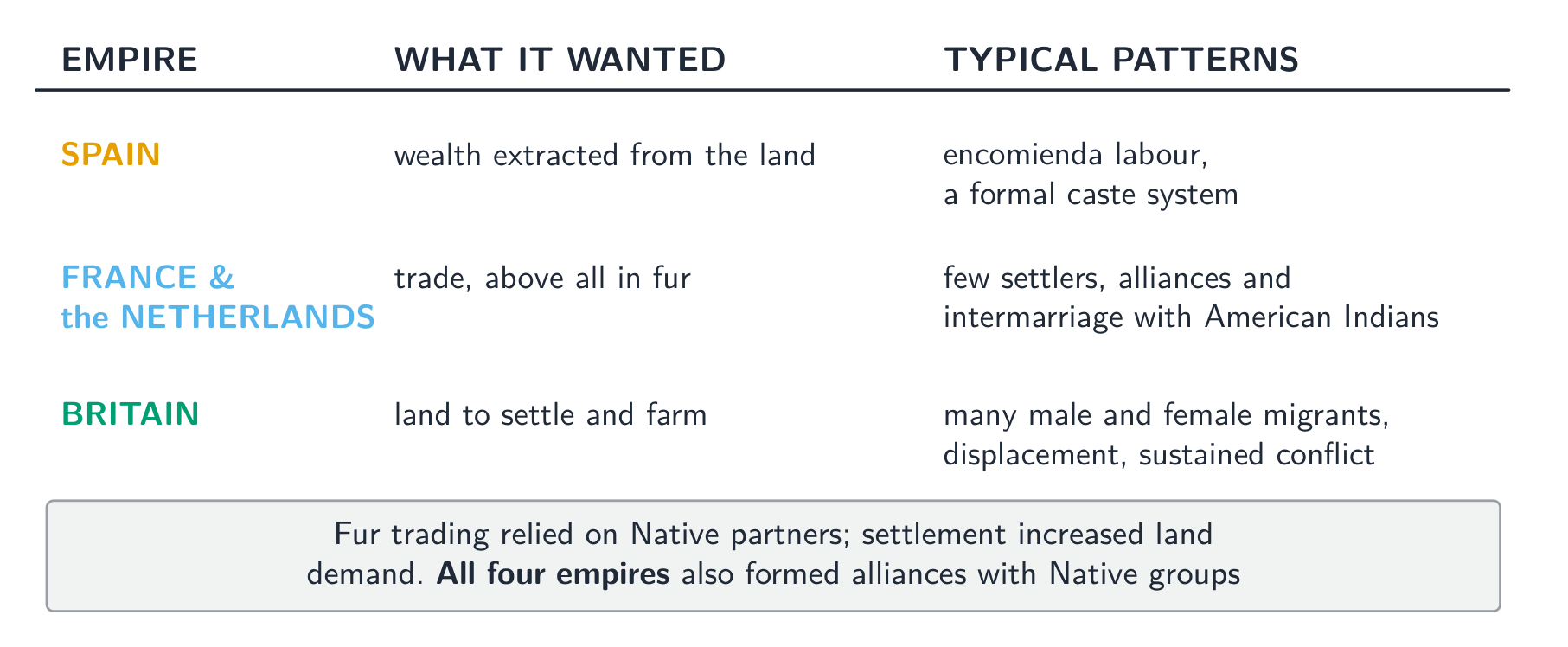
Imperial goals, migration and local conditions helped shape different colonial patterns:
Agricultural settlement increased British demand for Native land and contributed to displacement and conflict. This is a broad comparison, not a rule that British colonists never traded or made alliances. French, Dutch, British and Spanish colonies all formed alliances with Native groups; trade, cooperation and conflict could coexist. Native communities pursued their own diplomatic and economic goals.
Try it — explain the different strategies. These are teaching summaries, not historical quotations. A colony has few European settlers and depends on Native partners for furs. Another has many farming settlers seeking additional land. A third extracts resources through institutions that subjugate Native communities. Match the patterns to French/Dutch, British and Spanish colonization. Explain the link between each economic goal and its relationships; do not only name an empire.
Worked reasoning. French and Dutch fur exports relied on Native trading partners and diplomatic relationships. British agricultural settlement increased demand for land and contributed to displacement and conflict. Spanish resource extraction relied on institutions that controlled Native labour and society, alongside conversion and other goals. These are patterns with variation, not complete accounts of every colony.
Transfer — test a universal claim. A student says, "Only French and Dutch colonists made Native alliances; British settlers never did." Use the course evidence that all four empires allied with Native groups to explain why the claim fails. A British alliance does not erase land conflict, and a French trading alliance does not establish that French colonization was always peaceful. Identify the place, period and purpose before generalising.
One variable — what the empire wanted — predicts the relationship it had with American Indians.
| English |
|---|
| subjugating/ˈsʌbdʒuːɡeɪtɪŋ/ |
| trade alliances/treɪd əˈlaɪənsɪz/ |
| fur/fɜː/ |
| male and female migrants/meɪl ænd ˈfiːmeɪl ˈmaɪɡrənts/ |
| Thematic Focus | Learning Objective | Historical Developments |
|---|---|---|
GEO | Unit 2.C |
|
Source: College Board AP Course and Exam Description
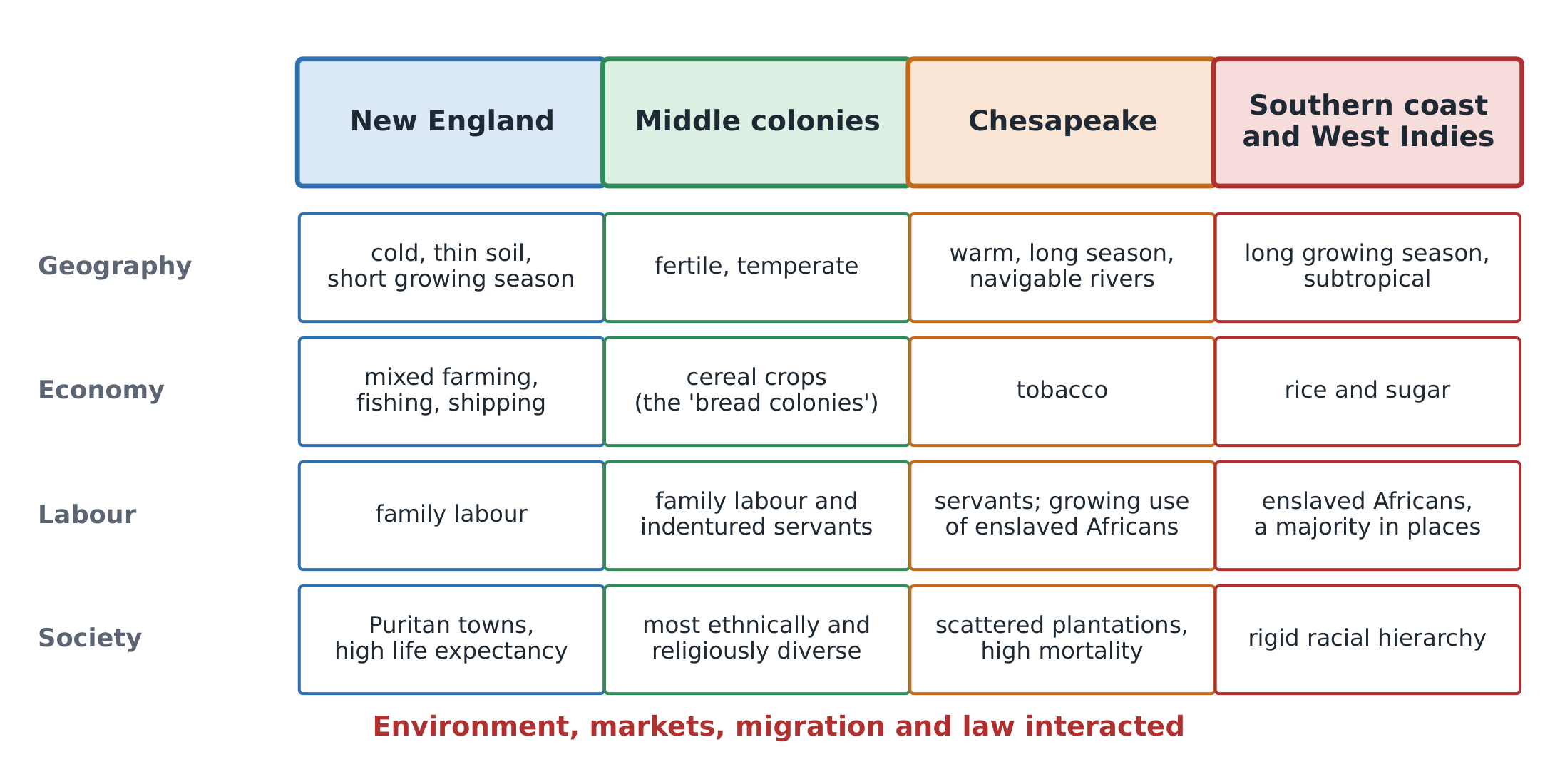
British North America was not one place. Four regions developed distinct societies.
Try it — compare using evidence. Use the regional notes to compare the Chesapeake with New England. Name one economic difference, describe the labour patterns, then explain how the difference connects to production. Include a similarity: both regions took part in Atlantic commerce.
Worked comparison. The Chesapeake exported labour-intensive tobacco and increasingly relied on enslaved Africans after extensive use of indentured servants. New England combined family farming with fishing, shipping and commerce. Different production patterns helped shape different labour arrangements, while both regions participated in Atlantic markets. These are dominant patterns; they do not mean slavery was absent from New England or that all Chesapeake workers had the same status.
Transfer — qualify a causal claim. "Warm weather caused slavery, and geography determined society." Explain one relevant environmental influence and two other factors. Long growing seasons supported some plantation crops, but export demand, migration, colonists' coercive decisions and laws establishing racial and hereditary slavery also shaped labour systems. Climate did not require people to enslave others. All British colonies participated in slavery to varying degrees; say where slavery was more common, rather than claiming it was absent elsewhere.
One political feature was shared. Distance from London, and Britain's initially lax attention 松散管理, let the colonies create self-governing institutions 自治机构 - colonial assemblies that later shaped resistance to imperial control.
| English |
|---|
| Chesapeake/ˈtʃesəpiːk/ |
| tobacco/təˈbækəʊ/ |
| indentured servants/ˌɪnˈdentʃəd ˈsɜːvənts/ |
| Puritans/ˈpjʊərɪtnz/ |
| family farms/ˈfæmɪli fɑːmz/ |
| cereal crops/ˈsɪərɪəl krɒps/ |
| ethnically and religiously diverse/ˈeθnɪkli ænd rɪˈlɪdʒəsli daɪˈvɜːs/ |
| rice/raɪs/ |
| sugar/ˈʃʊɡə/ |
| lax attention/læks əˈtenʃn/ |
| self-governing institutions/self ˈɡʌvənɪŋ ˌɪnstɪˈtjuːʃnz/ |
| Thematic Focus | Learning Objective | Historical Developments |
|---|---|---|
WXT | Unit 2.D |
|
Source: College Board AP Course and Exam Description
An Atlantic economy 大西洋经济 developed in which goods - and enslaved Africans and American Indians - were exchanged around the ocean rim. Continuing trade increased the flow of goods in and out of American Indian communities, changing them too.
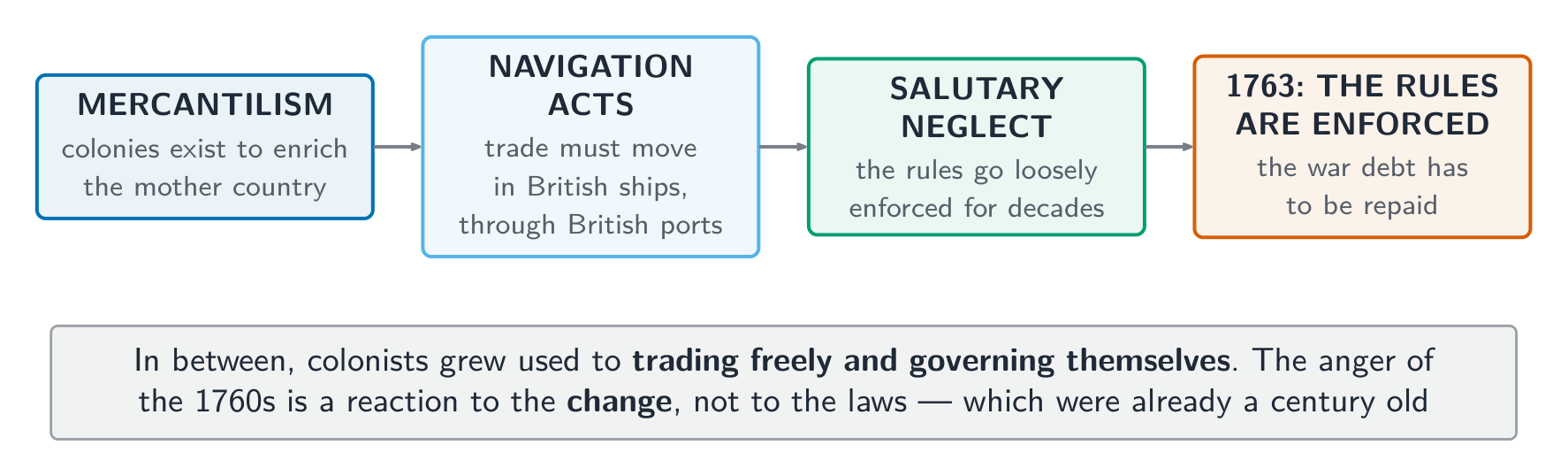
From the mid-seventeenth century, the British government tried to bring its colonies into a coherent imperial system, driven by mercantilism 重商主义 - the belief that colonies exist to enrich the mother country. The Navigation Acts 航海条例 required colonial trade to move in British ships through British ports.
Enforcement was loose for decades, a practice later called salutary neglect 有益的忽视. Colonists grew used to trading freely and governing themselves, which is exactly why tightening the rules after 1763 provoked such anger.
The Navigation Acts were a century old by 1763. What changed was enforcement — and the anger is a reaction to the change.
| English |
|---|
| Atlantic economy/ətˈlæntɪk ɪˈkɒnəmi/ |
| mercantilism/ˈmɜːkæntəlɪzəm/ |
| Navigation Acts/ˌnævɪˈɡeɪʃn ækts/ |
| salutary neglect/ˈsæluːtəri nɪˈɡlekt/ |
| Thematic Focus | Learning Objective | Historical Developments |
|---|---|---|
WOR | Unit 2.E |
|
Source: College Board AP Course and Exam Description
Contact produced both accommodation 调适 and conflict 冲突, and the balance differed by empire and region.
Where trade mattered most - New France, the Dutch fur trade - alliances and intermarriage were common. Where land mattered most, conflict followed. British expansion led to sustained military conflict 军事冲突 with American Indians over land, resources, and boundaries.
Resistance took organised forms. The Pueblo Revolt 普韦布洛起义 of 1680 drove the Spanish out of New Mexico for over a decade and forced lasting changes in Spanish policy - the clearest example in the course of native resistance succeeding.
| English |
|---|
| accommodation/əˌkɒməˈdeɪʃn/ |
| conflict/ˈkɒnflɪkt/ |
| military conflict/ˈmɪlɪtəri ˈkɒnflɪkt/ |
| Pueblo Revolt/pˈwebləʊ rɪˈvəʊlt/ |
| Thematic Focus | Learning Objective | Historical Developments |
|---|---|---|
SOC | Unit 2.F |
|
Unit 2.G |
|
Source: College Board AP Course and Exam Description
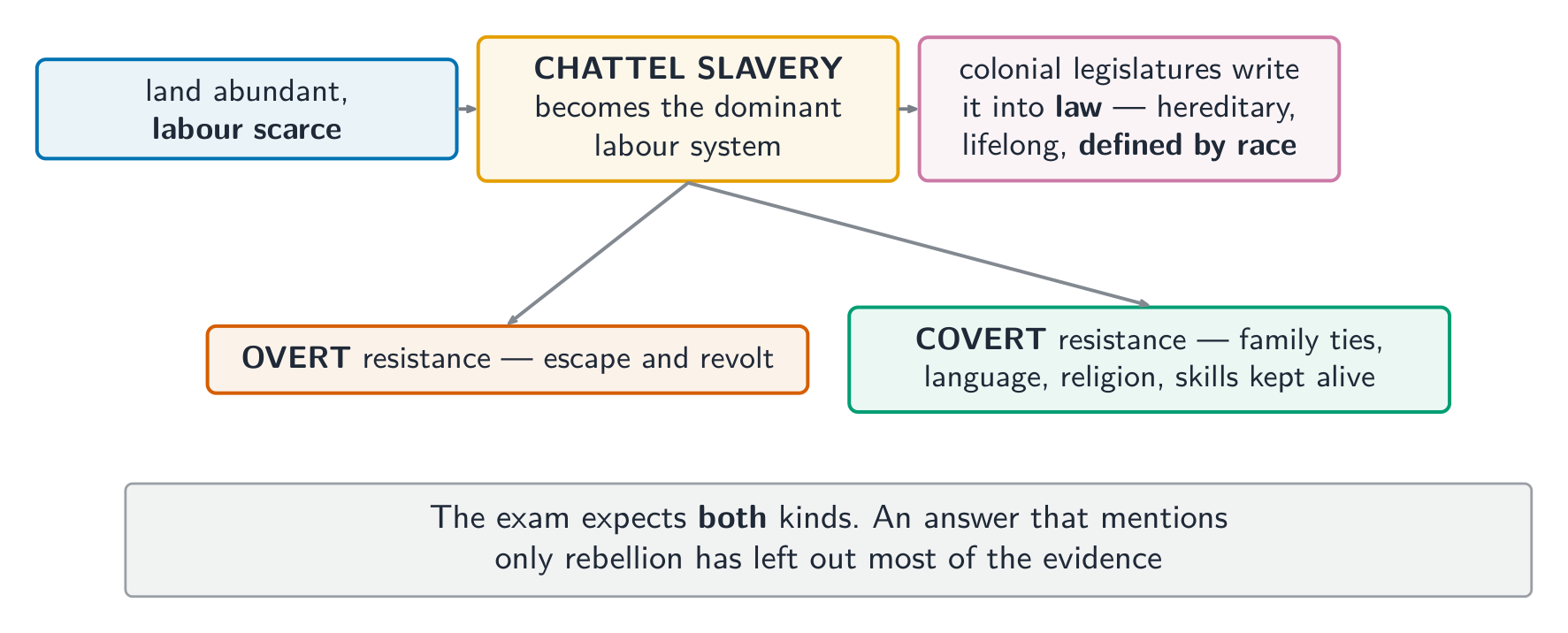
All the British colonies participated in the Atlantic slave trade to varying degrees, because land was abundant and labour scarce.
As chattel slavery 动产奴隶制 became the dominant labour system in many southern colonies, colonial legislatures wrote new laws creating a strict racial system 严格的种族制度. Slavery became hereditary, lifelong, and defined by race - a legal structure, not merely a practice.
Enslaved Africans developed overt and covert means of resistance: escape and revolt, and also the maintenance of family ties, languages, religious practices, and skills. The exam expects both kinds; an answer that mentions only rebellion misses most of the evidence.
| English |
|---|
| chattel slavery/ˈtʃætl ˈsleɪvəri/ |
| strict racial system/strɪkt ˈreɪʃl ˈsɪstəm/ |
| Thematic Focus | Learning Objective | Historical Developments |
|---|---|---|
NAT | Unit 2.H |
|
Unit 2.I |
|
Source: College Board AP Course and Exam Description
Two opposite processes ran at once.
Toward diversity: the presence of different European religious and ethnic groups produced a significant degree of pluralism 多元并存, most visibly in the middle colonies.
Toward similarity: the colonies experienced a gradual Anglicization 英国化, adopting British goods, print culture, legal norms, and political ideas even as they developed autonomous political communities.
Transatlantic exchange also brought the Enlightenment 启蒙运动 and, in the 1730s and 1740s, the religious revivals of the First Great Awakening 第一次大觉醒, which encouraged colonists to question established authority - religious first, political later.
The goals of European leaders and colonists increasingly diverged 分歧, and colonists' resistance to imperial control drew on local experience of self-government and evolving ideas about rights.
| English |
|---|
| pluralism/ˈplʊərəlɪzəm/ |
| Anglicization/ˌæŋɡlɪsaɪˈzeɪʃn/ |
| Enlightenment/enˈlaɪtənmənt/ |
| First Great Awakening/fɜːst ɡreɪt əˈweɪkənɪŋ/ |
| diverged/daɪˈvɜːdʒd/ |
| Learning Objective | Review: Unit 2 Key Concepts |
|---|---|
Unit 2.J |
|
Source: College Board AP Course and Exam Description
The unit ends with comparison 比较, the reasoning skill this period is built to teach: the regions differ enough that almost any claim about "the colonies" needs qualifying.
Worked example (a real AP exam question). The 2025 exam asked, as part A of a short-answer question, "Briefly describe one political development in British North America from 1607 to 1753." A teacher-written response consistent with the official 2025 Set 1 Question 3(A) scheme describes a development and its relevant characteristics: "Colonial assemblies such as the Virginia House of Burgesses developed powers over taxation and spending, which gave colonists practical experience of representative self-government before 1754." Notice the shape: Briefly describe requires relevant characteristics, more than an isolated term. This model describes what assemblies did; a name alone is insufficient. Marks are lost here by writing too much about the wrong thing, or by staying vague ("colonies became more independent").
| English |
|---|
| comparison/kəmˈpærɪsn/ |
Grounding. CED Topics 2.2, 2.3, 2.5 and 2.6 support these comparisons and qualifications. The exam-linked response is checked against the official 2025 Set 1 Question 3(A) paper and scheme (local paper PDF5, scheme PDF6); it is a teacher-written model, not an official sample.
Work through it step by step, with instant-check exercises.
Loading subjects…