In one decade a country doubles its territory. That sounds like a triumph and it brings one question with it: will slavery go there? Every compromise from then…
English narration · English + 中文 subtitles burned in
5.1 5.2 5.3
Manifest Destiny and Expansion
Syllabus
5.1 Contextualizing Period 5
Learning Objective
Preview: Unit 5 Key Concepts
Unit 5.A
Explain the context in which sectional conflict emerged from 1844 to 1877.
KC-5.1 The United States became more connected with the world, pursued an expansionist foreign policy in the Western Hemisphere, and emerged as the destination for many migrants from other countries.
KC-5.1.I Popular enthusiasm for U.S. expansion, bolstered by economic and security interests, resulted in the acquisition of new territories, substantial migration westward, and new overseas initiatives.
KC-5.1.II In the 1840s and 1850s, Americans continued to debate questions about rights and citizenship for various groups of U.S. inhabitants.
KC-5.2 Intensified by expansion and deepening regional divisions, debates over slavery and other economic, cultural, and political issues led the nation into civil war.
KC-5.2.I Ideological and economic differences over slavery produced an array of diverging responses from Americans in the North and the South.
KC-5.2.II Debates over slavery came to dominate political discussion in the 1850s, culminating in the bitter election of 1860 and the secession of Southern states.
KC-5.3 The Union victory in the Civil War and the contested reconstruction of the South settled the issues of slavery and secession, but left unresolved many questions about the power of the federal government and citizenship rights.
KC-5.3.I The North’s greater manpower and industrial resources, the leadership of Abraham Lincoln and others, and the decision to emancipate enslaved people eventually led to the Union military victory over the Confederacy in the devastating Civil War.
KC-5.3.II.i Reconstruction and the Civil War ended slavery, altered relationships between the states and the federal government, and led to debates over new definitions of citizenship, particularly regarding the rights of African Americans, women, and other minorities.
5.2 Manifest Destiny
Thematic Focus
Learning Objective
Historical Developments
GEO Geography and the Environment — Geographic and environmental factors, including competition over and debates about natural resources, shape the development of America and foster regional diversity. The development of America impacts the environment and reshapes geography, which leads to debates about environmental and geographic issues.
Unit 5.B
Explain the causes and effects of westward expansion from 1844 to 1877.
KC-5.1.I.A The desire for access to natural and mineral resources and the hope of many settlers for economic opportunities or religious refuge led to an increased migration to and settlement in the West.
KC-5.1.I.B Advocates of annexing western lands argued that Manifest Destiny and the superiority of American institutions compelled the United States to expand its borders westward to the Pacific Ocean; however, this frequently provoked competition and violent conflict.
KC-5.1.I.D Westward migration was boosted during and after the Civil War by the passage of new legislation promoting western transportation and economic development.
KC-5.1.I.E U.S. interest in expanding trade led to economic, diplomatic, and cultural initiatives to create more ties with Asia.
5.3 The Mexican–American War
Thematic Focus
Learning Objective
Historical Developments
WOR America in the World — Diplomatic, economic, cultural, and military interactions between empires, nations, and peoples shape the development of America and America’s increasingly important role in the world.
Unit 5.C
Explain the causes and effects of the Mexican– American War.
KC-5.1.I.C The United States added large territories in the West through victory in the Mexican– American War and diplomatic negotiations, raising questions about the status of slavery, American Indians, and Mexicans in the newly acquired lands.
KC-5.1.II.C U.S. government interaction and conflict with Mexican Americans and American Indians increased in regions newly taken from American Indians and Mexico, altering these groups’ economic self-sufficiency and cultures.
Source: College Board AP Course and Exam Description
Period 5 runs from 1844 to 1877. Disputes over slavery and federal power intensified into civil war and continued during Reconstruction.
Expansion sharpened disputes over slavery. The desire for access to natural and mineral resources 自然与矿产资源, and the hope of settlers for land, pushed Americans west. Advocates justified annexation through Manifest Destiny 天定命运论 - the claim that the United States was destined, and superior enough, to spread across the continent.
The Mexican-American War 美墨战争 added enormous territory in the West. Later, wartime legislation such as the Homestead Act 宅地法 boosted migration further, and interest in expanding trade produced economic and diplomatic initiatives abroad.
Expansion also meant conflict. The government's interaction with Mexican Americans 墨西哥裔美国人 and American Indians produced dispossession, resistance, and new legal disputes over land and citizenship.
natural and mineral resources/ˈnætʃərəl ænd ˈmɪnərəl rɪˈzɔːsɪz/
Manifest Destiny/ˈmænɪfest ˈdestɪni/
Mexican-American War/ˈmeksɪkən əˈmerɪkən wɔː/
Homestead Act/ˈhəʊmsted ækt/
Mexican Americans/ˈmeksɪkən əˈmerɪkənz/
5.4 5.5 5.6
Why Expansion Broke the Political System
Syllabus
5.4 The Compromise of 1850
Thematic Focus
Learning Objective
Historical Developments
NAT American and National Identity — The development of and debates about democracy, freedom, citizenship, diversity, and individualism shape American national identity, cultural values, and beliefs about American exceptionalism, and in turn, these ideas shape political institutions and society. Throughout American history, notions of national identity and culture have coexisted with varying degrees of regional and group identities.
Unit 5.D
Explain the similarities and differences in how regional attitudes affected federal policy in the period after the Mexican–American War.
KC-5.2.II.A The Mexican Cession led to heated controversies over whether to allow slavery in the newly acquired territories.
KC-5.2.II.B.i The courts and national leaders made a variety of attempts to resolve the issue of slavery in the territories, including the Compromise of 1850.
5.5 Sectional Conflict: Regional Differences
Thematic Focus
Learning Objective
Historical Developments
SOC Social Structures — Social categories, roles, and practices are created, maintained, challenged, and transformed throughout American history, shaping government policy, economic systems, culture, and the lives of citizens.
Unit 5.E
Explain the effects of immigration from various parts of the world on American culture from 1844 to 1877.
KC-5.1.II.A Substantial numbers of international migrants continued to arrive in the United States from Europe and Asia, mainly from Ireland and Germany, often settling in ethnic communities where they could preserve elements of their languages and customs.
KC-5.1.II.B A strongly anti-Catholic nativist movement arose that was aimed at limiting new immigrants’ political power and cultural influence.
Unit 5.F
Explain how regional differences related to slavery caused tension in the years leading up to the Civil War.
KC-5.2.I.A The North’s expanding manufacturing economy relied on free labor in contrast to the Southern economy’s dependence on enslaved labor. Some Northerners did not object to slavery on principle but claimed that slavery would undermine the free labor market. As a result, a free-soil movement arose that portrayed the expansion of slavery as incompatible with free labor.
KC-5.2.I.B African American and white abolitionists, although a minority in the North, mounted a highly visible campaign against slavery, presenting moral arguments against the institution, assisting escapes, and sometimes expressing a willingness to use violence to achieve their goals.
KC-5.2.I.C Defenders of slavery based their arguments on racial doctrines, the view that slavery was a positive social good, and the belief that slavery and states’ rights were protected by the Constitution.
5.6 Failure of Compromise
Thematic Focus
Learning Objective
Historical Developments
PCE Politics and Power — Debates fostered by social and political groups about the role of government in American social, political, and economic life shape government policy, institutions, political parties, and the rights of citizens.
Unit 5.G
Explain the political causes of the Civil War.
KC-5.2.II.B.ii The courts and national leaders made a variety of attempts to resolve the issue of slavery in the territories, including the Kansas–Nebraska Act, and the Dred Scott decision, but these ultimately failed to reduce conflict.
KC-5.2.II.C The Second Party System ended when the issues of slavery and anti-immigrant nativism weakened loyalties to the two major parties and fostered the emergence of sectional parties, most notably the Republican Party in the North.
Source: College Board AP Course and Exam Description
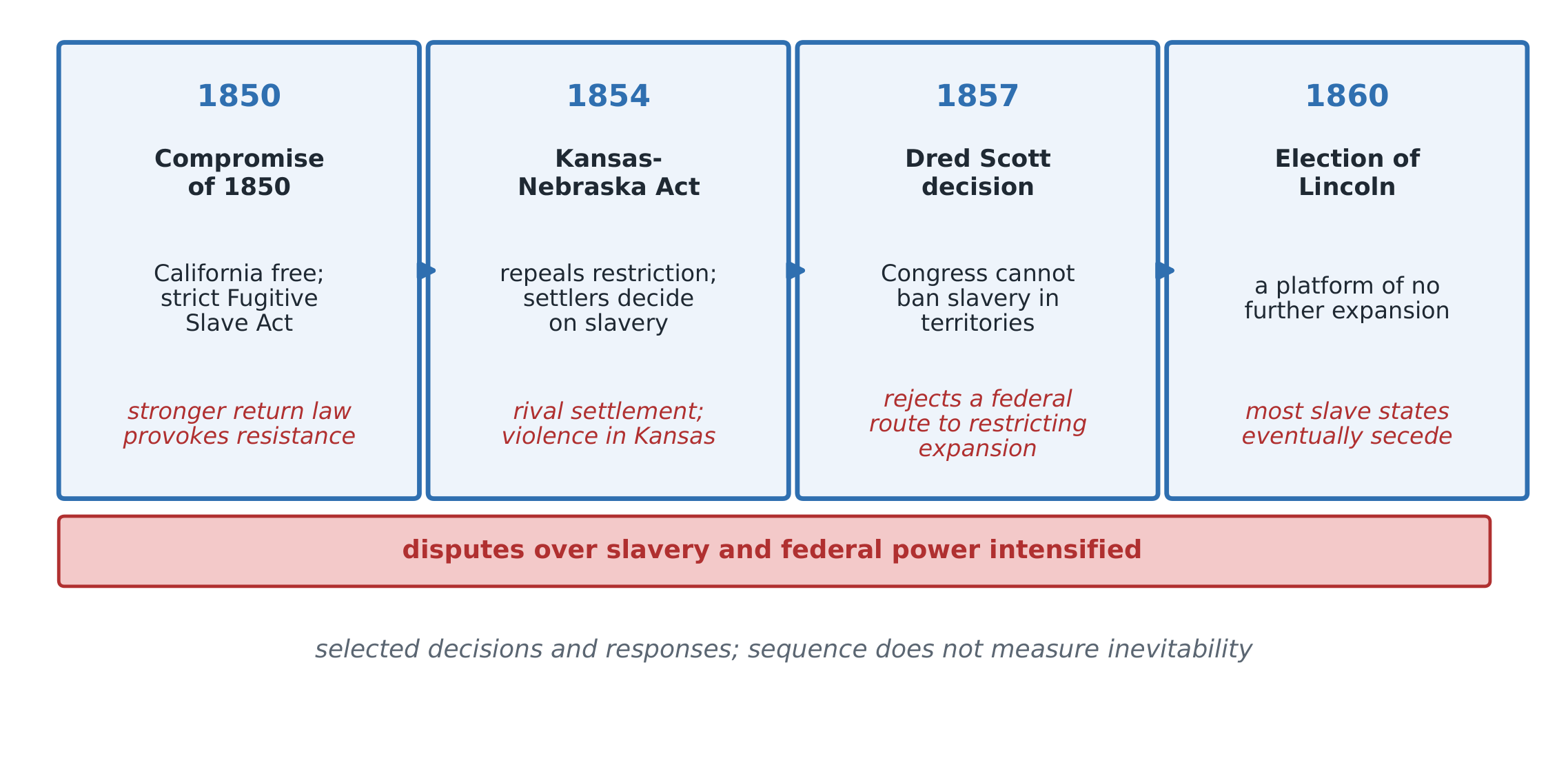
Acquiring land intensified the question of whether slavery would expand and who could decide. Different institutions tried different answers, but these failed to end sectional conflict.
Try it — assess a political bargain. Selected measures in the Compromise of 1850 1850年妥协案 admitted California as a free state, left slavery possible in Utah and New Mexico, ended the slave trade in Washington, D.C., and strengthened the Fugitive Slave Act 逃奴法. Identify a measure welcomed by opponents of slavery's expansion and one welcomed by slaveholders. Why could stronger enforcement of escaped enslaved people's return create opposition in free states?
Worked explanation. Free-state admission limited slavery's expansion in California. The stronger fugitive-slave law helped slaveholders recover people who had escaped, including into free states; opponents of slavery resisted this enforcement. Leaving slavery possible in Utah and New Mexico did not settle its status throughout the West. The bargain addressed competing demands without removing the conflict over slavery.
Try it — explain a rule and a response. The Kansas–Nebraska Act of 1854 repealed the Missouri Compromise restriction for the new territories. Popular sovereignty 人民主权原则 let settlers decide whether to permit slavery. Proslavery and antislavery activists entered Kansas to influence the outcome, and violence followed. Explain how the policy raised the stakes of settlement.
Worked mechanism. A previous restriction was removed, so the territorial decision could permit slavery. Competing groups tried to shape that decision by entering Kansas. The struggle over slavery's future involved violence known as Bleeding Kansas rather than an accepted resolution. This explains a particular conflict; it does not mean every use of popular sovereignty must be violent.
Try it — qualify a claim. The Dred Scott decision 德雷德·斯科特案 in 1857 held that Congress lacked authority to prohibit slavery in federal territories and rejected Scott's claim that residence in free territory had made him free. A student concludes: “The Court removed one route to limiting slavery's expansion, so every possible political compromise became illegal.” Identify the supported part and revise the overstatement.
Worked judgment. The ruling rejected Congress's authority to ban slavery in the territories, challenging a federal legislative route to restricting expansion. It did not outlaw every imaginable political bargain. Distinguish Congress's compromise laws, settlers' decisions under popular sovereignty and the Court's constitutional ruling. These methods failed to end sectional conflict.
Political choices and responses intensified conflict; this sequence does not measure inevitability.
Ideological and economic differences produced diverging responses 分歧的回应 to slavery. The free-soil movement opposed slavery's expansion partly because it threatened free labour; not every supporter opposed slavery on moral grounds. African American and white abolitionists campaigned against slavery itself. Defenders of slavery invoked racist doctrines, states' rights and claims that slavery was a positive good. Slavery disputes and anti-immigrant nativism weakened the old major parties; sectional parties grew, including the northern Republican Party 共和党.
Exam transfer — adapted practice from 2025 AP US History, Set 1, short-answer Q2(C). Stimulus summary, not a quotation: in the question's 1830 speech, Daniel Webster defended using existing federal power for internal improvements benefiting the whole Union and opposed treating states as separate countries. The task asks for a similarity to a political debate from 1848–1865. Try it using the Dred Scott debate. Explain the shared issue in both debates; the full paper contains Webster's original excerpt.
Teacher-written model. Both debates concerned the extent of federal power. Webster defended exercising existing federal authority for improvements serving the Union. Debates over Dred Scott concerned whether Congress could regulate slavery in federal territories; the Court denied its authority to prohibit slavery there.
Why this fits. The official scheme accepts a similarity about federal powers. This model explains that issue in both debates and uses an event within the required dates. The policies differed: internal improvements and slavery. They shared an issue without being identical. This is our model, not an official sample or a guarantee of credit.
Compromise of 1850/ˈkɒmprəmaɪz ɒv wɒn ˈθaʊznd ˈeɪthʌndrɪdn ˈfɪfti/
Fugitive Slave Act/ˈfjuːdʒɪtɪv sleɪv ækt/
Popular sovereignty/ˈpɒpjʊlə ˈsɒvərɪnti/
Dred Scott decision/dred skɒt dɪˈsɪʒn/
diverging responses/daɪˈvɜːdʒɪŋ rɪˈspɒnsɪz/
Republican Party/rɪˈpʌblɪkən ˈpɑːti/
5.7 5.8 5.9
Secession and the Civil War
Syllabus
5.7 Election of 1860 and Secession
Thematic Focus
Learning Objective
Historical Developments
PCE Politics and Power — Debates fostered by social and political groups about the role of government in American social, political, and economic life shape government policy, institutions, political parties, and the rights of citizens.
Unit 5.H
Describe the effects of Lincoln’s election.
KC-5.2.II.D Abraham Lincoln’s victory on the Republicans’ free-soil platform in the presidential election of 1860 was accomplished without any Southern electoral votes. After a series of contested debates about secession, most slave states voted to secede from the Union, precipitating the Civil War.
5.8 Military Conflict in the Civil War
Thematic Focus
Learning Objective
Historical Developments
WOR America in the World — Diplomatic, economic, cultural, and military interactions between empires, nations, and peoples shape the development of America and America’s increasingly important role in the world.
Unit 5.I
Explain the various factors that contributed to the Union victory in the Civil War.
KC-5.3.I.A Both the Union and the Confederacy mobilized their economies and societies to wage the war even while facing considerable home front opposition.
KC-5.3.I.D Although the Confederacy showed military initiative and daring early in the war, the Union ultimately succeeded due to improvements in leadership and strategy, key victories, greater resources, and the wartime destruction of the South’s infrastructure.
5.9 Government Policies During the Civil War
Thematic Focus
Learning Objective
Historical Developments
NAT American and National Identity — The development of and debates about democracy, freedom, citizenship, diversity, and individualism shape American national identity, cultural values, and beliefs about American exceptionalism, and in turn, these ideas shape political institutions and society. Throughout American history, notions of national identity and culture have coexisted with varying degrees of regional and group identities.
Unit 5.J
Explain how Lincoln’s leadership during the Civil War impacted American ideals over the course of the war.
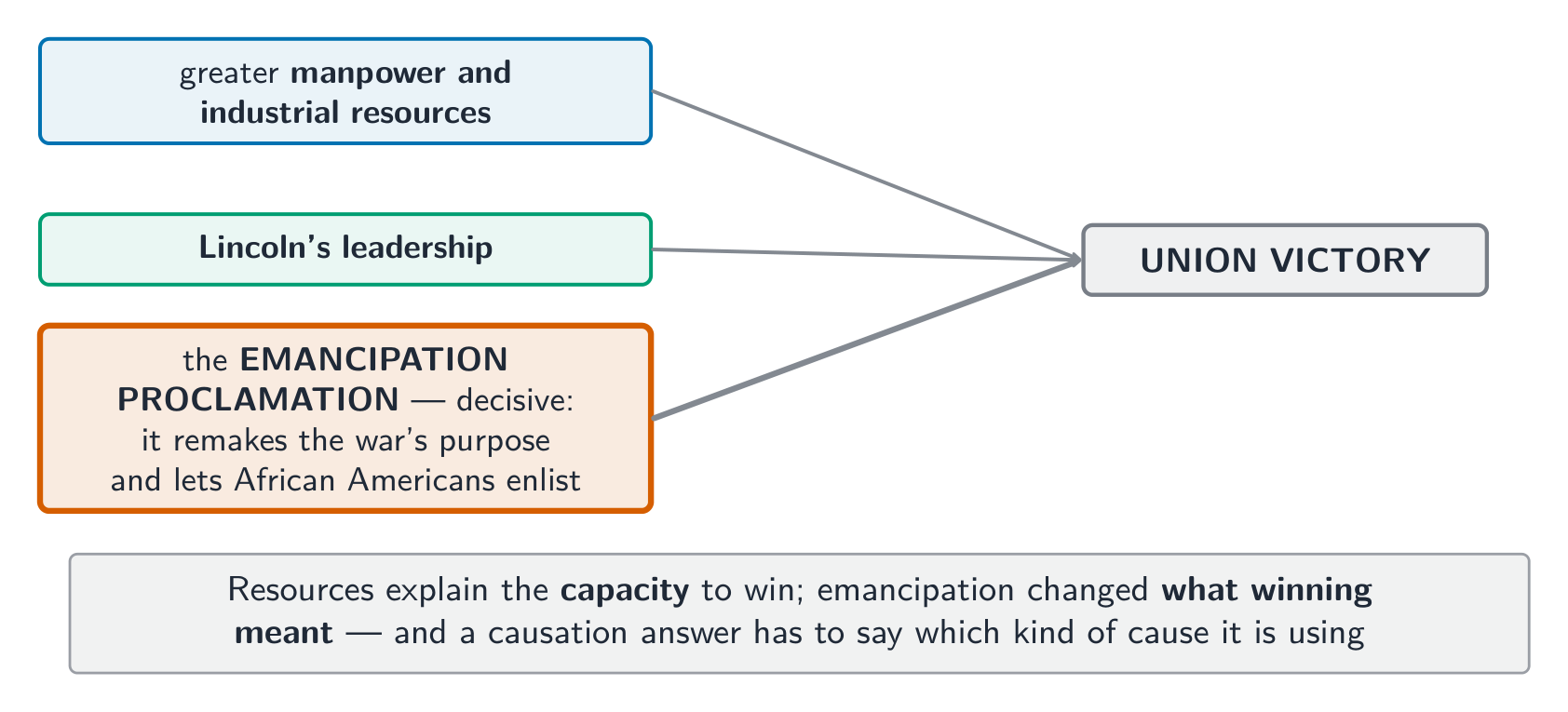
KC-5.3.I.B Lincoln and most Union supporters began the Civil War to preserve the Union, but Lincoln’s decision to issue the Emancipation Proclamation reframed the purpose of the war and helped prevent the Confederacy from gaining full diplomatic support from European powers. Many African Americans fled southern plantations and enlisted in the Union Army, helping to undermine the Confederacy.
KC-5.3.I.C Lincoln sought to reunify the country and used speeches such as the Gettysburg Address to portray the struggle against slavery as the fulfillment of America’s founding democratic ideals.
Source: College Board AP Course and Exam Description
The election of 1860 1860年大选 brought Abraham Lincoln 林肯 to power on a platform of preventing slavery's expansion. Southern states responded by seceding 脱离联邦, and the war followed.
The Union won because of greater manpower and industrial resources, Lincoln's leadership, and, decisively, the Emancipation Proclamation 解放黑奴宣言, which turned the war into a war against slavery and enabled the enlistment of African American soldiers.
Government policy changed on both sides during the war: conscription, taxation, and an expanded federal role in the economy. African Americans' service and the actions of enslaved people who freed themselves by reaching Union lines shaped the outcome as well.
PCE Politics and Power — Debates fostered by social and political groups about the role of government in American social, political, and economic life shape government policy, institutions, political parties, and the rights of citizens.
Unit 5.K
Explain the effects of government policy during Reconstruction on society from 1865 to 1877.
KC-5.3.II.ii Reconstruction altered relationships between the states and the federal government and led to debates over new definitions of citizenship, particularly regarding the rights of African Americans, women, and other minorities.
KC-5.3.II.A The 13th Amendment abolished slavery, while the 14th and 15th amendments granted African Americans citizenship, equal protection under the laws, and voting rights.
KC-5.3.II.B The women’s rights movement was both emboldened and divided over the 14th and 15th amendments to the Constitution.
KC-5.3.II.C Efforts by radical and moderate Republicans to change the balance of power between Congress and the presidency and to reorder race relations in the defeated South yielded some short-term successes. Reconstruction opened up political opportunities and other leadership roles to formerly enslaved persons but it ultimately failed, due both to determined Southern resistance and the North’s waning resolve.
Source: College Board AP Course and Exam Description
Reconstruction 重建时期 attempted to settle three questions: the status of the freedpeople, the terms of readmission for the southern states, and the balance of power between the states and the federal government.
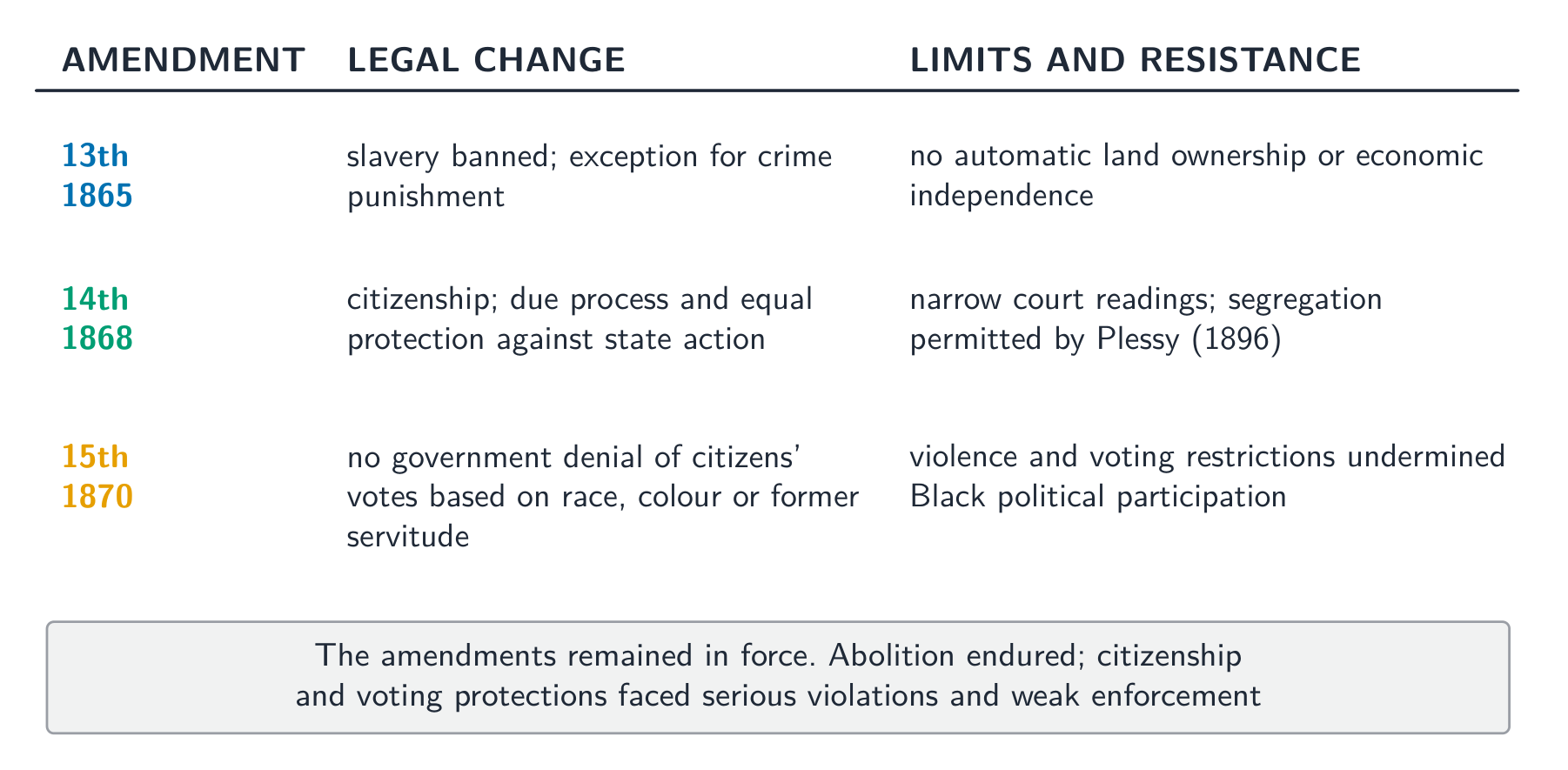
Try it — apply the Reconstruction Amendments. These are teacher-written cases after the relevant ratification. A: In 1865, a formerly enslaved person challenges being held as property. B: In 1868, a U.S.-born person subject to U.S. jurisdiction claims citizenship. C: In 1870, state officials deny an otherwise eligible citizen the vote solely because he is Black. Match each case to an amendment and state the relevant protection.
Worked application. The 13th Amendment 第十三修正案 (1865) banned slavery and involuntary servitude, with an exception for punishment after due conviction for crime. The 14th Amendment 第十四修正案 (1868) established citizenship for U.S.-born or naturalized people subject to U.S. jurisdiction and barred states from denying due process or equal protection to persons. The 15th Amendment 第十五修正案 (1870) prohibited federal or state denial of citizens' voting rights because of race, colour or previous servitude (such as enslavement). Thus A matches the 13th, B the 14th and C the 15th. These Reconstruction Amendments 重建修正案 address different protections: citizenship did not automatically give everyone the vote, land or effective protection against violence.
The women's rights movement was both emboldened and divided 既受鼓舞又出现分裂. Section 2 of the 14th Amendment used “male” in its representation rule; the 15th prohibited race-based voting denial but did not prohibit denial on grounds of sex.
Radical and moderate Republicans 激进派与温和派共和党人 sought to change the balance between Congress and the presidency and reshape southern society through the Freedmen's Bureau, military occupation and new state constitutions. Reconstruction opened political and leadership opportunities to formerly enslaved people. Southern resistance and declining Northern commitment weakened these gains.
Try it — assess the limits. Plantation owners retained most southern land; sharecropping limited freedpeople's economic independence. Segregation, violence, court decisions and political tactics undermined African Americans' rights. Does this mean every right returned to its prewar legal position? Distinguish constitutional change, enforcement and access to land.
Worked judgment. The amendments remained in force: slavery was abolished and formerly enslaved people gained citizenship. Resistance did not repeal those provisions. Violence and discriminatory practices could prevent people from exercising voting and equality protections, while narrow court interpretations limited protection. Abolition did not itself redistribute land, and sharecropping could maintain dependence despite legal freedom. “All three stopped working” erases real changes and differences among the protections.
Explore
Match cases to constitutional protections
Apply the different amendment protections to cases after the relevant ratification.
Radical and moderate Republicans/ˈrædɪkl ænd ˈmɒdərət rɪˈpʌblɪkənz/
5.11
The Failure of Reconstruction
Syllabus
5.11 Failure of Reconstruction
Thematic Focus
Learning Objective
Historical Developments
NAT American and National Identity — The development of and debates about democracy, freedom, citizenship, diversity, and individualism shape American national identity, cultural values, and beliefs about American exceptionalism, and in turn, these ideas shape political institutions and society. Throughout American history, notions of national identity and culture have coexisted with varying degrees of regional and group identities.
Unit 5.L
Explain how and why Reconstruction resulted in continuity and change in regional and national understandings of what it meant to be American.
KC-5.3.II.D Southern plantation owners continued to own the majority of the region’s land even after Reconstruction. Formerly enslaved persons sought land ownership but generally fell short of self-sufficiency, as an exploitative and soil-intensive sharecropping system limited blacks’ and poor whites’ access to land in the South.
KC-5.3.II.E Segregation, violence, Supreme Court decisions, and local political tactics progressively stripped away African American rights, but the 14th and 15th amendments eventually became the basis for court decisions upholding civil rights in the 20th century.
Source: College Board AP Course and Exam Description
Reconstruction produced lasting constitutional changes while resistance and weak enforcement undermined political and economic opportunities.
Southern plantation owners continued to own most of the region's land even after emancipation. Many formerly enslaved people entered sharecropping 分成租佃 arrangements that produced dependence and debt rather than economic independence.
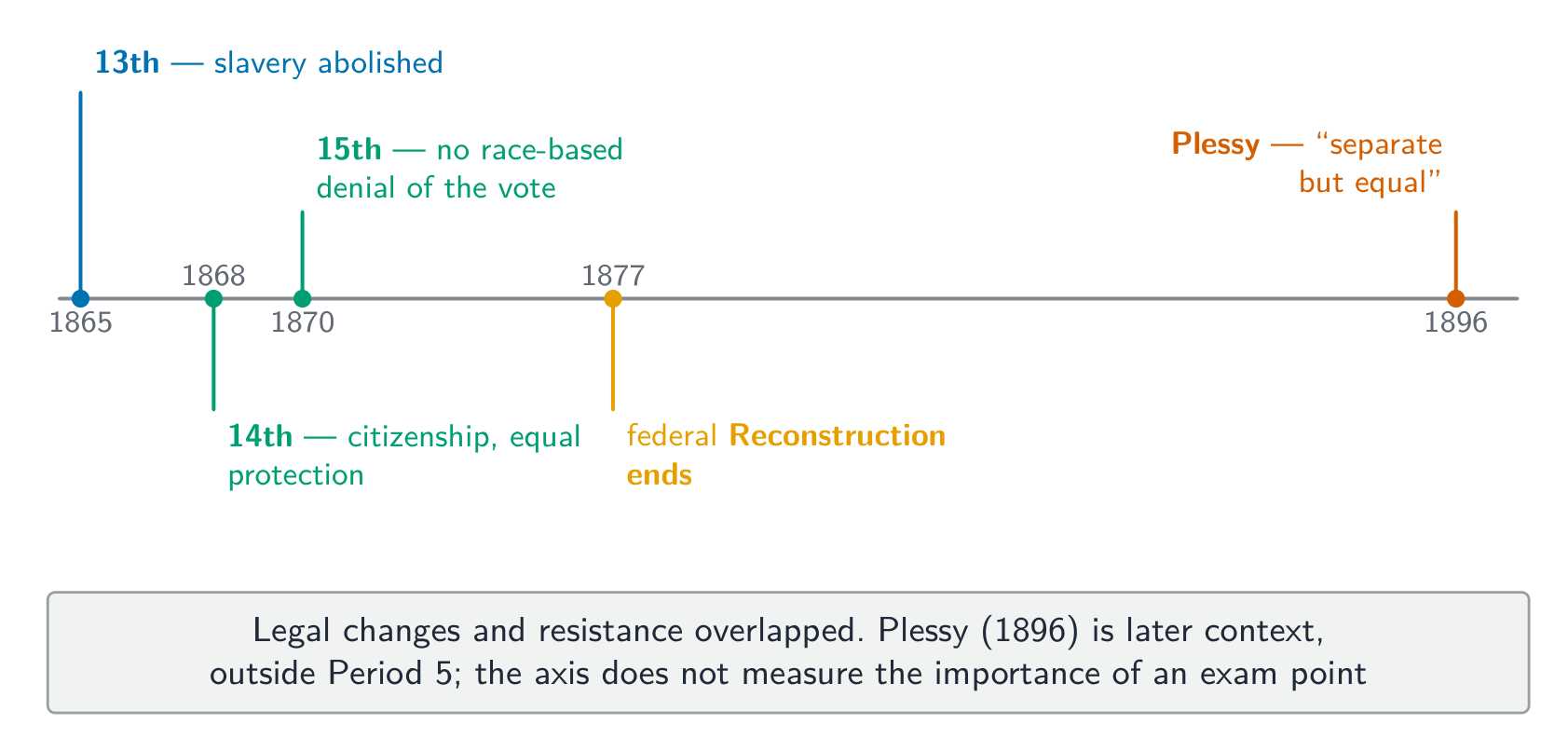
Segregation 种族隔离, violence 暴力, unfavourable Supreme Court decisions 最高法院判决 and local political tactics progressively stripped away 逐步剥夺 opportunities to exercise African Americans' rights. The 14th and 15th Amendments nevertheless remained a basis for later civil-rights decisions. Constitutional guarantees and effective protection are different questions.
Explore
Legal changes and later restrictions
Distinguish constitutional changes, enforcement and later context; the dates do not measure the importance of an event.
Unit 5.M
Compare the relative significance of the effects of the Civil War on American values.
KC-5.1 The United States became more connected with the world, pursued an expansionist foreign policy in the Western Hemisphere, and emerged as the destination for many migrants from other countries.
KC-5.1.I Popular enthusiasm for U.S. expansion, bolstered by economic and security interests, resulted in the acquisition of new territories, substantial migration westward, and new overseas initiatives.
KC-5.1.II In the 1840s and 1850s, Americans continued to debate questions about rights and citizenship for various groups of U.S. inhabitants.
KC-5.2 Intensified by expansion and deepening regional divisions, debates over slavery and other economic, cultural, and political issues led the nation into civil war.
KC-5.2.I Ideological and economic differences over slavery produced an array of diverging responses from Americans in the North and the South.
KC-5.2.II Debates over slavery came to dominate political discussion in the 1850s, culminating in the bitter election of 1860 and the secession of Southern states.
KC-5.3 The Union victory in the Civil War and the contested reconstruction of the South settled the issues of slavery and secession, but left unresolved many questions about the power of the federal government and citizenship rights.
KC-5.3.I The North’s greater manpower and industrial resources, the leadership of Abraham Lincoln and others, and the decision to emancipate enslaved people eventually led to the Union military victory over the Confederacy in the devastating Civil War.
KC-5.3.II.i Reconstruction and the Civil War ended slavery, altered relationships between the states and the federal government, and led to debates over new definitions of citizenship, particularly regarding the rights of African Americans, women, and other minorities.
Source: College Board AP Course and Exam Description
Comparison is one useful reasoning skill for this period. Compare Reconstruction's legal changes with practical outcomes, identifying both changes and limits rather than treating every gain as erased.
Exam transfer — 2025 AP US History, Set 1, short-answer Question 4(A–B), paraphrased. A asks for one political development during Reconstruction, 1865–1877. B asks for one effect of its end, 1877–1900. Try each part before reading the models. Would the 1896 Plessy decision fit A?
Teacher-written model for A. African American men held political office during Reconstruction, expanding formerly enslaved people's participation in government.
Teacher-written model for B. After Reconstruction ended, southern states enacted segregation laws that separated Black and white people in public facilities.
Why these fit. The official scheme accepts African American officeholding for A and southern segregation laws for B. Each describes a development within the relevant dates rather than only naming a term. The 1896 decision is outside A's dates. B extends beyond Period 5; later context is appropriate because the question explicitly asks for it. These are our models, not official samples or guarantees of credit.
5.12
Exam tips
Explain how expansion sharpened disputes over slavery and federal power, connecting a decision to its consequences.
Use specific evidence such as Dred Scott, explaining its relevance rather than expecting a named event alone to earn credit.
Give the Emancipation Proclamation its strategic role: it redefined the war's purpose and enabled Black enlistment.
Learn the three Reconstruction Amendments by what each one does; questions often turn on the difference between them.
For Reconstruction, distinguish lasting legal changes from sharecropping, segregation, violence and restrictive Court decisions, explaining mechanisms rather than only naming them.
On comparison prompts, develop both sides. Explain the relationship with relevant evidence from each.
Interactive lessons on this topic
Work through it step by step, with instant-check exercises.